Sunday, September 15, 2013

Retrogrouch Ride: Rivendell Long-Low


I thought I’d share some pictures and info about one of my favorite bikes. A Curt Goodrich-built Rivendell Long-Low from about 2001.
 
Long and Low - among the strawberry plants.
I'm proud of those fender lines.
I purchased this as a frameset new and direct from Rivendell, although it was not built specifically to my order, as most Riv-badged bikes are. This was listed on the Rivendell website as a special offer and was available for immediate delivery – no waiting – although there was no real explanation of its story. It was exactly the size I’d have wanted, and was very much what I might have ordered if I’d have been able to custom-order a Rivendell. The best part? It was $500 less than the starting price for a new Riv frame.

Some interesting details about the frame: The head lugs are a bit different from most Riv-badged bikes. The points are rounded and shorter, and the lugs don’t have as many hooks and swirls. In fact, the head lugs are the same as were used on the first generation of the Rivendell-designed, Japanese-built Atlantis and Rambouillet production frames – although the lugs had a little extra cutting and shaping to make them a little more “special.” According one of Rivendell's flyers from 2002, they would sometimes use the Atlantis lugs on a Rivendell if the particular geometry called for it. One other thing that makes the frame different from other Rivendells I've seen is the fork crown. Rivendell bikes usually have really interesting flat-topped fork crowns – this one has a much more plain semi-sloping crown. I've identified it from RR 23 (June-ish 2001) as a Long Shen LC-17, and according to that article, it was used on many Rivendells, but I've never seen another one with it (I'm guessing they were used on some of the earlier bikes, but by 1998 or 99, I believe most were using the Riv-designed flat crowns). It’s still nice, but the overall effect with the lugs and fork crown is a more understated frame than most of its brethren, which suits me fine.
 
Atlantis Lugs 
The frame is built for cantilever brakes and has huge clearances for tires and fenders. I have it equipped with Velo Orange hammered fenders and Rivendell Jack Brown 33.333 mm (green label) tires and there is still plenty of room to spare. It is painted in a light blue that has just the slightest hint of green to it, and a contrasting cream head-tube. If Rivendell has anything like a “standard” color for its bikes, this is probably it.

I built this up with what I believe is an ideal selection of components, each part selected for the best reliability and durability. After about 12 years and I don’t even know how many miles, everything is holding up exactly as I’d planned. Other than tires, and a new chain and cassette, nothing has been changed since I first built it up. It’s gained a little “beausage” (BYOO-sage) – beauty through usage (a Grant Petersen term) but everything still works like aces.

I built my own wheels with Shimano Ultegra hubs and Ritchey Rock Pro rims. I’m not sure those rims are available anymore, at least not in the 700c size, but the rear rim is an asymmetrical design that helps equalize spoke tension on both sides of the dished rear wheel, making it stronger. The Ultegra hubs are notable for being essentially the same internally as the more expensive Dura Ace hubs. They are serviceable, and have proven themselves to be very reliable. One could spend a lot more for hubs, but they wouldn’t be gaining much for their money.

The derailleurs are Ultegra (6500 generation), which work beautifully and look pretty good, too. Shifters are Dura-Ace 9sp bar-ends. The right lever (rear derailleur) has a friction option, but I’ve never needed it: the indexing works well. The left lever has a very fine micro-ratcheting mechanism that gives a light feel with great fine-tuning control of the front derailleur. I have bikes with integrated brake/shift levers – but really, with bar-end controls as good as these, I don’t see the STI or Ergo controls as offering any significant advantage. The bar-end levers can be shifted without taking hands off the bars; they are durable, reliable, and work flawlessly; they offer more user control (especially on the front derailleur); they are less vulnerable to damage, there's less to break or wear out, and they’re cheaper.

TA Zephyr Crank, with elusive TA quill pedals. There's
a Phil Wood BB holding it together.
Instead of the Shimano crank and bottom bracket setup, I used the very lovely Specialties TA Zephyr crank with a Phil Wood bottom bracket. The Zephyr isn’t available anymore, but it was a great looking, super strong, low-q-factor (for a triple) cold-forged crank. The Phil Wood BB is about as good as a square-taper BB can get. I also have the TA pedals, which are probably the best quill pedals ever made. Excellent bearings. Replaceable cages. Even the little flip tab is replaceable. They have grease ports in the end for easy maintenance. I don’t know if these are available here in the US anymore – over the years they’ve seemed to disappear and reappear every so often. Current status: unknown.
Brooks B-17 - well aged - and a Baggins Bag.

Handlebars, stem, and seatpost are all from Nitto. Beautiful and strong. Headset is a Stronglight Delta needle-bearing unit. Needle-bearing headsets are incredibly long-lasting, but still completely user-serviceable. I have spare bearings and races should they ever need to be replaced. I wrapped the bars with Tressostar cotton tape and many coats of natural shellac. It’s holding up incredibly well. Maybe once every other year or so, I’ll put on a fresh coat of shellac. The saddle is, of course, a Brooks B-17. The honey color has darkened significantly over the years, but it is wonderfully comfortable.


Cotton tape and shellac bar wrap. Twelve years
old and still looking great. 
Brakes are Shimano cantilevers. I upgraded them with Aztec pads which I think improves their braking. The brakes are light, smooth, and powerful. They are also easy to adjust. For brake levers, I had thought about using some old Shimano aero levers with under-the-tape cable routing – the spring loaded SLR versions are really nice. But I had a pair of vintage SunTour Superbe levers (with non-aero cable routing) that weren’t being used, so I put them into service. They work so well, I’ve never seen the need to change them. Maybe if the bar tape ever needs to be replaced, I’ll put on different levers, but I don’t foresee that happening anytime soon.

I've never gotten the backstory on this bike. Why was it available at such a discount back in 2001? Did someone place an order then change their mind? Was it made for a photo shoot? Was it built to try out new lugs, or experiment with geometry -- like some kind of prototype? (Rivendell has put prototype frames up for sale before, but they don't usually badge them as Rivendells -- they'll call them "Protovelo" to make clear what they are). Whatever its backstory was, in the past 12 years, its story has been mine. It's proven to be one of my most versatile bikes. Comfortable, and great-handling. I've ridden it on century rides (it's an absolute dream on centuries) and I've commuted on it to work. It's equally at home on roads and on trails. If for some reason I ever had to get rid of all my bikes except for one, this would be the one I'd have to keep.

Thursday, September 12, 2013

Bikes Aren't Cars - and it's a good thing

The title of this post probably rises to the highest peak of “Duh” mountain – glaringly obvious to anyone with half a brain. But as obvious as it seems, all kinds of people – cyclists and non-cyclists alike – continually seem to forget that point in a wide array of bike-related arguments.

Here’s an argument I hear when cyclists talk about the direction that bicycle design is heading. It goes something like this: Cars and even motorcycles now have computer controlled engines, anti-lock disc brakes, power steering, “fly by wire controls” and all kinds of technological advancements, and they’re better for it. Why shouldn’t bikes be the same? Why do luddites and “retrogrouches” keep insisting that bikes stay stuck in the past?

Back to the obvious. Bikes aren’t cars – or motorcycles, either. Comparing them misses the point of what makes bicycles great; turning the bicycle’s virtues into vices. Bicycles, by their very nature, are simple machines. Cars, and even motorcycles, are inherently far more complicated to begin with than bicycles, and they need to be. Much larger, much heavier. Consisting of many more systems, made up of many more individual component parts. They need far more energy to move and stop. They are capable of much higher speed, and likewise capable of much more chaos and carnage should those components or systems fail to work properly.
Modern tech helps cars -- and they need it.
image from chevrolet.com

Consider brakes. For decades, most cars, trucks, and motorcycles used drum brakes. For a long time, these brakes were mostly cable-operated, then hydraulic. The change to hydraulics was significant when one considers the effort needed to stop a 4000 lb. car. But being more difficult to cool, drum brakes could be prone to overheating and thereby were more prone to “fade” – loss of braking power under hard use, so better cars started using disc brakes – first on the front (with drums on the rear) and then both front and rear (some less expensive cars and trucks today still use the front disc/rear drum setup). Disc brakes could be cooled better and gave improved stopping power without as much “fade.” In more recent decades, anti-lock brakes, which require delicate sensors and some pretty serious micro processing power, made it safer to stop in slippery conditions. The braking systems have become much more complicated – yet the improvements have made cars much safer and easier to control.
Modern tech makes motorcycles faster, more efficient
and maybe a little safer
image from commons.wikimedia.org

Now the push is to add disc and hydraulic braking to bikes. But people tend to ignore the fact that braking on bicycles is already hard to improve beyond small gains. The power needed to stop a bicycle and rider is a tiny fraction of that needed for car. With most cable-operated rim brakes today, modulation is predictable, fade is minimal, lever effort is light, and braking power is strong enough to lock up the wheel if desired. All hard to improve upon. In all but the most extreme conditions, controlled safe stopping is easy. In situations where disc brakes and hydraulics are supposed to offer better performance, the actual difference is still very small, and not without trade-offs (more on that in a future post).

Consider suspension. Cars and trucks have had some form of suspension almost from the beginning. Apart from a few holdouts (Harley “hardtails,” for instance, which continued to be produced up to 1957) most motorcycles have used full suspension at least since WWII. Imagine driving a 3–4,000 lb. car, 5–6,000 lb. truck, or even a 600 lb. motorcycle without suspension. Imagine that kind of weight slamming rigidly into a pothole, a speed bump, or some uneven railroad tracks. The mass and the speed would combine to make the force unbearable. It’s basic physics. And now, fully independent, computer-controlled suspension can adjust for uneven pavement, different surfaces, and correct for things like oversteer or understeer, making cars much safer to handle.

Is this really necessary? On a Huffy?
image from www.cpsc.gov
Since the late 1980s, engineers and designers in the bicycle industry (apparently coming from motorsports backgrounds) have insisted on bringing bicycles into the “modern age” by adding suspension both front and rear. But bicycles have a small fraction of the mass of even the lightest motorcycles, to speak nothing of cars and trucks. The force of hitting a bump is considerably less. The speed is much slower, and the bicycle is more maneuverable, so it’s much easier to avoid the bumps in the first place. And good riding technique allows us to safely soak up most bumps without mechanical suspension. For downhill mountain bike racing, that suspension can be a real benefit – but think of all the people out there riding full-suspension bikes (which they've been convinced into thinking they need) on pavement, on bike paths, and on groomed trails – bobbing along on springs, dampeners, and elastomers, held together with increasingly complicated linkages. What benefit do they really get, and is it worth the added cost and complexity?

Cars and motorcycles have switched from mostly mechanical engine systems and controls to microprocessors. Mechanical carburetors have been replaced by computer-controlled fuel injectors. Mechanical point ignition systems have been replaced by computer-controlled electronics. All these changes have led to better gas mileage, cleaner emissions, and engines that are more reliable. All good things. On the other hand, while they are less likely to break down, when they DO break down, it is unlikely that anybody but a highly trained mechanic will be able to do anything about it. When it happens, our only choice is to stand at the side of the road and wait for the tow truck.

Today, bicycles are moving towards electronic shifting systems. Their tiny computer brains are able shift quickly and reliably, even under hard riding conditions. I have no doubt that they work really well – the R&D guys at Shimano have tested their Di2 thoroughly to make sure it’s completely dummy-proof. And, like all the new technologies that start at the top price range, these systems will filter (are filtering) down to even the entry-level price points (today Ultegra, soon 105, etc.).  I’d be willing to predict that the next step in electronic shifting will be to incorporate cadence and wheel speed sensors to allow the computer to shift gears automatically. When the stuff works, it works well – but when something goes wrong, fixing it on a ride will be unlikely. Wait by the side of the road or the trail and wait to be picked up by a patient spouse or a good friend with a car and some time to kill.

Cars and motorcycles are complex to begin with -- by their very nature. The added complexity of modern technology helps to keep their systems working properly, improves their efficiency, helps compensate for poor driving skills, and even helps make them safer. Bicycles are (and should be) simple and highly efficient machines. Adding technology and complexity does not make them more efficient, and it doesn't necessarily make them safer. Small gains in performance are often offset by other drawbacks. And the added cost only hurts accessibility and adds to the perception that bicycles are just fancy toys for rich people.

Tuesday, September 10, 2013

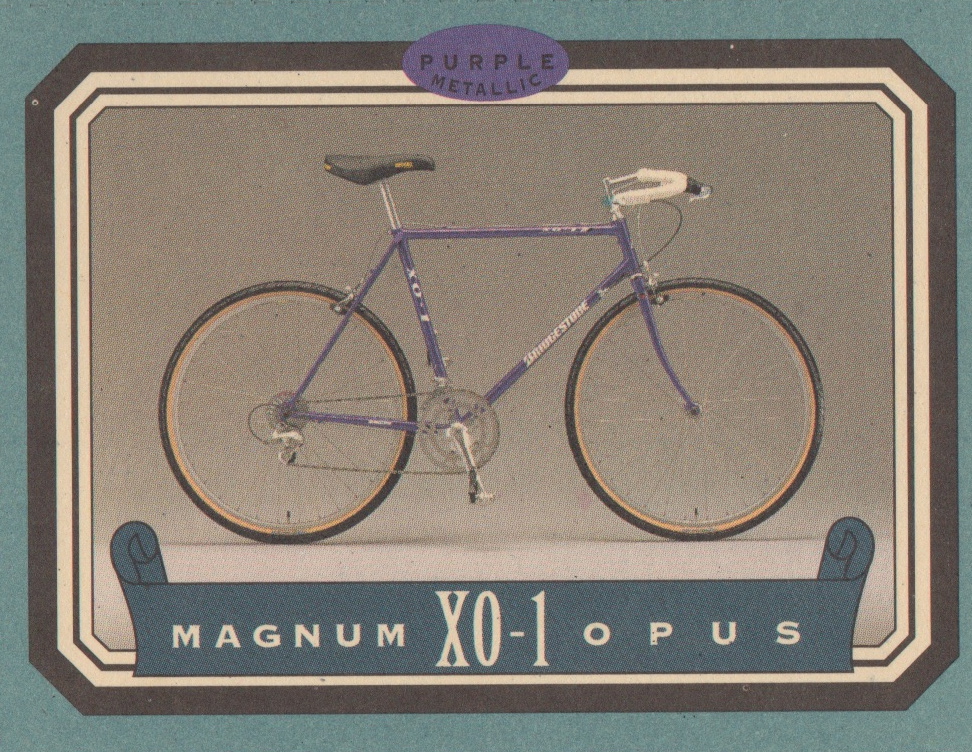
Bridgestone XO-1: Cult of Personality

I mentioned in an earlier post, Retrogrouch: Origin of the Species (8/30/13) my affinity for the work of Grant Petersen, formerly of Bridgestone Bicycles, and the founder of Rivendell Bicycles. Of all the bikes that Bridgestone produced for the US market, I believe the bike that most strongly represented Petersen's unique philosophy on bicycle design was the XO-1. And that is the bike that, more than any other produced by Bridgestone, probably has the strongest following almost 20 years after the end of B'stone's US operations. The bike practically defines the concept of a "Cult Bike."

Introduced in 1992, the concept was to create a "do anything" bike, equally at home on the road or on the trail. The ultimate "hybrid" (while conspicuously avoiding the term "hybrid"), the XO-1 had a road bike frame and geometry with 26" wheels, but slick road tires (mountain bike tires up to 1.6" would fit). It had a double chainring crank that was drilled for a third ring (110/74 bolt circle -- for a large selection of rings) should a rider decide to add one later. But the most prominent, and perhaps most controversial feature was the mustache handlebar -- designed by Grant Petersen, and produced by Nitto.

Scan from the 1992 B'stone catalog.
The inspiration for the mustache bar came from bikes in Japan where many schools would ban kids from riding bikes with drop bars -- the belief apparently being that drop bars encouraged reckless riding habits. The semi-drop bars that these bikes used had a shape that was something almost between a flat bar and a drop bar which still allowed a fairly "sporty" riding position. The mustache bar adapted the shape, giving it more width and a bit more reach, making it suitable for American adult hands. Despite being a new, innovative shape, it had an oddly old-fashioned "retro" appearance -- making it both new and yet oddly familiar at the same time. It wasn't hard to imagine riders in the '90s (1890s, that is) riding on similar handlebars. Petersen and the folks at Bridgstone apparently loved them. The bicycling press apparently hated them.

In Bicycling Magazine's April 1992 issue, the headline of their XO-1 review proclaimed "The 'Mustache Bike' Misses by a Whisker." That reviewer, John Kukoda, went on to say, "Great bike, bad bars," and, "The handlebar looks cool, but isn't." Other editors claimed "I wanted to like the bar, but . . . my hands still went numb," and, "I couldn't get comfortable." So much of the bad press seemed to focus on the bars.

A "trading card" with picture on the front, info on the back.
The other thing that seemed to hold the bike back, at least as the critics were concerned, was the difficulty in categorizing it. Reviewers and perhaps retailers wanted to label it a "hybrid" but that name didn't really fit. It wasn't strictly a "road bike," "touring bike," or even a "mountain bike," but rather, a bike that was capable of being whatever its owners wanted it to be.

The '92 Bicycling review put it like this: "The bike defies categorization. It reflects the personal preferences of its iconoclastic designer, dubbed a 'retro-grouch' by one editor for his approach to component selection." (yes -- an editor writing for the very same Bicycling Magazine!). "The XO-1 (is) too much bike for the typical hybrid shopper. . . Most hybrids sell for less than half as much and attract entry-level riders who like an upright position but don't need a mountain bike. They don't need the XO-1's refinements either."

Unfortunately, the press assessments of the bike really missed the point. The bike wasn't meant for an entry-level buyer, wasn't meant to be a "hybrid," and wasn't meant to be categorized or pigeon-holed into some pre-processed, pre-determined mold. It was really intended to open up possibilities -- ready to take whatever form that its owners -- serious and enthusiastic cyclists -- best saw fit. It was an excellent base -- great bones, if you will -- on which owners could impart their own needs and create their own adventures. They could add that third chainring for lower gearing and go touring. They could put fatter tires and take it on fire roads and off-road trails (in reality, it was probably rugged enough to be all the "mountain bike" that many mountain bike riders ever really needed). They could put fenders on it and use it as a wickedly cool commuter. It could be all of the above, depending on the owners whims, or it could be something else entirely. Given the trend in the industry today, to keep making more and more narrowly defined bike categories, (I think the latest "must have" trend is the so-called "gravel bike," which is yet another role the XO-1 would probably fill exceedingly well), the versatility and category-bending approach of the XO-1 is part of what makes it so endearing.

From the '93 Catalog
In its first year, the bike had super nice Dia Compe sidepull brakes in the "normal reach" configuration (47 - 57 mm reach) -- which by contemporary comparisons would be considered "longer reach." It also had a lovely cast fork crown, dubbed in the catalog as "The Most Expensive Fork Crown in the World." That original XO-1 was offered in two color choices: Purple Metallic or Pearl Tusk (kind of cream or off-white). One thousand bikes were produced that year. In 1993, the sidepull calipers were replaced with cantilever brakes. The '93 catalog copy lamented the change, but pointed out that wheel changes would be much easier with fat tires. Probably true. That year, the XO-1 was offered only in one color choice: Construction Pumpkin (a gorgeous orange) with a Tusk (cream) panel. Again, only 1000 bikes were produced.

There were other "lesser" XO models -- XO-2, and XO-3 in 1992, characterized by welded (not lugged) frames, heavier tubing, and less expensive components. The XO-2 model had a slightly different version of the mustache bar that took mountain-bike style controls. In 1993 the range went all the way from XO-1 through XO-5. But most of the other models really were more like the hybrids offered by other brands.

In 1994, the XO-1 was dropped from the lineup. The only XO bikes in the catalog were the XO-3, 4, and 5. The 3 model had a lugged frame somewhat like the much nicer XO-1, as well as the original mustache bar, but other details of the frame (such as the lovely fork crown - now gone), along with the component choices, marked it as a lower-cost entry. Not long afterward, the end came. Bridgestone pulled out and left the USA market for good.

My own experience on the XO-1 is perhaps worth mentioning. When the bike was released in '92, I was a financially struggling student in gradual school (where you gradually find out you don't want to go to school anymore -- from John Irving's The World According to Garp) so buying one was not an option. Same in 1993. By '94 I was finally out of school and gainfully employed. Went to my Bridgestone dealer for an XO-1 -- but they were all gone. Soon after that, so was B'stone. (Sigh).

With the loss of Bridgestone, Grant Petersen went on to start Rivendell. There, one of the bike models, dubbed the "All-Rounder," was like a fancier, more expensive spiritual descendent of the XO-1. Later, in 1999 (1999.75 says Rivbike.com) they released the Atlantis which took the torch and continues on today as a do-anything, go-anywhere bike that defies categorization.

Now, roughly 20 years later, clean, lightly used XO-1s are sought after. There were only 2000 made in two years, so they are fairly rare and definitely collectible. In hindsight, the virtues of the bike stand out -- not just for what the bike was (or wasn't), but for what it could be. Not only that, but the much-maligned mustache bars are alive and well and sold through Rivendell's website (I have them on two of my bikes -- and love them).

Addendum: Fun facts: The lovely fork crown on the XO-1 was originally spec'd for a Japanese-market Bridgestone touring bike called the Atlantis (1981 - 1982, according to Rivendell Reader #35 from 2005). That model wasn't sold in the US. The original Atlantis was designed by Hiroo Watanabe and modeled after classic French randonneuring bikes. When Rivendell introduced their Atlantis in '99, the seat-tube decal had a crest with a stylized figure "2" in a diamond -- a subtle little homage to the original Atlantis.

Monday, September 9, 2013

Bike Rack Hack

This isn't uniquely a "retrogrouch" issue -- but if you like bikes with fenders, like I do, then you've probably run into the problem of carrying a befendered (I don't think that word actually exists) bike on a roof rack. You remove the front wheel and attempt to mount the fork into the rack, but the tail end of the bike's fender interferes with the wheel tray, making it impossible to fit the bike unless the fender is removed -- which would be a major pain hardly worth the effort.
Roof racks like this are very secure, but they are
NOT fender-friendly.  (image from Yakima.com)
I have seen products that mount into the rack's fork attachment and essentially act as a "riser" to lift the front of the bike high enough that the fender will clear the wheel tray. They are actually meant (I believe) for bikes with disk brakes, which apparently also have clearance issues with this type of rack. These "riser" products are fairly expensive for what they are, and they don't seem particularly secure to me -- no matter how tightly the mounts are tightened, they can still allow the bike to move a bit (such as pitching forward when stopping the car, for example), at least on some models of racks.

I managed to make my own fork riser for befendered bikes (I like the word so I'm sticking with it) out of some inexpensive supplies from my local hardware store, and some cast-offs from my old bike parts bin. For lack of a better name, I call it the Bike Rack Hack. It raises up the front of the bike by roughly six inches, enough to clear even long fenders.

This riser lifts the front fork over 6" -- enough to allow
even long fenders to fit. It is also triangulated and won't move.
Here's what you'll need to make one: aluminum bar stock, 1" wide by 1/4" thick, and another piece 1" wide by 1/8" thick. You'll need about 14 inches of the 1/4" stock, and about 22 inches of the 1/8" stock. You'll need threaded rod in 3/8" diameter, plus four 3/8" hex nuts, four 3/8" nylon lock nuts, and eight washers. You'll also need an old hollow axle from a front hub, plus the appropriate lock nuts (you could also use the bearing cones from the hub -- don't worry if they're totally gouged or pitted -- in fact, it's probably better if they are), and a front wheel quick release skewer. Lastly, you'll need a block of wood -- preferably a piece of treated lumber, but if you paint it, then treated may be unnecessary.

You'll need two 7" long pieces of the 1/4" bar stock. Bend them in your bench vise in a slight offset bend as shown -- only about 1 cm. -- and they should be like mirror images of one another. These will be the risers. Take two 11" long pieces of the 1/8" stock, and bend them in similar fashion -- about 3/4 inch this time, and again, they should be like mirror images of one another. These will be the braces that extend down along the sides. When you drill the holes into the riser pieces to accept the threaded rod and the old hub axle (four sets of holes altogether), the exact location of the holes isn't crucial, but it IS important to make sure the holes line up as mirror images of one another, otherwise things will come out a little cock-eyed. The most crucial measurements on the whole thing are for the width between the risers -- they have to match up with the rack's fork mount, and with your bike's fork. Remember that standard road hubs are 100 mm wide, so that should be the width at those attachment points. The nice thing is that you can "fine tune" the fit by playing around with the threaded rod and hex nuts.

When assembled, the lower part must be 100 mm wide on the inside faces (same as a hub width) to fit into the fork mount. At the top, it should be about 80 mm on the inside faces. When the axle and locknuts are installed at the top, it should measure 100 mm outside the locknuts -- just like a normal road hub. That way, your fork will slide right in.


The side pieces help brace the riser so that it doesn't pitch forward with a bike attached -- mine are 11", but they could just as easily be 10" or 12" -- 11" just looked right to me. I drilled a hole through the wheel-tray of my rack to accept a carriage bolt and wing nut -- it goes through the block of wood which fits into the wheel tray. You can cut some bevels on the wood to better fit the inside profile of the tray.

.

Here you can see the wood block (cut from a piece of scrap 2x4), shaped to fit into the wheel tray. A carriage bolt, some washers, and a wing nut secure the piece into the wheel tray, bracing the whole riser and keeping it from pitching forward under braking.


The roof rack's fork mounting skewer goes through these holes at the bottom of the riser.  Locate these holes so that the legs will still clear the cross bars on the roof rack -- centered no more than 3/4" from the end should be fine, but it could vary a little depending on different roof rack brands and models.

One thing worth pointing out is that using a basic quick release skewer to attach the bike to the rack doesn't provide a way to securely lock the bike should you need to leave it unattended. Most of the racks today do have a locking mechanism for that, but this little homemade hack doesn't offer that. What I do, if I have to leave my bike unattended while on the roof rack, is I simply run a cable lock through the frame and around the rack crossbars or the roof rails on my car.

There you have it -- a fairly simple riser for befendered bikes. Cost: about $12, and maybe an hour to make. Paint it flat black, and it will match right up with most roof racks. It can be mounted or removed in just a couple of minutes without tools. 

Warning: if you carry bikes on a roof-mounted rack, make sure you don't drive your car into the garage with the bikes on the roof. It happens! Here's a tip -- when loading bikes onto the roof, put something in front of the garage door, or just inside it, and leave it there -- for example, a sawhorse with a big sign on it that says "BIKES on the ROOF!" When you come home, you won't be able to pull into the garage without getting out of the car to move the sawhorse -- your bikes will be safe. 

There you go -- useful hacks from the Retrogrouch! 


Saturday, September 7, 2013

Simple Machines

This is likely to be a very meandering post. Forgive me. I'll try to make it worth the read.

I'm a teacher at a public high school (my blog has yet to hit big enough to allow me to quit my job) and we have a custodian at my school who is a fount of all kinds of knowledge. There isn't much that Rob the janitor doesn't know, and very little that he can't do. If we ever find ourselves in some kind of post-apocalyptic nightmare scenario, or even just a season of Survivor, Rob is the guy everyone wants on their island.

So, the other day, Rob arrived at my classroom with a large flatbed pushcart loaded up with a couple hundred new textbooks. As he and I unloaded the cart, a thought occurred to me.
     I asked Rob, "How much do you suppose all these books weigh?"
     Rob considered the weight listed on a single case of books. He did a quick calculation in his head (a lot quicker than I could -- did I mention I'm an English teacher?), and replied, "A little over 1/2 ton."
     "Can you lift a half ton?" I asked.
     "Nope," he replied.
     "But you didn't have any trouble rolling this down the hall."
     He answered, "Nope, but I also can't lift a tree, but give me a big enough pry bar . . ."
     "Exactly," I said.
Rob then went on to remind me that it was Archimedes who said, "Give me a long enough lever and a fulcrum and I can move the world." Rob and I agreed: that's the beauty of simple machines.

Image from Mechanic's Magazine, Vol. II, 1824 
Wheels and axles. Levers and pulleys. Inclined planes, wedges, and screws. These simple devices don't defy the laws of physics and gravity, but they do help us use the laws to our advantage. Mechanical advantage. To do more work with less effort, for example.

Think about that cartload of books. I don't know anybody who could lift that kind of weight, but put a big lever under it, or hook that weight up to some pulleys and lifting it becomes easy. Put the load onto a cart with wheels, and moving it around is no problem. Allow me to get a little hypothetical on this subject. Pick up one of those books and you'll know you're lifting about five pounds (textbooks just keep getting heavier!). But if someone added that book to the cart (or removed one from it), would you be able to tell the difference? What if they added or removed two or three of them? Would the cart suddenly get noticeably harder or easier to push? How many pounds would someone have to add or subtract from the load before the difference could be felt? Without lining up a bunch of test subjects, I'm going to take a guess and say that it would take at least 10 books, or 50 pounds, to be noticed -- maybe more -- it's just guess, but it's a guess that feels right. The same mechanical advantage that allows us to easily move hundreds or even thousands of pounds makes a difference of only a few pounds seem inconsequential.

What got me thinking about that cartload of textbooks was an ongoing "friendly disagreement" I have with other cyclists about the importance of the weight of a bicycle. Not too long ago I was out for a ride with a friend. At one point we had to "portage" our bikes around a road blockage and my friend picked up my bike and remarked (with shock!) how heavy it was. I knew my lugged steel-framed bike weighed more than my friend's carbon machine, but in actuality, I doubt the difference was more than three or four pounds. We can of course detect that kind of weight difference when we lift a bike up, but the thing is, that isn't how we ride a bike. And considering the way a bike is actually ridden, a few pounds don't really make much difference. Keep in mind, a bicycle is far more efficient a machine than a basic flatbed pushcart. With pneumatic tires and high-quality bearings in the hubs, the friction and rolling resistance are incredibly low. The leverage gained from cranks and gears makes the weight difference of a few pounds almost meaningless.

Also keep in mind that we can't just talk about the weight of the bike. We have to consider the weight of the rider, too. So it isn't a question of a 17 lb. bike vs. a 21 lb. bike. If the rider weighs, for example, 150 lbs., then we're really comparing 167 to 171 lbs. making the difference even less significant and therefore harder to discern while riding. Here's another fun thing to consider: carrying a pair of 24 oz. water bottles adds roughly three pounds to a bike. But how many people honestly can say they feel faster when they've emptied their water bottles? Most of us probably don't notice that difference except when we're carrying the bike up or down stairs, or putting the bike up on the roof rack of a car. Or posing for post-ride photos with our bikes held triumphantly in the air.

What about climbing? We're definitely going to notice extra weight when climbing, right? Actually, even that isn't so simple. Even a steep climb -- say, something like 18% grade -- is still 82% horizontal if you look at it differently. The steepest climb I've ever ridden was 25% grade, but roads that steep are rare. One of the toughest, most famous climbs in the Tour de France is Alpe d'Huez, and that has a maximum gradient of "only" 13% (it averages about 8%, but it goes on for over eight miles). But what is a hill, if not an inclined plane? We might have difficulty dead-lifting a certain amount of weight vertically, but rolling up an inclined plane allows us to easily raise weight that we couldn't otherwise lift, so again, a small difference in weight really doesn't make as big of a difference as we tend to believe.

So does weight make a difference on a ride? Does it affect our speed or make us work harder? Sure it does. But you really need to be talking about pounds, not grams -- and more than a couple pounds, at that. In Grant Petersen's book Just Ride, he cites a Cornell Aeronautical Lab study (commissioned by Schwinn) that found a difference of only 1 mph in average speed for every 12 pounds added to or subtracted from a bike. Now, a lighter bike definitely feels faster. But I think the perceived difference is a lot greater than the actual difference. Accelerating from a standstill will be quicker, especially if it's the wheels that are lighter, and one can really feel that difference. But once the bike is rolling, it doesn't take extra effort to keep a heavier bike going, so the overall effect is minimal. When we're riding out of the saddle, like on a climb or a sprint, and rocking the bike beneath us, a lighter bike will feel different (we perceive it to be faster) because we're essentially tossing less weight side to side -- but again, I expect that the actual difference in forward progress is less than what it feels like. When I ride a heavier bike uphill, I feel that weight being shifted left to right -- but it doesn't feel like I'm dragging an anchor behind me.
My commuter -- pushing almost 40 lbs, fully loaded.

I ride my bike to work as much as possible. The bike I commute on has a lugged steel frame and is fully equipped with racks, fenders, lights, and bags. Fully loaded for work, it easily tips the scales at nearly 40 lbs. My morning commute is 13 miles and takes me about 50 minutes: an average of 15 mph. I take a different route in the afternoon -- 15 miles, with a couple moderate climbs. It takes me about one hour: again, an average 15 mph. On occasion, if the weather forecast is really good and I don't have to carry much to work, I'll ride one of my lighter bikes -- about 23 lbs. I'm easily dropping 15 pounds or more, so one would expect that the commute would be faster. And it does feel faster. But in actuality, the morning ride takes barely less than 50 minutes. The ride home takes barely less than an hour. Any gain I get with the lighter bike is so minor that it is easily wiped out by a poorly timed traffic light. In other words, those traffic lights probably make a bigger difference in my commute time than the weight of the bike.

Cyclists obsess about bicycle weight. Some spend huge sums of money to shed a few grams. And sometimes the quest to shed grams throws all the other priorities out of whack, like strength, durability, comfort, or convenience. The way I look at it, bicycle components can be light -- or they can be stupid-light. Too many components today are stupid-light. And then I have cycling friends who smirk at my fendered bikes -- too much weight, they'll say. But when the roads are wet, I figure those fenders are worth every ounce in keeping me comfortable. But ultimately, the quest to shed grams yields much smaller gains than what people perceive, or what they'd like to believe. Remember: pounds, not grams.

Bicycles are, at their heart, simple machines -- or really, a combination of several simple machines working in harmony. A "compound machine" consisting of wheels, levers, and pulleys. The simple machine transforms our energy and makes us much more efficient than we can be on our own. We go farther and faster using less energy. High quality, supple-casing tires lower our rolling resistance, and high quality bearings lower our friction losses. Gears give us the leverage -- the mechanical advantage -- to move effortlessly. And all of that advantage combined makes a few grams, or even a few pounds, a fairly minor factor in our speed or our enjoyment of the ride.

Thursday, September 5, 2013

Shifting Gears: the Learning Curve and Upgrade Fever

In my Sept. 3rd post (Retro Friction - Part One) I closed with a question about the downsides to friction shifters as opposed to the indexed, integrated, and electronic shifting systems of today. I pointed out that with friction shift levers, "fast and precise shifting is a matter of user skill, but I don't really accept that as a downside. Lots of things require skill and practice, and we usually respect that, so why should being really skilled on a bike be different?" I thought that my statement might warrant further explanation.

Back when indexed shifting was first sweeping the bike industry, I remember one of the arguments for it was that shifting with friction levers was too difficult for beginners. In my Aug. 30 post (Retrogrouch -- Origin of the Species) I referred to Fred Zahradnik's 1990 article Techies Unite! from Bicycling Magazine -- the one in which he coined the term "Retrogrouch." Here's a quote from that article: "It's easy for experienced riders to forget how difficult it is for beginners to shift a friction system. Gear fear has intimidated many people right out of the sport. By contrast, push-and-click systems let them ride out of the showroom with confidence. Smooth shifting under power, a recent innovation, is something even the most advanced rider can appreciate." Similar arguments are being made today for the latest must-have trend, electronic shifting. Thing is, I didn't accept that argument back then, and I don't accept it now.

As I said, lots of things require skill and practice. Creating art. Playing a musical instrument. Even cooking. People who are just starting out don't expect to have the skills of seasoned practitioners. But that reality doesn't keep them from trying or enjoying those activities. For example, I play the guitar. I didn't even attempt to learn to play the guitar (or any instrument, for that matter) until I was nearly 30 years old. And of course, I decided right from the beginning that I wanted to learn "fingerstyle" guitar (think of Paul Simon's The Boxer, for instance) which is much more intricate and painstaking than simple strumming. Starting out, it was slightly intimidating. Could I get my left and right hands to do such different and intricate things simultaneously? I found that I could. After a few months of lessons, and a lot of practice, I became fairly proficient. The challenge of it kept me going, and the desire to get better motivated me, and I continually got better. Years later, I'm quite good at it, and yet there is still more to learn, and more room for improvement. The challenge and the desire for mastery doesn't make it less enjoyable -- it makes it MORE enjoyable.

Now compare cycling to other sports. Few people on the local public golf course, or even at the expensive country club for that matter, have the skills to play on the PGA tour. But for some reason, it doesn't stop them from golfing. Few people playing basketball with their buddies at the local YMCA have the skills of LeBron James. But they still enjoy playing the game. My throwing, hitting, and catching skills wouldn't get me a spot on the local little league baseball team, much less anything approaching a professional ball club, yet I can still enjoy throwing a baseball around with my kids or my friends. All sports involve a certain amount of skill and conditioning. With practice we can improve our skills and performance. For a lot of us, that challenge and the desire to improve is what motivates us. It doesn't discourage us. We can enjoy it even if we aren't perfect, and we build personal satisfaction from seeing our improvement gains.

Cycling is an equipment-centered sport. Manufacturers recognize that if they want to keep making money and expanding business in a market base that isn't expanding that greatly, then they have to continually update and "improve" their equipment to keep the buying pressure on the existing market. They have to convince existing owners that their "old" equipment (which might only be a couple of years old) is no good anymore and the "new" equipment makes their "old" equipment obsolete. It's upgrade fever. And the marketing claims are all about how much better the new equipment is. The latest technological breakthrough! It will instantly make you perform like the pros you admire so much! The hype would have us believe that we don't need to practice or train to develop and improve -- we can have it all instantly.

Golf is another equipment-centric sport. Can't golf without clubs. Evidenced by the commercials aired during any golf tournament, it seems that golf is caught in the same upgrade fever that cycling is. Titanium and carbon fiber are everywhere. Advanced technology golf balls supposedly fly farther, more accurately. The latest club technology instantly makes you a better golfer, or so says the marketing hype. If one of the manufacturers could create a club that instantly gave everyone the drive and accuracy of a PGA pro (and some of the advertising hype stops just short of making those very claims), people would line up to buy it. But in golf, the skills are still important. And one only improves them by practice. And practice comes through playing more golf -- which is where the enjoyment should come from. For a player without the skills, the promised gains that come with the latest-technology clubs and balls will only carry them so far if anywhere. In other words, if I can't golf worth a damn, the latest clubs won't transform my game. But if someone enjoys playing golf, they can enjoy it whether they're playing with old-tech steel/wood/iron clubs or with the latest carbon/titanium wonders.

Here's another thing about my analogy with golf. In actuality I don't very often play golf. I don't really enjoy golf that much. And it isn't because I don't have the latest wonder-clubs. Having them wouldn't make me enjoy it more (and no, this truth does not hurt my analogy -- in fact, it only helps it -- keep reading). Cycling is really no different. The need to shift gears, or the perceived complexity of shifting is not what keeps non-riders from riding bikes. I doubt many, if any, people stay away from a bike for that reason. And I doubt that constantly changing technology is converting huge numbers of people into cyclists.

Ultimately, though, in all the discussion about the hyped benefits of this year's big breakthrough that renders last year's big breakthrough obsolete, it's easy to lose sight of the fact that shifting gears on a bike -- even with an old-style friction system -- simply isn't that difficult. Friction shifting, especially, is very forgiving. Slightly over-shift or under-shift the exact gear you want? No big deal. Is the chain making noise on the cog because the derailleur's not lined up exactly right? Easy fix. Dial it back a little. All better. Is the cable tension a little off? Not even an issue. And there's virtually no such thing as mismatched shifters/derailleurs/cogs, etc. So when you get down to it, how big can the improvements truly be from one system to another? How much do we gain between friction and indexed shifters, between stand-alone indexed levers and integrated brifters? Between cable-operated brifters and electronically controlled ones? And are those incremental gains worth the added complexity that comes with each new breakthrough? Are they worth the compatibility issues and the costs of upgrade fever?

We have choices -- between super simple, inexpensive systems that take slightly more skill from the rider, or super complex, expensive systems that require only slightly less skill. It's not even a question of one approach being superior to another -- they're just different. But as for us Retrogrouches, you know which one we'll choose.

Wednesday, September 4, 2013

Retro Friction - Part Two - Copies and Competition

In my previous post, I looked at the Simplex Retrofriction shift levers -- widely regarded by many riders as the best friction levers -- ever. Using a spring loaded clutch, they held the levers in place against the pull of the derailleur spring, but allowed a nice light touch and excellent control for shifting. But they weren't the only game in town. Today I want to look at some of the copies and competition, as well as an evolutionary missing link!

A pair of SunTour BarCons. A great
set of shifters for touring.
SunTour Sprint levers - fresh from
the box. Minty!
SunTour probably had the most popular competitor to the Retrofriction lever, known as the Power Ratchet. I've searched a bit to see exactly when they were introduced, but couldn't pin it down exactly, but suffice it to say, they were pretty much right on the heels of the Simplex version. Power Ratchet worked in a similar way to Retrofriction except that instead of a smooth pawl-less clutch, it used a very tiny ratcheting mechanism. When moving the levers, one could feel tiny little clicks, but it was still a smooth working shift lever with a fairly light touch. The bar-end version was incredibly popular with touring cyclists. There were also down-tube and even stem-mounted versions, and later a thumb-shifter version for mountain bikes. The last versions of the Power Ratchet were offered on one of SunTour's higher end road component groups, Sprint, and it had an even finer-tooth ratchet than previous versions, making them extra smooth. Today, Dia-Compe makes a reproduction of the extra-fine Power-Ratchet mechanism (available fromVelo-Orange), and Rivendell offers another reproduction under the name "Silver" which is even styled quite a bit like the old SunTour Sprints. I still use both the original SunTour levers as well as the newer reproductions and I like them a lot.

Shimano Fingertip Bar-end shifters.
Thumb shift and stem-mount versions
were also available.
Shimano made a competitor as well, but it worked a little differently than either the Simplex or SunTour. Called Fingertip control, Shimano essentially made a spring-loaded lever which counterbalanced the spring in the derailleur. No clutches or ratchets. A fairly simple idea and it seemed to work pretty well (though I don't recommend taking them apart -- I've done it and had a helluva time getting the spring back in place!). These were available as a bar-end shifter and later as a thumb shifter for mountain bikes. I have also seen a stem-mounted version of them, but if they had a down-tube mounted version (I'm sure they must have!), I have yet to find a pair.
C-Record Retrofriction.

I think the most interesting competition came from Campagnolo who were probably tired of seeing so many racers replacing their shift levers with the Simplex ones. In 1985, which was just after the introduction of Shimano's SIS, Campy released its C-Record group with levers that worked and felt very much like the Simplex Retrofriction levers. Finally, racers who insisted on an all-Campy bike could get the same smooth shifting control that riders with Simplex were enjoying for more than a decade. Alas, Campy had finally caught up with their French competitor, only to be caught completely unprepared for the indexing competition from Japan. It nearly killed them.

Prior to Campy's release of the C-Record Retrofriction, however, was a little-known version modeled on the Super Record/Nuovo Record levers. Like a Missing-Freaking-Link!

A Missing Link!
For me, the discovery came one day about nine years ago while I was searching "Campagnolo" on eBay (something I do a lot). I saw a pair of NOS (new-old stock) SR/NR shift levers listed that looked a little odd to me. The base of the levers was larger and wider than the regular ones that are almost ubiquitous on eBay (where they often sell for $30 - $40). I hadn't seen a pair like that before, but nothing in the listing mentioned them being different or special in any way, and they didn't seem to be getting any special attention from bidders, either. The seller apparently believed them to be "normal" Super Record shifters, but I started wondering . . . could these be an early version of a Campy retrofriction-style shift lever? I looked up old Campagnolo catalogs online and couldn't find any reference to such a thing existing. I searched Campy timelines for clues and found nothing. I even emailed a couple of people whom I thought might know something about them and was told no such thing existed! I bought them anyhow. Turned out, my suspicion was exactly right. Since then, other sets have come up for sale (but very rarely) and I even found a seller in the UK who had acquired a small stock of them and sold them online (all gone now, however). But don't expect to find any secret or hidden bargains on them anymore.

What exactly was the story on these shifters? I'm not really sure. I've read that Campy never put them in their catalogs but quietly produced a fairly limited number of them as early as 1983, then discontinued them not long afterwards just as quietly. Other people have suggested they were put out as sort of a prototype -- something with which to get some feedback from racers. Then when it came time to put them into full production, they made the C-Record version and discontinued Super Record and Nuovo Record entirely. Either way seems plausible (in fact, they could both be true to some extent), or it could be something else entirely, but I've never seen a definitive answer.

Last version of Campy's Retrofriction
levers with more cable-pulling capability.
Some day I'll try these with a 10-sp cassette.
By the way, before discontinuing their Retrofriction levers for good, Campy made one more version with a larger, asymetrical "barrel" on the right-hand lever for more cable-wrapping capacity -- probably useful for 8-speed cassettes. I have a pair still in the box, but I haven't tried them out. But I even wonder . . . if they would work with 8-speed cassettes, would they also work on 9 or 10-speed setups which are overall the same width? Hmm. . . something new to try. . . someday.

Correction - 9/25/13: Reading an article on the Simplex and SunTour levers in the Autumn 2013 Bicycle Quarterly (Vol. 12, No. 1) which just came out, I found a reference that the SunTour Power Shift levers may actually have come out just ahead of, not just after, the Simplex Retrofriction levers. Apparently, the Power Shift bar-end levers appeared in an ad from New Cycling, in Dec. 1971, whereas the Simplex Retrofriction levers were introduced in 1972. My research into the subject couldn't find the SunTour levers available prior to 1973.