Monday, July 7, 2014

Bicycle Innovations For People Who Don't Ride Bikes

I'm always skeptical when "home fashion" and "lifestyle" magazines write about bicycles and bicycle gear -- they almost always highlight the most inane and pointless "innovations" designed to appeal to people who very likely don't ride bikes.

The latest I've seen was this from Dwell -- a magazine and store for the fashionable home. American Cycle: Modern Gear for Biking. It's a "roundup of tech-savvy biking gear and stylish new cycles" that will "give you more reasons to ride." Anybody who needs this gear to give them a reason to ride is obviously happier being seen in a fashionable cafĂ© with a bike near them than actually on their bike.

 Here are the highlights:
Double-O Lights: this 80-lumen headlight's main selling point is that it clings to its holder with magnets and won't fall off. That, and you can fit it around your U-lock so nobody steals your fashionable lights. I had no idea that headlights were just falling off bikes all over the place. No word on pricing, but I have no doubt that brighter lights are probably available for less. Worried about theft? Unclip the light and take it with you. There's an idea.
The Shelfie: "A (literally) elevated storage solution, the Shelfie unit boasts sculpted curves as fine as the ones on your Italian cruiser." Ummm. . . it's a box. It has a hook on one side that supports the bike by its saddle. I cannot actually imagine something quite so pointless heralded as a tech-savvy innovation. Funded through Kickstarter, but the price has yet to be announced.
You just knew they'd have the Vanhawks Valour electronically "connected" bike on the list. The carbon-fiber bike sports the kind of build quality we expect from department store bicycle-shaped-objects. The maker also touts "safety" while the bike itself actually has no brakes. (see more HERE)
The "Growler" bike from Inner City Bikes. This "durable, industrial" bike's most notable feature, apart from it's really unconventional (and uncomfortable-looking) geometry, is the fact that it has this built-in holder for a growler. That's a half-gallon bottle of beer -- really popular with "beer artisans" lately. Enough with the beer and bikes thing already, people. Fun fact about carbonation -- beer does not hold up to a bike ride. If you can't wait until you get home before you have a beer, it might be time for a meeting.  
Cycle Pack from Nanamica: "This new edition of the Japanese-made backpack is a step up in the ever-stylish Hershcel category of carryalls." If it sounds expensive, that's because it is, at $480. But ultimately, it's just a backpack. OOHH -- but the article says the part that rests against your back is padded. I have a $10 backpack from Target, and it's padded, too. 
Po Campo Ultimate Bike Share Bag -- specially made to fit in the baskets on those bike-share bikes in cities like New York, Chicago, and London. I suppose if somebody uses bike share bikes a lot, it might be handy, and at $85 it seems like a bargain compared to the Nanamica backpack, but what do I know?
Cleverhood rain poncho. I actually have no problem with rain capes or ponchos -- I don't particularly favor them myself, but some people like them, and that's fine. And I suppose if somebody wants a rain cape, the one from Cleverhood is probably very nice, but then at $239, it had better be. But I think if this guy is going to ride in the rain, he's rendered his rain cape completely pointless by riding a fenderless bike.
Now THAT'S what I like to see. The Cambium is the new non-leather saddle from Brooks -- made with rubber and a specially bonded fabric top -- it looks great, and reports so far are very good. No complaints from me about a Brooks saddle being in this "roundup" -- but I had to groan over this bit from the description: "Anyone's (sic) who had the pleasure of owning a Brooks racing saddle has also felt the pain of breaking one in." Time to bust the myth. The only people who say things like that are people who've never ridden a Brooks leather saddle.
The Reductivist Ring Tool -- a minimalist multi-tool that also can serve as a key ring. It has several hex heads, plus screwdrivers, a Torx head, and a couple of spoke wrenches, and . . . wait for it . . . a bottle opener! Does every bike tool now have to incorporate a bottle opener? 
Musguard -- This rolled up piece of plastic can be unrolled and strapped to the seat tube, turning it into, well, not a fender or mudguard, exactly -- more like a filth deflector. When not in use, it can be rolled up around the top tube (as shown). Whatever. Just get some fenders.
And a Fortune bonus -- yes, the folks at Fortune are weighing in, too, with their pick for the bike of the future.
The Samsung Smart Bike -- which connects to a Samsung smart phone -- gives you GPS, a rear-view camera, laser-beam generated "bike lane" lights, and more. The curved frame is "meant to reduce the roughness of riding on urban terrain." Sure it is. At least it has brakes. Doesn't look like much room for a fender in the back, though -- so that rear-view camera is bound to get covered with road spooge in no time at all. Shock of all shocks, though -- is that a Brooks sprung saddle on there? Unbelievable.

Unrelated News: Blog updates will be a little spotty for the next week or so. I'll post what I can when I can. News will come later. Thanks for your patience.

You are here

Friday, July 4, 2014

Happy July 4th

Just a quick post today for those two or three people who are sitting around wasting time on the internet instead of celebrating America's birthday.

My little neighborhood in Akron always has a July 4th Kids' Bike Parade -- all the kids decorate their bikes and parade around the block with a marching drum corps and a police escort. It's a perfect day for it.

The Retrokids and their one-family parade train.
The Retrokids decorated our bike train -- consisting of my early 80s Stumpjumper and a double Trail-A-Bike. For added effect, we also tacked on our old Burley trailer with a cardboard cutout that I made of the Statue of Liberty.
There's the train in all it's glory. Stumpjumper, double Trail-A-Bike, and a Burley trailer.
With the three of us pedaling, and pulling Lady Liberty along with us, we attracted more than our fair share of attention. There were ribbons for the best-decorated bikes -- somehow we didn't win. Are you kidding me? We were practically a bike parade all by ourselves. Doesn't matter. There were popsicles for everyone at the end of the ride. Fun times.

Happy 4th of July folks. Now shut off the computer and go outside!

Thursday, July 3, 2014

Deore: The First Touring Gruppo

There was a time when, if you wanted a great touring bike, you pretty much had to build it yourself. If you had a healthy budget and knew where to look, you could have a good frame built for you by somebody and select all the best parts for touring. Or you'd buy a bike off the showroom floor that came as close as you could get, and change out a bunch of parts to get it the rest of the way to where you wanted it.
A Daniel Rebour illustration of the first
Deore "Touring Ensemble" (not gruppo).

When it came to the components for a good touring bike, you had to pick out the best parts from a variety of component makers, each with their own specialty. For a long time, most of them were French. For example, you'd select a triple T.A. Cyclotouriste crank, or perhaps the Stronglight 49 -- either way you'd have that 50.4 BCD, and a wide range of available chainring sizes, and a really small granny ring. For brakes, you'd get Mafac -- center pulls or maybe cantilevers. For the rear derailleur, probably a Huret -- the Duopar if you could get one. On the front, maybe a Simplex Super LJ. Hubs? Maxicar was a great choice. By 1980, less traditional touring cyclists might have substituted a Sugino crank or SunTour derailleurs.

It was a lot easier equipping a top-quality racing bike. If you wanted the best you only needed to know one name: Campagnolo. By the 1960s, Campy (or Campag for my readers in the U.K. or Australia) made pretty much everything needed for a bike, and once they introduced their own brakes in '68, the "full Campy" was born. You could get the whole Campy gruppo and the only other decisions left to make were for the stem and handlebars (most people went with Cinelli) and a saddle.

For tourists, there was no equivalent to the "gruppo." That is, until 1981. That was when Shimano introduced the "Deore Touring Ensemble."

OK, I guess I'm overstating the "complete gruppo" notion a bit (and actually, I cringe when people use the word "gruppo" with anything other than Campagnolo). At first, the Deore line consisted of the crank and bottom bracket, pedals, front and rear derailleurs, and shift levers. Apparently by Shimano's rationale at the time, the remaining parts of the group, such as hubs, brakes, and headset, could be filled in with parts from the 600EX line which were finished to a similar quality. The 600 hubs could be had in traditional threaded freewheel (600) or cassette freehub (600EX) configurations. The 600EX brakes were available in a 57-mm reach side pull, which was probably considered adequate for touring by some at the time, though the 1982 Shimano catalog shows a pair of cantilever brakes designated as 600-level (apart from the catalog, I've never actually seen a pair!). Within a year or two, Deore cantilever brakes and hubs would be added to round out the group.

The French influence could readily be seen in the original Deore crankset. Like the standard-bearer of the time, the T.A. Cyclotouriste, the Deore's large ring bolted to a small 50.4 BCD spider, and the middle and inner rings mounted on to the big ring. However, the Deore's big ring looked thicker and less "flat" compared to the French counterparts. In Bicycling magazine's original 1982 review of the group (May 1982), they said that the large Deore chainring was more resistant to flexing than the T.A. version. By the mid 80s, however, Shimano would adopt the 110/74 BCD favored by Sugino, and that would become the new standard for wide range triple cranksets for a long time to come.

The Deore pedals were an unusual innovation that never really caught on. Called Dyna Drive in the typical Shimano fashion of inventing new names for everything, the design more or less eliminated the usual pedal axle by incorporating the bearings into a large-diameter threaded stub. The cranks had a corresponding large diameter threaded hole for the pedals (if someone wanted to use "normal" pedals with the Dyna Drive crank, Shimano made threaded insert adapters for the crank). The DD was also available on the Dura-Ace and 600 groups. The benefit was supposed to be that they would allow a lower pedal platform and place the bottom of the foot lower in relation to the pedaling axis. I don't really understand how that is supposed to lead to better biomechanics in the pedal stroke, but then I never really "got" Biopace chainrings, either. What I do know is that reviewers said the pedals offered a nice, wide, supportive platform, but also had a slightly wider "Q-factor" and were more likely to strike the pavement when cornering.

The Deore rear derailleur was like a beefed up 600EX, with medium and long cage options, and with some extra tweaks to make it better suited for heavy duty and long-distance touring use. It also came marketed with its fair share of Shimano-isms: "Servo-Panta," "Centeron," "Hatch-Plate," and "Sealed Mechanism." Here's a translation: Servo-Panta is Shimano-ese for dual-sprung pivots -- that is, both the top and bottom pivots on the derailleur were spring-loaded, Simplex-style. Centeron was Shimano's little trick of having some lateral play in the jockey pulley. Combined with the special Centeron shift levers which also had a bit of extra movement designed into them, and a little extra free play in the derailleur itself, the Deore rear derailleur would more or less "center" itself on the cogs when shifting, thereby making for smoother, quieter operation. Hatch-Plate meant that there was not a full back plate on the pulley cage -- only a small tab to keep the chain from accidentally coming off the pulleys. That tab, or "hatch plate," could be moved aside, allowing the chain to be installed or removed easily from the derailleur. Note that SunTour had a similar feature on its various GT models, except that it was the front of the pulley cage that was open instead of the back. The hatch plate also meant the cage could get closer to the spokes, making it easier to fit 6 cogs into 5-speed spacing. Sealed Mechanism is an easy one. The spring-loaded pivots were set to the proper spring tension at the factory, then sealed -- no adjustments or maintenance needed, which was good because I doubt it was possible. Though it would not shift quite as well as the slant-parallelograms from SunTour, it was a solid, durable derailleur.

There isn't a lot to say about the front derailleur other than that I don't think it would look totally out of place with a modern component group (No, I take that back -- it looks much better than a lot of the black-painted, garish-logo'd derailleurs of today). Front derailleurs haven't changed much in 30+ years, either in form or function. Reviewers found the Deore front shifter to work well for triple cranks -- at least as well if not better than the top competition of the day. Of course, it did still have its own Shimano-isms, in this case, the "Trap-Ease Mechanism" which meant that the derailleur angled up and out as it shifted up to the larger ring. It was supposed to improve those upshifts.

I don't know why the deer head icon seems more
"mountain-bikey" than "touring-bikey" -- but it does.
Ultimately, the "Deore Touring Ensemble" did not actually do for touring bicycles what Campagnolo did for racers -- not even close. Even though it was introduced at just the time when lots of Japanese bicycle manufacturers had figured out how to make really nice loaded-touring bikes, many of those were leaving the factories with a mix of SunTour (gears and derailleurs), Sugino, SR, or Takagi (cranks) and Dia Compe (brakes). In fact, I checked with friends on the Classic Rendezvous group, and we could only come up with two or three bikes that came with the full Deore group from the factory. Otherwise there were a few makers, such as Schwinn or Raleigh, who used the Deore derailleurs, but not the other components from the set. I'm sure the crank and Dyna Drive pedal combination were off-putting -- yet another example of Shimano gimmickry and not playing well with others.

No, the real impact of Deore turned out to be with the mountain bike market which would really take off soon after the group's release. Though SunTour got a slight jump on the MTB market, engineering problems with the first SunTour MounTech derailleurs gave Shimano a chance to catch up. The first re-styling of the Deore group included the "deer head" icon that seemed to hint at the shift in focus (to be honest, I can't say exactly why a deer head seems more mountain-bikey than touring -- but for some reason it does). Well, that, and the fact that they also came out with flat-bar brake levers and thumb shifters -- the writing was on the wall. Touring bikes were out. Mountain bikes were in.

Today, really good road touring bikes are a rarity -- and those that are available from the big mainstream manufacturers often have overly huge, tacky-looking mountain bike components: wide Q-factor MTB cranks, ungainly derailleurs, V-brakes. If someone wants a more classic, traditional touring bike today, they have to go the same route that that touring cyclists did "back in the day" -- get a frame set and select all the parts themselves from a variety of component manufacturers (and maybe hunt eBay for some classic pieces from the past). We've come so far, only to end up back in the same place.

Wednesday, July 2, 2014

For the Top 1% of the Top 1%

Every time I think I've seen it all, something comes along to set a new benchmark of over-the-top ridiculousness.

Just days after bemoaning $3600 wheels, and over-priced wĂĽnderbikes for the richest 1%, I see this: 


That's right. Specialized has just made a bike for the top 1% of the 1%. The article says it will sell for £16,000, or $20,000 American -- though I don't even know how that works, because at the current pound/dollar exchange rate, that should be over $27,000 -- either that, or the Brits are gettin' screwed.

The folks at Specialized say the new McClaren S-Works Tarmac "represents the pinnacle of carbon fiber bike design" and will be limited to just 250 ĂĽber-wealthy freds. 

The article goes on to explain what makes this bike "worth" the asking price. "The McLaren uses 300 percent more high-modulus fibers in its construction, reducing material and therefore weight. We've also used more than 500 unique carbon fiber ply shapes in the construction -- that's 300 more than the standard S-Works." I don't actually know what that means, but it reminds me a bit of the Spinal Tap bit: "it goes to eleven."


To be one of those "lucky" few people to attain one of these blessed-by-god-on-high chariots, you can't just go to the local Specialized dealer. Nope. First, you have to "register interest" at the company website, then wait to be contacted by Specialized. I think there's something in there about an interview process, evaluation of one's investment portfolio, a home-visit by the Specialized selection committee, submission of character witnesses (Yes, Mr. Sinyard, as long as I have known Rod, he's always been a self-obsessed, materialistic douchebag -- can he buy the bike now?) and ultimately, a special body-geometry fit session. OK - I might have made some of that up. I don't actually know the selection details, as I got nauseous after the first paragraph and had to quit reading. I was only able to return to the computer to write this after lying down in a dark room, snuggling a Carradice canvas saddlebag, and inhaling from a tin of Proofide.

Best of all, those selected to purchase the S-Works McLaren also get a "free" McClaren S-Works Prevail helmet and custom-fitted S-Works McLaren shoes. Sweeeeet.

The news from Specialized even managed to trump yesterday's big release, a 10-lb. road bike from Trek:

I guess they're really banking on the UCI relaxing those weight limit rules.
That, and Specialized found a way to make Trek's $15,749 bike (in its top-level form) look like a bargain.

"Trek's goal from the outset of the project was to build the lightest production road bike on the market. Besides being incredibly light, the bike also had to be an elite-level race machine. After years of testing, using pro-rider feedback, strain gauges, accelerometers, and countless iterations of geometry and lay-up prototypes, Trek engineers believe they have succeeded in that goal."

To help reach that goal, the bike is built up with "Tune Skyline tubular rims, MIG45/MAG150 hubs and Komm-Vor Plus saddle, a SRAM Red 22 group, Cane Creek AER headset, Jagwire's new sectioned housing, Vittoria Crono CS 22c tubulars, a Bontrager XXX integrated bar/stem and Speed Stop direct-mount brakes." I don't know why I just listed all that -- maybe just to make it look like I actually care.

So, if this thing is so great, where are the disc brakes and electronic shifting we're all supposed to want now? Get with it, Trek!

The article in BikeRadar goes on to say how different the Émonda is from their other top-level offerings: the Domaine and the Madone -- which is to say, not all that different, actually. "When BikeRadar asked for an apples-to-apples comparison, (Trek road bike manager) Coates declined to give specific numbers, but said they are quite similar in stiffness and compliance. . . In bench tests they are essentially the same . . . the compliance numbers are virtually the same." Got it?

I'd say more about the Émonda, but, A) BikeSnobNYC wrote plenty about it already today, and B) I'm starting to feel sick again. There's a Carradice saddlebag and a tin of Proofide waiting for me.

Tuesday, July 1, 2014

And to Think I Made Fun of It

Back in February I poked fun at the Infinity Seat, an innovative new approach to a bicycle saddle that bucks conventional wisdom and distributes the rider's weight to the muscle mass of the buttocks, rather than trying to support the sit bones. I said at the time that the inspiration was probably a toilet seat.

I still think it's goofy, and am still a firm believer in a classic Brooks B-17, but I got this email yesterday from Diane at Infinity, thanking me for writing about the Infinity Seat (did they realize I was making fun of it?) and giving me an update:

Mike McClintock, in his Century Cycles jersey,
and sporting that crazy saddle.
"Race Across America (RAAM) finisher Michael McClintock, age 56, achieves his dream of riding across America while utilizing the revolutionary Infinity Bike Seat. In his second attempt to conquer this legendary bike race, McClintock's wife Robyn searched the internet to find a bike seat that would help with saddle sores and butt pain. Mr. McClintock, an electrical contractor from Wooster, Ohio was determined to finish this race and his wife was going to help him find the bicycle seat he needed to reach his goal."

To be honest, my interest in this has less to do with the Infinity Seat, and more to do with the fact that McClintock is a local guy (Wooster is only about 35 miles from my home, Akron) and was sponsored by my local bike shop, Century Cycles.

Mike was riding with a cause, to raise awareness and money for Central American Medical Outreach (CAMO) and for the American Cancer Society. All in all, it's quite an achievement.

McClintock previously attempted RAAM in 2011, but after making it nearly 2,300 miles in 8 1/2 days, had to withdraw for medical reasons. His wife, Robyn, stated that in 2011, "Mike was so uncomfortable to the point he was off the bike frequently and never finished the race." Even in training for this year's race, it is said that he "struggled with saddle sores and questioned whether he could make another attempt." But apparently, he credits the unusual saddle as being "instrumental in making my attempt successful." And to think I made fun of it.

I'm glad to see a local guy finish RAAM and fulfill one of his dreams -- there's a lot to be said for that. Congratulations, Mike -- and Century Cycles. And yeah, you too, Infinity Seat.

Still not giving up my Brooks saddles, though.

Monday, June 30, 2014

Huret Allvit

Most of the old Schwinn "10-speeds" used versions of the Huret
Allvit (rebranded with the Schwinn name) -- even as late as the
1980s, when it was woefully outmatched by the competition.
If you ever rode an old Chicago-built Schwinn 5- or 10-speed bike, like the Varsity, or Continental, or maybe even a 5-speed StingRay with the big "stick-shift" on the top tube, chances are you remember the Huret Allvit derailleur. The Allvit was the derailleur of choice on most Chicago-built Schwinns (apart from the Paramount line), as well as a huge number of other entry-level 60s and 70s "10-speeds." In fact, the Huret Allvit was probably one of the biggest-selling derailleurs ever made.

Most people who remember the Allvit probably don't have fond memories of it, and it's true that it had its flaws (flaws that became more apparent the longer it was made), but when it was first released in 1958, it represented some real improvements in derailleur design. It wasn't a great derailleur -- but it was an important one for its impact on the bicycle market.

The original 1958 version of the Allvit didn't
have the big cover over the mechanicals that
the derailleur would later be known for. 
In the 1950s, most derailleurs, especially on less expensive bicycles, were of the plunger-type. Campagnolo introduced its parallelogram Gran Sport at the beginning of the decade, but it was not for the budget-conscious. The Allvit was a parallelogram derailleur for the masses. But besides that, in some ways, it was possibly a better engineered derailleur than the Campagnolo. Take a close look at the Allvit's parallelogram and notice that it pivots out from the far end of its arm, rather than from the top as the Campy design did. The writer of the blog Disraeli Gears called it "wacky" but I disagree. Like the brilliantly engineered Nivex, the movement of the Allvit would carry the jockey pulley away from the wheel axle as it moved inward -- thereby following the profile of the cogs better, and keeping a closer chain gap across the range.

It should be noted that in those early years, the Allvit was  not necessarily considered a cut-rate derailleur. In the late 50s and early 60s, it was used by racers and cyclotourists alike, and was installed on some very nice bicycles, including those from such respected names as RenĂ© Herse.

Whether branded as Huret or Schwinn, this was
probably the Allvit most people remember. The
big steel outer plate provided some "bash"
protection for the flimsy mechanicals underneath.
The flaws of the Allvit were that its flat, stamped steel construction seemed pretty flimsy, it was not all that nicely finished, and it was relatively heavy (and got heavier with each new version). The pivots could loosen, or get gunked up, or the whole thing could just get twisted and bent out of shape. Another flaw was that it was made far too long without regard to what the competition was making.

The first version of the Allvit, shown above, was made without the familiar shroud -- its operation was out in the open for all to see. By 1961, the version most of us remember seeing and/or using was released, with all the mechanicals covered by a steel guard. Though it added more weight and made it a little harder to adjust, the cover plate did provide some "bash" protection for the flimsy parallelogram. That was one of the features that endeared it to Schwinn, and according to Frank Berto's book, The Dancing Chain, for a number of years Schwinn wouldn't spec a rear derailleur without such a feature.

Speaking of Schwinn, they are one of the reasons that the Allvit became such a huge seller. When the company wanted to move into the "adult" (or at least teen-aged) bicycle market, offering "lightweight" (a relative term, but consider the heavyweight tanks the company was known for) multi-speed bikes, their first successful mass-market offering was the Varsity. That bike was an "8-speed" with a Simplex plunger-type derailleur in its first year, but by 1961, it was a "10-speed" equipped with the Huret Allvit. Soon the company offered a full line of 5- and 10-speed "derailleur" bikes using Schwinn-badged Allvits. For many Americans in the 60s and early 70s, a Schwinn Varsity, or perhaps one of its slightly nicer siblings, such as the Continental, was probably their first "10-speed." According to Berto, for the first half of the 60s, more Schwinn Varsitys were sold in the U.S. than all other derailleur bikes combined. Add to those Schwinn numbers all the other bikes equipped with the Allvit -- from department store clunkers to more "serious" (again, relatively speaking) bikes such as those from Raleigh and some of their subsidiaries, and lots of French manufacturers, and you can see how Huret managed to sell 5 million Allvits by 1965. During that decade and through the bike boom of the early 70s, they were cranking out more than 100,000 each month.
Seen here in its Schwinn-branded guise, the Allvit
"Safety" was supposed to let an inexperienced
rider backpedal in the wrong gear without jamming up. 

Later versions of the Allvit were beefed up a bit more, which made them heavier, but no less flimsy. A long-cage touring version, dubbed the Super Allvit, was available, but couldn't compete with the SunTour V-GT in price or performance. In the mid-70s, a version known as the "Safety" (or GT-500 in its Schwinn-branded guise) had a massive shroud around the top pulley. Schwinn catalogs called it a "jam-free backpedal cage" and declared that it allowed an inexperience rider to backpedal despite being in the wrong gear. Ummm. . . OK.

In any case, Huret kept making the Allvit as long as Schwinn would keep placing it on bicycles like the Varsity, which means both stayed on the market into the early 80s, long after they were far surpassed by competition from Japan.

Schwinn Approved, made by Shimano,
the GT100 was supposed to mimic the
"best" features of the Allvit.
On the subject of Japanese competition, when Schwinn first started importing bikes from Japan and needed Japanese-built components, Shimano stepped up by producing a derailleur with a very Allvit-style shroud. It looked like the Allvit, but it shifted like a Shimano Lark, which is to say, better.

Sugino's VIC probably shifted OK, but
one has to wonder why anyone thought
this was a good idea in the mid 1990s.
Interestingly, in the 1990s, well into the era of indexed shifting, Sugino offered a completely updated version of the Allvit, called the VIC. Very rare and not commercially successful, it borrowed the Allvit's outer plate and "upside down" parallelogram action but with a less "flat," more "sculpted" design. I've never seen one in person, but according to Disraeli Gears, it was a real porker at over 450 grams.

Some people probably hated them, and I doubt anybody actually loved them, but the Huret Allvit was still an important derailleur, historically speaking. Though it was not a great derailleur, for many Americans, the Allvit was the introduction to derailleur-equipped bicycles.

Saturday, June 28, 2014

The Price of Performance

The cost of high-performance bicycle gear is outta control. I've written about that before (What For the Money? and That Bike Cost HOW Much?) so I'm in danger of repeating myself here. Popped-out-of-a-mold carbon fiber wĂĽnder frames that cost $10,000. Electronic shifting group sets that retail for over $4,000 - 5,000. Carbon fiber wheel sets that cost over $3000. The worst, most vomit-inducing part is when the industry cheerleaders try to justify these outrageous costs by inflating marginal (if not completely unnoticeable) improvements with claims of radical performance gains.

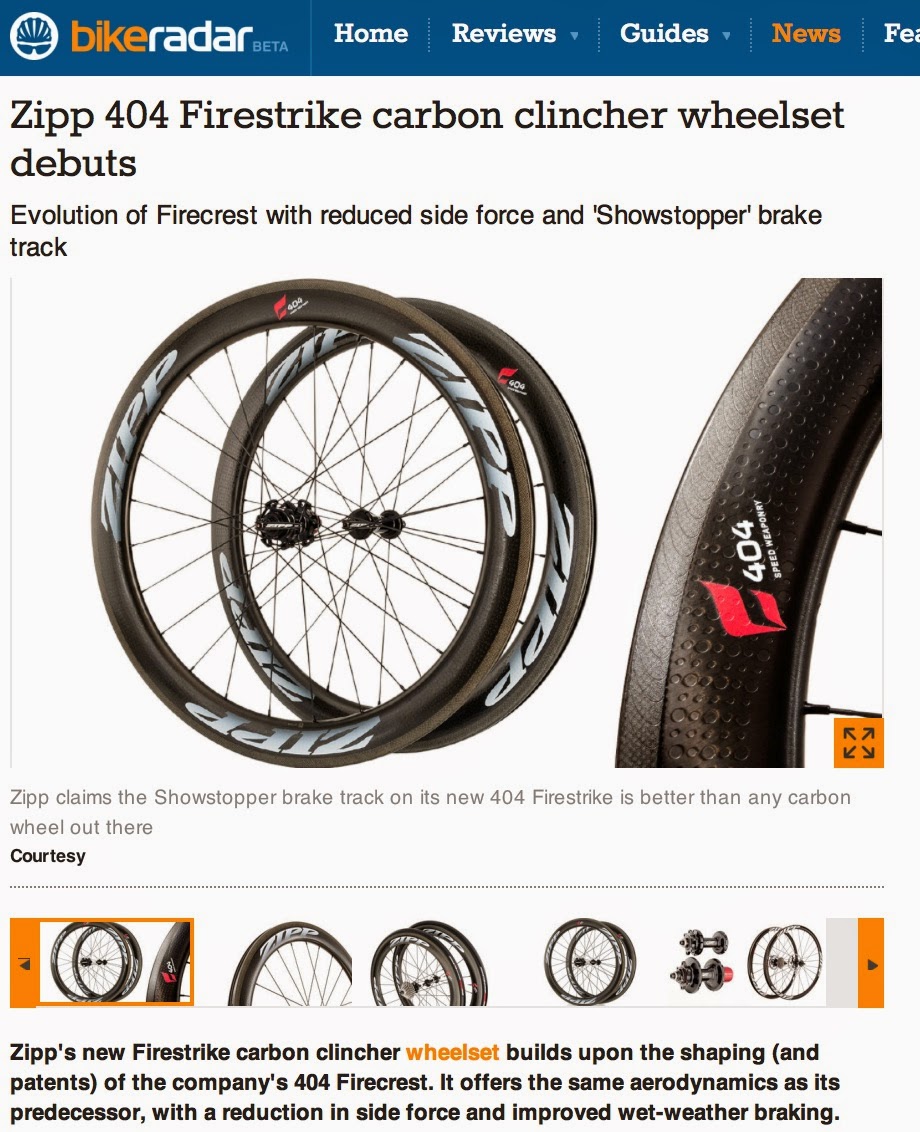
For example, reading through some of the other bike-related websites, like VeloNews, BikeRumor, and BikeRadar, I've seen stories hyping the new Zipp 404 Firestrike wheels, which retail for $3,600. The way they're all going on about these wheels, you'd think that all previous wheels were square, and someone just invented the whole "round" wheel concept. Then again, they go through the same hyperventilating over pretty much every new carbon fiber wheel set that comes along, virtually every other week.


The VeloNews review starts by saying, "Zipp says that from the moment the brand introduced the Zipp Firecrest line, the engineers have been hard at work to develop a still better wheel set." Sounds like planned obsolescence to me.

The articles go on to talk about all kinds of technical alphabet soup -- "mathematically derived CFD rim shape," "ABLC dimple pattern," "SiC brake track," "ceramic ABEC 3/grade 10 bearings" -- which buyers can concentrate on trying to decipher, thereby distracting them from the realization that they paid way too much money to end up going the same speed. If that buyer is a perennial mid-pack finisher in Cat. 4 races, they will still be a mid-pack finisher. If that person is just a guy who likes to ride fast with the club, he might be able to rattle off the alphabet soup and impress the kinds of people who are impressed with that kind of nonsense, but he'll still be the same rider.

Something else that should be noted is that Zipp and their cheerleaders go to great lengths to say how the braking performance of these new carbon clinchers is so great that it's similar to aluminum alloy rims. Carbon rims have notoriously terrible braking (sometimes downright dangerous), but the only time the manufacturers and their cheerleaders will admit that is when they come out with a new upgrade. Then, it's the old rims that were lousy -- but the new ones are comparable to aluminum. Does anyone else sense the tremendous irony here?

VeloNews says, "The new Showstopper brake track is the big change from Firecrest, which already sports one of the best carbon brake tracks on the market. Still the Firecrest struggled under wet braking, and the Firestrike seeks to improve that, allowing riders to race the 404 Firestrike clinchers in any conditions." So in other words, the old wheels were among the best, as long as you didn't get caught in the rain. Another way to phrase that is they were crappy wheels that cost a premium price. And the new ones are supposed to be a big improvement, until next year's upgrade reminds us that what we really want is a good set of classic aluminum alloy rims.

The funny thing about the Firestrike 404 wheels is that they are, for all intents and purposes, virtually no different from the "old" Firecrest 404 -- the most obvious difference is "strike" vs. "crest" in the name. Otherwise the distinctions are so subtle that it would be virtually impossible to tell the difference. . .

They had to color the "new" rim red in this little graphic, otherwise you'd never know it was "new."

. . . But then, the "old" Firecrest 404 wheels will still be available for riders looking for a "bargain" at $2,725. It's just another symptom of this "upgrade fever" price-equals-performance sickness that all a company has to do to make a $2,725 wheel set look like a bargain is to make some barely-perceptible tweaks and slap a $3,600 price tag on them. For contrast, I should note that I've never paid $3600 for a complete bike -- much less a pair of wheels. And I have some really nice bikes.

Looking at these prices, and reading the claims, it amazes me that there aren't more Retrogrouches.