Monday, October 21, 2019

Nashbar and Performance - The Changing Face of Bicycle Retail


If you've visited either the Bike Nashbar or the Performance websites lately, you've probably noticed that they've gone through some changes. You might even notice that, apart from the names, they're virtually the same site. Well, it turns out that basically they are. The last year or so has brought pretty big transformations to the two famous mail/internet bicycle shops - including Chapter 11 bankruptcy, closed stores and warehouses, and a complete consolidation of brands.

It's all an interesting twist in a story about the rapidly changing nature of retail shopping. Both Nashbar and Performance have been such a fixture for me since I first got interested in cycling - and I'll bet many people can say the same.

A look back:

An early ¼-page ad from Bicycling!
magazine, January 1975. It's the earliest
one I could find.
Bike Nashbar got started in 1974, though at the time it was known as Bike Warehouse. Arni Nashbar, an advertising man from New Middletown, Ohio (near Youngstown) started up the mail order bike shop out of his home with about $1000 of his savings. His idea was to keep the costs of doing business as low as possible, and thereby keep the prices of goods lower than the competition. One way to keep the costs down was with his catalog. Cyclists of my generation probably remember well the old Bike Warehouse/Nashbar ads and catalogs with their simple black and white hand-drawn pictures. They were decidedly a low-budget affair. As I understand it, Arni either didn't want to pay extra for reproducing actual photographs of the products for his catalog, or didn't have a good means to do so (perhaps both) so he put the manufacturers' own product photos on a light table and traced them by hand. Combined with the pulpy newsprint type of paper they were printed on, the overall look and feel lent the catalogs an old-fashioned "homey" or "folksy" charm. He continued to produce the catalogs that way at least through the 1980s. Eventually he had to give in to marketing pressure and "slicker" competition and start running full-color catalogs (I think it was in the '90s) but part of me missed the old style.

I couldn't pin down exactly when it happened, but somewhere around 1981 - 1982, Bike Warehouse became Bike Nashbar. For the first year or two afterwards, they were putting "Formerly Bike Warehouse" under the Bike Nashbar name.

A double-spread-page ad from 1980 - Still going by the name Bike Warehouse. Look at some of those prices! Cinelli stem, $19.80; Campagnolo Nuovo Record derailleur, $39.80. SunTour Superbe derailleur, $24.40. Oh, to have a time machine.
Now Bike Nashbar: this was from early in1982. 
Arni Nashbar also specialized in buying up overstocks, discontinued items, closeouts, etc., and passing the savings on to the customer. Another element in making his catalog shop a price leader was to make deals directly with manufacturers, mostly in Asia (first Japan, later Taiwan and China) to produce goods with the Nashbar name, eliminating middlemen. The same factories that were producing bikes, components, clothing, and accessories for big well-known brands were producing items with the Nashbar name for a fraction of the price. Nashbar-branded items typically didn't have a lot of drool-factor, and I suppose image-obsessed cyclists turned their noses up - but in my experience, many of the products were as well-made as the more popular branded items but a little more "basic" and were a great value. I had several pairs of Nashbar's best-quality bib shorts that were easily my favorites - the lycra blend was thick and durable, the chamois was a good fit and feel (and machine washable) and they lasted for many many years, miles, and wash cycles. I would often reach for them before some popular-brand shorts that cost much more.
Nashbar offered some really nice bikes for the money. This one from about 1986 or '87 had a Japanese-built Tange #2 frame, full Shimano 600 SIS group (including the brakes), tubular wheelset, and Selle Italia Turbo saddle. The bike listed for $479 - anywhere from $50 - $100 less than comparable bikes from more popular brands - and made in the same factory as some of them.

Many cyclists in Northeast Ohio and Western Pennsylvania probably share memories of an advantage to being nearby the company's Youngstown-area headquarters: the Bike Nashbar warehouse outlet store. It was a no-frills shopping experience, with tables and bins full of the things Nashbar was famous for: closeouts and overstocks - marked down to practically give-away prices. Also, the company had a very liberal return policy, so one could also get great deals on opened-box and returned goods (you had to check carefully that everything was in there!). When I was at Kent State University in the mid/late '80s, at least once or twice a year our bike club would rent a couple of 9-passenger vans and make the roughly hour-long pilgrimage to the Nashbar outlet to do some bargain hunting.

The origins of Performance Bicycle Shop are somewhat similar to the Nashbar story. In 1981, Gary Snook and his wife Sharon, from Chapel Hill, North Carolina, invested their savings into a catalog mail-order bike shop. The focus of Performance was to offer a wide selection of high quality bikes, parts, and accessories at low prices. The glossy, full-color catalog gave it more of an up-market look and feel as compared to Nashbar. I remember how getting those catalogs every few months was like getting a glitzy "wish book" - the feeling was not unlike being a little kid and getting the big Sears and JCPenney catalogs at Christmas time. "I want this, and that, and those, and . . ."
This is the earliest Performance catalog I could find - from 1983, when the company was only about 2 years old. Compared to Nashbar, it was a much glossier, "slicker" presentation.

Performance offered top-tier frames - and complete build kits. If you bought a frame, you could choose between different component packages and have the complete bike assembled and shipped directly to your home.
I used to drool over the frame pages in the Performance catalog. Here's an interesting thing to point out in this '83 catalog: Among these beautiful Italian and British frames, there is a McLean, from North Carolina-based framebuilder McLean Fonvielle. His fully custom-built frames were offered under the Silk Hope name, while his more "production-oriented" bikes were sold under the McLean brand. The quality between the two was said to be nearly identical because Fonvielle couldn't bear to skimp even on the lower-priced frames. He built approximately 300 frames before he died at the age of 30 in 1983.
My friends and I always loved seeing all this high-end gear pictured together in one place.
Performance, like Nashbar, also contracted with manufacturers in Italy and in Asia to produce bikes, components, and accessories with their own name on them. In the mid '80s, they offered some really lovely Italian frames, built of Columbus SL tubing, and made in the same shop that also contract-built for more famous brands. Again, the quality of their products was very good, but typically cheaper than the better-known brands. Performance also opened a nationwide chain of full-service storefronts, so they had not only the mail-order business, but also a presence on the street. That was an interesting twist, considering that many brick-and-mortar shops were probably driven under by the company to the point where there were probably a lot of places where Performance was the only physical bike shop in town.

Both Performance and Nashbar, along with the other mail-order shops, took a lot of criticism for undercutting brick-and-mortar bike shops. It was a fair criticism. With low overhead, volume buying, and eliminating some of the distribution layers, they were often able to sell goods for less than the traditional shops could buy them. Another source of irritation was that some shoppers would engage in "showrooming" - essentially using the bike shop as a place to try on shoes, helmets, etc., only to buy them for less from the catalog shops. Both of these issues have only gotten worse in the internet age - and in fact, those same changing trends, and an increase in internet shopping choices, eventually worked against Performance and Nashbar, as internet competition has re-shuffled the industry even further.

In 2000, Performance bought Nashbar (and another competitor, Supergo, if I recall correctly), but the two companies were still run as more-or-less independent entities. Both brands continued offering bicycles, components, clothing, and accessories with their own names on them, but Nashbar continued to put more of a focus on value pricing, deep discounts, closeouts, etc., while the Performance brand focused more on having a range of leading brands, and continued to have a more upscale image.

The current state of affairs started in 2016. Performance had accumulated a lot of debt to Advanced Sports International (ASI) which owned and distributed several popular bike brands, including Fuji, SE, Breezer, and Kestrel. The result was that ASI ended up buying Performance. A new company - Advanced Sports Enterprises (ASE) - was formed to manage both the internet shopping brands and the bicycle brands, and that takes us back to the beginning of this story.

Unfortunately, the purchase of Performance didn't stop the losses or solve the debt issues. ASE, the parent company that controlled both Nashbar and Performance, along with those aforementioned bicycle brands, filed for bankruptcy last year, and different parts of the company were divided up between different investors. One investment group, Tiger Capital, took over the bicycle brands, while another, AMain Cycling, became the new owners of the popular online retailers. AMain consolidated the Nashbar and Performance retail operations, and as a result, Nashbar's Ohio warehouse was shut down, and all the Performance brick-and-mortar storefronts were closed, offices shuttered, and most if not all employees let go. Both websites became little more than mirror images of one another, offering the same products, which now all ship from the same warehouse facility. (I'm hearing from good sources that some of the bike brands may be totally gone. Whatever future they have is uncertain.)

The store closings probably mean that there may be some towns that have lost their only full-service bike shop, and it goes without saying that a lot of folks are out of jobs. And as often happens with bankruptcy, creditors and suppliers are left holding an empty bag. It's a little ironic that many people pointed to the mail order bike shops as contributing to the failure of full-service brick-and-mortar bike shops a decade or more ago - and then further shifts in shopping trends ended up killing Performance and Nashbar in return. There's so much competition on the internet - and nowadays the competition is global. Sometimes one can find products sold from Europe or the UK shipping directly to customers in the US at prices (including shipping) that can't be beaten even by American-based discounters.

All in all, it's kind of a sad twist that demonstrates the volatile nature of retail. It makes me wonder what changes we'll see in the future, and what it will take for bicycle retailers to survive.

Monday, October 7, 2019

Retrogrouch Re-Run: In Honor of Ginger Baker

I saw in the news this weekend that legendary rock drummer Ginger Baker has died. Though it doesn't, on the surface, seem to have much to do with a bike blog, many of us who obsess over classic and vintage bicycles know that Baker, along with musical partner and equally legendary rock guitarist Eric Clapton, was once an avid cyclist and maybe (dare I say?) a bit of a bike geek. 

A few years back, I wrote about the bike connection - mostly in regards to Clapton, but also Baker - and their classic album: Cream's Disraeli Gears. I don't have anything new to post today, but it seemed appropriate to do a "Retrogrouch Re-Run" of that post. Here it is:

I was listening to Disraeli Gears by Cream the other day and it got me thinking about bicycles.

Bicycles? Really?

Yep.

Granted, lots of things get me thinking about bicycles, but it's probably already well known among us old bicycle enthusiasts (or maybe not) that Eric Clapton has been a huge fan of bicycles -- especially classic Cinellis -- going back to his youth. So was the band's drummer, Ginger Baker, for that matter. Their mutual love for racing bicycles, and a roadie's malapropism, led to the title of that iconic 1967 album.

The story goes that Baker and Clapton were talking about bikes one time in the back of a car, and according to Baker, "Mick Turner was one of the roadies who'd been with me a long time, and he was driving along and Eric was talking about getting a racing bicycle." Apparently, Turner commented about the bike having "disraeli gears," as opposed to derailleur gears. (The actual Disraeli was a British Prime Minister during the Victorian era). "We all just fell over," said Baker. "We said that's got to be the album title." (disraeligears.co.uk)

I first heard about Clapton's passion for bicycles when I saw this picture in one of the bike mags back in the 80s"
That's Eric Clapton taking delivery of a new Cinelli Supercorsa from Antonio Colombo in 1987. Colombo is the owner of Columbus tubing, and has been the owner of Cinelli since 1978.
Clapton's love for classic Cinelli bikes has been well documented over the years, and he has apparently owned more than a few, from different vintages. In fact, here's another picture from the 80s, which one can find on the Cinelli website.


I've heard and read from numerous sources, including former British framebuilder Dave Moulton, that Clapton used to race a bit in his teens, probably time-trials mostly (like most British racers in those days), and that bikes and guitars were the competing interests in his life. Guitars and music of course took the lead, but he never really let go of the bike bug.

Clapton used to have a blog (it appears to be defunct at this time) where he would occasionally post some thoughts, and sometimes pictures, of his passions. Sometimes, his bikes would make the blog, like this vintage track bike:

Photo from Eric Clapton's now-defunct blog. Great old components would sometimes make the blog, too.
In 2010, Clapton was pictured on the cover of a Japanese fashion magazine (with an English-language title -- Free & Easy. Gotta love it!) posing with what looks to be a '60s-vintage Cinelli.


Clapton mentioned bikes a few times in his 2007 autobiography, too. In one passage, he talks about getting one of his first bicycles. In another he describes a visit to Japan, and meeting with designer Hiroshi Fujiwara. He writes, "Hiroshi came over to the hotel with his new Cinelli track bike. He is still a leading pioneer in street culture, hence the Cinelli. . . I have caught the obsession of course. He is very infectious, and I have begun buying vintage road bikes, not to ride but because I have always loved the equipment of cycling, especially bikes and accessories from the sixties."

Legendary drummer, Ginger Baker, 
looking iconic and ironic in the 60s 
(from gingerbaker.com)
As mentioned previously, drummer Ginger Baker, who collaborated with Clapton both with Cream and with Blind Faith, was also once an avid cyclist and aspiring racer. In Baker's own website, under the history archives, there is a quote from a 1967 press article: "Ginger Baker was doing very well as a professional bicycle racer when he was fifteen. He had already discovered and enjoyed listening to the music of jazzman Dizzy Gillespie. One day he sat down at a drum set and found he could play . . . He's been a drummer ever since."

Something tells me that the description of the 15-yr old Baker as a "professional bicycle racer" is a slight exaggeration, but numerous sources mention his early ambitions to race bicycles. In a 2009 Rolling Stone interview, it was said that an accident on the bike with a taxi left him with a busted bicycle, ending the dream. Another source says that the accident broke his leg, and it was during that time while he was recuperating that he started playing the drums. In any case, the drums quickly changed the direction of his life.

It's fun to imagine these two legends of rock -- one of the greatest guitarists, and one of the greatest drummers -- chatting between gigs, or out on tour, swapping stories of riding, racing, and the bikes they loved.

Saturday, September 21, 2019

RetroMod

With school back in session, and with a new schedule and new teaching assignments, it seems I haven't had a lot of time for blog writing these last few weeks. But I have been riding to work as much as possible. Usually I ride a decidedly non-retro-grouchy bike to work, fully decked out with racks, panniers, fenders, bags, and lights - and with an aluminum frame, modern Shimano components, and even (gasp) disc brakes. I see it as utilitarian pack mule that gets the job done without inspiring much passion - and riding it in rain or winter's salty slush doesn't make me cringe the way I would if I were on a nice classic steel bike.

The last couple of days have brought us fantastic weather -- warm, sunny, and with no hint of rain in sight. I haven't had to carry a lot of gear back and forth either, so for my last few commuting rides I decided to skip the pack mule and take something a little more lively: my black & blue Mercian "retro-mod." Since I haven't really featured it on the blog much, I thought I might take some time today to rectify that.

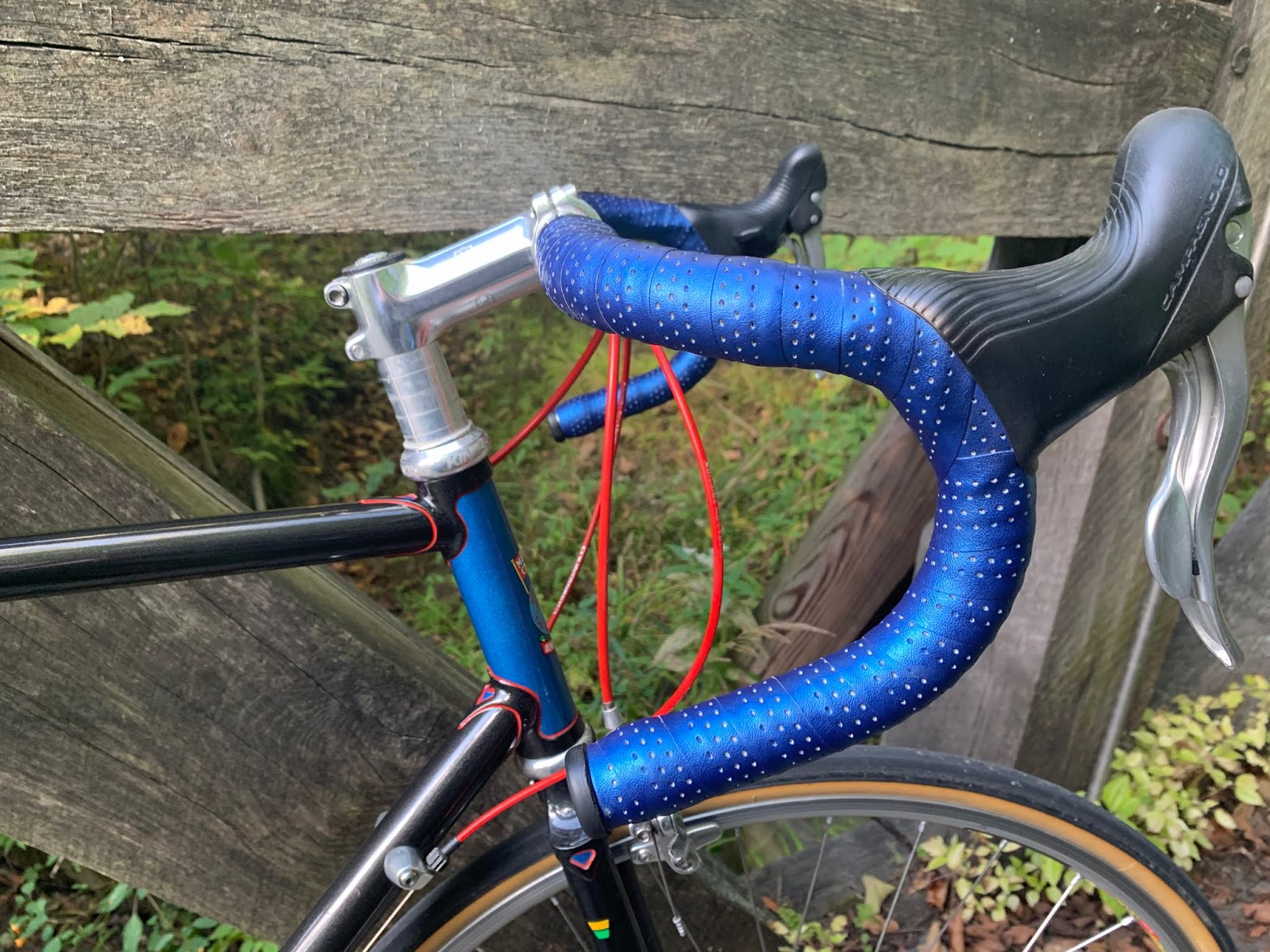
This was a frame I had built back around 2010 - a King of Mercia model in Reynolds 725 heat-treated chrome-moly. The "retro" comes from the lugged steel frame and vintage-inspired paint scheme with contrasting panels and bands on the seat-tube. The "mod" comes from its modern (well, modern for 2010) components - including 10-speed cassette and Campy Ergo brake/shift levers. Prior to acquiring the pack mule with its disc brakes, this was the most "modern" bike in my collection.

In the Mercian color palette, the main color is called Black Pearl - it has a fine metallic sparkle that catches the light. The contrasting color on the head-tube and seat-tube is called Blue Intenso Pearl. I had Mercian finish it off with red pinstriping and lug outlining. The bar tape, from Fizik, was a near-exact match to the blue contrasting panels, while the saddle has a center stripe in the same shade. The red cable housing picks up the red in the pinstriping. It's very matchy-matchy, but it all fell together so easily that I couldn't resist it.
The bike was built with clearance for reasonably large tires - those are about 28 mm, though I think 32 would fit without difficulty. Most of the components are Campagnolo, but Campagnolo doesn't make a "medium" reach brake as the clearance on this frame required. The brakes I ended up using were made by Tektro, but they have a beautifully polished finish and first-rate hardware (like the barrel adjusters and the eccentric quick release) much nicer than their low price would indicate. I was "snobby" enough to carefully remove the Tektro name from the calipers, though. I upgraded the pads with top-quality ones, and the brakes look and work as well as the best. 
The tubing on the frame is slightly oversized, but that meant an oversized 1⅛ steerer, too. Yes, I think 1⅛  is overkill on a steel bike, but apparently the available lugs made it necessary. So I had to get a threadless headset (Chris King) and stem. The stem from Velo-Orange is a decent-looking one with a nice polish, but honestly I think a traditional quill stem looks better on a steel bike. Another thing - commonly available aluminum headset spacers tend to be really thick, making the already large steerer tube look even bigger. I had a friend who owns a machine shop turn down some nice thin spacers for me on his lathe. It helps the look. What would be ideal would be to have someone craft a nice, slim stem out of steel, but that's an expensive option.
I've used or at least tried the integrated brake/shift lever systems from the three main component makers - Shimano, SRAM, and Campagnolo, but of the three, I really prefer the Campagnolo Ergo.  The Shimano shifters have a "lighter" touch, but the Campagnolo have more "feel" or "feedback." The paddles for shifting need only a small "throw" to execute a shift, and can make multiple gear shifts with one press of the lever. By contrast, the Shimano take a much longer sweep of the lever to make a shift. The lever shape is a little weird-looking (at least they are if you typically use more traditional or vintage-styled levers), but they feel nice in the hand. The bodies are long and offer plenty of room for big hands.
In this shot you can see the sparkle in the black and blue paint, and the little hand-cut heart detail in the lugs.
Campagnolo Centaur 10-speed drivetrain looks good in silver. The crank looks a little like the late-'80s C-Record but has the Ultra-Torque bottom bracket system. There can be issues with that system (I wrote about that HERE), but mine was set up well to make it smooth and trouble free. Fun detail: my bottle cage is carbon fiber. It's the only carbon fiber thing I have on any bikes.
The light, nimble, and racy bike made for a fun change of pace on my commutes for a few days.

Monday, August 19, 2019

Americane Vintage Road and Track Bike Show

This weekend I took a drive up to Rochester Hills, Michigan, near Detroit, for the 11th annual Americane Vintage Road and Track Bike Show, organized by Vintage Velo Rendezvous Michigan (VVRM). The show was held at the International Velodrome at Bloomer Park and included free admission to the track in addition to the vintage bike show. Having never actually ridden on a velodrome before, I was eager to give it a try, so I loaded up a couple of vintage bikes for the show, including my track bike. It's about a 3½ hour drive from Akron to Detroit, which means I was probably the farthest from home of any of the event's attendees. But I knew there'd be some familiar faces at the show as I've met a few Michigan vintage bike fans over the last few years as I've been traveling there for other vintage-oriented bike rides.

Weather for the event could best be described as tenuous. Rain in the morning made for a wet track that needed to dry out in the earlier hours of the day. But the sun came out to dry things off in time for the main event, and eventually it got into the upper 80s (though someone said it was close to 100 on the track!). But then more storms rolled in for the afternoon and cut things short. By the time the show judges were announcing winners, people were rushing to pack up their bikes as lightning could be seen (and heard) moving closer.

A view of the velodrome at Bloomer Park.
There's two riders on the track - Tim P. on one of the "loaner" track bikes, and Mark A. on his lovely vintage Masi Pista.
The velodrome facility had someone on hand to provide free one-on-one lessons on track riding, so I took advantage of that. It didn't take long, and after a couple of laps, I was up on the banking and having a ball.
There I am on the banking, riding my vintage Mercian track bike.
There were some awfully nice bikes brought in for the show. It was great to see what people entered - and lots of bike-lust opportunities. There were awards given for Best British, Italian, French, North American, Japanese/Asian, and "Other" European, as well as a "People's Choice - Best in Show" and "Judges Choice."

This red and white Atala, owned by Jon A., was the winner for best Italian bike.
My Mercian track bike was part of the show - with my green and red 753 Mercian just behind it. 
I liked this blue Colnago - and I also enjoyed talking with its owner, Bob B. I'm going to take a moment here to plug his charitable organization FB4Kdetroit (Free Bikes 4 Kidz) which gets bikes to kids in need. If you're in the Detroit area and have a bike to donate, or would be interested in helping out in some other way (like building or repairing donated bikes), contact them at fb4kdetroit.org. It sounds like a great cause.
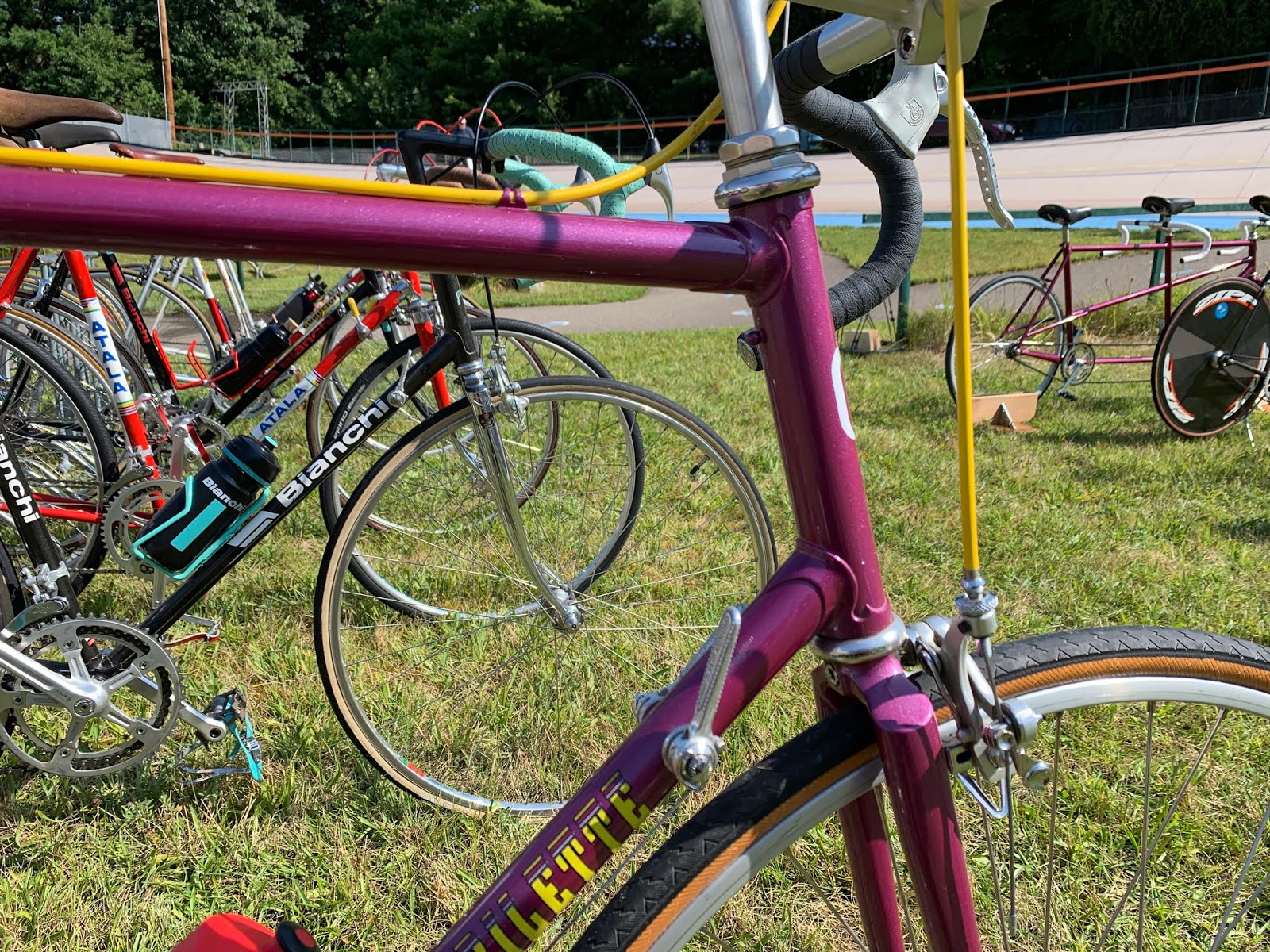
I got a few pictures of this beautiful example of Mark Nobilette's work, owned by Phil K. Elegant lugwork under shocking purple paint. This was the winner for best North American entry.

I really liked the seatstay/seat lug treatment on this bike.
Beautiful old Gios Torino pista. Stunning.
This old Rochet would have been my pick for best French bike. One doesn't see many of these - and this example has some really nice details.


I think this was the French category winner (photo by Tim Potter) - A very nicely detailed Peugeot PX-10, owned by Phil H. 
Tim P. won "Best Japanese/Asian" for this wonderful Nagasawa keirin racing bike. Fun fact: I learned at the show that Tim's father-in-law was a championship keirin racer in Japan. He had some  magazine articles, news clippings, and plaques to display.
Just look at that clearance under the fork crown! Tight!
Okay - so, like a dope, I forgot to get a decent picture of my own 753 Mercian at the show. But this is the bike that won both "Best British Bike" and the "Judges Choice" awards. Wahoo!
Accepting one of the two awards for the green Mercian from event organizer Jon Albert. (photo by Tim Potter).
If you're a Facebook user, there are a bunch more photos on the event page - including more of the bikes, and more of the prize winners (sorry - I didn't get pictures of all of them), with photos uploaded by several participants. Maybe more will be added over the next couple of days. Anyhow, check those out HERE.

So as the last awards were handed out, thunder was rumbling and everyone was packing it in. Too bad, as I was hoping to get back out on the track again before heading home. All in all, it was a fun day (even if it was cut a little short) and I was feeling pretty good at getting some recognition for one of my own bikes at the show. I understand VVRM is hoping to see the event grow - I'll be keeping an eye out for another invite next year. Thanks, guys!

Monday, July 29, 2019

Biking in Canada: Part Trois

At this point, our family trip into Canada is done and we're back home. But our last visit was to the City of Quebec, several hours drive northeast of Montreal. I had mentioned in the previous post that the older parts of Montreal give a person the impression of a European city - and Quebec is a lot like that, but even more so. The "Old City" is reportedly the only fortified or "walled" city in North America (at least north of Mexico), and some parts of it date back to the 1600s. Our lodging was in rented house in the borough of Beauport, a short drive away from downtown. We spent about three days there - a lot of it exploring the "Old City" as a family, though I did get to do some riding on my own.

I had been warned that Quebec was not as "bike friendly" of a city as Montreal, but I wouldn't totally agree with that. There were numerous bike lanes, both on-street and separated, and there is a very nice bike path along the riverside. But the "Old City" is very compact -- conjested with cars and huge tour buses,  the streets are narrow (which apparently is not a deterrent to the buses), and crowded with tourists, and overall it seems really better suited to exploring on foot. However, having said that, because it is such a fight to find parking around the "Old City," I would at least suggest getting there by bike if at all possible, bring (or wear) walking shoes, find a good place to lock your bike, and then go walking.

This was on the steps leading from the "Upper Town" (or Haut-Ville) to the "Lower Town" (or  Basse-Ville). You can get a sense here of why getting around on a bike would be a bit tricky.
It's easy to forget you're not actually in Paris.
As I said - lots of narrow streets and alleyways - bustling with people. This alley was brimming with artists selling their work to tourists.
There are so many little cafes with tables on the sidewalk or on the street - and tons of interesting shops.
So, all of that was fantastic to see, but trying to get through much of it with a bike would be a pain. So for a much more peaceful ride, I decided to head over to the Ile d'Orleans, which sits right in the middle of the Saint Lawrence River, just to the east of the city.

The bridge to the isle was only about a 15-20 minute ride from the house where we were staying.
But first I rode over to Montmorency Falls, which was just a short detour from my route to the bridge. It was early so I got to enjoy seeing the falls pretty much by myself. The falls are reportedly 272 feet high, which is actually 99 feet higher than Niagara Falls.

Those cables going across the falls are a zipline. Not for me. Merci, NO!

From up on the observation deck by the falls, I could get a good view of the bridge and the Ile d'Orleans. I'd have a nice, fast downhill ride to the bridge.
(Gratuitous bicycle shot)
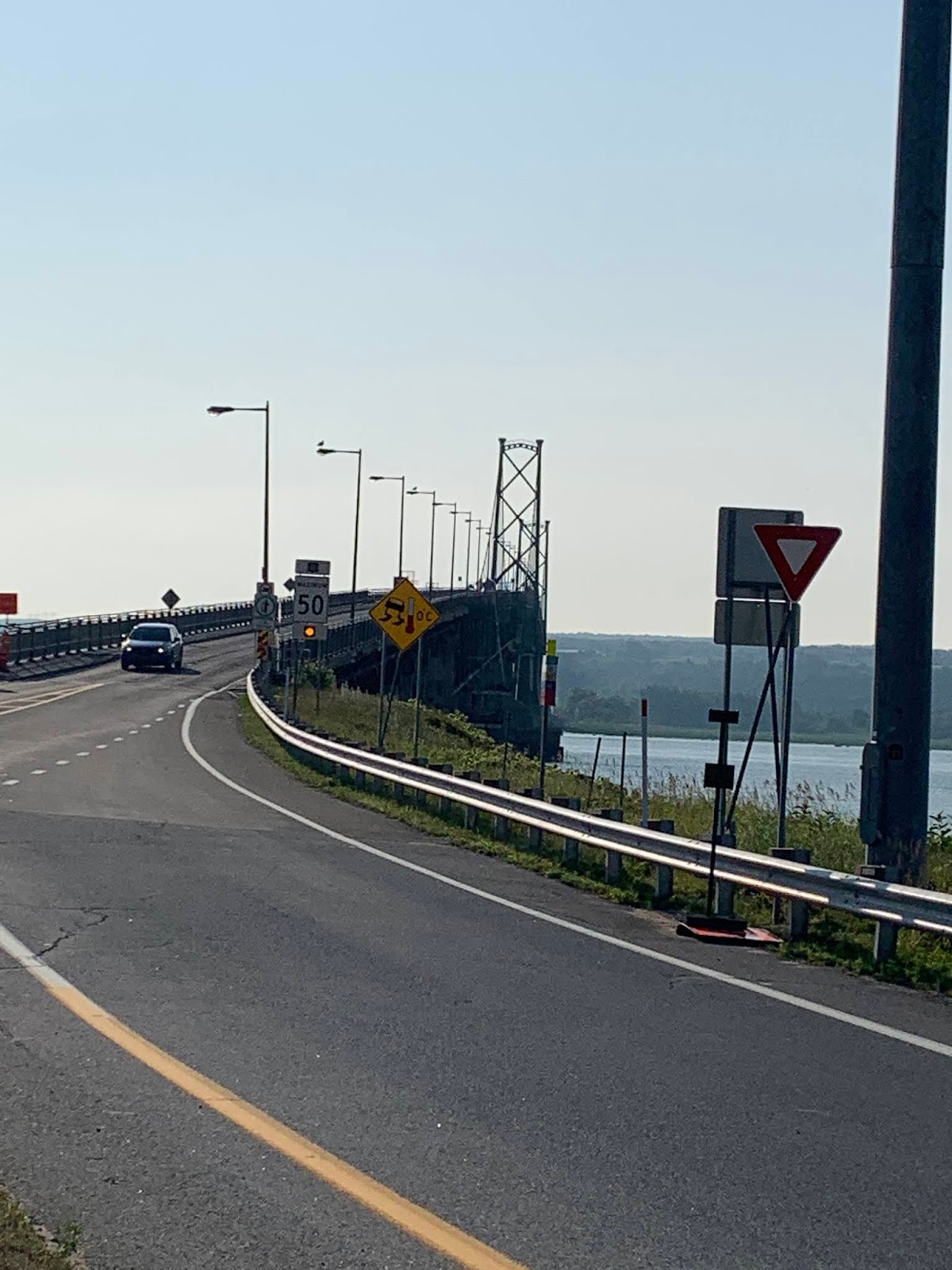
Approaching the bridge, which is a fairly delicate-looking suspension bridge.

I was up early so there was very little traffic on the bridge. But it's a very narrow roadway, and the walking/biking "lane" on the side is also very narrow. You wouldn't want to encounter someone coming the opposite direction.
At the mid-way part of the span. Did I mention that I really do not like high places? What's worse is that a truck would drive by and I could feel the whole roadway bounce. Oh, my stomach.
Nice view, though.
Once onto the Ile d'Orleans, there is one main road, Route 368, which encircles the perimeter of the whole island. It's about 42 miles all the way around. Orleans is sparsely populated, and primarily agricultural. There is not much in the way of development - and it's really peaceful as a result.

(Shadow "selfie")
I'm told that the island can get pretty busy with tourists this time of year, but again, I was out there pretty early. One of the big draws of the island is the produce. I saw farms of all kinds - fruits and vegetables, poultry and eggs, dairy, and there are produce markets and lots of little roadside fruit stands all along the 368. There are also vineyards and some small wineries, little cafes here and there, and quaint bed-and-breakfast inns.

I spotted this beautiful little cottage overlooking the river. There were lots of others like it.
One of many strawberry farms. OK, just for a frame of reference, try to imagine the powerful perfume of strawberries filling your nostrils. It was so strong I just had to stop. The downside of being out so early was that the markets and roadside stands weren't open yet. I was sorely tempted to run down there and pick a handful, but couldn't bring myself to do it.
Another farm with a great view.
After a great ride around the island, it was time to make my way back to the bridge.
There's Montmorency Falls, as seen from the bridge. The house where we were staying was at a similar elevation as at the top of the falls, so you can see I'd have some climbing ahead of me.
Before making the climb back up to the house (and the climb was a doozy) I enjoyed a leisurely ride for a few miles on the bike path that follows the Saint Lawrence, then started climbing. Did I mention that before leaving for Canada, I had put a different freewheel on the Mercian? I found an Ultra (narrow) 6-speed to replace my 5-speed. My low gear went from 24 to 28 teeth, with a 42-tooth chainring. That was helpful. And my smallest cog went from 14 to 13 - while picking up an extra gear ratio in the middle. Nice.

The following morning, we got the car packed up and started making the drive back home. All told, we had an excellent week in Canada, and it was nice to be able to experience at least some of it on two wheels. I hope the readers enjoyed it too.