Thursday, February 12, 2015

Modern Problems: There's No School Like Old School

In my previous post, I looked at the self-assessment quiz from BikeRadar, "20 Signs That You're an Old School Cyclist." If you read the original article, or took the quiz, you might have noticed a link to another BikeRadar list, "20 Problems Only Modern Roadies Have." It isn't set up as a quiz, but if it were, I'd have gotten a big, fat, goose-egg zero.

Funny thing about these "modern roadie" problems is that I've seen some of these guys roll their eyes and snigger at my downtube shift levers and 5-speed freewheels. But I can honestly say I've never had a ride end because of a dead battery, and I'm sure I never will. And I'll take pride in the fact that, short of a bike-destroying crash, or major mechanical failure like a busted axle or something, if something goes wrong on the road, I'll probably be able to fix it well enough to get home without calling for a ride.

Here's the BikeRadar list, and my thoughts on each -- has any of this ever happened to you?

20. You return from an epic ride to find your GPS didn't record and it feels like you just wasted your day and energy.   Never happens. No GPS. No computer. And unless someone is riding for all the wrong reasons, and deep down just doesn't like bicycles, how can any "epic" ride be a waste of a day and energy?

19. Your gears stopped working . . . because of a dead battery.  Never happens. Will never happen.

18. Your first ride of 2015 was on 2 January. All the achievable Strava KOMs were already taken.
I barely know what Strava is. Do you need a smart phone to use that? 'Cause I don't have one of those, either.

17. You work out indoors on windy days because your aerodynamic frame and wheels are just too scary outside.  Let me see if I understand this right . . . a bike that's "too scary" to ride outside? How much does something like that cost? Money well spent.

16. A rest day is when your GPS is turned off.   NopeSee #20 -- I don't even have GPS in my car.

15. You can't train indoors because your computer has a virus.  I don't often ride indoors, but when I do, I use old-school rollers and crank the stereo (or should I say, the "hi-fi"?). What's the computer for?

14. You're involved in a crash and you get X-rays . . . of your bike. The sore ribs go ignored.  Steel frames usually wear their damage where you can see it. If it isn't bent, dented, or wobbly, it's probably fine.

13. You see someone wearing a tiger-print skinsuit and your first thought is "brave."  The less said about this the better. Can you even get tiger-print wool jerseys?

12. A car hits you because they didn't see your "murdered-out" bike and matching kit. Luckily you caught the whole thing in HD video.  I had to look it up to even find out what "murdered-out" means. I learned it means all black -- frame, components, wheels, and even clothes. Hmmm -- and it resulted in getting hit by a car? Then I guess "murdered out" is an appropriate expression. Anyhow, that is not me. And I don't have HD video capability on or off the bike.

11. Your brakes are leaking oil.  You've got to be kidding me.

10. Your power meter keeps cutting out -- you decide it's pointless to ride like this.  I've never used a power meter. And how can it be pointless to ride without knowing how many watts you're generating? Maybe if you really don't like riding. . .

9. Distracted by your GPS, you hit the back of a car.  Want to get "connected"? Get connected with the ride -- the bike, the road, and the surroundings -- instead of the devices.

8. It's wet outside, so you wonder if you should just ride your cyclocross bike on the road today?  Does this cyclocross bike have fenders? If not, then what's the difference? Or the point?

7. You get a flat and find neither you nor anyone in your group has a 60/80 mm valve tube. You call a cab/your spouse, delete the file off your GPS and pretend the ride never happened.  80 mm valves? Holy Shmoley. So what are we saying here - we don't know how to patch tubes?
The closest thing I can think
of to #3 - jokers could do
this to you when stopped at
a light, too.

6. Your heart rate/cadence/speed or power sensor malfunctions and picks up the data of a young-gun riding past. You immediately screen-shot the effort.
Never. No sensors to malfunction. Screen shot? That requires a smart phone. See #18.

5. You can't operate your bike computer because the touchscreen doesn't work with the gloves you're wearing.  I haven't used a bike computer in probably 10 years or more. It said "Avocet" and had little clicky buttons.

4. You have a Gran Fondo coming up, but can't decide whether to use 50/34, 52/36 or 53/39 gearing on the front. And the rear cassette is a whole other drama!  Choices are nice. Too many can be paralyzing.

3. You're sitting at the lights and go to push off -- you shift for a gear but nothing happens. You quickly hear the laughter of your mate riding off and look down to find you've been unplugged.  Closest I can come to this is when some joker would surreptitiously shift your downtube lever into the highest gear, like those Team Cinzano guys do to Dave Stohler in Breaking Away.

2. Fixing a bottom bracket creak is no longer a matter of reaching for a wrench and grease. It now requires a hammer, a cup remover, a headset press, a new bottom bracket and a whole bunch of Loc-tite.  I've said before that modern bottom brackets are pretty ridiculous. If you've got a bike with a traditional threaded bottom bracket, hang on to it.

1. Your crankset tells you not to quit your day job.  I don't even know what this means. Is it a power meter thing? Do they talk now, too? And insult you if you're not putting out enough watts? Sheesh.

There you have it -- modern problems for modern roadies. And if it were a quiz, I'd have scored a big, fat "0". That's one "failure" I think I can live with.

Now, if you'll all excuse me, I need to get back to my search for a Swiss-threaded bottom bracket for an old Motobecane. . .

Tuesday, February 10, 2015

You Know You're an Old School Cyclist . . .

Somebody recently called my attention to a fun "self assessment" quiz on BikeRadar: "20 Signs That You're an Old School Cyclist."

There are 20 statements on the quiz, and a person gets one point for each that applies to them. Several of the questions have "extra credit" points. According to the article, scoring above 5 points means you might be "old school." Only 5? Jeez. I think I come up with 19.

Here are the items on the quiz, and how I answered them:

#20. You know what a peanut butter wrench is. +1 point if you know why it's called that. +2 if you own one. Yeah -- I picked up all 3 points on that one. I almost wish there were more bonus points for having multiple examples (you know, one for the crank bolts, and one for track axle nuts!). Or models other than Campy. The TA and Zeus ones are kind of nice to have.

#19. You still wear white socks. Not exclusively. But yes.

#18. You still use toe straps. Just not on pedals.  Actually, I do still use them on pedals -- and for lots of other uses as well, like cinching a spare tire under the saddle, or securing a tool wrap, or as mini tie-downs when packing, or securing packs to racks, or . . .

#17. You've told a newbie that Super Record ball bearings were hollow. OK, never done that. But I remember hearing it.

#16. You've secured a spare tubular under your saddle with a toe strap. +1 if you still do. +2 if wrapped in Gazzetta dello Sport.  See my answer to #18. Though I've never wrapped a spare in newspaper -- apart from useless affectation, why would someone do that? If it rains, then you've got a pulpy wet mass to deal with. Blah.

#15. You know what "drillium" is. +1 if you owned any. Yes. And Yes.

#14. You know what you had to drill out when the pin extractor failed and the @#$%! hammer wouldn't budge it. Yep. Never actually done it myself, thankfully. But enjoyed watching the spectacle once or twice.

#13. You talk about being "on the rivet" and you've actually been on a saddle with a rivet. I think my preference for Brooks leather saddles has been well documented on the pages of this blog.

#12. Someone mentions their Rapha jersey and you think they rode for Gitane. Okay, no points for me. I wouldn't mind having a Rapha jersey or two, but they're way out of my budget.

#11. You know why cycling shoes had long laces. I actually don't get points for this one. I'm assuming that it's so you can tuck the laces in under the toe straps and keep them out of the chain (because that's what I do) -- but it seems to me it would just be better if the laces were shorter.

#10. You used Modolo shifters and they broke (if they didn't break, you never used 'em). No points for me. I assume they're referring to the plastic shift levers Modolo used to sell in the 80s (they called them "carbon fiber" but I'm pretty sure they were mostly just plastic). I remember them, but never used them. I'm not losing sleep over skipping that experience, either.

#9. Your first freewheel had five cogs. Yep. I also had a Sturmey Archer 3 speed hub before that, but that apparently doesn't earn points.

#8. You already have a digital pressure gauge. One on each hand, in fact. That's me.

#7. You still refuse to admit that indexed shifting is that much of an improvement over Positron. Hell, forget Positron, what about Mighty Click? Or Huret Commander? I've said more than once on this blog that my favorite shift levers of any time are still the friction-only Retrofriction levers -- whether the Simplex version, or the less common Campagnolo ones. SunTour's Power Ratchet levers are pretty great too.

#6. You wore wool. Under your wool. That's me. I've also been known to wear wool over my wool.

#5. You know which gutta is red and which is white. I hated the red stuff, so I learned the difference pretty quickly.

#4. You still think of them as "Maes" bars. +2 if you know who they're named for and why. I'm not giving away the answer to this one, but I know it. A hint: 1936 and 1939.

#3. You took the Conconi test. Never did it. Had to look it up to remember what it was. Even back then I never knew what the test was called. No points for me.

#2 You put a wet sock over your spare bidon. Because ice cubes were for sissies. Call me a sissy, but I never did this.

#1. You can name all five -- oops, four -- 5-time TdF winners. You mean there are people who can't?

I find it odd that the BikeRadar article says any score above 5 pegs someone as "old school." Apart from kids who just picked up their first bike yesterday, could anyone really score less than 5? If any readers of The Retrogrouch take the quiz and score above 15, leave a comment. Have fun! And remember - there's no school like old school!

Monday, February 9, 2015

Could These Be The "Good Ol' Days"?

I had a reader comment recently that I'm too negative.

When you label yourself not just "a retrogrouch," but "The Retrogrouch," I suppose that negativity is something like an occupational hazard.

Not that I think the comment about my negativity was necessarily true, but I decided today I would look at what's good in the bike world today. Yes, even though carbon fiber and bloated, ugly components are all the rage today, and the industry would like us to believe that electronic shifting, disc brakes, and smartphone connectivity have made our old bikes obsolete, there are actually some developments that can be seen as good for all of us, retrogrouches included.

Good News Item #1: Tires

When I first got into bikes seriously, most road bikes either came with 27-in. wheels (ISO 630), or racing tubulars. The 27-in. tires were typically 1-in., 1 1/8-in., or 1 1/4-in. wide. The tubulars were typically available anywhere from about 21 mm to 28 mm wide, and while they were highly regarded for their "ride" quality, they could be pretty fragile, and a headache when they flatted. The good ones were (and still are) pretty expensive. I could never afford the really good ones. Some time in the later 1980s the 27-in. size was replaced by 700c (ISO 622), and good clincher tires started to really chip away at the performance of tubulars -- but for a lot of years, the trend was very much "narrower is better." Not only that, but to bolster weight claims as a marketing advantage, it was also very common throughout the 80s and 90s for companies to make their tires even narrower than their labeled size. So you'd see ads proclaiming that Brand X's 700c x 25-mm clincher was the lightest among the competition -- but in reality, the tire was lighter because it only measured about 20-mm wide.
The 700c x 38 mm Barlow Pass from Compass.

Today, road tires are available in a huge variety of sizes, casings, and treads. Not only that, but a sense of "reality" seems to have returned to size labeling. Road tires can be found as large as 50 mm, and widths well into the 30s are not uncommon. When I ride my Rivendell Long-Low with its Jack Brown 33.3 mm tires, I just shake my head wondering how anyone ever thought a 20-mm tire was a good thing. Rivendell also offers their 28 mm Roll-y Pol-y tires, which will fit a fair number of bikes out there, though maybe not many carbon bikes, most of which have too-tight clearance. Compass Bicycles has tires from Grand Bois and their own Compass line in a great variety of widths, and their supple casings mean that one can get great performance and ride quality that rivals (or beats) many tubulars. And another great thing is that a lot of these tires are once again available with classic-looking natural tan sidewalls.

For people on vintage bikes that still have 27-in. wheels, the choices are diminishing, but Panaracer Paselas are still available in that size, and they're a pretty decent tire for most road riding, have a classic look, and can usually be found for under $30.

And as a final note on tires (although it's also a point about wheels, not just tires) is that 650b (ISO 584) has made a pretty effective comeback, giving another good choice for road bikes. Some very nice, supple 650b road tires are being used in some really sweet randonneur bikes out there today.

Good News Item #2: Randonneur Bikes

The last decade or so has seen a lot of trends that I can't get behind -- like increasingly racer-oriented geometry on road bikes, and increasingly narrow "market segments," (gravel bikes, anyone?) but the appearance of more choices like randonneuring bikes, which offer speed, performance, comfort, and versatility, is a very nice development. Bikes like this owe a lot to French cyclotouring bikes of the past, and have seen something of a rebirth in recent years.

Not to take away at all from some other top-notch builders working
today, but Peter Weigle sets the bar very high for Randonneur bikes.
(photo from Peter's Flickr site)
In a conversation I had with framebuilding master Peter Weigle last year, I remember Peter saying how discovering randonneur bikes really opened up an exciting new avenue of creativity and expression for himself as a builder. Drawing inspiration from the great "constructeurs" of the golden age, he has put his own personal stamp on the genre in his bike designs and construction, with incredible attention to detail. His bikes just might be some of the best of the breed, though I certainly don't mean that to diminish other really great builders today.

A number of other custom builders have similarly drawn inspiration from the past -- and versatile bikes that can be ridden fast, with sprightly handling, while carrying more than the bare essentials are a great result. Now, those custom-built bikes represent the pinnacle of the genre, but there are even some smartly-designed and nicely made off-the-rack options that can provide a lot of the function, but without the artistry, at a price more of us can afford. Bikes like the Velo-Orange Polyvalent (under $600), or the Soma Grand Randonneur (under $500), seem to fit that profile. With their welded frames, I don't find them particularly exciting aesthetically, but then if they were lugged and brazed, they'd cost a lot more. It's also worth noting that there are probably some options available that "split the difference" with a balance of artistry, function, and price -- so it's definitely worth exploring.

Good News Item #3: Traditional Pedals

You'd think that clipless or "click-in" pedals would have totally taken over by now -- but it turns out that versatile traditional are still alive and well. MKS makes some really fine pedals in a variety of styles - whether traditional quill pedals for use with toe clips and straps, or flat pedals for city riding. They also make a nice touring pedal inspired by the classic Lyotard "Marcel Berthet" model. Rivendell, Velo-Orange, and Soma Fabrications are all good sources for other traditional non-click pedals for some more variety.

The great thing about traditional pedals is that one doesn't need special footwear to ride. Whatever shoes you happen to be wearing become "riding" shoes. I found that once I got over the need to "suit up" for bike rides, I started riding my bike a lot more often - recapturing some of the joy I had as a kid when I rode my bike everywhere because it offered me so much freedom at a time before I could drive. With traditional pedals, a bike can be so much more than an expensive piece of "exercise equipment" or "training tool" -- but a useful and versatile part of our daily lives.

Good News Item #4: eBay

EBay? Really?

Hey, love it or hate it, there is nothing I can think of that has had a bigger impact on the vintage bike market than eBay. For anyone who likes classic bikes and equipment -- the great stuff of the past -- and wants to keep their classics on the road, it's hard to think of a better source for bikes and parts that are out of production. It's like the world's biggest swap meet, and there is virtually no bike component or accessory that won't show up on eBay eventually if one has the patience to search and wait. Yes, there are always those losers who are way too "generous" in their descriptions of their auction goods, or trying to get $1000 for their worn out Varsity. And prices for some NOS components can get a little crazy sometimes. Then again, surprising bargains can regularly be found for clean, barely used bikes or parts. Need a French-threaded headset for an old Peugeot? Want a wide-range 5-speed freewheel for an old touring bike? Need new pulleys for your old Nuovo Record derailleur? It's hard to think of a better place to look. What did we do before eBay?

The biggest "down" on eBay? Jerks like this guy (some really bad language - so consider it NSFW):


Luckily, there aren't that many jack@$$es like that. Jeez what a waste of a nice bike.

There you have it -- some things that, for the most part, even a retrogrouch can feel good about.  Now if the D@#n weather would just clear up.

Friday, February 6, 2015

Storm Clouds on the Horizon?

Remember this?
The Tesla of Bicycles?
Unless your short-term memory is completely fried, of course you do, because it was just Wednesday that I wrote about the $500 Storm eBike, which was dubbed by some in the media as "the Tesla of bicycles." To me, it looked like someone strapped some batteries and a motor onto one of Walmart's $200 fat bikes, and I hardly saw anything worth getting excited about.

Well, after having raised well over $2.5 million in just a matter of days on IndieGogo, some are saying the "Storm" might be nothing more than a pissy sprinkle, if not worse. A writer for Yahoo Tech, which helped promote the Storm, now writes, "It was a crowdfunding campaign successful beyond anyone's wildest dreams. But dreams are not reality. And some things really are too good to be true."

The article goes on to say that the makers of the Storm have gotten a cease-and-desist letter from Prodeco Technologies, which also makes an electric bike named Storm, which sells for $1300. The letter reportedly accuses the company co-founder Storm Sondors (yeah - really) of making "grossly inaccurate" and "false" claims in their crowdfunding campaign.

Apparently, the success of the IndieGogo campaign attracted lots of other attention, too, particularly from other makers and sellers of eBikes, most of whom found the claims about the Storm bike highly suspect. Which claims did they find questionable? How about the power, the speed, the range, the recharging time, the weight, and the quality. So that's, ummm, basically all of them.

To watch the video, you first have to get used to the tight
close-up of the reviewer, and wonder about his whole
"talking while walking" format. But basically, he questions a
 lot of the Storm's claims.
There's a video on YouTube from ElectricBikeReview where the guy looks at some of the claims, and compares them to other eBikes he's ridden and reviewed -- and let's just say that he has some questions.

For one thing, he looks at the claimed weight of 45 lbs. Keep in mind that the Mongoose fat bike sold by Walmart has a claimed weight of 45 lbs, and that doesn't have a motor and battery strapped to it. The reviewer from EBR points out that the $6000 Felt Lebowske, which appears to be somewhat similar in specs to the Storm, but with an aluminum frame and much higher quality components, weighs in at 48 lbs. He goes on to look at other claims as well, but none of it looks good for the Storm.

You can watch the video here:


But wait -- it gets worse. It seems that the people behind the IndieGogo campaign are kind of hard to track down. According to the Yahoo Tech article, the company's website re-directs to the IndieGogo page, and nowhere on either site is there any kind of physical address to be found, or any kind of contact info. Domain name information for the company's website is masked, too, which is generally not a good sign.

To add to the murkiness, there is virtually no information anywhere about Storm Sondors, and not much about his co-founder, Jon Hopp, either -- or at least, nothing that would lend much credibility to the notion of running an upstart eBike company. Yahoo Tech found Hopp's Facebook page, and on it were two pictures of bikes that look a lot like the Storm, but with different names and graphics. Are these just cheap eBikes currently being cranked out by some Chinese factory, with stickers for whatever brand people want to slap on them?


Both pictures are from Hopp's Facebook page.

Finally, another concern is over the way IndieGogo handles fundraising, as opposed to the way Kickstarter handles it. Apparently, while Kickstarter doesn't charge contributors until the goal is met, and still gives people a chance to cancel their pledge if they change their minds, IndieGogo collects money immediately, and has no obligation to refund contributions if things turn sour. Considering that Storm already has more than $2.5 million in contributions, there is potential for a lot of disappointed or angry investors out there. It will be interesting to see where this whole thing goes.

Is it possible to make a $500 eBike? Sure -- but don't expect it to be the "Tesla of bicycles" and don't expect it to live up to the promises. I suppose if this thing goes really badly, it might even have a noticeable effect on crowdfunding in general.

All in all, this thing is almost starting to make a Walmart fat bike look good.

Wednesday, February 4, 2015

The Tesla of Bicycles?

A lot is being made these days of the Tesla "premium" electric cars, which bring serious performance, hot styling, and lots of media buzz to "green" vehicles -- then again, at $70,000 and up, they'd better, right?

A couple of recent upstarts (I've decided I prefer that to the term "startups") are trying to make their names by linking themselves with that Tesla name -- by producing what they would like people to call "The Tesla of Bicycles."

Yep. The Tesla of Bicycles.

Which part of the Tesla name they want people to associate with their products isn't quite clear to me though. It certainly isn't the premium performance or styling. Is it the fact that they are electric? OK, but electric bikes are all over the place these days. It certainly doesn't have anything to do with being "green" either, as strapping an electric motor and some big lithium-ion batteries to a bicycle is kind of the opposite of going green, if you ask me.

The Storm puts the Fat in Fat Bike.
The Storm eBike is currently on IndieGogo and has far surpassed its fundraising goal. The introductory price for the Storm is currently set at $499, though that price is only good until Feb. 6 -- so act fast! The price may climb to over $1000 when it goes full retail. However, taking a close look at the bike itself, the frame and components don't look to be any better than those found on Walmart's $200 fat bike, so I'm guessing most of that extra cost is for the batteries and motor.

The makers of the Storm claim their bike weighs "only" 45 lbs. and can travel 30 miles on a charge. But the reviewer for Yahoo Tech points out that the 350-watt motor doesn't quite have enough power to get the thing up steep hills without some pedaling assistance from the rider, to which I'd add "good luck with that." The Storm website also claims the bike is "Perfect for your next camping trip" because it can "handle the rugged terrain and take a beating on-road or off-road." Have fun pedaling this beast home when the battery runs down, leaving you stuck in the middle of that rugged terrain. I think they could improve the efficiency and range of the Storm considerably by putting some road-worthy wheels and tires on it, instead of these monster fat tires that are all the passing rage. I mean, the website says it's perfect for the beach (well, it does come from Malibu) but those tires and wheels make it less than ideal for pretty much anything else.

Another west-coast upstart, the Bolt, is also being dubbed by the media as "the Tesla of bikes" -- though to be fair, it seems the inspiration for its builders is more moped than bicycle. Yes it can be pedaled like a bicycle, but that really isn't the point of a moped. And again, I fail to see how this gets compared to the Tesla. It has that "built in somebody's garage" look to it -- probably because it was built in somebody's garage. At about $5000, it's also a lot more expensive than the Storm electric fat bike, though its makers say that like most electric vehicles, "it pays for itself over time." Actually, that is something that can not be said of the $70,000+ Tesla, unless one has a pretty extended interpretation of the phrase "over time."
The Bolt Motorbike is more "Motor" than "Bike."
The Bolt also has smartphone connectivity, because everything has to have smartphone connectivity today. That's right -- the bolt can be started with a unique command from the user's phone, and all "vital statistics" are "recorded in real time." What a relief.

There's a lot of hype and attention in the media these days about electric and hybrid cars as "green" vehicles, but no matter what they do, these vehicles will never be as efficient and clean as the ultimate green vehicle, the bicycle. Keep in mind that "zero-emissions" claims of electric vehicles ignores the power plant that charges the batteries. And few sources will talk about the true cost and the environmental impact of lithium-ion batteries -- from the mining of the materials, to the manufacturing of the batteries, and eventually to the recycling of those batteries when they inevitably die.

No -- I say forget the Tesla. It's hardly the answer for our future. And forget this trend of strapping batteries and motors to bicycles. The way I look at it, it's just a step backward.

Monday, February 2, 2015

When Pedals Aren't Complicated Enough

Some people don't trust simplicity. If something is too simple, they figure something must be wrong, and it must be improved. One of the most wonderful things about a bicycle -- the very thing that makes it so efficient and effective -- is its simplicity, and therefore tinkerers and "innovators" of all kinds are convinced they must be able to improve on it.

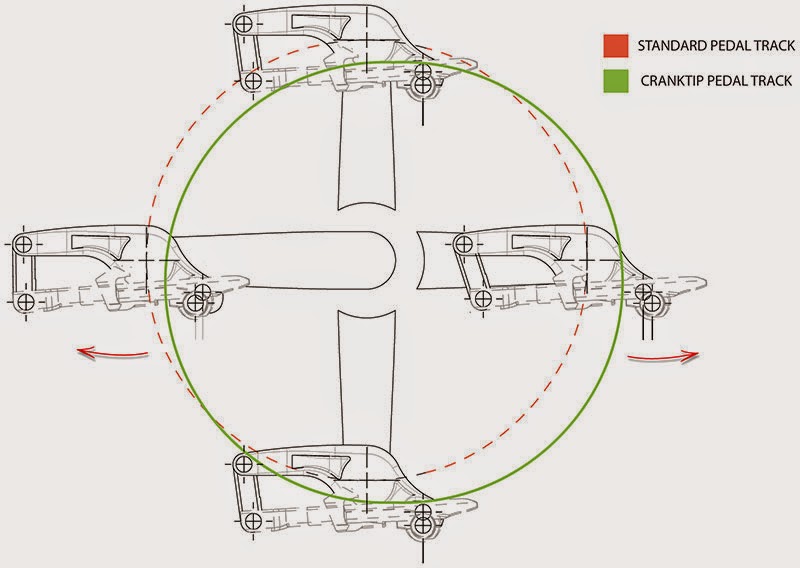
Pedals are simple. Too simple, apparently. So now there are these fairly complicated looking "swing-arm" pedals from Cranktip that are designed to vary the crank leverage, and therefore the pedaling torque, throughout the pedal stroke.

The company makes numerous claims about the performance gains one is practically guaranteed to see (and feel) by using these pedals. Their website makes quite a bit about "uneven forces" caused by the circular motion of a normal bicycle crank, which causes it to be "less efficient at producing rotating energy and as a result offers significant feedback or uneven resistance that the leg of the rider constantly absorbs." They go on to say that this feedback leads to leg fatigue, and is "something that riders have been unaware of in the past and until now, the feel of a crank has simply been what it is."

It must be a pretty serious problem if bicycle riders have been unaware of it for over a century.

Another claim is that the pedals "increase power and efficiency with a notable reduction in heart rate." I'm a little fuzzy on how that is supposed to work, but okay.

About the swing-arm design of the Cranktip pedals, the company says that it repositions the rider's foot in relation to the pedal axis in the crank, effectively changing the length of the crank at different points in the pedaling circle. At the forward part of the pedal stroke, the swing-arm pedal pushes the rider's foot 12 mm lower and 16 mm further forward than a traditional pedal -- and yes, one would have to adjust their saddle position accordingly. The company claims that this movement "dampens and dissipates the varying forces experienced during crank rotation," resulting in a smoother crank action with less "feedback" and less fatigue, while also "providing greater power due to the increased crank arm leverage."

If one were tempted to compare the effect of these pedals to that of using ovalized chainrings (remember BioPace -- which was so effective that the industry giant Shimano eventually gave up on it?), Cranktip is quick to point out that it is not the same at all. From their site: "Whilst an oval chain ring manipulates the forces created by the crank arm, the overall energy provided by the crank system is ultimately limited by the length of the crank arm." They go on to say, "the Cranktip pedal simply increases the actual overall crank arm length to provide greater torque regardless of the chain ring being oval shaped or round."

The website has a video where one can see the pedals in action. Interestingly, the website only seems to  offer the clipless racing pedals, but the video also shows a flat pedal in use. Were those just a prototype? Or will they be released later? Who knows. Better yet, who cares?


One thing that never gets mentioned is how the extra swing-arm mechanism, which is situated between the actual pedal and the crank, affects the overall q-factor of the crank (that is, the measurement between the pedals -- or, how far apart the crank puts one's feet). I can't say for sure, but from just looking at the pictures and the video, I'd have to guess that the extra mechanism probably adds close to an inch in overall q-factor. For all the talk about how these pedals improve the biomechanics of the pedal stroke, and are supposed to reduce leg fatigue, etc., it seems a shame to ignore the effect of q-factor on leg fatigue and knee pain.

Also, I don't want to sound like a weight weenie, but for the target market (racers? triathletes?) I'd assume weight could be an issue with these. According to Cranktip's FAQ page, "Are they heavier than conventional pedals? Yes, however the trade off with weight to increase power is more than worth it." So, how much heavier are they? At 700 grams, they are more than double the weight of a pair of Dura Ace clipless pedals. And at $400, nearly double the price, too.

All the claims about increased torque, better biomechanics, more power, less fatigue, etc. etc. sound pretty familiar, don't they? The same claims have been made again and again by the makers of oval (or out-of-round) chainrings, crooked crank arms, and more. But I have a hard time believing that one gets more power and speed for free, and I'm not just talking about money.

Nevertheless, if people out there really are convinced that there is such a thing as a free lunch, then might I suggest the ULTIMATE drive train. Why not combine the Dpardo "Sickle Power Curved" cranks, with Rotor Q-Rings oval chainrings, or some vintage BioPace rings, and the Cranktip pedals? Hell, the bike will probably pedal itself!


Everything is AWESOME!

Thursday, January 29, 2015

If Spiderman Had a Bicycle . . . The Razik Vortex

I think Spiderman is designing bicycles now, but he should probably stick to fighting crime. What else can one think when seeing something like the Razik Vortex? Weird.

I suppose there are a lot of people out there who would think a bike like the Razik is pretty cool. It's unique, I'll give them that, but it kind of makes me shudder. For sure, nobody will ever mistake it for any other bike on the road, and it doesn't even need its name brandished in billboard-sized letters on the downtube -- not that you can put a name on the downtube. They do have the name splashed pretty boldly on the fork, however.

The tubing design is actually not unique to Razik, but is something known as IsoTruss and was originally developed for NASA. The design of the tubing, which is constructed of carbon fiber and kevlar, forms a latticework of little triangles and pyramid-like shapes, which are supposed to make an incredibly light-but-strong truss structure. I've read that the carbon "lugs" that form the head tube, bottom bracket, and seatstay/seatpost junctions are capped inside to keep water from getting inside (but there may be some strong reasons against taking this out in the rain -- read on.)

Look closely and see that the brake and shift
cables are routed inside the latticework tubes.
There's no liner or anything to guide them, though,
so just try to imagine how much fun you'd have
changing cables! 
Is it light? Sure, but apparently not any lighter than some other high-end carbon fiber frames. That seems odd, but what do I care about weight, really? My lightest bike probably weighs in the neighborhood of 20 pounds! The other claims are of tremendous stiffness and improved vibration damping. I can't speak to the validity of vibration damping, though it's something carbon fans like to talk about. On the other hand, stiffness is like some kind of holy grail that bike designers and manufacturers have been chasing for years now. Though it seems to fit a certain sense of intuition that a stiffer frame is "faster" or more efficient, oddly enough there is no actual proof that a stiffer frame has any measurable benefit. As for "faster," that actually defies physics -- a bike is a stationary object until a rider makes it go, and it's only as fast as the rider. More efficient? It's pretty debatable, and I've seen lots of evidence to the contrary. Just read this article from Jan Heine at Compass Bicycles.

Reviewers of the Razik are giving it some mixed reviews, though my favorite was from Fat Cyclist, where he points out that the unusual tubing can actually be used to grate cheese. Handy!

Several testers have noted that the weird texture and shape of the tubes can be pretty painful if one should catch their knees or thighs on it through the pedal stroke, particularly if one rides with a tight, knees-in position. BikeRadar also pointed out that when riding in wet conditions, water and muck coming off the front tire flings up right through the open tubes and into the rider's face and neck. Got it -- this is a dry-weather-only bike.

The Razik Vortex is made in Utah (the IsoTruss structure was originally developed at Brigham Young University) and costs about $3999 for the frame. Expect an Ultegra-equipped bike to cost close to $6000, and somewhere near to $15 grand for Dura Ace with Di2, or Campy Super Record EPS. NASA technology doesn't come cheap. But if someone is obsessed with Spiderman, the Razik Vortex just might be a must-have item.