Tuesday, July 10, 2018

Getting Shafted

Chains are such a drag. I mean, what else can you call a transmission system that's only 98% efficient? And yes, they're, simple, straightforward, "proven" technology, and relatively inexpensive - but they also get greasy. So, Yuck.

And that's why innovators keep trying to come up with new and better alternatives.

The latest is a shaft drive transmission from Ceramicspeed - the same people who have been pushing the envelope with pricey lubricants, bearings and derailleur pulleys to eliminate drivetrain friction - in a quest to get drivetrain efficiency up to 99%. Their new shaft system uses carbon fiber, tiny ceramic bearings, and raspy-looking cogs with rows of outward-pointing teeth.

Though the pictures show a multispeed (I count 13) cog set, it's apparently only a mock-up as they haven't actually figured out exactly how to get the system to shift across all those teeth.
Instead of bevel gears, as most shaft drive systems employ, the Ceramicspeed design uses a pinion with tiny rollers to engage the outward-pointing teeth on the cogs. It's supposed to virtually eliminate friction.
. . . And it apparently works - as long as you don't want to shift gears. . . yet.
According to the system's developers, their shaft drive system has "49% less friction than a stock Shimano Dura Ace drivetrain averaged across all gears." That sounds impressive. On the other hand, as already mentioned, the traditional chain-drive transmission is already very efficient. Depending on certain variables, including the specific gear combination being used, as well as lubrication, the efficiency can be anywhere from 93 to 98 percent. For example - the highest friction/lowest efficiency gear combination would be one where you have an extreme "cross-chain" effect, such as the small chainring/small cog combination. So when you're talking about an improvement like 49% less friction, you're really talking about a fraction of what is already a very small fraction. In other words, while the difference might be measurable with a power meter, I'd be skeptical about whether many riders could actually feel the difference. I mean, can you feel the difference in drivetrain friction between your small chainring/small cog as compared to a more sensible gear combo? I doubt it.

Some caveats. First - the system is still very early in its development and there are a lot of issues that remain to be solved. One major issue (mentioned already) is that so far it cannot shift gears. There are some ideas involving a small electric motor to move the roller-bearing pinion forward or backward along the face of those cogs - but how to get it to move across those teeth in a synchronized way at speed and under load is something of a puzzle. Imagine shifting gears in a manual transmission car without use of the clutch, and without (or with worn out) gear synchrosCaarrunch!

Second - there is no compatibility, and likely no way to make it compatible with any existing bikes or frames. That shouldn't be a surprise, since it's a totally new thing, but bikes would definitely need to be built specifically for it. And I cannot even imagine what it would do to wheel changes.

Another thing to consider is the complexity and cost. I simply cannot foresee any way that a system like this could even approach the cost of chains and "normal" cogs. That raspy-looking cog set bears an unlikely combination of looking simultaneously fragile and dangerous, in addition to probably being a real bear to make.

A couple things to remember - shaft drive is nothing new. Columbia Bicycles (Pope Bicycle Mfg.) had a shaft drive bike as early as the 1890s. I don't believe they were the only ones, either. This was before the roller chain we've known for about a century took its current form and established itself as the preferred transmission. In a manner of speaking, one could argue that the chain was the improvement over the shaft. The shaft was overly complex, less efficient, and too expensive to manufacture as compared to chains. But that hasn't stopped numerous companies and "innovators" from trying to re-invent them.

Turn of the century (the 20th century, that is) Columbia shaft drive bike. It would appear that the bike had rear suspension, too.
Modern shaft drive from Dynamic in the UK.
On a related note, there are a number of shaft drive motorcycles out there - mostly touring models. The added cost and complexity, as well as the extra weight, are much more easily absorbed in a motorcycle than on a bicycle. But except for companies like BMW (better known as a car company, by the way) which uses shaft drive on most (maybe all) of its models, the majority of motorcycles still run with chains. I would argue it's for good reason.

So, is there a shaft-drive bicycle in your future? Meh. Probably not.

Thursday, July 5, 2018

Another Nice eBay Find

Once again, eBay comes through. Right on the heels of finding a 17-year-old virtually unused Brooks saddle, and a new-old-stock derailleur of the same age, I managed to find a pair of these: classic Sidi touring shoes - which could also be somewhere in the neighborhood of 17 years old. They haven't been made in years, which is a real shame.


I bought a pair of these about that long ago, back when Rivendell was selling them. They quickly became my favorites. The ribbed sole gives a nice grip on traditional pedals without feeling as "locked in" as an actual cleat, and makes them fairly "walk-able." I wore them for years.


Problem? My feet grew. I'm told that can happen. It got to where I could only wear them with the thinnest socks, and later, even that was too much. Eventually I had to let them go.


Recently, even though I wasn't actually searching for them, I happened to find a pair - in my (new, larger) size, barely used, and still with the original box. The buy-it-now price was good, too. I didn't wait for someone else to beat me to them. When they arrived, I was pleased to see they were in really excellent condition - maybe even a little better than described. The soles showed very little wear, and the uppers looked almost new.

Certainly there can be problems with eBay. Sellers complain about fees and policies that favor buyers. Buyers complain about getting sniped in the closing seconds of an auction, or about shady practices like shill bidding, etc. And there are always risks involving scammers. But on the whole, nothing has been a better asset to fans and collectors of vintage bikes than eBay.

Anybody out there remember what it was like trying to restore a vintage bike, or just keep one going, in the pre-eBay days? Say you were looking for some obscure old component, or a unique spare part that hadn't been made in decades. You'd have to watch and wait for a swap meet to happen, maybe travel a good distance to get to it, and hope somebody there might have what you were looking for (and prepare to be disappointed). Maybe you'd go to countless flea markets and garage sales, hoping to get really lucky (which was unlikely). Nowadays, eBay is like a huge worldwide swap meet that runs 24/7, and if you have a little patience, it seems to me that there isn't anything that won't show up there eventually. Any time I've really needed/wanted something, I can't recall ever having to search for more than a few weeks before some example would turn up.

Anyhow, even though I wasn't actively looking for the Sidi touring shoes, they popped up one day on my feed and I coudn't resist them. Anybody else out there have any good eBay finds (or horror stories?) Leave a comment.

Monday, July 2, 2018

New Old Brooks and a (Slight) Makeover

I just replaced the Brooks saddle on my Rivendell. It had 17 years of use on it and was getting almost a little too soft and saggy for my taste. Now, I've seen people ride them until they looked like swaybacked nags - mine wasn't at that point yet and with proper care it could probably last a good bit longer, but it seemed to me that 17 years is a pretty good run for any saddle.

I applied a bit of Brooks Proofide and took it for a ride.
You know, eBay is a really wonderful thing sometimes. Rather than buy a brand-new Brooks B17, I decided to search the 'bay for one that was barely used so I could save a few bucks. That's the thing about Brooks saddles: lots of people buy them, use them one time, and decide they're never going to get comfortable on it (shocking to me, since I find them comfortable right out of the box), so they sell the Brooks and buy some thick, massive, gel-padded monstrosity. It didn't take long to find exactly what I was looking for - a "barely used" B17 with a "buy-it-now" price of $72. I snapped it up.


When the saddle arrived, it was hard to tell it wasn't brand new. But the funny thing was when I flipped it over to look at the underside. Brooks saddles have a date code stamped into them, and as it turns out, this "new" old saddle had the same date code as my old one - both were made in 2001, also the same year my Rivendell was built. That's right - they were, in a sense, "brothers." In fact, the "new" old Brooks is actually a little nicer than the old one. The old one was a B17 "Standard" while the replacement one is a "Champion Special" - which has the larger hand-hammered rivets, a skivved lower skirt edge, and copper-plated rails. Some say the leather is a little thicker, too. It's hard to imagine finding a more perfect replacement.

Oh - so what did I do with the old one? I put it on eBay where it (shockingly) sold for nearly what I'd paid for the replacement - making the replacement practically free. Better and better.

The Makeover

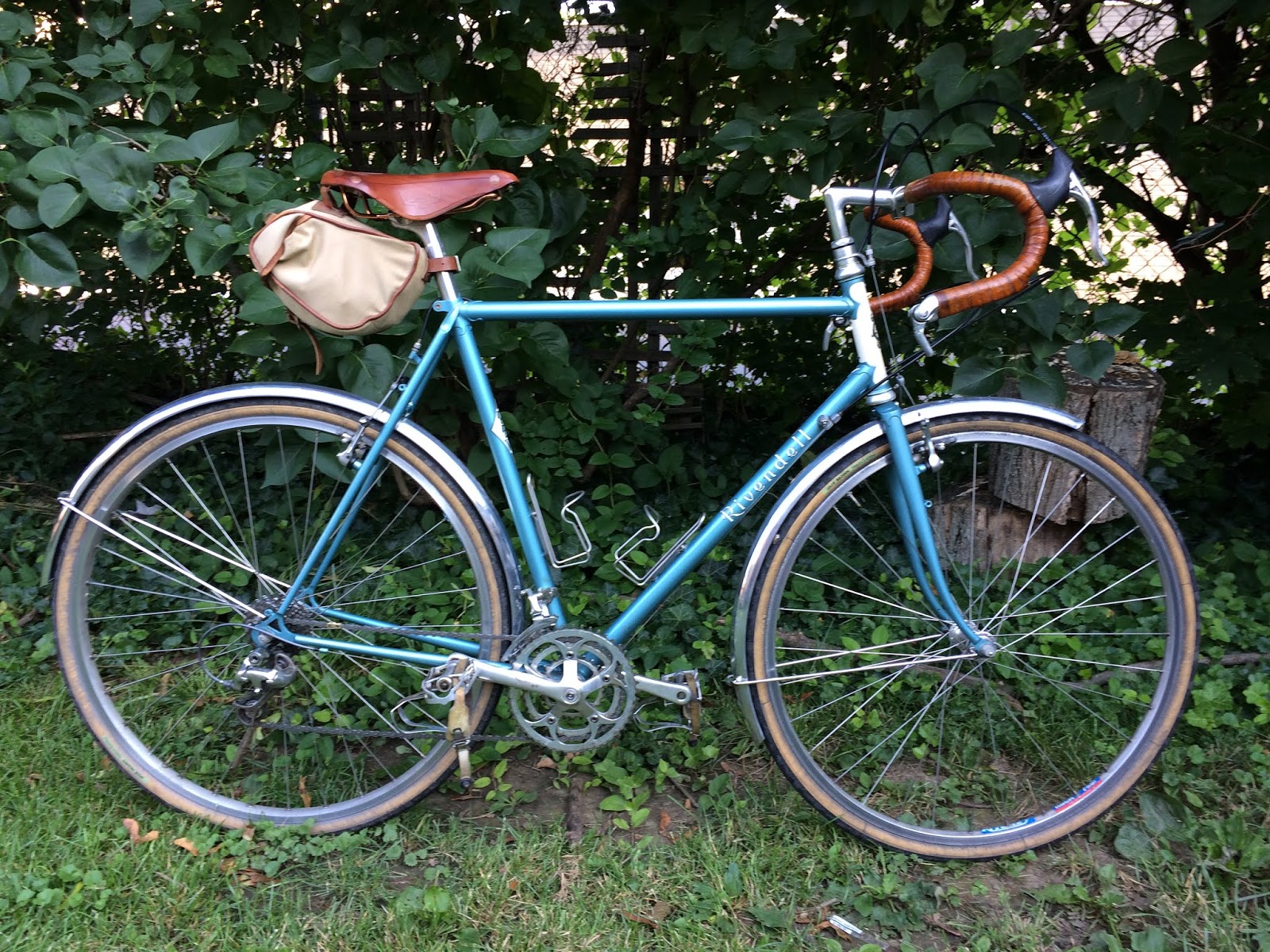
I have a lot of bikes. I lose count (yes - I really do), but I'm sure it's more than a dozen, and they're all really nice bikes. But if through some strange set of tragic circumstances I had to get rid of all of them but one -- to somehow make do with just one bike for the rest of my life -- I think the one I would have to keep would be my Rivendell. The bike is comfortable and handles well. It's no racer, but I'm fast enough on it to keep up with anyone I care to. It can take racks and some bags for a light tour. It accommodates tires at least up to 35mm with fenders. Overall, it's just a really versatile bike.


Built by Curt Goodrich back in 2001, it's the bike I've probably owned the longest. Back when I got it, I built it up with a great mix of parts that I'd selected for reliability, durability, and service-ability. Shimano Ultegra derailleurs and hubs. TA crank and pedals. Phil Wood bottom bracket. Stronglight needle-bearing headset. Nitto bars, stem, and seat post. Over the years, I've put a lot of trouble-free miles on it.

Recently I've been doing some cleaning and maintenance on the Riv to get it ready for a vacation I'll be taking with it, and I've made a few small changes - replacing parts on it for the first time since I first built it up (apart from things like tires and brake pads, that is).

First thing was the saddle, as already described. The next thing cropped up as I was taking parts off to give everything a good cleaning and lube. I went to remove the front derailleur (Shimano Ultegra 6500) and couldn't get it off. After 17 years, there was some noticeable oxidation on it - but apparently there was some corrosion hidden inside the hinge on the clamp, so the clamp was frozen and wouldn't budge. I shot a bunch of penetrating oil into it and let it soak for a while. Tried that again. Eventually in trying to pry it open, I got the thing off, but found I'd gotten it open only because the clamp bent - the hinge remained frozen. Oh, crap. Back to eBay. Whod'a thought you could find a NOS 17-year-old Ultegra front derailleur? A brand-new (old) component, exactly like the one being replaced - for less $$ than the current edition, too. Perfect. I replaced derailleur cables while I was at it.

After a good cleaning, degreasing, inspecting, and tuning, the last change was fenders. I had ridden this bike for the first few years I had it without any fenders at all, but for the past nine years or so, I've had it equipped with Velo Orange hammered-look fenders. Other than the fact that they were starting to rattle quite a bit (which I'm sure I could have solved) there was nothing wrong with them. But recently I was reading Jan Heine's book on René Herse's bicycles, and in those pages, bike after beautiful bike was equipped with fenders bearing a ridged or "faceted" finish - looking almost like the surface of a zeppelin. It was a great look and I took a bit of inspiration from it. Velo Orange sells fenders with that pattern on them, so I picked up a set and installed them. I'll set the hammered ones aside and re-use them when I build up a new bike for one of my daughters.

OK, maybe "makeover" isn't the right word here since the bike's barely changed. It's kind of funny to think that on a 17-year-old bike, even the new replacement parts are as old as the rest of the bike.

Incidentally, on my Sunday morning ride with the newly-freshened Riv, I stopped off at the little produce market in the valley - it's a popular stop for all the cyclists riding through the national park. When I came back to the Rivendell after buying some sweet corn and other fresh treats, I found a small crowd standing around admiring my bike. Many weren't even familiar with the name or brand, or even classic steel-framed bikes. They just knew they liked it. "Wow - that is a beautiful bike," I heard several people say.

Got to say, I was feeling a little lighter on the ride home.

Thursday, June 28, 2018

Man, Derailleurs Just Keep Getting Uglier

Yes, they do.  Mountain-bike derailleurs have been going that way for a while. But the latest generation of road components are doing everything to catch up. They've expanded, or swollen. Sprouted extra pivots. Transformed into complicated misshapen mechanical blobs.

Take a look at some of the newest road derailleurs:

The latest Dura Ace 9100. One website exclaims "Indulge in your love for impossibly crisp rear shifts." Oh, please. 
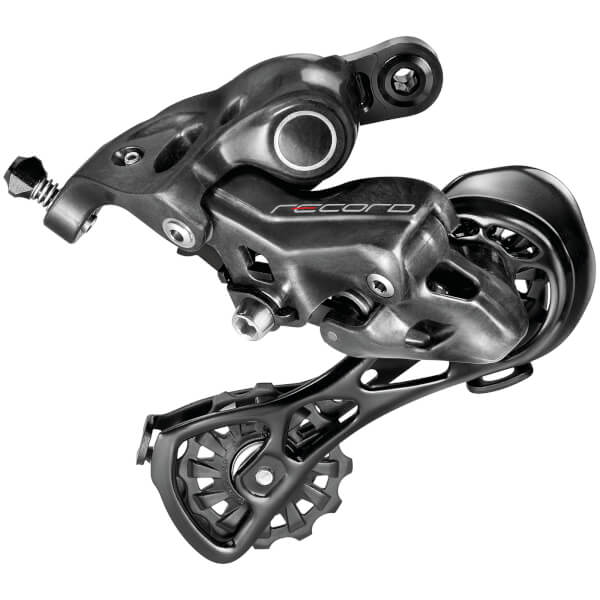
Newest generation Campagnolo Record 12-speed.

The SRAM Force. Looks like something out of Japanese Animé.
I suppose that part of the transformation is due to adding more cogs to the rear wheel (remember - we're up to 12 now), and the need to add more wrap capacity for the gear range that results. I assume the extra pivot that some have sprouted has something to do with keeping the upper pulley close to the cogs over such a wide range of gears. Maybe it does something to fight chain slap. Who knows?

Comparatively, derailleurs from the classic era look compact - maybe svelte. Somehow, maybe because of materials like carbon fiber and titanium, the bloated units of today don't seem to weigh much, if anything, more than the best of the past - but they sure look heavier.

Take a look at some of my favorite classics:

From my own collection - late '70s Campy Nuovo Record. No doubt that the modern version probably shifts better - but it can't hold a candle to the style of the vintage classic.
Early generation SunTour Cyclone - looked cool, and shifted about as well as anything made today.
Huret Jubilee - functional jewelry, and only weighed about 140 g. There was a long-cage version, too. (photo from ClassicRendezvous)
Shimano 600 "Arabesque" (with long cage) - worked nicely, and had some cool decorative details that existed for no reason other than to make it look special. (photo from VeloBase)

I suppose that some of the new derailleurs shift remarkably well over a tremendous range. These new designs give us racing derailleurs rivaling the range of the best touring derailleurs of the past. And yeah, maybe that's the thing that really matters. But damn, they're ugly.

Sunday, June 17, 2018

Fathers Day 2018

As far as I'm concerned, there is no better way to spend Fathers Day than going for a bike ride with the RetroKids. It was a hot one today - with temps up near 90º - but that didn't stop us from getting out on the Ohio & Erie Canal Towpath for a ride and a picnic.

It wasn't that many years ago that I was towing them behind me on a tandem trail-a-bike, and a Burley trailer before that. Now they're on the edge of having outgrown these 24" wheeled bikes. Full-size adult bikes will be coming soon.
Having our lunch near a visitor center in the national park. This might be the only picture of me that has appeared in this blog. 


Retrogrouchy bike shot. Vintage Stumpjumper, circa 1983 - repainted several years ago in shocking green.
A well-loved Carradice Barley saddlebag, covered in Towpath badges. They used to offer a new badge for each year. I don't think they do that anymore.
A stop on the wooden boardwalk over a beaver marsh. The RetroKids always like to stop and look for turtles and blue herons.
The marsh was formed by beaver activity, but somehow we've never seen the beavers.

Ice cream sundaes with big piles of fresh fruit at Szalay's market in the heart of the national park.  An indispensable stop on any bike ride in the valley.

That's all for today - I hope all the fathers out there enjoyed their day as much as I did.

Friday, June 8, 2018

Look Ma' - No Seat Tube!

There's nothing on a bike that's more pointless than the seat-tube. Am I right? I mean, if bicycles have an equivalent to a vestigial organ, it's the seat-tube on a diamond frame. And that's why any time "innovators" and designers want to create a "futuristic" looking bicycle, the seat-tube is often one of the first things they ditch. Besides - it's called a "diamond" frame - not a "two-triangles" frame.

One of the most iconic bikes on point would have to be the Trek Y-Foil of 1998-1999. Remember these things?

The negative of "famous" is "infamous." Notice that they're not exactly opposites. In other words, famous but for all the wrong reasons. Like Churchill was Famous, but Hitler was Infamous. If the word "Iconic" worked the same way, would the Y-Foil be Iniconic? There must be some way to say "iconic for notorious reasons" in one word. But I'm digressing.
Oddly enough, Y-Foils still have some kind of cult following. And as if this weren't goofy enough, they made a mountain bike version, too. Fans of the bike claim that the Y-Foil went away after such a brief run because the design was not approved by the UCI. If that were true, why did the MTB version go away too? Can't people just admit it was a fugly bad idea?

One of the latest on this no-seat-tube trend comes from the German company Urwahn, which is currently seeking funding on Kickstarter for its "unique" commuter bike.


Not only does this look-ma'-no-seat-tube bike represent the latest in futuristic design, but it's another bike billed as the "ultimate commuter" which might actually be OK if you work at home. Like most other "ultimate commuters" I've seen, it doesn't look like it would be comfortable or practical for any ride longer than a short hop down to the coffee shop. The website claims it can take full coverage fenders and a rack, but I'm just not seein' that.

Another relatively recent entry into the no-seat-tube club comes from AOI.Cycle:


With its laid back geometry, the AOI is like some kind of oxymoronic "future cruiser."

Cervelo has their P5X Triathlon bike, which I mentioned in this blog back in 2016:


The seat-tube-free design means there's more space for little cubbies and compartments for storing "hydration" formulas, goo packets, and maybe tools. But the real benefit is that it lets them brag that they're thumbing their noses at those ogres at the UCI and all their pesky regulations - which have never had an impact on triathlon bikes, or on most of the bikes made for non-professional-racing consumers for that matter. Remember what I said about the Y-Foil.

Here's a seat-tube-free design rendered in laminated wood from the German company Aceteam. It's also an e-bike.
Back in 2015 I called attention to the Viks Urban Cycle - an engineering-defying styling exercise from Estonia. Unlike many other styling exercises, however, you can actually buy the Viks. They have another version that looks almost the same except that it also foregoes seat stays. It's worth pointing out that the one-piece bars/fork make it impossible to make any adjustments for better fit or comfort - and apparently such frivolities as brakes are not really compatible with the design. Oh - you can get brakes, but according to the website: "All these are extras. Bike with extras is more complex to make, which in turn means extra fee. Don’t hesitate to ask us the prices."

Yep - the seat-tube's days are numbered. And good riddance, right? Just think how much those things are holding us back. Here's to the future!

Saturday, June 2, 2018

Farmers Market Saturday

We had some unseasonably hot weather in the last week of May (up in the 90s and humid), but we just got a reprieve from that for our first Saturday of June. I got up this morning and found it cloudy and cooler - low 60s - and perfect for a ride to the farmers market.

Every Saturday from late spring, through the summer, and into the fall there is a really nice farmers market in the Cuyahoga Valley - in the heart of the national park. Getting there on a bike just feels right. One can take the Ohio & Erie Canal Towpath for much of the way if they wish, though there isn't a direct connector from the path to the meadow where the market is held, so at least a short hop on the valley road is required - not that that's a problem. Bicycles are a common sight on the valley road, so drivers more or less know to expect us.

My Specialized Expedition touring bike seemed like the right bike for the errand. If I'd had more cash on hand and plans to really load up with goods today, I would have put a pair of panniers on the front rack, too. But I was really only after one thing today. I took this picture at one of the train depots by the Cuyahoga Valley Railway which runs through the park and right past the farmers market.
The market not only features many tents with some of the best locally grown produce, meat, cheeses, and baked goods, but there's always live music and often some crafts as well. There's usually vendors cooking up things to eat, too (breakfast burritos are a favorite).
I went to the farmers market mainly for one thing today. And it turned out that lots of other people had the same plan. This tent easily had the longest line in the whole meadow.
There's what I came for - and what all those others were waiting in line for: the first strawberries of the season. Small in size, deep in color, and the most flavorful strawberries you'll ever find. My handlebar bag (Acorn boxy bag) holds two quart boxes perfectly. It's like they designed it for this exact purpose.
While I was at the market, I also got some fantastic bread - though lots of other items were looking very tempting. Then I made my way home. The roads and trail through much of the valley are currently in bloom with little tiny white flowers that give off a powerfully sweet smell. I've only recently come to learn that they are Mock Orange shrubs - and they are all over the valley. That really capped off a nice morning ride.

That's all for now - happy summer, folks.