Friday, June 5, 2020

Yes, It's Summer

I know - the solstice is still a couple weeks away. But as far as I'm concerned, the first day of summer is today. I've been done with school for about a week now, but my kids still had school (online, but still . . . ) until yesterday. We spent their first official day off the way we often do, weather permitting: with a bike ride.

We packed a lunch and loaded up the bikes and headed to the Ohio & Erie Canal Towpath in the national park. It was hot and humid, but there are lots of shady spots along the path, and a light breeze, so it made for a pleasant ride.

The Retro-kids, leaving the old man behind.
 The mock orange bushes that line the roads and paths all over the park have just blossomed, and their sweet smell is like perfume blowing on every breeze.

After stopping to eat our lunch under a shady tree, we went to Szlay's Farm Market for ice cream. Today was their opening day - another event that marks the "real" beginning of summer.

"Grumpy" teenager.
"Happy" teenager.


We filled a basket with fresh fruit to take home from the market.
We stopped along the boardwalk over the marsh to get a look at an absolutely huge snapping turtle.
I was trying to get an idea of a measurement on this guy. His head was easily larger than my fist, his shell more than a foot across, and he must have been 2 ½ feet long from nose to tail.
There was something familiar about that scene above. So I looked back and found this picture, taken from the same spot five years ago. What were they looking at? A huge snapping turtle, with head larger than my fist, and a shell more than a foot across. Could it even be the same turtle?!? Holy cow.
I can't get over how much the girls have grown. But our bike rides are still such a big part of our lives together. I don't know how many more of these we'll have before they decide they've got other plans for how to kick off summer break, or they discover boys, or move away . . . Damn, those are sad thoughts. I simply have to make the most of it while I can.

Thursday, June 4, 2020

Retrogrouch Tool Time: The Chain Gang

When it comes to building a collection of bike-specific tools for doing your own maintenance, you'll find it's hard to go for long without having some kind of chain-breaker tool. Almost every bike has a chain - and if you need to remove it (and there is no "master link") there really is no substitute for a proper chain tool. Over the years I've managed to acquire several.

Most chain tools look and function pretty similarly to one another. Most look almost like a miniature vise, with some kind of "cradle" to position the chain links, and a threaded driver and "T" handle with a pin at the end. You position the chain into the cradle, line up the pin to the rivet, turn the "T" handle, and drive the pin through the chain -- pushing out the rivet. To reconnect the chain, you turn it around and use a similar process to drive the rivet back into place.

Let's take a look at a few in my collection:

The "Big Daddy" of chain tools: The VAR 06. Most other chain tools look like toys compared to this thing. I've never tried (and I'm not going to), but I have a feeling this would work on motorcycle chains in addition to bicycle chains. Like most vintage VAR tools, it's built to last a lifetime, and is probably the most "collectable" of chain tools.
This is a vintage SunTour chain tool. It's a pretty nice one with a couple of features that make it unique.


The SunTour tool has this little knurled knob and an adjustable "stop" at one end, opposite the "T" handle. With the stop retracted - or fully "out" - it opens up a recess to accept the chain rivet, and the tool is in chain-breaker mode. With the stop in the other position - fully "inserted" - it acts as a backing plate and prevents the chain rivet from going too far when re-connecting the chain. 
One thing about the SunTour tool is that it's pretty old - dating to the late '70s I believe (judging from the style of the logo and the packaging - which I still have). As nice as it is, like the VAR, it isn't really ideal for the super narrow chains on modern bikes today.

This Park CT-5 is designed to work with more modern chains. The CT-5 is their "compact" version, which I suppose could be packed into a saddlebag and taken along on rides as part of a roadside emergency tool kit. Park makes a much larger "professional" version - but the little compact one works fine for a home mechanic.
So, at one point I lost the little Park tool above, and when I was looking to replace it, I found this one from Topeak:
The Topeak tool is also designed to work on modern chains. And while it's still a lot smaller than a "professional" shop mechanic's tool, it is a little larger than the compact Park one, so it offers a bit more leverage. Interesting addition - that little "c" shaped hook thing is meant to temporarily hold two ends of a chain together, making it easier to get into position and reconnect them with the press. I've used home-made versions of that clip (an old spoke works well for that) - but this one came with the Topeak tool and gets stored in the handle. Nifty.
Shortly after I bought the Topeak tool, I found the Park one again (In case anyone was wondering why I have both).

For the sake of size comparison . . .
And then there's this thing:

A pair of chain-rivet "pliers." I got these in a box of assorted bicycle tools at a garage sale. They're pretty old - I'm guessing 1960s. I have tried them out - and when it comes to removing a chain, they work surprisingly well. A good hard squeeze on the handles, and "boom" - the rivet is out, and the chain is separated. I've tried it for re-connecting the chain, but haven't had as much luck with that. Getting the chain and the rivet positioned exactly right so the pin goes back in properly is just not something I've been able to do (though it IS supposed to work that way). Maybe I should get some old bits of chain and practice.

These were made by Gian Robert - which was maybe better known for making fairly inexpensive derailleurs. There is another tool, the VAR 303, which is almost identical. A lot of old-school bike mechanics have good memories of these.
Most modern chains these days have a master link for easier removal (but you still need a chain breaker if you need to remove a couple of links from a new chain). But sometimes those master links can be tough to separate - and if it's a dirty, greasy chain (which is probably why you'd want to remove it) - it can be even more difficult. So this is a nice one to have:

A simple pliers-type tool, but the jaws are narrow and shaped to get right in between the links in a bike chain. Position those around the ends of the master link, squeeze, and the link can be separated easily.

And before you go putting a used chain back on the bike, it's a good idea to make sure it isn't worn or "stretched." There are lots of different chain gauge tools out there - and some people just use a ruler.  Here what I use:
The Park chain checker. It can tell you pretty quickly if a chain is "passa" or "non passa." It's a good thing to keep in the tool box. 
By the way, I can't help but mention that chains don't actually "stretch." The fact that an old chain will be longer than a new one is the result of microscopic wear in the chain's rollers, pins, bushings, etc., multiplied by the number of "links" in that chain (Saint Sheldon has a pretty good article on that). Just sayin'.

Thursday, May 28, 2020

Retrogrouch Tool Time: Tire Jacks

Ever had that moment when putting a new tire onto a rim, and after you work the tire onto the rim all the way round, you get to the last couple inches, and no matter how hard you try, you can't get those last couple of inches of tire bead over the lip of the rim?

When that happens you want a tool known as a "Tire Jack."

Chances are, most cyclists have encountered a difficult-to-mount tire at some point or other. It's hard to pinpoint exactly why it happens. Sometimes it's the tire, sometimes it's the rim, and sometimes it's just the wrong combination of tire AND rim. Some brands or models of tires just seem to fit extra tight no matter what rims they're tried on. And one occasionally finds rims that, for whatever reason, will present a problem with any tire (a little larger in diameter than spec?). In any case, a tire jack is the tool that will safely coax those last inches of tire bead over the rim.

I've seen a couple different brands/models of tire jacks out there, but the most common one is sold by Kool-Stop, like this one here:

Interesting thing - the Kool-Stop name appears nowhere on the tool - but the name "Simson" is molded into the handle. I can only assume that is who actually manufactures the tool for Kool-Stop.

It's a simple tool that lets you apply a good deal of leverage. There is a stationary arm that ends in a "Y" shape, and a hinged arm with a hook at the end. The "Y" part braces against the rim on one side of the tire, while the "hook" part is placed under the bead on the other side, then you use the leverage of the long handle to pry the bead over the lip of the rim.
Like this:

And this:

I've had some frighteningly tight tire/rim combinations, but I've never had a tire that was so tight that I couldn't coax it onto the rim with this tool.

The Kool-Stop is a good tool to keep in the toolbox or workshop. But if you're out on the road and need to change a tire (and you know from experience it's going to be a challenge to mount), then there is a great "mini" version made by VAR that fits in the palm of your hand and can be packed easily in a saddlebag.

The VAR tire tool is pretty brilliant - consisting of a pair of tire levers for removing a tire, and a mini-version of a tire jack for getting it back on. The levers are maybe a bit too flexible to be ideal for removing a really stubborn tire, which I find to be true of most plastic levers. But the jack can be helpful in saving your thumbs when re-mounting the tire out on the road. As good as the full-size jack? Well, no -- it's only a fraction of the size, and a lot less leverage -- but it does make a difference. I have a couple of them stashed in saddlebags on different bikes.
One of the tire levers is stored in the center of the tool. As far as I know, VAR still makes these, but if you find them for sale today, expect the current production ones to be blue, not gray.
Both tools are pretty reasonably priced. The full-sized Kool-Stop tool sells for somewhere in the neighborhood of $15, and the travel-size VAR tool sells for anywhere from $10 - $20 depending on the seller, and where they're located - but it's probably the least expensive tool you'll ever get from VAR. Considering that many bike-specific tools can be awfully "spendy," these ones are a good addition to the tool collection, even if you're on a budget.

Monday, May 25, 2020

Memorial Day Ride - and RIP John Forester

I got out for a nice Memorial Day ride this morning. Our weather is sunny and unseasonably warm. I left early while it was still reasonably cool, hoping to beat the heat, but by the mid-point of my ride it must have already been nearing 80 degrees with high humidity.

I stopped for a photo near this little cottage in the national park. I'm not sure of the history of this place, but it has been vacant for as long as I can remember, and is (I believe) currently owned by the park service. They own a lot of the old houses in the park - some are used as offices, and a few are leased out to various groups, but not this one, apparently. It reminds me a bit of the cottage-style motels that used to dot the highways, but I don't think that's what this was. It's like a tiny duplex, in the midst of what used to be mostly farm land, so I wonder if it might have been lodging for seasonal farm workers for one of the local farms. Who knows? Cute little place, though - and a good spot for a bike photo.
The other thing I wanted to write about today was that I recently learned of the death of John Forester, whom many consider one of the "founders" of the modern bike advocacy movement, and the riding philosophy generally known as "vehicular cycling." I'm actually a bit late on this, as he died over a month ago on April 14 at age 90.

Forester was born in England in 1929, the son of Cecil Scott "C.S." Forester - author of such noted novels as the Horatio Hornblower series, and The African Queen (adapted into a classic film starring Humphrey Bogart and Katherine Hepburn). He moved with his family to California when he was 10 years old, and he would later take on American citizenship. He graduated from Berkely in the 1950s and had a stint in the U.S. Navy. He was a lifelong cyclist.

Living in the Palo Alto area in the 1970s, he famously received a ticket for riding in the street, and refusing to ride in the recently created bike-way. He fought the ordinance that mandated cyclists to use the bike-way and won. Many people cite that action as the beginning of a movement. He would go on to write numerous articles for cycling magazines, and became very involved in the fight against the Consumer Product Safety Commission's (CPSC) safety regulations on bicycles, which he believed were poorly written and conceived - and failed to distinguish adult bicycles from children's toys.

I have the 6th edition.
Forester should well be remembered for his book Effective Cycling which has been through 7 editions since it was first published in the 1970s. Though some people today may argue against some of his methodology, I believe his advice on sharing the road with motor vehicles - with the same rights, and responsibilities as motorists - is generally sound, and it is advice that I have long followed.

He was a controversial character in the bike advocacy movement, frequently ruffling feathers and clashing with other prominent advocates, in part because he was a staunch opponent of bike lanes and bicycle-specific infrastructure. That was a point that many modern advocates clashed with him on, and I'm sure there are some who believe that, if not for Forester, every city in the U.S. would be like Amsterdam. As for myself, I'm highly skeptical of such claims, and assume them to be grossly exaggerated. Personally, I tend to disagree with "all or nothing" approaches to anything, regardless of which side of an issue people are on, but in order to understand the reasoning behind Forester's stance, it's important to know that in his experience, and from his point of view, most bike lanes were poorly designed by people who did not ride or understand the needs of cyclists, and the efforts were typically undertaken NOT to help cyclists, but rather, to restrict them and keep them off the roads. People often described him as "inflexible" - but I think it helps to know where he was coming from.

Whether people agreed or disagreed with him, I think a lot of us owe some gratitude to Forester. Rest in peace, sir.


Saturday, May 23, 2020

Bike Safety 101: The Ballad of the Battered Bicycle

Welcome back to Bike Safety 101, where I pick apart old bike safety "educational" films and other materials - most of which would generally leave a person with the idea that they'd be much better off if they never threw a leg over a bicycle again. I haven't had a Bike Safety 101 post in a long time, but I recently watched a particularly dreadful old film that demonstrates that Americans weren't the only ones cranking out corny anti-bike propaganda. Today's film: The Ballad of the Battered Bicycle, a British film from 1947. The film features British stage and screen actor Stanley Holloway (maybe best known for My Fair Lady) as the rhyming narrator.

For reasons I can't quite fathom, the first full minute of this 9 ½-minute film is a montage of circus/carnival scenes:


And then we get to our narrator, Holloway, as some kind of carnival sideshow barker:

"I'll tell you now a dreadful tale of sorrow and of woe
about a wicked crime committed not so long ago. . .

. . . And that's it for the carnival, never to be seen again in this film. At this point, the film cuts to the bike shop where Henry, the hapless subject of the story, gets a new bike.

As his father pays for the shiny new bike, Henry immediately heads off on a path of destruction. "Now Henry's face lights up with joy - the bike shall be his pride - his father stays behind to pay - but he jumps on to ride."
Goofing off with friends and riding no hands, Henry and his new bike take the first of many spills.

Little Henry can't ride a straight line to save his life (literally and figuratively). Weaving down the middle of the road, he runs afoul of cars, lorries (that's trucks to us Yanks), produce carts, and buses.

. . . not to mention riding double - a staple of corny bike safety films.

Gradually Henry's bike gets shabbier and shabbier - with wobbly wheels, missing parts, and fenders held on with string.

And it all leads to this: careening through a "halt" sign, into the path of a bus - cutaway to the face of fear - and the tragic outcome.

Luckily for Henry, he's alive, but the bike is toast. The bus driver and all the passengers gather around him to point and jeer. "The passers by all gather round with faces hard and grim - and Henry understands at last what people think of him. Now every mouth spits out his name - whispers on every breath - that is the boy, young Henry Brown, who rode his bike to death."

And at this point, Henry is put on trial for "murdering" his bicycle.

"The judge and jury stare at him with pained and saddened eyes - while on the table cold and still, the battered cycle lies."
One by one, witnesses come forward to testify against Henry for reckless riding and for not taking good care of his bike. The jury finds him guilty, and the judge (also played by the narrator, Holloway) sentences him to two years walking.

"The moral of this yarn is clear - to stress it I should like - you have a duty to the world when you ride on your bike."

So, the film begins with a carnival - and ends in a courtroom. And the barker becomes the judge. Makes perfect sense (?).


Other than showing some examples of bad riding behavior, there isn't really a lot of rider education in the film. There is no depiction or discussion of what better riding might look like, or how to share the road properly and safely. And the biggest concern in Henry's trial is NOT that he ruined what seemed to be a pretty nice bike, or that he nearly got killed - but rather, that he might have "upset the bus."

The overall message of the film might have something to do with its producer - the Petroleum Films Bureau, which produced "informational," and "instructive" documentary films about the petroleum industry and automotive-centered topics, in addition to a few other "general interest" subjects.
Not that you're likely to learn anything from it - but if you enjoy corny old films as much as I do (or even just enjoy picking them apart) - you can watch The Ballad of the Battered Bicycle here:


Enjoy!

Monday, May 18, 2020

Bike Commuting Wrap-Up: Coronavirus Edition

With our school year drastically "truncated" due to COVID19, and with the announcement that we are definitely not going back before Fall, I suppose it's time for a look back at my bike commuting numbers for the year.

Up until the shutdown, I was actually having a pretty good year, commuting-wise. One of my best, in fact. I was well on track to be able to ride over 100 days, and I am fairly certain 110 might have been within reach. Well, we all know what happened next. Schools and many businesses in Ohio (and across the country) were closed in mid-March, and that put a cap on my commuting numbers until next year.

At the time the shutdown happened, I had ridden 82 days -- not too far off the 90 days I had set as my "minimum" goal for the whole year back in August. But given the truncated schedule, that still gave me a bike-to-work average of 61%. Considering that April and May are usually pretty good riding months for me, I'm sure that had we not closed early I could have improved that average, and nothing that I've seen of the weather we've had since March tells me otherwise. But 61% is still one of the better years I've had. In fact, last year I had only reached 80 days overall in a normal full-length school schedule. I beat that with 2½ fewer months of work!

So, here are some numbers. As already mentioned, 82 days gave me an average of 61%. At 28.5 miles each day, that works out to 2337 miles, and a savings of somewhere around 82 gallons of gas. At current gas prices, that's a savings of around $150, or somewhere in that neighborhood (gas prices have been pretty cheap the past year, haven't they?).

This also helped my long-term average slightly. I've been commuting by bike regularly for about 8 years now, and with this year factored in, my overall average ticked up slightly to 54%. In 8 years time, I calculate that I've ridden more than 21,000 miles just going to and from work.

I wish I could have gotten some more pictures from my commuting rides - but I was still riding in complete darkness through my entire morning commute when things shut down in March. So I'm going to have to post a re-cycled photo from the ride to work. Sorry about that. Here's a good one from last year - maybe I'll end with this:


. . . And let's just see what next year brings.

Thursday, May 14, 2020

Old Is Good: 1950 Mercian

Regular Retrogrouch readers know that I'm kind of a nut over Mercian bicycles. I have a pretty sizable collection of them myself - some older, some not so old. But whenever I see one, I have to take time to look it over. If it's my size and it's for sale, I can't help but contemplate whether or not I can add it to the collection.

I just recently saw a very special example that I really want to share here. It's not mine - and I don't think it's ever going to be - but it comes from Ken Wallace at the Bisbee Bicycle Brothel in Bisbee, Arizona. This is a very special bike for a number of reasons.

One, it's one of the earliest examples I've ever seen from the brand. It dates to 1950, and the Mercian shop had only opened for business in 1946. According to Ken, it was likely built by Tommy Crowther, who was one of Mercian's founders, along with Lou Barker.

Two, it's absolutely gorgeous and unique. It has beautiful hand-cut lugs in a shape that I've never seen before - not on a Mercian, and not quite like the ornate lugs even on other bikes known for such things. It also has a very rare head badge - the likes of which I've only seen on one other bike in all the years I've been following them.
Here's a shot of the head-tube and a very rare badge.
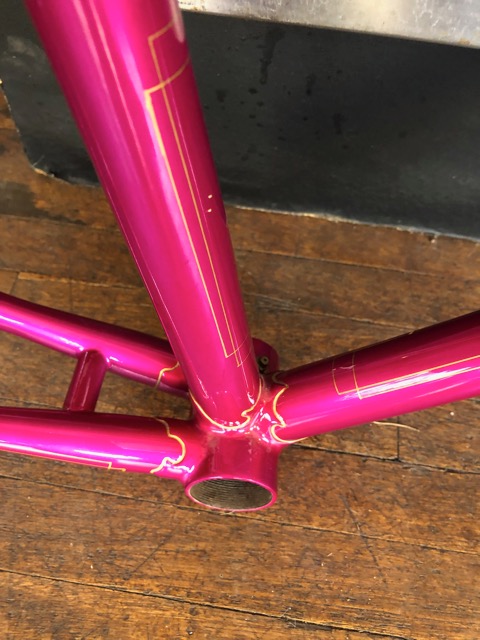
The color combination is pretty spectacular, too. Sort of a flamboyant fuchsia with white contrasts and gold lining.

. . . even has some chrome on the fork crown and "socks."

The shape of these lugs is really cool. It's possible that the shape of the Vincitore lugs (the brand's "fanciest" model since the late '50s or early '60s - and still made today) was partly inspired by these - but it's still a very different look.

A nice look at the seat lug -- notice that it also has some cool "box pin striping"

Even the bottom bracket carries the theme of the other lugs.

Interesting "arched" seat stay bridge - another detail one doesn't usually see on Mercians.

The serial number tells some of the story - 162nd frame built in 1950.

The paint condition is spectacular -- I thought perhaps too nice to be original. Ken confirmed that it was repainted at some point. Another clue pointing to a repaint was the downtube decal lettering which is of the current style, which I believe was introduced in the early '60s. Mercian bikes I've seen from the 1950s usually have a "script" lettering style like this:


It's clearly a really special bike. And it's just one of many special bikes at Ken's shop - which is as much a bike museum as it is a bike shop. I've never been there (never been to Arizona, for that matter) but I'd love to visit the place in person.


A couple pictures of the shop - all from their website.

There are not only tons of gorgeous vintage bikes, but also vintage parts, many photos, posters, and other bike-related nostalgia.

There's the same Mercian, up on the wall.
About ten years ago, Ken's shop was featured on a TV show called Arizona Highways. Here's a link to the video on YouTube. Enjoy!


Thanks, Ken, for sharing your Mercian with the Retrogrouch Blog.