Saturday, June 27, 2020

A New Bike Boom

Been to a bike shop lately?

If you have, you probably noticed a lot of empty racks. If you were actually looking to buy a bike, you may have been told you'd have to place an order and wait indefinitely for a bike to come in. If you needed repairs on a bike you currently own, you may have even found a longer than usual wait to get the job done.
Our local shop had a few rental bikes on the rack, and a handful
of others with "sold" tags on them.

It's uncertain how long the situation will last, but for now, it seems that we might be in the midst of a new "bike boom" - or more specifically - a "COVID19 Bike Boom." What's going on seems to be what one might call a "perfect storm," of increased demand, and reduced supply -- and a lot of it has to do with the reaction to the corona virus, both at home and abroad.

I was talking with the folks at my local bike shop, and what they have been experiencing seems to fit the stories that people are sharing all over the country. More people are buying bikes (along with helmets and other accessories), and others are getting long-neglected bikes road-worthy again. As far as the shortage goes, what the experts are saying is that there are several factors that have led to the supply/demand issue.

First, bike shops (in most states) remained open even as many other businesses were closed. The need for transportation meant that many states declared bicycle shops "essential businesses" - and if you're reading this blog, you probably agreed with that notion.

Second, people have been "cooped up" with little to do - but outdoor exercise has generally been permitted, as long as people try to maintain some "social distancing." Many people have discovered - or re-discovered - bicycling as a great way to get some exercise and enjoyment. The fact that fitness centers were closed (and may still be closed) fits right into that as well.

Third, the supply of new bicycles has been disrupted - first because of economic uncertainty, and second because of the virus. According to bicycle industry insiders, many manufacturers had already reduced their production in the last couple of years because of concerns about the current president's trade war. One source I found said production had been down as much as 25 - 30% even before the virus hit. Remember that China accounts for a huge percentage of the world's current bicycle production. If you factor in Taiwan and Japan into the figure, you'll find that the vast majority of bicycles and components are made somewhere in Asia - regardless of what brand might be on the frame. And Asian countries were among the first to shut down because of the virus - and to take the most serious measures to contain its spread.

The last time we had a drastic increase in demand for bicycles was the bike boom of the early 1970s. In that "American Bike Boom" sales of bicycles jumped from about 7 million in 1970 to 14 million in 1972. And the biggest part of that increase was in adult bicycles which had previously been only a small market segment. The tremendous spike in demand meant that American and European factories could not keep up, which proved to be a major opportunity for Japanese bike and component manufacturers who had been eager to break into the American market. Within a decade, they would dominate the world.

There are a few things that are different this time time around. As mentioned already, most of the world's bicycles are now being made in China and Taiwan. As their factories closed down due to virus concerns, there's really nowhere else that could pick up the slack. Most bike "brands" that we might associate as "American," "British," "European" are now nothing more than names on decals that get stuck on the bikes. So when the Asian factories shut down, nobody else had the production capacity to crank out bikes to meet the demand, and that has meant empty racks in the shops, and a waiting game for new bikes to come in.

Another difference is that in the '70s bike boom, the biggest chunk in sales was in "adult" bicycles -- but especially for lower priced, entry-level "10-speeds." From what I understand from talking to both sales people and buyers is that this time people are buying everything and anything they can get their hands on. If they've got the means, they've even been buying the high-ticket items like bikes with electronic and wireless shifting. While it can be a little harder to track accurately,  I've heard anecdotally that even sales of used bicycles are up. Whatever people can do to satisfy their current itch.

One thing that remains to be seen is how long before things go back to "normal." Demand could remain high as long as there is uncertainty about the virus and there are restrictions on what people can do for exercise and entertainment. I understand that factories in Asia are starting up again, so production should soon start meeting the demand.

Another thing that remains to be seen is how long will all these people who can't wait to get their hands on a new bike stay interested in biking. Not long after the boom of the 1970s, an awful lot of those bikes that were sold ended up collecting dust in basements and garages all over America. One can still find them today at garage sales for bargain prices, or (if you're really lucky) out on the curb on trash day, free for the taking. Will the current buyers be different? Will they keep riding even after everything is reopened and concerns about social distancing are just a memory? Or will the later half of the decade see tons of used bike bargains?

Only time will tell.

Sunday, June 21, 2020

Fathers Day 2020

Today is Fathers Day, and I spent part of it with my kids, part of it with my father, and a good bit of it riding bikes.

Since I planned to spend the bigger part of Sunday with my 80-yr-old father, the RetroKids and I did our traditional Fathers Day bike ride on Saturday. Our usual "go-to" for bike rides is the Ohio & Erie Canal Towpath, but this time we opted for some different scenery. The Towpath is a great biking destination, and very popular - but it isn't the only game in town. We are fortunate enough to also have a very nice trail on a converted rail line, known locally as the "Summit Bike & Hike" trail. The trail follows what was once known as the Akron, Bedford & Cleveland RR (also known as the "ABC Line") which went out of service in the 1930s, and spans the north-east quarter of Summit County, but also continues well into Cuyahoga County to the north, and Portage County to the East. It's a paved trail, well maintained, mostly flat, and a good place to ride with kids.

One of the best spots to stop and explore is Brandywine Falls. The path crosses a bridge directly over the falls, but it's a great place to get off the bikes and follow the boardwalk down into gorge.

The boardwalk path winds down along the rocky ledges, and to a couple of observation decks to see the falls.

My favorite part of the trail is a few miles south of the falls, where it passes through a corridor of steep rocky ledges. The ledges are so tall, covered in mosses and ferns, and it's always noticeably darker and cooler. I don't know if it was a natural formation, or if it was blasted out to make way for the railroad (it appears to be natural - but it's almost too perfect for a rail line to assume some blasting didn't happen). Anyhow, as we ride through that mossy green cathedral, I keep expecting a Hobbit or Golem or some other Tolkien creation to make an appearance.

While passing through the rocky corridor, we stopped for a drink and my daughter happened to park her bike in a perfect little spot of dappled sunshine.

So that was Saturday. For Sunday, my plan was to drive up to my father's (it's about an hour's drive away) and make him dinner. But before making the drive, I got up early for a ride on my own. The forecast was for temperatures in the 90s, but it was still in the upper 60s when I left.

I took the red Mercian, which hasn't been ridden since I finished renovating the Sequoia. The Mercian's shorter wheelbase and slightly thinner tires means it doesn't have quite the ride of the Sequoia, but the handling is "snappier."

I stopped for a photo by the old covered bridge.
By the time I got home (after making the usual long climb out of the valley) it was already noticeably hotter outside, and I was thoroughly drenched in sweat.

That's all for now - to all the fathers out there, Happy Fathers Day.

Tuesday, June 9, 2020

A Better Match

I've been putting a lot of miles on the Sequoia that I finished restoring earlier this spring. The bike has become a new favorite for its superb ride and handling. The frame is well-designed and beautifully built, the 32mm tires handle all kinds of road surfaces, and the gearing (50/36 chainrings, 13/28 freewheel) offers great range and really helps on the long steep climbs out of the Cuyahoga valley.

I also love the way it looks - but there was one thing that kept distracting my eyes. I had wanted to match the bar tape and the saddle, but the match was just a bit off and it was really bugging me! I'll bet a lot of people might not have even noticed, but my eyes were instantly drawn to the difference. Yes, I know - I get obsessive about things like that. I probably need professional help. That doesn't change the fact that I felt like I needed to unwrap the bars and try again.

Re-wrapped bars are a much better match this time.
I have two other bikes with Brooks saddles in the "Antique Brown" color, and my "recipe" for matching the bar tape was to use brown cotton tape with several coats of blonde shellac (it's usually sold as "clear," but "blonde" would be a better description). That gives a nice chocolatey brown color which usually matches well with the brown leather saddle. But whether it is due to the kind of natural variations that can occur in leather, or quality control at the Brooks factory, or whatever, the saddle I selected for the Sequoia has a decidedly "reddish" tone to it. The chocolatey brown just wasn't "right" this time.

Amber and garnet shellac flakes. Grind them in a coffee
grinder and dissolve them with denatured alcohol.
Before undertaking the time to re-wrap the bars, I did some experimenting with different colors of tape and different colors of shellac. The most common colors for shellac are the aforementioned "blonde," as well as "amber" - and those are usually the only colors available at most paint/hardware stores. I checked around the internet and found "garnet" (very dark red) shellac flakes from a place that usually supplies violin-repair shops. I made up a jar of garnet shellac, along with the other two colors I already had. Then I mounted a few short strips of bar tape (brown, yellow, and white - a couple of each) onto some card stock and started applying shellac in different combinations. Though it seemed doubtful at first, it turned out that white tape with garnet shellac gave me the closest match to the saddle. However, it took a lot more coats of shellac to get there.

Here are some progress pics:

This was the white cotton tape with two coats of garnet shellac. It's just a light buff color, and it's hard to believe it will ever be a match for the saddle. My experiment convinced me it would work.
A few more coats, and you can see it's starting to get closer.
It probably took twice as many coats as what I typically use for the desired effect - but it did get there. That also means that the bars have more "shine" than what I usually go for. After a few rides, some of the shine will get knocked down a bit and they should have the soft satiny look of nice tanned leather.

Finished. I think it took about six coats to get this rich reddish brown - and it's a spot-on match to the saddle this time.

Now when I look at the bike, the only thing that's going to catch my eye is how well the bars and saddle go together.

Thanks for indulging my obsession.

Friday, June 5, 2020

Yes, It's Summer

I know - the solstice is still a couple weeks away. But as far as I'm concerned, the first day of summer is today. I've been done with school for about a week now, but my kids still had school (online, but still . . . ) until yesterday. We spent their first official day off the way we often do, weather permitting: with a bike ride.

We packed a lunch and loaded up the bikes and headed to the Ohio & Erie Canal Towpath in the national park. It was hot and humid, but there are lots of shady spots along the path, and a light breeze, so it made for a pleasant ride.

The Retro-kids, leaving the old man behind.
 The mock orange bushes that line the roads and paths all over the park have just blossomed, and their sweet smell is like perfume blowing on every breeze.

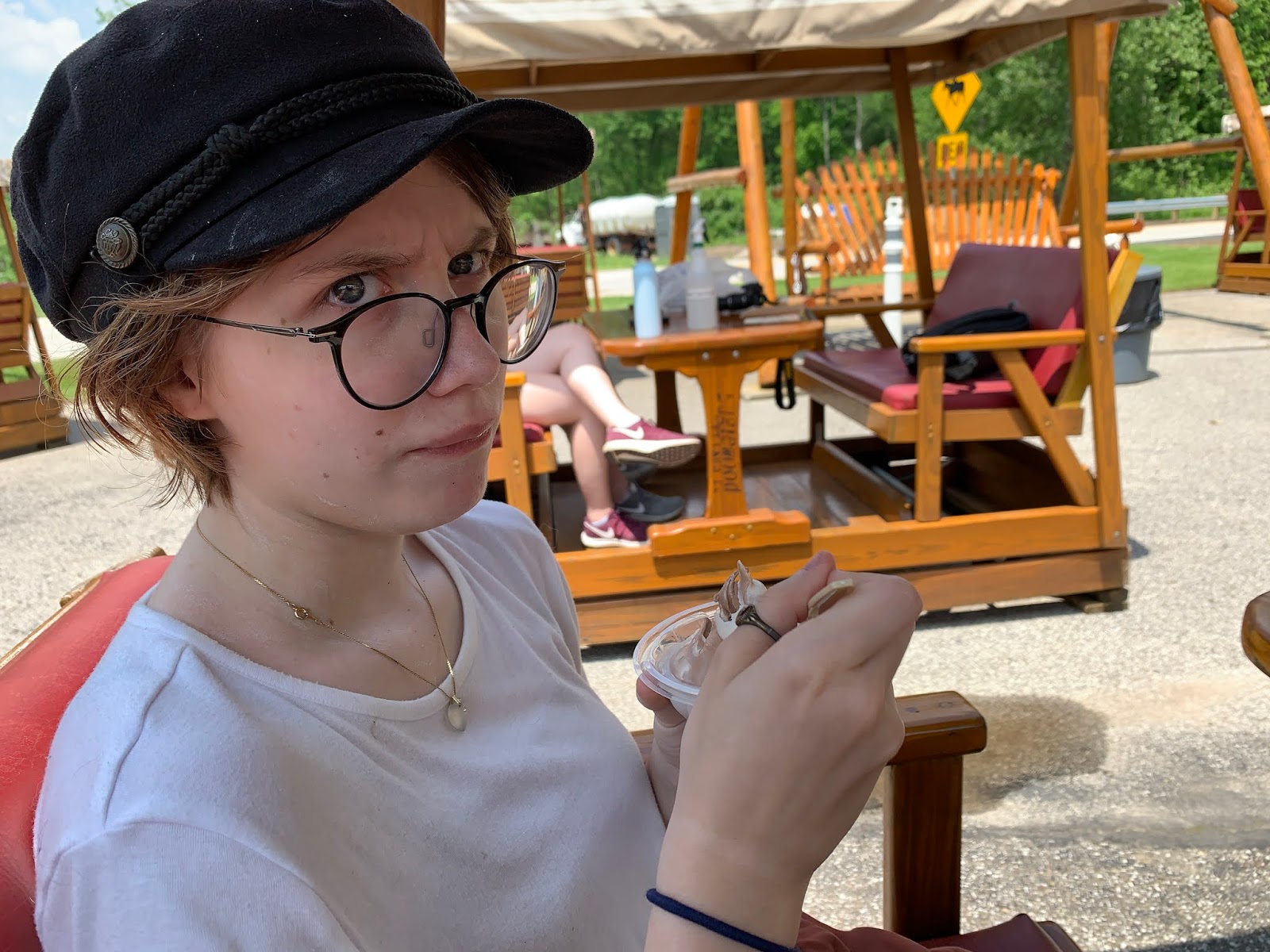
After stopping to eat our lunch under a shady tree, we went to Szlay's Farm Market for ice cream. Today was their opening day - another event that marks the "real" beginning of summer.

"Grumpy" teenager.
"Happy" teenager.


We filled a basket with fresh fruit to take home from the market.
We stopped along the boardwalk over the marsh to get a look at an absolutely huge snapping turtle.
I was trying to get an idea of a measurement on this guy. His head was easily larger than my fist, his shell more than a foot across, and he must have been 2 ½ feet long from nose to tail.
There was something familiar about that scene above. So I looked back and found this picture, taken from the same spot five years ago. What were they looking at? A huge snapping turtle, with head larger than my fist, and a shell more than a foot across. Could it even be the same turtle?!? Holy cow.
I can't get over how much the girls have grown. But our bike rides are still such a big part of our lives together. I don't know how many more of these we'll have before they decide they've got other plans for how to kick off summer break, or they discover boys, or move away . . . Damn, those are sad thoughts. I simply have to make the most of it while I can.

Thursday, June 4, 2020

Retrogrouch Tool Time: The Chain Gang

When it comes to building a collection of bike-specific tools for doing your own maintenance, you'll find it's hard to go for long without having some kind of chain-breaker tool. Almost every bike has a chain - and if you need to remove it (and there is no "master link") there really is no substitute for a proper chain tool. Over the years I've managed to acquire several.

Most chain tools look and function pretty similarly to one another. Most look almost like a miniature vise, with some kind of "cradle" to position the chain links, and a threaded driver and "T" handle with a pin at the end. You position the chain into the cradle, line up the pin to the rivet, turn the "T" handle, and drive the pin through the chain -- pushing out the rivet. To reconnect the chain, you turn it around and use a similar process to drive the rivet back into place.

Let's take a look at a few in my collection:

The "Big Daddy" of chain tools: The VAR 06. Most other chain tools look like toys compared to this thing. I've never tried (and I'm not going to), but I have a feeling this would work on motorcycle chains in addition to bicycle chains. Like most vintage VAR tools, it's built to last a lifetime, and is probably the most "collectable" of chain tools.
This is a vintage SunTour chain tool. It's a pretty nice one with a couple of features that make it unique.


The SunTour tool has this little knurled knob and an adjustable "stop" at one end, opposite the "T" handle. With the stop retracted - or fully "out" - it opens up a recess to accept the chain rivet, and the tool is in chain-breaker mode. With the stop in the other position - fully "inserted" - it acts as a backing plate and prevents the chain rivet from going too far when re-connecting the chain. 
One thing about the SunTour tool is that it's pretty old - dating to the late '70s I believe (judging from the style of the logo and the packaging - which I still have). As nice as it is, like the VAR, it isn't really ideal for the super narrow chains on modern bikes today.

This Park CT-5 is designed to work with more modern chains. The CT-5 is their "compact" version, which I suppose could be packed into a saddlebag and taken along on rides as part of a roadside emergency tool kit. Park makes a much larger "professional" version - but the little compact one works fine for a home mechanic.
So, at one point I lost the little Park tool above, and when I was looking to replace it, I found this one from Topeak:
The Topeak tool is also designed to work on modern chains. And while it's still a lot smaller than a "professional" shop mechanic's tool, it is a little larger than the compact Park one, so it offers a bit more leverage. Interesting addition - that little "c" shaped hook thing is meant to temporarily hold two ends of a chain together, making it easier to get into position and reconnect them with the press. I've used home-made versions of that clip (an old spoke works well for that) - but this one came with the Topeak tool and gets stored in the handle. Nifty.
Shortly after I bought the Topeak tool, I found the Park one again (In case anyone was wondering why I have both).

For the sake of size comparison . . .
And then there's this thing:

A pair of chain-rivet "pliers." I got these in a box of assorted bicycle tools at a garage sale. They're pretty old - I'm guessing 1960s. I have tried them out - and when it comes to removing a chain, they work surprisingly well. A good hard squeeze on the handles, and "boom" - the rivet is out, and the chain is separated. I've tried it for re-connecting the chain, but haven't had as much luck with that. Getting the chain and the rivet positioned exactly right so the pin goes back in properly is just not something I've been able to do (though it IS supposed to work that way). Maybe I should get some old bits of chain and practice.

These were made by Gian Robert - which was maybe better known for making fairly inexpensive derailleurs. There is another tool, the VAR 303, which is almost identical. A lot of old-school bike mechanics have good memories of these.
Most modern chains these days have a master link for easier removal (but you still need a chain breaker if you need to remove a couple of links from a new chain). But sometimes those master links can be tough to separate - and if it's a dirty, greasy chain (which is probably why you'd want to remove it) - it can be even more difficult. So this is a nice one to have:

A simple pliers-type tool, but the jaws are narrow and shaped to get right in between the links in a bike chain. Position those around the ends of the master link, squeeze, and the link can be separated easily.

And before you go putting a used chain back on the bike, it's a good idea to make sure it isn't worn or "stretched." There are lots of different chain gauge tools out there - and some people just use a ruler.  Here what I use:
The Park chain checker. It can tell you pretty quickly if a chain is "passa" or "non passa." It's a good thing to keep in the tool box. 
By the way, I can't help but mention that chains don't actually "stretch." The fact that an old chain will be longer than a new one is the result of microscopic wear in the chain's rollers, pins, bushings, etc., multiplied by the number of "links" in that chain (Saint Sheldon has a pretty good article on that). Just sayin'.

Thursday, May 28, 2020

Retrogrouch Tool Time: Tire Jacks

Ever had that moment when putting a new tire onto a rim, and after you work the tire onto the rim all the way round, you get to the last couple inches, and no matter how hard you try, you can't get those last couple of inches of tire bead over the lip of the rim?

When that happens you want a tool known as a "Tire Jack."

Chances are, most cyclists have encountered a difficult-to-mount tire at some point or other. It's hard to pinpoint exactly why it happens. Sometimes it's the tire, sometimes it's the rim, and sometimes it's just the wrong combination of tire AND rim. Some brands or models of tires just seem to fit extra tight no matter what rims they're tried on. And one occasionally finds rims that, for whatever reason, will present a problem with any tire (a little larger in diameter than spec?). In any case, a tire jack is the tool that will safely coax those last inches of tire bead over the rim.

I've seen a couple different brands/models of tire jacks out there, but the most common one is sold by Kool-Stop, like this one here:

Interesting thing - the Kool-Stop name appears nowhere on the tool - but the name "Simson" is molded into the handle. I can only assume that is who actually manufactures the tool for Kool-Stop.

It's a simple tool that lets you apply a good deal of leverage. There is a stationary arm that ends in a "Y" shape, and a hinged arm with a hook at the end. The "Y" part braces against the rim on one side of the tire, while the "hook" part is placed under the bead on the other side, then you use the leverage of the long handle to pry the bead over the lip of the rim.
Like this:

And this:

I've had some frighteningly tight tire/rim combinations, but I've never had a tire that was so tight that I couldn't coax it onto the rim with this tool.

The Kool-Stop is a good tool to keep in the toolbox or workshop. But if you're out on the road and need to change a tire (and you know from experience it's going to be a challenge to mount), then there is a great "mini" version made by VAR that fits in the palm of your hand and can be packed easily in a saddlebag.

The VAR tire tool is pretty brilliant - consisting of a pair of tire levers for removing a tire, and a mini-version of a tire jack for getting it back on. The levers are maybe a bit too flexible to be ideal for removing a really stubborn tire, which I find to be true of most plastic levers. But the jack can be helpful in saving your thumbs when re-mounting the tire out on the road. As good as the full-size jack? Well, no -- it's only a fraction of the size, and a lot less leverage -- but it does make a difference. I have a couple of them stashed in saddlebags on different bikes.
One of the tire levers is stored in the center of the tool. As far as I know, VAR still makes these, but if you find them for sale today, expect the current production ones to be blue, not gray.
Both tools are pretty reasonably priced. The full-sized Kool-Stop tool sells for somewhere in the neighborhood of $15, and the travel-size VAR tool sells for anywhere from $10 - $20 depending on the seller, and where they're located - but it's probably the least expensive tool you'll ever get from VAR. Considering that many bike-specific tools can be awfully "spendy," these ones are a good addition to the tool collection, even if you're on a budget.

Monday, May 25, 2020

Memorial Day Ride - and RIP John Forester

I got out for a nice Memorial Day ride this morning. Our weather is sunny and unseasonably warm. I left early while it was still reasonably cool, hoping to beat the heat, but by the mid-point of my ride it must have already been nearing 80 degrees with high humidity.

I stopped for a photo near this little cottage in the national park. I'm not sure of the history of this place, but it has been vacant for as long as I can remember, and is (I believe) currently owned by the park service. They own a lot of the old houses in the park - some are used as offices, and a few are leased out to various groups, but not this one, apparently. It reminds me a bit of the cottage-style motels that used to dot the highways, but I don't think that's what this was. It's like a tiny duplex, in the midst of what used to be mostly farm land, so I wonder if it might have been lodging for seasonal farm workers for one of the local farms. Who knows? Cute little place, though - and a good spot for a bike photo.
The other thing I wanted to write about today was that I recently learned of the death of John Forester, whom many consider one of the "founders" of the modern bike advocacy movement, and the riding philosophy generally known as "vehicular cycling." I'm actually a bit late on this, as he died over a month ago on April 14 at age 90.

Forester was born in England in 1929, the son of Cecil Scott "C.S." Forester - author of such noted novels as the Horatio Hornblower series, and The African Queen (adapted into a classic film starring Humphrey Bogart and Katherine Hepburn). He moved with his family to California when he was 10 years old, and he would later take on American citizenship. He graduated from Berkely in the 1950s and had a stint in the U.S. Navy. He was a lifelong cyclist.

Living in the Palo Alto area in the 1970s, he famously received a ticket for riding in the street, and refusing to ride in the recently created bike-way. He fought the ordinance that mandated cyclists to use the bike-way and won. Many people cite that action as the beginning of a movement. He would go on to write numerous articles for cycling magazines, and became very involved in the fight against the Consumer Product Safety Commission's (CPSC) safety regulations on bicycles, which he believed were poorly written and conceived - and failed to distinguish adult bicycles from children's toys.

I have the 6th edition.
Forester should well be remembered for his book Effective Cycling which has been through 7 editions since it was first published in the 1970s. Though some people today may argue against some of his methodology, I believe his advice on sharing the road with motor vehicles - with the same rights, and responsibilities as motorists - is generally sound, and it is advice that I have long followed.

He was a controversial character in the bike advocacy movement, frequently ruffling feathers and clashing with other prominent advocates, in part because he was a staunch opponent of bike lanes and bicycle-specific infrastructure. That was a point that many modern advocates clashed with him on, and I'm sure there are some who believe that, if not for Forester, every city in the U.S. would be like Amsterdam. As for myself, I'm highly skeptical of such claims, and assume them to be grossly exaggerated. Personally, I tend to disagree with "all or nothing" approaches to anything, regardless of which side of an issue people are on, but in order to understand the reasoning behind Forester's stance, it's important to know that in his experience, and from his point of view, most bike lanes were poorly designed by people who did not ride or understand the needs of cyclists, and the efforts were typically undertaken NOT to help cyclists, but rather, to restrict them and keep them off the roads. People often described him as "inflexible" - but I think it helps to know where he was coming from.

Whether people agreed or disagreed with him, I think a lot of us owe some gratitude to Forester. Rest in peace, sir.