Tuesday, November 17, 2015

Bike Commuting Highs and Lows

Almost two years ago, I posted about a recurring incident that would happen on my morning ride to work (Share the Road?). There was this woman who would come up behind me in her car and blast her horn at me, startling me completely, then she'd pass me in the wide-open left lane, laying on her horn the whole way past. There was no reason whatsoever for her actions -- there was no traffic. She'd have the whole road to pass without having to wait or slow down at all. It was obvious that her horn was her way of telling me that, as far as she was concerned, I have no right to be there.

For two years I've been trying to catch this lady. I could never get her license plate. I could never notice her coming until it was too late. The traffic lights were never in my favor that I could catch her. But last week, it finally happened. Last week, as I was riding along, she came up behind me as usual, honking her horn -- but this time she did it when she was less than a half-mile from where she works. I could see clearly where she pulled into the parking lot.

Oh My God, I've Got Her! I said out loud to nobody who could hear me.

My heart pumping and my legs racing, I pulled into the same parking lot. My eyes were scanning for her car. I saw her on the other end of the lot, heading for a parking spot, and I cut across the lot so that I pulled up to her just as she was pulling to a stop.

It's hard to sound calm and relaxed when you're half out of breath and your blood is pumping not just from exertion but anger. As she sat in her car with the windows closed, I yelled at her, "Lady - you've got no business honking at me! I have the same right to the road you do. If you want to go by me, then just go around!" I think I might also have told her where she could shove her horn.

She rolled down her window. "Can I speak now?" she asked.

She then went on to say "I should not have to slow down to a crawl to get by you. You don't have the right to slow down traffic."

Complete B.S.

I went on to point out that I was on the far right side of the road, and that she had the full left lane and most of the right lane to use for passing - That there was no traffic - That she didn't have to slow down even a second to get by me - as evidenced by the fact that she used the left lane to pass me even as she was blowing her horn. On the other hand, I did not point out that my bike was probably worth more than her piece-of-crap car, even though that's probably also true.

She stuck to her excuse that she shouldn't have to slow down for a bicyclist. I told her she has to slow down for other traffic all the time -- cars slowing down to turn, school buses stopping to pick-up/drop-off kids, etc. etc. I told her she probably didn't sit behind those school buses blowing her horn.

She said she only honked at me two times. I told her that it was "only" two times this month (absolutely true), but I'd been watching for her for the past two years. I told her I considered her actions to be harassment and intimidation, then I took a picture of her license plate and told her I'd be reporting her to the police - then went back on my way to work feeling totally pumped.

Yes, I called the police later that day. Just as I'd suspected, they told me that there's nothing they can do unless an officer witnesses it. Yeah -- that'll happen. Granted, I knew they weren't going to write her a ticket or anything based on my say-so, but I hoped they might at least send her a letter to notify that a complaint had been registered against her. No dice.

Doesn't matter though. I have a feeling that just being confronted, and knowing that I now know where she works, I think she's re-thinking her actions. I've actually seen her twice since then, and she hasn't made a sound. Yesterday, she was stopped next to me at a light (why didn't that ever happen before?!) and I swear I thought she was going to blow off the light just so she could get away from me. She didn't do that, but did take off in a hurry when the light turned green, though.

On A Different Note:

Also yesterday on that morning commute, I had a very different encounter.

As I stopped for another traffic light, a car pulled next to me, and the window buzzed down. I braced myself for another dose of verbal abuse.

"Excuse me," said a little grand-motherly lady, "are you riding your bike to work?"

I told her I was.

"Well God bless 'ya," she said, "is it very far?"

About 13 miles, I said.

"Well God bless 'ya," she repeated. Then the light changed and she waved as she drove off.

Damn. Why can't they all be like that?

Thursday, November 12, 2015

Huffy Goes Plus Size

As I posted last month, some people are calling "Plus-Size" the latest and greatest thing to hit mountain bikes. But in a sign that either confirms that to be true, or possibly heralds that the trend has already peaked and will start trailing off soon, one can now buy plus size mountain bikes at WalMart and other big-box retailers. Yep - Huffy now makes plus size. Huffy 3.0.

The Torch 3.0 is the basic model 29+, selling for $199.99
Huffy seems to have totally embraced plus-size bikes, too, in offering 4 different models in 3 wheel sizes - 26-in., 27.5, and two 29-in. models. I suppose that offering the bikes in 3 different wheel sizes is supposed to make up for the fact that they apparently don't offer different frames sizes. Instead, they seem to be "one size fits most" and the concept of proper bike fit must not be a priority.

The 26+ model, the Tyrant, is $179.99, and the 27.5+ Vantage is $189.99. Two versions of the 29+ sell for $199.99, with a disc-brake-equipped "top-of-the-line" model selling for $249.

Just like department-store fatbikes, it's practically a given that most of the Huffy 3.0 bikes that get sold will be ridden primarily on pavement, where their mid-fat tires will be more or less unnecessary. Still, that doesn't stop them from proclaiming the benefits of  "better traction," "more momentum" and "less exertion."

The 29+ Warhawk is the "top-of the line" at $249.00. Disc brakes and a slightly "hydroformed" frame seem to be the main "upgrades" over the lesser model. All the models appear to have the same, spindly, crappy-looking "suspension" fork.
To announce the new "3.0" line, Huffy put out a new commercial with the very strange tagline "Be the Motor."

In the video we find this guy. . .


. . . on this bike . . .


. . . zipping around this "rugged" terrain . . .


. . . in some kind of post-industrial wasteland:


Most of what the guy rides on could easily be handled with a decent road bike with some tire clearance -- like on this path that under most definitions would be described as "paved":

Good thing he's got those fat 3-in. tires.
But he does encounter a stray rock:

Any rider who wasn't filming a commercial for a "rugged" new mountain bike would just go around it.
Oh -- and there's a gratuitously-placed small pile of loose dirt:


Some unexplained elements include this small man-made "brush fire". . .


. . . And the weird motorcycle engine sound effects throughout the video:

"Vroom - Vroom" -- How old is this guy supposed to be? Six?
Yeah - that "explains" the sound effects -- but the concept still doesn't make a lot of sense.
Does the arrival of department store plus-size bikes mean that the new trend has fully caught on? Or is it about to jump the shark?


You can watch the Huffy 3.0 commercial right here:


Enjoy!

Wednesday, November 11, 2015

Photo Essay on Richard Sachs

It's probably no secret that American framebuilding master Richard Sachs no longer takes orders for new bicycle frames. The wait list is already long enough that the man has all the work he needs for well into the foreseeable future. And the price for one of his superb frames is enough to make it an enviable commodity -- though still priced less than many of the popped-out-of-a-mold carbon fiber wünderbikes that get so much attention today.

Photo used with permission by Nick Czerula.
Click on the photo for a link to the full collection.
I recently saw a very cool photo essay of Sachs at work in his Connecticut workshop by New Hampshire photographer, Nick Czerula. Czerula spent more than a year with Sachs, as a "fly on the wall," or following him along cyclocross race courses - capturing the man at work and at rest, at play and at competition. The photos were originally released as a book, Richard Sachs - Bicycle Maker, in 2012, though that book is currently out of print and hard to find (someone's currently offering a used copy for sale on Amazon for $2,904 plus shipping. Holy cow).

The book has been released for a limited time in a free online version through Adobe Slate - which makes for an interesting, dynamic viewing experience.

Czerula's collection contains very few words - only a minimum of captions or comments. Instead, he lets his crisp black and white photography tell the story of one of the most iconic of American framebuilders. One can scroll through the photos, and follow the process of building a frame - starting with lug preparation, and tube mitering, and up through brazing it all together. Something that is very striking, and is mentioned as one of the few captions, is that apart from a drill and a belt sander, Sachs uses virtually no power tools in his shop. Hand saws and files carry out the majority of his work. But there are also plenty of "stolen moment" shots of the man very much at ease with himself. Some shots capture the quirks and his humor, while other shots show him as a tough competitor on the cyclocross course.

The Richard Sachs - Bicycle Maker collection will be available free for a "limited time" on the Adobe Slate site, though I don't know how long that "limited time" is, so I recommend checking it out sooner rather than later.

And to see more of Czerula's work (a lot of which is bicycle-related), check out his website, facebook, instagram, or twitter.

Monday, November 9, 2015

The Latest Solution to Creaking Press-Fit Bottom Brackets Is . . .

. . . A THREADED BOTTOM BRACKET.

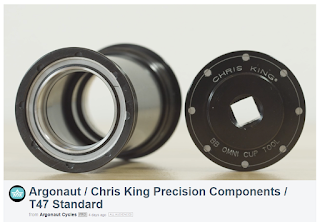
No kidding. The bike industry is all abuzz with the release of another new bottom bracket standard -- one that may actually solve the issues of sloppy-fitting, creaking press-fit bottom brackets for good. And it comes in the form of a threaded bottom bracket.

Eureka! Why didn't anyone ever think of this before?!

Oh yeah -- I did, though I couldn't possibly have been the only one. I even came up with a catchy trademark-able name for mine: ThreadTech.

The new standard, created jointly by Chris King and Argonaut Cycles, is called T47 (that name represents "threaded - 47mm") although Chris King is calling their product "Thread Fit 30i." It utilizes a bottom bracket shell that is the same basic dimension as a PF30, except that the shell's interface is threaded. Interesting note -- if an existing PF30 shell is made of steel or aluminum, it could theoretically be threaded to accept the new T47 standard. Different cups could easily be machined to fit the T47 shell to accommodate different BB spindle sizes, such as 24mm or 30mm. Thicker or thinner cups could also allow for different spindle lengths, adding to the compatibility with most of today's crank and bottom bracket systems.


According to Ben Farver of Argonaut, the PF30 system is a popular one that offers good crank compatibility, but tolerance variations between different manufacturers lead to the well-publicized problems that the press-fit systems encounter. Probably inspired by some of the threaded retro-fit systems that have been coming out lately as solutions to press-fit creaking, Farver could see the benefits of a threaded system, like the traditional British-threaded BB (or BSA). But from the standpoint of modern bicycle manufacturers, the smaller diameter of that system has its own drawbacks. "The traditional threaded BSA is great from a durability standpoint, but it limits a customer's crank options," said Farver in a promotional video. "As a frame manufacturer, I don't want to have to talk someone into buying one of my bikes while at the same time talking them out of a crank they might want to use."

Basically, the idea of the T47 is that it combines the reliable interface of traditional threaded bottom brackets with the larger diameter proportions that have become so much more popular in the industry today. Farver said, "I called Jay Sycip, who runs the Cielo arm of Chris King, and we discussed the true consumer benefit of creating a threaded spec that leverages the larger bearing used in the PF30. We agreed that it would yield a much higher interface success rate, and more importantly, a better ride. So this project is an attempt to solve a problem the entire bike industry is suffering from, and lead the way to a better, lasting standard."

It's nice to point out that the T47 is an "open standard" - which means that anyone can use it freely. That speaks well to the possibility that it could be adopted widely around the industry, and restore some meaning to that currently meaningless word "standard."

One could almost get optimistic with a turn of events like this. Then again, it's always possible someone else will come out with a competing standard and consumers will have to sort out which one will last and which will turn out to be another Betamax. This is the bicycle industry we're talking about here, after all.

Nevertheless, I'm going to put my hopes in the "optimistic" side for a change, even if it means that I would eventually run out of things to grouch about.

Friday, November 6, 2015

Resurgence of Steel Frame Bikes?

Ever check out Gear Patrol? I usually don't, as it is a website/online magazine that's mostly aimed at an economic demographic that pretty much eats people like me for lunch.

But the other day, it was called to my attention that I should check out the site. And there, amid articles about hyper-expensive exotic cars and motorcycles, expedition watches, and brandy -- all priced for the top 1% -- I saw this article about steel bicycles:


The bicycle pictured at the top of the article was built by Chris Bishop, who is one of a new generation of very talented framebuilders working today. Though the bike shown has some very non-retrogrouchy features (electronic shifting, disc brakes, and a straight fork), it's an awfully nice bike -- and it's lovingly built in steel.

The GP article quotes Bradley Woehl, the owner of American Cyclery in San Francisco, as well as former racer Andy Hampsten, who now heads Hampsten Cycles, which offers most of their models in steel (though generally designed and built for non-retrogrouches). The article talks about how steel was displaced, briefly, by aluminum in the '90s, then carbon fiber started taking over by the end of that decade. OK - nothing most of us don't already know. What's cool is to see an article about latest and greatest trends saying something like this:

"But where these newer materials excel at traits necessary for speed in racing like lightness and stiffness, they have major shortcomings in characteristics important for everyday riders, like comfort, toughness, and cost-effectiveness."

American Cyclery's Woehl adds, "When aluminum came along, it was lighter and stiffer than steel, which, if you're a good hill climber, you need that out of your bike. If you're just riding to work, the coffee shop, or even a bike tour down the coast, not so much."

The article describes a perceived shift in priorities that may be leading to renewed interest in steel as a building material. "Utilitarian bikes for everyday riding and bike touring; high-end custom frames from big-name bike builders; and even classic bike races that mix romanticism with reality. This shift of the gears has been a good one for cycling. Bike commuting has increased by 46 percent in America since 2005, and as that boom continues today, steel's influence on cycling's identity is rising."

Some other excerpts that might resonate with Retrogrouch readers:

"The steel bike rides better, it lasts longer, it ages more gracefully, and it's a more practical thing," Woehl says. . . "They're heavier than aluminum and carbon fiber" but "the extra weight of steel versus aluminum or carbon fiber isn't a deal breaker for most amateur riders who, unlike pro racers, don't need to shed every possible ounce of weight in order to keep up with the peloton. And unlike carbon fiber bikes, steel frames are being custom made around the country without reaching astronomical price tags."

That last part can be true, though it's also just as true that one can easily spend just as much on a custom-built steel frame as they would on a carbon fiber one. Though some of us would argue that they'd be getting much more bike for their money.

There are some elements in the article that I believe are a bit over-simplified. For one, there was this quote: "An aluminum bike has a really harsh ride quality -- it's stiff and unforgiving. Every little pebble you run over in an aluminum bike, you feel that bump."  Such a statement can often be supported by looking at most of the aluminum bikes that have been on the market over the years - built with over-sized tubing to compensate (usually over-compensate) for that material's lack of stiffness as compared to steel. But the harsh ride quality is more a product of design and construction than it is of the material itself. I've ridden some old Vitus aluminum frames with their 1-in. to 1 1/8-in. diameter tubes and found them to be quite comfy. Granted, I still greatly prefer steel as a frame material, but it's important to understand the differences.

The sidebar titled "What to Look For," is similarly simplified. I guess the gear-heads who worship the latest equipment are only expected to be able to afford it, not fully understand it.

"Steel is versatile, strong and relatively affordable -- but its popularity has also spawned shoddy versions not worth their cost. . . Start by checking the grade of the steel . . . Chromoly is a safe bet, as is higher-grade steel like Reynolds 853. . . Classic steel frames and higher-end models often use lugged construction or fillet brazing, both of which are beautiful but expensive. The more modern construction uses stronger TIG weld, which works just fine."

Reynolds 853 is a "safe bet"? That's pretty high-end stuff -- and not likely found on junk frames. And regular readers of this blog know how much I love lugged construction, but there are some relatively inexpensive lugged frames built in automated factories these days. It's true, I don't know of many (or any) inexpensive fillet-brazed frames. What about TIG welding? Is it really stronger? All three construction methods, if done right, will result in frame joints that are stronger than the steel tubing itself, so a statement like that could really use some clarification. TIG welding is a lot more common these days, too -- but it isn't necessarily any less expensive. Most low-cost mass-produced steel frames are TIG welded today, but a lot of super expensive high-end and custom-built frames are welded, too.

With so much hype about the latest carbon fiber wűnderbikes, and pushing the envelope in search of the lightest and fastest bike possible, it's almost a shock to see an article like this one extolling the virtues of a steel bike as though it might be the latest thing. But no doubt, if a person is looking for a bike to be a long-time riding companion, and want a bike that is more versatile - capable of more than just go-fast racer-wannabe riding - then chances are, that person is going to get the most bike for the money in steel. It's just surprising to see others coming around to that.

Wednesday, November 4, 2015

Classic Components: 2 Bolt Seat Posts

People don't often give a lot of thought to the basic seat post. Until they have one that doesn't stay put, that is. Or maybe the problem is that it's impossible to get the position "just right."

The Nuovo Record seat post is the perfect mount for
a Brooks leather saddle.
When it comes to seatposts, my favorites have long been the 2-bolt designs -- exemplified by the classic Campagnolo Nuovo Record, made from the 1960s through the mid-'80s. Campy also made a Gran Sport seatpost of the same basic design in the 1970s that looked almost identical (actually, they were so similar that I don't think I could reliably tell the difference between them). Particularly rare is the original version of the Record seat post from the 1950s -- which looked pretty similar to the later ones, but was made of steel, not aluminum.

The great thing about the 2-bolt design is that it allows infinitely small adjustments for saddle angle, while holding the saddle firmly in place, requiring less tension per bolt. Once adjusted, they do not move. Another benefit to the 2-bolt design is that one can make tiny adjustments to the saddle angle or the fore-aft position independently. That is, one can easily alter the tilt of the saddle without moving it forward or backward on the rails. Or move the saddle forward on the rails without affecting the angle. That isn't easily done with a single bolt post.

The big complaint people would have with the NR seat post was that it was a pain to set up. Its two bolts for tightening and adjusting were only accessible from above the cradle -- under the top of the saddle, which meant trying to get a wrench into the awkward and tiny spaces between the saddle rails and the side skirts. OK, in retrospect, it could have been thought out a little better. Maybe a lot better.

Campagnolo did make a special offset wrench for the task:

The classic Campy seat post wrench -- angled to get up under the saddle to reach the bolts. As an added bonus, the open-end was just the right size for adjusting the tension bolt on Brooks saddles.

Park Tool used to make their own version of the Campy seat post wrench that was a little easier to use -- especially with plastic saddles. Instead of gripping the bolt heads on their six sides, it gripped the bolts at the corners, which gave the user a lot more "angles" to work with, which was helpful when trying to work in the tiny space under a saddle. It worked great as long as the bolts didn't get rounded. I have one, but they're long out of production and very hard to find today.
Racing leather saddles - like the Brooks Swift (shown)
or the Swallow make adjustment a bit easier. Wide touring
models aren't bad, either.
Another thing about the Campy 2-bolt seat posts is that, in my experience, they are easier to set up with leather saddles -- especially those racing models with more cut-away sides. The side skirts on all-leather saddles tend to be a little more flexible than plastic, so its easier to get up under them with the wrench. I've found that plastic saddles, like the old Cinelli Unicanitor, or an '80s-vintage saddle like a Selle Italia Turbo, are tougher to adjust. The side skirts just don't have as much "give" to allow the wrench some room to work. For those, I think the Park Tool wrench shown above is a big help.

Campagnolo's first single-bolt seat post, the Super Record, also had to be adjusted from the top, so the bolt was nearly as difficult to access -- and it had the distinction of requiring arm-breaking tension to get the saddle to stay put. Even then, it might still end up slipping. At least that was my experience with them. I'd get the saddle position and angle where I'd want it, and torque the hell out of the bolt. Out on the road, by the end of a ride, the saddle would be pointing at the sky. For that reason, I've got a couple of bikes with full Super Record components throughout, with the exception of the Nuovo Record seat post. Yes, it takes longer to set up. But once it's set, you can forget about it.

In the '70s and '80s, there were some direct copies available.
This Sakae Ringyo, or SR, seat post from Japan is a very faithful copy of the Campy design. Not that I've tried, but I wouldn't be surprised if the parts were directly interchangeable. Sugino made one too, that I believe was very popular with the Japanese Keirin racing circuit. Vintage ones, sometimes NOS, can be found regularly on eBay. 
Today, if there is a "spiritual descendent" of the Campy 2-bolt seat post, I'd have to say it is this one, made by Nitto:

Nitto calls this model the Jaguar, but Rivendell fans probably know it as "the Frog" because the clamping parts, when viewed from the side (without a saddle mounted) kind of look like a smiling frog. So that's what they always called it in their catalogs. Whatever name people prefer to call it, the Nitto has similar dimensions and set-back as the old Nuovo Record, and it is sumptuously finished. But the real benefit of the Nitto design is that it adjusts with an allen wrench from below the cradle. What a concept. Superior clamping, nearly infinite adjustability for angle, and easy setup. There's also another model from Nitto called the S-83 which is very similar in design and I believe slightly less expensive.
On one of my bikes, I decided to give this post a try, from Velo-Orange:

The VO Grand Cru seat post has a good amount of set-back, is nicely finished, and adjusts easily from below the cradle. There is a newer version that has slightly more setback, though personally I prefer the look of this original version. At $55, the VO is a nice value. (photo from VO) 
I don't suppose there's anything wrong with a well-designed, well-made single-bolt seat post. But when a simple component works as well as the ones shown here, it's hard for me not to be drawn to them.

No retro-grouching today. Just a little look at stuff I like.

Tuesday, November 3, 2015

Viks Carbon

Back in April of this year, I commented on an article from BBC Autos that looked at the supposed "10 Most Beautiful Bicycles."  I think an important qualification should be that they were the 10 most beautiful bicycles in the eyes of a bunch of automotive editors.

One of the bikes included on that list was this one - the Viks Urban Cycle (all photos from Viks):

 Here's what I had to say about it at the time: "Designed by Estonia's Velonia studio, the Viks is best described as industrial minimalist -- right down to its seat-tube-less frame design. Its shape is formed out of two large steel tubes that join together at the head tube. Given the extra wheel-following curve at the "down-tube," it seems like they've more than made up for whatever weight they lost with the lack of a seat tube -- while further reducing structural integrity at the same time. According to the designers, brakes would be very tricky to fit. In other words, this is better suited for hanging on the wall than actually riding."
Incidentally, I've often wondered why so many "futuristic" design-school re-imaginings of the bicycle leave out the seat tube - as if that one structural detail is somehow holding everyone back.

Well, the Viks is apparently still rolling, and I recently saw that they've released some new models that keep most of its unusual design aesthetic, while still retaining its lack of useful features. Like brakes.

Brakes? We don't need no stinkin' brakes.

For the company's first anniversary (or anniloversary, as they called it) they showed we don't need no stinkin' seatstays, either:

Apparently not for production, the company says that the bike shares most of the geometry, etc., from the original Viks, with the exception of the "invisible seat stays." Invisible seat stays? So that's what they're calling them. And the bike uses thicker frame tubes to compensate for the lack of both a seat tube and seat stays. "The frame flexes only to an extent of making the ride even more comfortable over small bumps and potholes." Yes, it probably does that -- at the expense of structural integrity. Keep in mind that these guys are designers, not engineers.
Looking at the original Viks design, one could probably have guessed that, despite the lack of a seat tube and other amenities, the bike would probably still weigh quite a bit. In fact, even the bike's designers at Velonia studios apparently described the weight as "an unimaginable amount." I don't know - I can imagine quite a bit.

But to answer the weight critics, the company has recently announced a new model for their "2nd Anniloversary:" The Viks Carbon. It is said that with its carbon fiber tubes (joined by stainless steel connecting joints) and carbon aerospoke wheels, the new version drops about 3 kilos, or over 6 pounds as compared to the regular version. Apparently, it still weighs about 22 lbs complete, though.

Now it's even more about style over substance. Carbon-style.
Browsing through the Viks website, I also saw this little styling exercise:
No - that's not really wood. It's only painted with a (fairly real-looking) faux wood grain. I know that wooden bikes seem to be all the rage these days, but the point of a faux wooden bike eludes me.
For people who want to look really good while sipping espresso, while their impractical style machine leans on the wall next to them, I guess the Viks is the way to go. Either that, or hanging it on the wall - I can't imagine much else a person would do with it.