Tuesday, January 21, 2020

Gathering Parts - Wheels and Tires

With my Specialized Sequoia frame off at the painters, I'm taking time to go through my parts for the build. My next few posts will be dedicated to that subject, and it seems to me that wheels are a good place to start.

I found a set of complete vintage wheels that seemed like they'd be the perfect match for my project - '80s vintage SunTour Cyclone hubs with Araya 700c rims and stainless spokes (32 front and rear). They were used, but appeared to be in good condition: the hub bearings felt perfect and smooth, the rims appeared to be in excellent condition, and the wheels ran true. The hubs looked a bit dull/tarnished - but with a bit of elbow grease, I was able to make them look suitable for a freshly restored frame.

I suspect these wheels were original equipment on a pretty nice complete bike from the period. Telltale signs: plastic "pie plate" spoke protector under the freewheel, and CPSC-mandated plastic reflectors attached to the spokes. Obviously those items are now in the trash.

The Cyclone sealed bearing hubs were very similar to hubs sold with the Specialized brand in the '80s - and both brands were made by Sansin. As usual, the screen-printed labels were a bit scratched up. The rear one doesn't look too bad, but the one on the front hub was unreadable, so I removed what was left of it when I did my polishing.
The SunTour quick release levers looked about perfect when I got the wheels.
The Araya rims appear to have an anodized finish, with double eyelets at the spokes (a nice touch) and look great. They would have been a popular rim on many higher-end Japanese-built bikes in the '80s.

My first instinct for tires was the Panaracer Pasela - a great all-around road tire at a great price. But then I found a good price on a pair of Panaracer Gravel King tires, which made them only a few dollars more per tire. The Gravel Kings have a slightly more supple casing, and a fine file tread. Haven't tried them yet, but my first observation is that they were a little harder to get mounted. I had to get out the Kool Stop tire jack to get the last couple inches of bead over the rim. That sort of thing sometimes makes me a little nervous, as I worry about what happens if I get a flat out on the road. I have a small VAR tools tire jack that's packable, so I'll have to remember to keep that handy just in case. Otherwise, they mounted up straight and even all the way around - like all the Panaracer-made tires I've used.
Stay tuned for more. . .

Monday, January 13, 2020

Old is Good: Specialized Sequoia

Back in the early '80s when I was first catching the bike bug, Specialized was likewise just starting to expand from tires and other bike components to frames and complete bikes. Their Allez and Sequoia models were the first offerings, soon followed by the Stumpjumper mountain bike, and the Expedition grand tourer. With well-designed frames and top-notch Japanese construction, their early bikes were lustworthy - and to a lot of retrogrouches, they still are.

I have had one of the early Stumpjumpers for a while now. It has become my kid-and-grocery hauler. For a lot of years, that was the bike to which I'd attach the Burley or the Trail-a-Bike kid trailers (sometimes both simultaneously). Nowadays I hook up an old Burley that I converted into a flatbed cargo trailer and haul groceries. Those early Stumpies have some cool build details, like lugged frame, fastback seat stay cluster, and a cool twin-plate "bi-plane" fork crown. I had mine powder coated in "Kawasaki green" and "updated" it with mustache bars and slightly more modern components ('90s instead of '80s).

A few years ago, I restored an '83 Expedition. That one is a real beauty, and one of the best long-haul touring bikes of its time (or any time?). I kept consistent with what was original, and made some reasonable updates and upgrades to the components, using '80s vintage Specialized components wherever possible - like crank, pedals, seat post, etc.. I also took advantage of the fact that the frame was wired from the factory for a bottom bracket generator, and installed the generator and a headlight for some on-demand lighting.

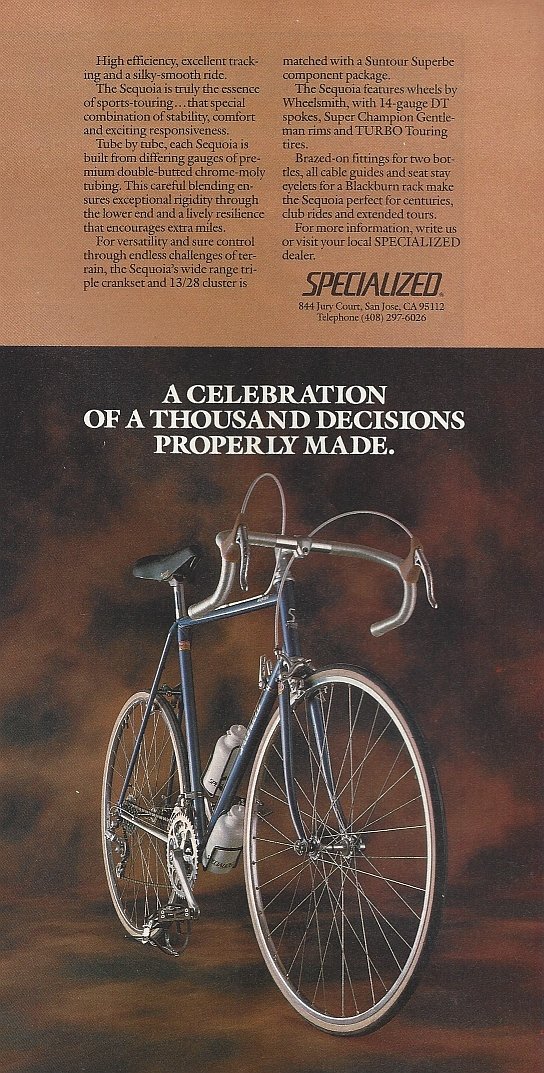
An ad from 1982
Always interested in "completing a set" of the early Specialized bikes, I've long had my eye open for the early generation Allez and Sequoia models. It wasn't long ago I got outbid on a 1st-gen Allez, designed by Tim Neenan (currently of Lighthouse Cycles) and possibly built by Yoshi Konno (of 3Rensho fame). I would have had to see it up close (or have had some better pictures) to say for sure if it was a Konno-built Allez, but I was interested in it regardless. Ultimately it didn't matter, as I hadn't bid enough to win it anyhow.

Recently I found the other bike I'd been looking for. A decent '82 Sequoia frame came up in my size for a price I could live with. The paint was pretty scratched up, there was some minor surface rust, and the decals were faded and/or peeling. But the chrome was still good, and there were no dents or dings, so I thought it would be a good candidate for restoration.


Like the original Allez, the Sequoia was also designed by Neenan, and the very first shipment of them (consisting of a few hundred frames as I understand it) were also built in Japan by Konno. Those ones can be identified easily because they have a fastback seat stay cluster. One can see a picture of Mike Sinyard's Konno-built Sequoia in a BikeRumor article about Specialized's headquarters and museum. Frames like mine, with a tidy, fluted seat stay treatment, were either built by Toyo, or the Miki frame shop (or possibly even Miyata) but I can't say for sure which one. I've looked into it, and even the people who were involved with frame production at Specialized in the '80s (Tim Neenan, Bryant Bainbridge, and Jim Merz - all of whom still participate in the various online bike groups/forums) seem to have some conflicting info about which frames were made where or when. I mean, we're talking about nearly 40 years ago, now. I imagine they could all be equally correct and incorrect in their memories to some extent, and different shipments could have come from different sources in different years.


The Sequoia was meant to be the ultimate "sports tourer" - a fast, racy bike that could accept a rack and do some light touring - a great "all-'rounder" road bike. It was designed for "normal reach" brakes (which by today's standards would be like "medium-long") and could fit larger tires than an all-out racing bike of the day. I haven't put tires into it yet, but I expect (or am hopeful) 32mm tires would fit - though maybe not with fenders. A 1982 Bicycling magazine test gave the bike excellent marks for ride quality, giving much credit to the specially selected Tange tubing - with a heavier-gauge down tube, but lighter top and seat tubes. That review also had the Sequoia fully equipped for touring with racks and panniers both front and rear.

I did narrow mine down to '82 by looking at a few details (besides the fact that that was how it was sold to me). One is the look of the decals, which are the second style, but still have the "Designed by Tim Neenan" sticker on the chain stay. The bikes later underwent a minor redesign by Jim Merz - I think maybe in '83(?). Mine also lacks shift lever bosses, which I believe were probably added in '83. From what I can gather by looking closely at other examples I've seen, I think when Merz updated the design, the frames got slightly shorter point lugs and a fork crown engraved with a slash-style Specialized "S" icon. The lugs on mine are very long-pointed, and the fork crown is bare. Also, the Merz redesign added some bottle cage bosses to the seat tube, whereas mine has bosses on the down tube, and another pair under the down tube (as seen in the '82 ad above), but none on the seat tube. That under-the-down-tube bottle location is an odd one. Loaded touring bikes would sometimes have it (my Expedition does, for example) and many riders would use it to hold a camp stove fuel bottle. It's an odd thing on a bike like the Sequoia though, and I'm likely to never put those bosses to any use. Fun side note: I once saw where someone had a mini-sized bottle cage on that set of "underneath" bosses that held a bottle of Phil's Tenacious Oil. Why anyone would need to carry a whole bottle of Phil's oil with them on rides, I couldn't say - but it was cool and quirky enough to make me want one.


So now that I've got the frame, I'm evaluating what parts I have, and what parts I'll need to complete the bike. As pointed out in my last post, I have several nice old SunTour Cyclone derailleurs to choose from, as well as a pair of normal reach Superbe brakes, and Cyclone hubs - so I'm thinking I'll do a mostly SunTour build-up, which is how a lot of these left bike shops in the early '80s.

I'll have more on that in upcoming posts. Stay tuned. . .

Friday, January 10, 2020

Old is Good: A Quartet of Cyclones

It's no secret to anyone who's read this blog for a while that I've always been a fan of SunTour. When I was young, impressionable, and had only the most modest of budgets for bicycles and parts, I lusted after Campagnolo - but I rode SunTour. Their derailleurs and other components were among the most affordable, and functionally (for the derailleurs, at least) among the best available at the time. Up until Shimano took SunTour's slant parallelogram design (immediately after the patent expired) and turned the world on to "index shifting," SunTour had been the best thing going. The brand's demise was one of those developments that probably started a lot of cyclists down the road to becoming future retrogrouches.

I've written before about one of my favorite SunTour derailleurs - the Vx, which was an attractive and durable workhorse for a bargain price. Today I want to take a look at another favorite, the slightly more upscale Cyclone.

One of my first nice bikes, a Schwinn Super Le Tour, was equipped with a Cyclone, and it made a good impression on me. One of my favorite vintage bikes currently uses one, and I have several more examples waiting for the right projects to come along.

When the Cyclone first came out, around 1975, it was a revelation: beautifully finished, shockingly light (about 175g), and functionally flawless. One of the unique things about its design was the "hidden" cable routing which went straight through the parallelogram. It looked cool, and made for a very direct path for the pulling forces that would actuate the unit - which I would expect would somewhat reduce the torque that the parallelogram pivots are normally subject to. The downside was that it made cable replacement a little more complicated. I've found in my experience that there is no re-using old cables, because any little kinks in a used cable make it almost impossible to feed through to the body to the fastening bolt. As long as you have a nice, new, unmolested cable, it is actually easier than it looks.

The first-generation Cyclone had a cool embossed logo on its face, some "shadow lines" and other neat visual details. There was also a black and silver version (think Campagnolo Super Record) if you're into that sort of thing. Technically speaking, I think this example would be a version 1.2 (in today's parlance). It can be distinguished by its slightly longer upper pivot arm, which drops the parallelogram a few more millimeters as compared to the first iteration. I'm not sure exactly when that little change happened, but I'm guessing many people never noticed.

The Cyclone also came in a long-cage touring version, the Cyclone GT. This would have been one of the lightest touring derailleurs available. Yes, the Huret Jubilee was also available in a long-cage touring version, and was lighter than the Cyclone, but the Cyclone would have shifted better over a wider range, while costing significantly less.

Here's a Cyclone GT from my collection, and it's in gorgeous condition. One thing I've noticed about the GT is that the pulley cage is almost identical in design to the cage on the Vx-GT, which was the gold-standard touring derailleur of the time. The split or open design allowed for easier chain removal. One might also notice that, unlike the short-cage version, the upper pulley is concentric with the cage pivot point. Most other wide-range derailleurs did not do it that way - but the benefit is that the distance between the upper pulley and the cogs (the "chain gap" that is) doesn't change when shifting gears at the crank. So the shifting across the rear cogs was consistent whether the rider was on the big ring, the small ring, or the granny ring.

Around 1981, the Cyclone got a complete redesign, which reflected the trend towards aerodynamics. The Cyclone M-II was attractive, and beautifully finished, but also a little bit "generic." Gone were the embossed logo and other visual interest points.  Everything was smoothed over and sculpted. Logos (while minimal) were screen printed on. No doubt this was a response to the introduction of Shimano's Dura Ace AX aerodynamic group, but unlike Shimano, SunTour didn't spend buckets of cash marketing the supposed aerodynamic benefits (which were questionable anyhow). Shimano's aero groups never really caught on, and were quietly dropped after a couple of years - but the smoothed out, almost featureless aero look stuck around for the rest of the decade. One thing about the M-II generation is that it was even lighter than the original. Many sources put the weight somewhere around 165 grams!

Here's a beautifully well-preserved long-cage example. It's really hard to find used examples from this period with the logo fully intact like this. Normally they get scratched and worn off to the point of being pointless. I've installed a few of these on bikes over the years, either for myself or for others, and I often end up just polishing off the remains of the logo. No need for that on this one, however. Notice that the M-II retained the unusual cable routing, but the pinch bolt was moved into the front face plate. I also want to point out that I've never seen another Cyclone with this particular pulley cage. Most of them have the same basic GT cage as the 1st gen. version shown above, with the concentric pulley and cage pivot point. On this example, the axis of the upper pulley is slightly off from the pivot point, and the cage has a more modern look, but I was shocked to discover that it is steel! So much for being the low-weight leader. I'm curious if this was maybe a short-lived experiment intended for mountain bikes? It doesn't appear in any catalogs. I've seen some ARX models that used a cage like this, but no Cyclones. What an oddball!
In 1984, the Cyclone was redesigned again (making the 2nd generation a very short-lived one). I don't know what the designers and SunTour intended, but it would appear that the focus for the 3rd generation design was different from the previous ones. It's almost as if perhaps SunTour decided that racers weren't going to use Cyclone anymore, so their Superbe became the weight leader. Cyclone bulked up a lot, both visibly and measurably (growing to nearly 210 grams). Acquiescing to demands of the mass market, the unique cable routing was ditched for a simpler, more "normal," mechanic-friendly attachment.
This example from my collection is in overall nice condition - but in typical fashion, the logo is mostly worn off. Most of the 3rd gen. Cyclones I've seen were all silver. I've occasionally seen some black and silver versions. On this one the upper and lower pivot arms seem to have a slight "slate gray" anodizing, while the front face and the pulley cage are polished silver.
One odd thing about the 3rd generation Cyclone is that they got rid of the long GT pulley cage. There was a "racing" version, and a "mid-range" version with cages that appeared to be the same length (??). And for touring, they had a bizarre "weight-penalty-be-damned" 3-pulley cage (the pulleys were in something like an "L" arrangement) that I guess was supposed to wrap a lot of chain without extending as low as a normal long cage derailleur. SunTour offered a bunch of derailleurs with that design. One doesn't see them in the wild very often, and I'm guessing that serious touring riders were probably starting to look more closely at mountain bike derailleurs like the Deore.

The next (and final) generation of the Cyclone would be the indexing-compatible "accushift" version, which was a very nice derailleur - and a little more svelte than the 3rd generation, but I don't have an example in my collection. Accushift never worked as well as Shimano's SIS, and it was only a matter of time before SunTour would end up buried. Such a shame, really. 

Of the three Cyclones I have shown here that aren't currently attached to any bike, one of them will be installed on a bike soon - but I have to decide which one to use. I'll have to keep you posted.

That's all for now. . .

Saturday, January 4, 2020

Remembering Frank Berto

I'm a bit late in posting this, but last month the bicycling community lost a true friend and fount of knowledge with the passing of Frank Berto, author of several books and longtime contributor for magazines like Bicycling and Bicycle Quarterly. He was 90 years old.

Frank Berto and his derailleur testing rig - scanned
from a 1980 article in Bicycling Magazine. 
Berto wrote more than 100 technical articles that were not only authoritative, but accessible and engaging to read. One of his best contributions to the bicycling world was his objective study of bicycle gears and changers. Cutting through all the marketing hype and mythology surrounding derailleurs, Berto built a testing rig using the lower half of an old bicycle, an electric motor, and some gauges, that allowed him to precisely and uniformly measure how well and quickly a derailleur would complete a shift. His testing proved that cost had little relationship to shifting quality, and that less expensive units (like those from Japanese maker SunTour) would handily outperform much more expensive ones. One of the long-lasting outcomes of that work was that eventually all component makers would adopt the "slant parallelogram" design originally patented by SunTour. The superiority of that design (supported by Berto's independent testing) is due to the fact that it allows the derailleur to better follow the profile of the cogs, keeping the "chain gap" between the upper pulley and the cogs more consistent. His study on optimal tire pressure is also well-regarded and has helped to improve the quality and performance of todays bicycle tires.

As mentioned, Berto was the author of several books on cycling, the most notable being his extensive history of lightweight derailleur-equipped bicycles, The Dancing Chain. I have found that book to be an enjoyable read, and an indispensable resource. I have read it cover-to-cover -- and I find myself revisiting parts of it again and again, particularly when doing research for articles on this very blog. Another book that I haven't yet read (but plan to soon), is his history of mountain bikes, The Birth of Dirt.

Frank Berto's technical prowess came from his Masters Degree in Mechanical Engineering (California Institute of Technology, 1958) and his work as an instrumentation consultant for the oil industry. But he loved bicycles, and spent much of his spare time applying his knowledge to studying and improving them - and sharing that work with the rest of us through his articles and books.

I'll wrap this up with a Thank You to Frank for all he shared with us, and heartfelt condolences to his family.

Wednesday, December 25, 2019

Christmas Bike Ride

We have been "blessed" with unseasonably warm weather during this week, which means I was able to get out for my traditional Christmas bike ride this morning. What little snow we got last week has almost completely vanished but for a few patches in those shady spots that never seem to get the sun. Though we had temperatures in the 30s and some pretty soupy fog when I first headed out, the temperatures rose up to the 40s, the fog gradually faded, and by the time I was making my way up the long climb that always ends my rides, there was some hazy sunshine peeking through. It may hit 50 by the afternoon.

I've been getting out for Christmas bike rides since I was about 19 years old, so that's nearly 35 years I've been doing it. The weather doesn't always permit a bike ride - but I manage to ride a lot more often than not. It's become a tradition I look forward to.
At Stan Hywet Hall in Akron, the former home of F.A. Seiberling -
co-founder of Goodyear Tire and Rubber. I stopped for a photo
on my way home.
Roads were quiet this morning. All the way from my home in Akron to the little town of Peninsula in the heart of the Cuyahoga Valley National Park, and all the way back, I didn't see a single other cyclist on the road. There weren't all that many cars either, apart from some chippy sitting at an intersection putting on makeup after the light turned green. With weather as nice as we're currently having, I was more than a little surprised to be the only one on a bike.

With more than 20 miles under my belt for the day, and my famous pot roast in the oven, I'm taking a little break before the holiday madness starts anew. Then it's time for the Christmas Sequel: The In-Laws.

However you're spending your holidays, I hope they are relaxing and peaceful. And if you get a chance, I hope you'll be able to enjoy a bike ride.

Friday, December 20, 2019

Biking To Work - Midterm Review

In wrapping up another semester at work, it's a good time to take a look back at the previous months and to take stock of the kind of bike commuting year I'm having. Remember that a teacher's calendar goes from August to June, so the approach of Winter Break means we've reached the half-way point of the school year.

Back in August, I started the year with the same basic goal I usually do: to ride at least 90 days and to reach at least a 50% bike-to-work average for the whole year. In addition, I had set a goal to ride at least 50 days by Christmas, expecting that this would set me up in a good position to make that year-end goal.


So, at this, the half-way point, how am I doing?

Well, as of today, I have ridden 61 days, for an average of 70%. At 28.5 miles per day, that gives me a total of 1738.5 miles. I estimate that this works out to somewhere around 61 gallons of gas that I didn't use, and a savings of maybe $140 - 150 at current gas prices. Now, this compares to my best year (2017) where I had 71 days by Christmas Break, and my worst year (2014) where I only had 35 days at the same point. (I had only managed 61 days for that whole year - so I've matched that  this year in half the time!).

Looking back at my old calendars, I've noticed that every other year where I've managed more than 55 days by Christmas, I finished the school year with over 100 days, so assuming this winter isn't any more terrible than usual, I figure I'm well positioned to achieve something similar by June. We'll just have to see how that works out.

And yes, I keep a stack of my old calendars, kind of like Justice Brett Kavanaugh. ("Nov. 23, rode to work in the snow. Pumped iron. Had some brewskis with PJ and Squee."). I like that I can look back and see what days I rode or didn't, or when we had snow, or what my average was at any point through the year and compare year-to-year, month-to-month, etc..

Oh - for those non-teachers out there who follow the "normal" calendar, I found that from Jan. through December 2019, I rode to work 101 days and had a year-long average of 54%.

Wrapping it up for now, sometimes on my way to work in the morning I'll stop along the way to snap a picture or two. Here are a few from the past few months:

Light fog on an August morning - at the start of a new school year.

Brilliant sunrise, painted clouds, and early November frost.

First big snowfall of the year in mid November gave the trees a white frosting.
That's all for now - happy holidays!

Monday, December 16, 2019

Tire, Tires, Tired

The more miles I ride, the more I'm convinced that there are few things that make a bigger difference in a bike than tires.

In so many of the discussions I've had with other bike geeks, and in the majority of articles I've read in the bike magazines and blogs over the years, the discussions often focus on the quality of the frame or the frame material. Think how many arguments have been waged over Steel vs. Aluminum vs. Titanium vs. Carbon. Even in the "old" days when nearly everyone rode steel, riders still debated Reynolds vs. Columbus (or Vitus, or Tange, etc.).

Now, I'm not going to throw all that out the window and say the frame isn't important. Obviously a good frame is the backbone of any good bike. Hell, the way I (and many others) see it, you can change/replace pretty much any part on a bike except the frame, and most people would still say it's the same bike. Replace the frame (and move all the old components to the new frame) and it's a different bike. But these days, I think that any comparison that doesn't take tires into account is incomplete. Take a bike that seems to have a lackluster ride - one that feels heavy, slow, or "dull" - and swap the tires and sometimes it can transform the bike for the better.

Readers who are anywhere near my age probably remember when the big trend in tires was narrow 19 - 20mm clinchers (probably pumped up to 120psi!). Starting in the late '80s, many racing bikes  would strain to fit a tire any bigger than 23mm. The thinking at the time (based on lab tests using tires run on mechanical rotating drums) was that hard and narrow was faster. Of course, that meant a lot of folks were riding criterium bikes with rock-hard tires that could chatter one's fillings loose. More recent studies that take into account the bike and the rider on actual road surfaces seem to dispute those old results to the point that today the trend seems to be going the other way. Bikes are being made to accommodate larger tires, and the belief is that using that extra air cushion to smooth the ride wears a rider out less, and might actually be faster. I know that I am definitely going larger in my tire choices - and am glad that many of my bikes will fit them.

Part of what got me thinking about this was my commuting to and from work - and my non-retrogrouchy pack mule of a commuting bike. That thing has an aluminum frame with massive, oversized tubing and wildly manipulated tube profiles (swaged, oval, or even hexagonal). It's not pretty (in fact, to my vintage-bike aesthetic, it's an abomination!). Anyhow, besides the fact that I can ride it in the rain, snow, or salty slush without caring, it can also fit 35mm tires with fenders. A frame like that could potentially have a pretty punishing ride - but the large tires help that a lot.

Here's another thing - it isn't enough that the tires be large-volume. The kind of casing, tread, and weight also make a difference. Jan Heine has written about this a lot in his Bicycle Quarterly magazine and on his blog. Now, one might take what he says with a grain of salt because he also markets and sells his own line of tires (Rene Herse - formerly Compass). But in my experience, the claims hold true and the tires live up to the billing. As I understand it, the tires came about because of the testing they had done with the magazine - not the other way around.

Anyhow, it's not just about size or width. For a given tire size, light and supple tires will usually outperform those with stiff casings, thick tread, and "flat protection" belts. Part of that is borne out by conventional bikie wisdom: reducing weight from rims and tires makes a bigger performance difference than reducing weight from the frame or other components. But the "suppleness" of the tire casings has a noticeable effect on a bike's ride. It's a big part of why vintage sew-up tires with silk casings feel so good and fast.

So, back to the ugly pack mule. When I first got that bike, it came equipped with 35mm Schwalbe Marathon tires: a very popular tire among many tourists and commuters. They are known for their durability and flat resistance. Honestly, I think the tires must be made for streets that are paved with broken glass, roofing nails, and thumbtacks - and overkill for my needs or tastes. The major downside was that the bike felt sluggish and slow. The ride was pretty miserable, to be honest. One of the first things I did with that bike was take off those tires and replace them with a pair of Continental Contact Speed tires (sometimes labeled "Sport Contact"). The size/width was the same, but the Continentals were noticeably lighter. The casings were thinner and more flexible, the tread thinner, but still with some flat protection built in. The bike was completely changed. It was more comfortable and the handling was almost "lively." It's possible they are potentially more"fragile" than the Marathons from a puncture-resistance angle, but I've never suffered a flat in the time I've been using them, going on two years.

The Contact Speeds have a look that reminds me of a basketball - with a fine pebbly texture that wraps around the whole tire, including the sidewalls. In fact, Rivendell sells them on their website and calls them the "basketball tires." The profile is very "round" and they have a good ride and nice handling, too.

After nearly two years, the center is worn smooth,
but I think there's still enough rubber there to
get me to Spring. I have a brand new pair ready to
mount up when they're needed.
Another thing I like about them is that they are available (as are the Marathons) with a reflective band on the sidewalls. Much of my morning commute is in the dark, and I like the extra bit of visibility they give. I don't know for sure what they look like to the drivers, but when I go down to the dark basement to get my bike in the morning, I can sometimes see the tires reflecting back in a way that says loud and clear "BICYCLE."

As long as I'm on the topic of tires that can really improve the ride, I'll mention that I'm still a huge fan of the Panaracer Pasela tires, which are available in a large range of sizes and widths. And if I were after the best "performance" above all other considerations, it's worth noting that they are even lighter and more "supple" than the Continentals. I've used them for commuting, and they're a great "all around" tire - but I did suffer a couple of flats with them on the ride to work, and as far as I know, they don't seem to be available with the reflective sidewall. They are nice tires, though, and the price is terrific.

And then there was snow.

Riding year round does mean that I have at times had to deal with snow on the roads. A couple of years ago I picked up some studded snow tires: Schwalbe Marathon Winter. Needless to say, these are even heavier than the regular Marthons (I think weight is listed at over 900 grams!). When riding on roads with patchy snow, or with snow packed down to a slick, icy surface, they really do make a difference and I'm glad to have them. When riding up hills in those kinds of conditions without the snow tires, I'll find my back tire slipping as I try to make my way up, and I'll have to keep my weight low and on the back wheel as I climb very slowly. Cornering can be pretty scary, too. With the snow tires, I can stand up and climb with gusto, and I'll feel more secure in corners. On the other hand, when the snow melts, they are miserable. The rolling resistance and weight don't just make the bike feel slow. It's measurably slower. By my estimate, I'd say they add about a minute per mile to my commute, and at the end of the ride I feel totally spent. My morning ride (a little over 12 miles) will normally take me an average of 10 - 15 minutes longer, and the afternoon ride (just over 15 miles) will take at least 15 minutes longer. Riding with snow tires makes the bike feel like a truck -- a truck you have to pedal!

We had some snow a couple of weeks ago and I put the tires on. But after a few days, temperatures came up and the snow melted. With no more snow in the forecast, I decided it was worth taking the time to swap the tires again. If I see snow in the forecast, I can always switch them back (again) - but I just can't see keeping those winter tires on there if I don't absolutely need them. As great as they are when you need them, they are just awful when you don't.

I will say this - switching to the Continental Contact Speeds after riding a few days on the Winter tires made the bike feel like it had wings. That's a darn good feeling.