Monday, August 17, 2015

The "Answer" to Drunk Cycling

Equality is a funny thing, isn't it? For example, in the eyes of the law, a bicyclist and the driver of a car have the same right to the road, and have the same responsibilities. They are supposed to be equal. Yet in terms of protection, as in an accident for instance, we cyclists have a distinct disadvantage to cars with their thousands of pounds of sheetmetal and airbags, etc. On the other hand, when it comes to their ability to inflict damage on other people and property, obviously a car is capable of much more carnage. To many non-cyclists the answer to that little de-facto inequality is simple - make all cyclists wear a 6-oz. foam hat, and then they don't have to do anything to curtail the rights of drivers to text and watch YouTube videos while driving, or even expect them to pay attention while operating a 2-ton weapon of mass destruction. And then there is the overwhelming attitude of many drivers that bicyclists are 2nd class road users who don't really have the right to be on the road at all, despite what the law may say. So in many ways, we're all equal, except when we're not.

People who don't ride get some stupid notions about cycling and cyclists. And then they come up with stupid products to try to capitalize on that stupidity. And then stupid reviewers try to convince us of their merits.

Take the Alcoho-Lock, for example -- it is a lock that includes a breathalyzer to keep drunk cyclists off the road. That's right. You lock up your bike with the Alcoho-Lock, and then if you've been drinking, you have to get on your knees, put your mouth up to the lock, and blow. If it detects too much alcohol, the lock refuses to open. Not only that, but it sends a message via the user's smartphone to a family member so that they can either come pick the person up, or chastise them (I'm not sure which).

Of course, the non-cycling reviewers at Gizmodo think it's swell.

"You might chuckle at the idea of a drunk cyclist, but since they often share the road with motorists, they can be just as dangerous as an inebriated driver," their reviewer writes.

Yep -- totally equal. Drunk Cyclist = Drunk Driver.

Mind you, I'm not suggesting anybody should drink and ride any more than they should drink and drive. But just as dangerous as an inebriated driver? Yeah - that's why we see headlines like this all the time: "Drunk Cyclist Leaves Dozens Dead." Also remember that, while it's certainly possible to ride a bike when drunk, basic balance issues probably make it physically harder to do. It's much easier to get behind the wheel of a car under the circumstances.

And you know how you should never read the comments section after an article involving bicycles? Yeah - I made that mistake again:


It happens all the time, doesn't it?

The makers of Alcoho-Lock have a website with a helpful graphic that shows how to end the plague of drunk riding:


And a video to show the merits of the product. It opens with shots of a bunch of hip-looking urban riders in Japan, all out riding at night (all on their way to get rip-roaring drunk, apparently):

"Under normal circumstances, bicycles are really fun to ride."
Note the minimalist lighting, dark clothing, and nary a helmet in sight. Which of these things will get them killed first?
"Unfortunately, more people are becoming less conscious 'drunk-riding'."I'll side-step the less-than-masterful translation from Japanese to English. But "more people are becoming less conscious" of drunk riding? Were people more conscious of it at some previous time?
Get on your knees and pucker up. After a night of heavy drinking, that could be a bad idea.
The Alcoho-Lock communicates with the user's smartphone app (keep that phone charged, or you might not get your lock open!) to give an blood-alcohol-content reading. If the BAC is too high, the lock won't open.
Then your "partner" gets a call. Maybe something like "your waste of a husband just got wasted again"?
That's right - put the kid on the phone to talk to her drunk father.
"Convince cyclist not to drunk-riding." Again, side-stepping the awkward Japanese-to-English translation. Maybe a reader would like to write some dialogue for this uncomfortable conversation?
"I strongly hope you ride safely and not cause any accidents," says a bike mechanic at the end of the video. Because as we all know, bicycles are the real threat to public safety. 

I just hope that legislators here in the U.S. don't hear about the Alcohol-Lock. They'll be sure to add it to their mandatory helmet laws.

Wednesday, August 12, 2015

Chris Boardman on Helmets and Safety

Former bicycle racer, and several-times holder of bicycling's Hour Record, Chris Boardman, has recently been in the news for his controversial stance on bicycle safety and helmets. You see, Boardman had the audacity to ride a bicycle without a helmet when he appeared on BBC TV late last year. "I dressed as I would to drive down the shops. I have nothing against helmets," Boardman said afterwards, when a firestorm of disapproval swept up. "My riding a bicycle in normal clothing, looking like a normal person was greeted by some with cries of horror. It's both understandable and unfortunate because it obscures what I believe are the real issues." He added, "There's absolutely nothing wrong with helmets, but it's not in the top ten things that you can do to keep safe."

Read Boardman's full statement "Why I didn't wear a helmet on BBC" 
on the British Cycling website.

The helmet flap has been brought back into the news because Boardman is about to release a bicycle safety film -- aimed not at cyclists, but at the drivers of cars. The short film, called Space, is meant to educate drivers about a British Highway Code section that requires drivers to give cyclists and horse riders as much room as a car, and reinforces the legal right of bicyclists to ride two abreast. I'm not exactly certain of the full contents of that particular section of their highway code, but it sounds like it's similar to the 3-foot passing laws that are making their way in some states here in the U.S. Boardman says (as all cyclists know) "Some motorists don't give cyclists sufficient space when overtaking, failing to take into account the wobble room a cyclist needs. Cyclists don't always ride in a straight line partly because they can spot potholes and other road imperfections that motorists can't."

Boardman points to cities in the Netherlands to show how the large number of cyclists on the roads, as well as well-thought-out bicycle infrastructure, make cycling safer - despite the fact that helmet use is less than 0.5%. He wants to make bicycling such a normal part of life that people don't fear it. He says, "We are drowning in data - economic, health, pollution, you pick any battleground you want and using cycling as a mode of transport for short journeys wins hands down."

The real issues to bicycling safety come from cars with inattentive drivers and poor road design -- not from the cyclists' attire, or their helmets. But the attitude of most legislators (and the people who leave asinine, psychotic comments on any bicycle-related story on the internet) is that bicycle safety is solely up to the cyclists themselves. Mandatory helmet laws are often the result of that kind of thinking. Boardman points out that countries that have brought in compulsory helmet laws - "such as Australia and New Zealand - have actually seen a 30 to 50% drop in the number of people cycling." He added, "When less than 2% of people in the UK cycle regularly, bringing in a law that would actually put more people off would be a serious step back."

"If cycling looks and feels normal, more people will cycle. The more people cycle, the safer they are," he says in his statement on British Cycling. He also goes on to point out how cycling can help reduce the numbers of people who suffer from obesity-related illnesses, and from pollution-related illnesses.

Boardman's attitude about helmets seems to be pretty similar to my own. When I'm suiting up for a long ride, a helmet is just part of my regular routine. There are other times, like riding through my neighborhood to pick up a few groceries, that I'll leave it behind. More importantly, I have no illusions that a helmet will do anything for me in a collision with a car. They simply are not designed or built to protect in that kind of impact (if you don't believe me, read about helmet testing HERE). Nobody should overestimate what a helmet will do for them, but unfortunately, to people who don't ride (like most legislators, I assume), helmets are everything.

It's good to see someone trying to re-direct attention onto the real issues that affect bicyclists' safety. Too bad that all people see is a guy who didn't wear a helmet on the BBC. I'll be interested to see the film that Boardman was working on with the British Cycling Federation. I'll probably post a link here on the blog when it gets released.

Saturday, August 8, 2015

Recommended Viewing: The Legs of Amsterdam

"Without a bike, you're nowhere in Amsterdam. Bicycles are like the legs of Amsterdammers."

That's a notion you'll hear phrased several times in the short documentary De Benen van Amsterdam, or in English, The Legs of Amsterdam, directed by Wytse Koetse. The film follows a day in the life of a little bicycle repair shop in the Jordaan district of Amsterdam. The dingy little shop, located on a narrow alley, has been part of the neighborhood for 90 years, and its owner, Frans van der Meer, has been part of its history for the past 22 years.


Frans's shop is vastly different from the bike shops we've come to know here in the U.S. There are no wide, gleaming rows of sparkling new carbon fiber bikes, and racks of garish lycra clothing and new helmets. In fact, other than some new chains and inner tubes, there probably isn't anything in the shop that isn't recycled and reused. There are a few bikes along the walls (to be tripped over) -- but it isn't clear if they are used bikes for sale, or just repair jobs waiting to be picked up. The little shop, with virtually no windows, is lit by nothing more than a few old fluorescent tube fixtures that flicker and barely work at all. Stacks of wheels, bins full of nuts, bolts, and axles, and boxes of old hubs and sprockets clutter every nook and cranny in the shop. No, Frans's shop appears to be the place where people who rely on their workhorse bikes day in and day out come to get honest repairs to get them back on the road. Nothing fancy - just get it done right.

I couldn't help but notice that even Frans's work stand is just something whipped together from recycled parts - a couple big hooks suspended from a few old inner tubes.

One of the great things about the film is that it is not only a portrait of the little shop and its owner - but it also portrays a busy little working class neighborhood and its people. Throughout the film, a number of customers come in for repairs, but it also seems that some are there as much to visit an old friend as they are there to get their bikes fixed.

"The great thing about being a bicycle repairman is you fulfill a social role."
"It's always a lively bunch here," says one regular visitor. "Neighbors come to have coffee and catch up." He then goes on to describe how Frans will help a guy out by repairing his bike even if the guy is a little short on cash.

In one scene, a little old woman comes in for repairs, another regular customer . . .


. . . and makes some sandwiches for Frans and his assistant while they fix her bike.


There are some funny moments in the film, such as this one from the beginning:

"Look at this, the bike chain is not even tightened. What a Belgian way to do that."
I have to admit, I don't actually know why that's funny - but I still had to laugh.

And it should be noted that, however good of a mechanic Frans may be at keeping these old workhorses going, the film probably shouldn't be taken as any kind of instructional film, or an example of good and safe shop practices. There are lots of shots like these ones:

Grinding . . .
. . . welding . . .
. . . more grinding . . .
and nary a bit of eye protection to be found. Frans looks away (so he can't actually see what he's doing) so as to avoid the sparks. Awesome!

And the frame welding job is . . . well . . . it's welded.

Frans says, "I welded everything. It's all fixed."
Nice.
I really enjoyed getting this look at the humble little bike shop in Amsterdam's Jordaan district. And humble really describes it - the shop - the owner - the people. At the end of the film, as Frans sweeps up and turns out the lights, he says, "This shop is my freedom. It's my work and I feel at home here. I'll never be a millionaire or anything like that. But I enjoy what I do. I enjoy my work. I enjoy my life. I'm happy and satisfied. Happy to be a bicycle repairman."

You can check out De Benen van Amsterdam on Vimeo, or watch the embedded version from YouTube right here:


Enjoy!

Friday, August 7, 2015

Bicycling and Weight Loss

When I left for college at the age of 18, I was 6 feet tall and weighed no more than 130 lbs. Hard to believe that today, but I was a bean pole. Contrary to what one might expect, I didn't look like some kind of Holocaust survivor, either. I was just super lean, and had (still have) a really slim, bird-like frame. The wrists are a good place to get an idea of what someone's bone structure is like, and my wrists were so small that I typically couldn't wear men's watches unless I could punch a bunch of extra holes in the band.

Also, like a lot of teen-aged males, I was super active and must have had a crazy metabolism. In those days, I'd go for bike rides of anywhere from 50 to 80 miles at a time, then get home and devour a large pepperoni pizza by myself, or a dozen tacos or something. By the end of college, I was still riding regularly, but not nearly the same kind of mileage. I gained some weight, and graduated weighing about 145. After getting married, and settling into full-time work, I gradually gained more weight and eventually maxed out at 185 pounds. For a 6-ft man, that probably doesn't sound all that unusual, but on my frame, it was a lot. I mean, it's not like it was muscle or anything. I even developed the kinds of problems that one typically associates with being overweight - like sleep apnea.

So I'd try to lose weight, and my favorite way of getting exercise was always cycling. As a teacher, there were years where I could take a summer off, and before I had kids, that meant lots of time to ride. I started riding every day, and while I wouldn't do the kinds of rides I did when I was 18, I'd still get out for 30 or 40 miles a day most days. Twenty miles would be the minimum I'd go. I was averaging about 250 miles per week - and I wasn't losing anything. Not a pound. Talk about frustrating.

I was generally hungrier, being that I was putting in all those miles, but I was trying not to eat more than I might have otherwise. At the same time, I wasn't cutting calories, either. But it still just didn't make sense that I wasn't losing any weight.

A few years ago, I read Grant Petersen's Just Ride, and one of the things he says in that book is that cycling in general isn't really all that great for losing weight -- at least not by itself. Not that there's anything wrong with it, but that if losing weight is the particular goal, there are probably other things one should do.

Hmm. . . Maybe. But there may be another thing to consider.

One summer, I took a summer job - writing and editing for a local magazine publisher. The offices were eleven miles from my home, right in the heart of the Cuyahoga Valley National Park, which is the local cycling mecca. My boss was an avid runner and cyclist himself, so he had a shower installed at the office. I figured it was a perfect setup to start riding my bike to work. I'd ride the eleven miles there in the morning, and while everyone else was getting their coffee and donuts, I was getting a shower and changing. Afterwards I'd have a light breakfast at my desk - usually some toast and a piece of fruit. Lunchtime was my big meal. The only place I could get lunch (other than packing my own) was a restaurant down the street that was known for Big American fare - bacon cheeseburgers, huge orders of french fries, nachos, and all that other high-calorie, high-fat kind of food. Not to mention a beer list that took up a whole wall. My usual was the cheeseburger and fries. At 5:00, I'd ride the eleven miles back home. Have a light dinner, and end the day.

About a month into the summer, I was with my wife shopping. Apparently, I kept hiking my pants up and I didn't even realize I was doing it, but my wife noticed.

"What are you doing?" she asked.
"I don't know - it feels like my pants keep slipping down," I said.
"How much weight have you lost?"
"I haven't been checking," I said. "I didn't know I'd lost any."

When we got home, I stepped on the scale. I'd lost about 15 pounds without even being aware of it. "Holy cow," I thought. "I'm melting!"

By the end of that summer, I'd lost a total of about 20 - 25 pounds and gotten down to about 160. I had to get a bunch of new clothes. The sleep apnea went away, too.

Funny thing was that I still hadn't really changed my diet all that much, except for the fact that I was eating these big cheeseburgers and fries at least a few times a week. And I was only riding about half the total miles that I was riding during those times when I was actively trying to lose weight. 250 miles per week, no weight loss. About 120 miles per week, and I was dropping pounds without even realizing it. What gives?

I'm not in the habit of reading sports medicine journals or anything, but I have a theory. I was only riding about half as many total miles, but I was also splitting those miles up into two short rides per day instead of one long ride. I think that was the key. Two shorter rides in a day rather than one longer ride -- exactly what one gets when they bike to work.

It's pretty well established that exercise can raise one's metabolism so that they are burning more calories, and that this calorie burning boost can continue for a while even after the exercise is done. I was riding the eleven miles to work first thing in the morning and getting my metabolism going, so that even as I'd be sitting there at my desk, my body was probably still burning calories to the point that by lunch time I was famished. I'd eat that big lunch, work for a few more hours, then at the end of the day, I'd get out and ride another eleven miles to get home. Get my metabolism back up again at the end of the day, and keep burning calories into the evening hours.

I've talked to other people and read about still others who started riding their bikes to work regularly who also reported impressive weight loss. I wouldn't mind hearing from somebody who has done some actual research into this, but I think there's probably something to it. And obviously, if I'd cut back on the carbs, I'd probably see an even bigger difference -- but fact is, I still love bread and pasta just too much.

A few years ago I started riding to work for my regular full-time teaching job. That first year I did it, I managed an impressive 50% bike-to-work average, including the winter months. I also lost more weight - again, without really trying to and without changing my diet. I was down to about 150 pounds at one point. In subsequent years, lousy weather and a couple of extra-harsh winters lowered my bike-to-work average somewhat, so my weight has fluctuated a little, but mostly I seem to be staying somewhere between 155 and 160 pounds.

I start back to work again in another week. One of the things I'm looking forward to is getting back to a regular routine of bicycle commuting. If the weather cooperates, it might be possible to get back to a nice lean 150. Biking for weight loss may or may not be so effective - but at least in my experience, bicycle commuting seems to make the difference.

Thursday, August 6, 2015

Throwback Thursday: Schwinn Catalogs

After running scans of those old Schwinn ads from the '60s and '70s last week, I had a couple of people write mentioning how much they also loved the Schwinn catalogs from the same period. There are some great sites that feature complete archives of old Schwinn catalogs online, HERE, and HERE.

My favorites are the catalogs from about '65 through '74 -- those are the ones with the full-color spreads, attractive models, and travel-destination settings (Disneyland, Universal Studios, and Hawaii were among some of the locations).

Of course, go check out the archives, but I have a couple of favorite images to share for a brief post for today.
1965 Mens "Sport" bicycles . . .
. . . And Ladies "lightweight" models. Looks like a simpler time, doesn't it?
1968 Men's Paramounts. Photographed in front of the LA Coliseum. Very clean-cut looking guys, given the time.
1968 - Ladies "lightweights." It could just as easily be a fashion spread.
1971 - Breeze and Collegiate ladies models. And a couple of cute lady models. The '71 catalog was shot on location in Hawaii.
From 1972 - Sport Styling for the Girl On-the-Go. Got to love the tennis whites.
From 1973 - Yes, Virginia, there was a "ladies" version of the Paramount. 

And the ladies Super Sport. Cute dimples.

1973 accessories. Do NOT lock your bicycle to a tree.

And then there's this one - my favorite, and a favorite of some readers, too. Today's swimwear's got nothing on this model's paisley bikini. And that dude's outfit? Wow. Re-defines bicycling fashion. 
Oh, yeah - and the bike is pretty awesome too.
Hope you enjoyed - Just a brief post today.

Wednesday, August 5, 2015

What Is The Masi Legacy?

Few bike names evoke more passion than Masi. The Italian master Faliero Masi was one of the preferred builders of many great racers, including Eddy Merckx, Fausto Coppi, and Jacques Anquetil (regardless of whose name appeared on the bicycles themselves), and the name is loaded with that "mystique" that makes bike fanatics drool like Pavlov's dogs.
Yeah, the current Masi logo bears
the name "Milano," but has as much
connection to that Italian city as
those Pepperidge Farm cookies.

Though Faliero's son Alberto continued to build excellent bikes in Italy, the U.S. rights to the Masi name were sold to American investors when a Masi factory was built in Southern California in the early '70s. That California factory fostered many great names in American framebuilding, as well, including Mario Confente, Brian Baylis, and others. Established builders like Albert Eisentraut and Dave Moulton also spent some time building at the California Masi factory.

The Masi name has been revived in recent years, but really has little, if anything, to do with the brand's storied past. According to Wikipedia, the brand is now owned by Haro Bikes, which is best known for BMX.

I just learned that Masi has a "Legacy Project." So, what exactly is the legacy of this current incarnation of Masi? Is it a legacy of bikes built by an Italian artisan under the famous Vigorelli velodrome? Or the legacy of the California factory turning out tidy American-built frames with an Italian accent through the '70s and '80s? Or is it the legacy that prevents Alberto Masi from selling bikes with his own name on them?

Looking at the company's current website, one can find lots of popped-out-of-a-mold-somewhere-in-Asia carbon fiber frames, and one "Speciale Series" lugged steel bike that is probably built in Taiwan, but looks decent from a classics-appreciating standpoint.

But what about that Legacy Project? Two limited-edition frames are being offered - in road and cyclocross versions -- dubbed the USA Gran Criterium and the Cross Campaigner respectively. Being built in the U.S. might mean that the legacy they are trying to invoke is that of the California factory. The fact that they are being painted by Jim Allen, who got his start at the California Masi factory, would seem to bear that out. Or maybe it has something to do with the fact that the bikes are built from steel?

Then again, steel or not, looking at the bikes, I don't see anything that says "Legacy."

Comically oversized tubing, with a MASSIVE head tube. Welded construction. Bloated carbon fiber fork. And the cyclocross version has thru-axles and disc brakes. Who are they trying to appeal to? Is it the racers and racer wannabes? The original Gran Criterium was about as good as top-level race bikes got in their era. But riders looking for a narrowly focused, top-level race bike today aren't likely to be buying steel. And riders after that Masi "legacy" may not appreciate those design and build details that make the bike look like a ferrous version of a carbon-fiber bike.

I've got no problem with made-in-America steel bikes for the go-fast crowd -- but calling it a "Legacy" just leaves me with lots of questions.

Monday, August 3, 2015

The Great Boffo

"The man is more important than the machine." That is the message young readers and future retrogrouches should take from Frank Dickens's classic children's story The Great Boffo, which has just been re-released by the Pursuit imprint of Snowbooks.

First published in 1973, The Great Boffo draws its inspiration from the golden era of bicycle racing, when road-hardened, mustachioed men wore goggles and raced over dusty unpaved roads. The author, Frank Dickens, was well known in the U.K. for his long-running comic strip Bristow, which ran for a record-setting 41 years. Dickens was an avid bicyclist, and in the 1940s had moved to Paris to pursue his dream of becoming a professional bicycle racer. When he found he could not make a living as a racer, he began selling cartoons to French magazines and newspapers, including the sports daily L'Équipe with its historic link to the Tour de France.

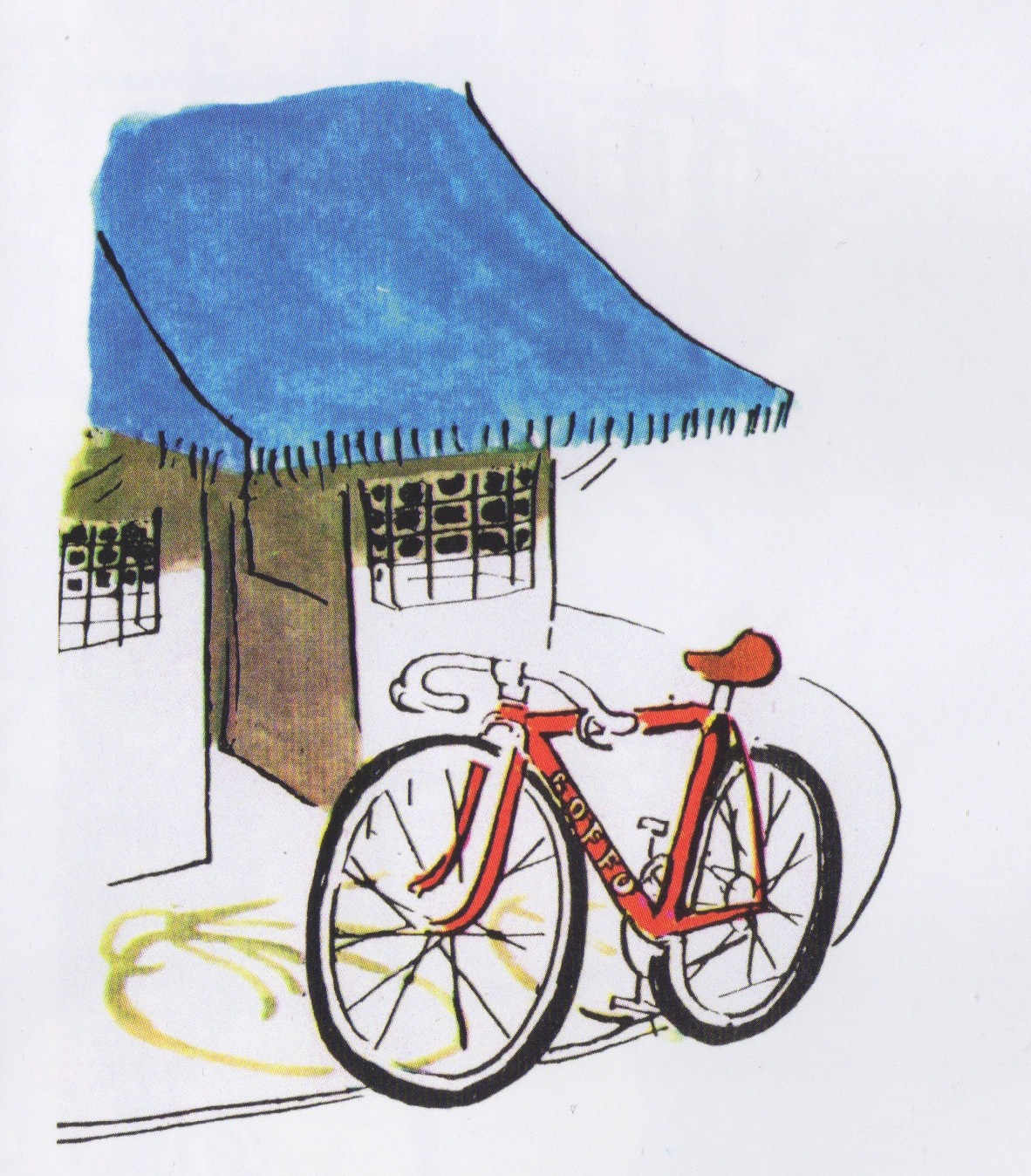
The boy stared and stared. On such a machine
one could hardly be beaten. "It is not surprising
that Boffo wins all his races," he said to himself. 
It seems fitting that The Great Boffo, written by an avid cyclist and racer, was revived by another fanatical bicyclist, James Spackman, who has fond memories of the book from his own childhood. "My dad used to read it to me as a kid, and certain phrases from it (such as "the man is more important than the machine") are often quoted in my family." Spackman accepted it as a privilege to bring back one of his childhood favorites and to introduce his old hero to a new generation of children.

The book is about a little boy who works in a wine shop and idolizes the champion bicycle racer, the Great Boffo. The boy dreams of seeing his hero when the big race comes through his town, but unfortunately he has to work, making deliveries for the shop's owner, Mr. Oscar, who has no time for enjoying bicycle races.

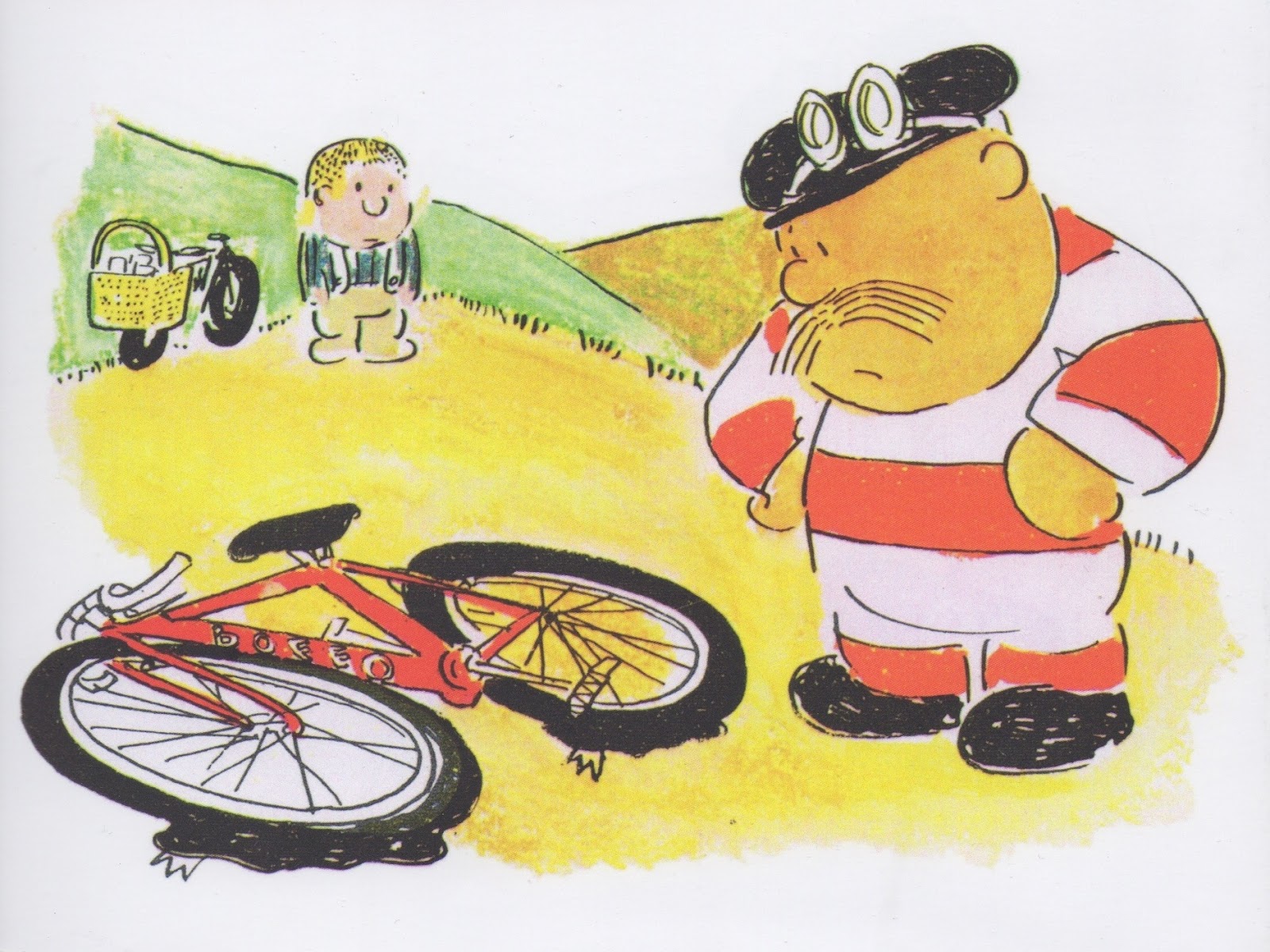
While the boy is out on his "heavy and awkward" delivery bicycle, carrying bottles of lemonade to a customer across town, he happens upon the feeding station for the race -- but the station is empty and the racers are approaching. Thinking fast, the boy gives them the drinks from his basket. But when one of the bottles shatters on the ground and his hero, the Great Boffo, suffers a double puncture, the boy finds he has another way to save the day, as Boffo borrows his delivery bike to get back into the race.

"Both tyres are punctured," he said sadly. "I am out of the race, lad."
"The man is more important than the machine."
The Great Boffo is a thoroughly enjoyable book for kids and adults alike, and the overall message is one that I think any retrogrouch can get behind. Whether you buy it to share with a child or to enjoy it yourself, the book can be purchased HERE through Amazon.