Monday, May 11, 2015

Bike Safety 101: Just Like A Car

With a title that reminds young viewers about who really controls the roads, the bicycle safety film Just Like A Car echoes other vintage car-centric educational titles like Bicycle Today Automobile Tomorrow and Drive Your Bike. Like many of these old films that I've examined in the Bike Safety 101 series, Just Like a Car, produced in 1972 by Film Loops, Inc., is definitely a reflection of its time. But in many ways it is also different in its tone and its presentation than some of the other films I've discussed here.

For one thing, throughout much of the film there is very little narration, or even much talking of any kind. Unlike the Sid Davis films such as The Bicycle Clown, or Bicycle Today Automobile Tomorrow, Just Like A Car does without the judgemental or condescending monotonal narrator. Unlike films such as Drive Your Bike, this one mostly does away with stiff and overly scripted dialogue. Instead, the film instructs mainly through visual imagery, sound effects, and music -- often really cheesy music with instructional lyrics. But the film manages to avoid some of the preachiness that overpowers so many other bike safety films, and instead shows biking to be fun (there's a shocker!) while also emphasizing a certain amount of due caution when sharing the road with cars.

The film opens with a shot of an open road, with the roaring sound of a high-performance engine -- maybe a muscle car. The camera pans and zooms, as if trying to locate the speeding car. We see something approaching in the distance, just cresting a little hill . . . is it a Mustang? Corvette? . . . No. . .

. . . It's a girl -- racing down the road on her Schwinn Varsity. Her hair is blowing behind her, and she looks like she's having a blast.

Cue the very '70s music:

♫ "I'm back on the road again, I've been travelin' (on my bicycle). I've turned every curve and bend, I've been travelin' (me and my bicycle). But you know where I go, what I see, is a world tellin' me you're alone, on your own and you've got to be watchin' out for yourself and be thinkin' constantly. 'Cause you know your bike is just like a car. Got to take it like you know who you are. If you want to be a rebel a while, ridin' in style, open your eyes and you'll see. Just like a car. . ."  Ok -- you should watch out for yourself, but wouldn't it be nice if someone instructed drivers to spend at least some of their time looking out for us, too?
Next follows a montage that shows, among other things, an evolution of bikes and cars, as well as lots of goofy clips from old silent-era films showing bikes and cars behaving badly.

Then comes a segment that alternately shows a series of kids on bikes, and people in cars, as they slow down for pedestrians, stop for signs, signal for turns, etc. -- all following the same rules of the road. No narration - just the familiar opening notes from Beethoven's 5th repeating, played on horns and bicycle bells.
♫ Ba Ba Ba BUM ♫ (that's supposed to be Beethoven's 5th if you can't tell).
The little girl signals with her bell before stopping for the old lady who steps into the road without looking.
Lots of groovy old Sting-Rays and banana-seat bikes.
Here, a very observant boy sees a ball rolling into the street from behind the parked car. He correctly predicts an unseen child may follow right behind -- so he signals a stop for the car behind him, then stops for the girl. Realistically speaking, I think it would be really hard to signal and still be able to stop in time. 
The full orchestration of Beethoven's 5th cues up for a busy city scene. Visually and musically, the busy city traffic becomes a symphony of sorts.

As usual, we get the message that bicycles should stop at intersections and walk across. Maybe bikes aren't "Just Like A Car" after all.

Here's one of the few bits of narration in the film: "When there's more than one person on the road, you've got to communicate." Which is followed by a clip from an old Charlie Chaplin film showing an argument that turns into a pie fight. I guess the message is that when it comes to traffic, the potential for conflict is always there. Or that people on the roads often act like children. Or, maybe that if you anger drivers of cars, they might hit you with a pie.


The narration continues (briefly): "Sometimes other people don't want to communicate with you. Then you've got to watch out for yourself."

"Defense. It's all defense," the narrator says. With the scene from a basketball game, we hear the crowd chanting "DE-Fense, DE-Fense, DE-Fense. . ."

Cut over to the kid on his bike, scanning the road for cars. . . 

"DE-Fense, DE-Fense . . ."
He starts to pull out, only to change his mind and exit the road quickly when he sees an absolutely homicidal driver speeding his way in a station wagon.
The homicidal psychopath swerves and weaves at high speed, right where the boy would have been had he not escaped - then speeds off, running through a stop sign. Actually, I love the fact that the film leaves the impression that sometimes drivers really are @$$holes.
The crowd cheers. The kid seems surprisingly relaxed considering that some psychopath just tried to turn him into a hood ornament. Just another friendly day in the neighborhood.
Again we hear the crowd from the basketball game chanting "DE-fense, DE-Fense. . ." The boy scans the road all around. . .
. . . That Chevy behind him is bearing down on him pretty good.
Suddenly another jack@$$ throws his door open into traffic. The kid is ready and takes impressive evasive action. Knowing how close the Chevy is behind him, he takes a hard right and skids to a stop in a driveway.
The Chevy that was following close behind slams on the brakes. I'd have enjoyed seeing him tear the  idiot's door off with his car. It would be a good lesson for motorists, too.
And the crowd goes wild! "DE-Fense DE-Fense!"
The next sequence has another song with cheesy instructional lyrics:

"When I'm ridin' down the street, everywhere I go I meet some signs tryin' to tell me somethin'. At every corner, every bend it seems as though there's just no end to those signs always trying to tell me somethin'  
♫ Now when I ride I get to feelin' free and clear, don't you? And it's not always pleasant being told what I should do. But when I see a sign ahead I read it through and through. Wanna know why? It's tryin' to tell me somethin'.♫ 
♫ "If you want your freedom and you think that you don't need 'em, remember there's times they'll keep you livin'." 
As a goofy recap to the lessons of the film, there's an after-ride interview in the locker room. Yeah, it's corny, and I'm a little embarrassed to admit it, but it did get me to chuckle a little.
"This is Woody Woodford with the post-race show brought to you by Zip toothpaste. Welcome Bob, that was quite a ride. Tell us, Bob, the secret to your riding success. Is it because you use Zip toothpaste?"

Umm, No. Bob explains that he has a good bike and he keeps it in top condition (a bike safety film staple). He goes on, "I keep my eyes on the road, and I always have a good defense."


They go back to the "instant replay" to review some of Bob's skills (like that impressive evasive move where a less attentive rider would have been doored). The message here is actually pretty good advice I think for anyone who shares the road with cars. "Anticipation," Bob tells us. "Thinking. Scanning. Looking around. You've got to expect the worst and figure out the angles. You can never tell when a car door is going to pop open in front of you. . . You've got to look out for yourself out there. Nobody else will." The interview sequence, like a lot in the movie, is pretty corny, but as far as the advice goes, I have to admit, I often think the same thing when I'm out there riding in traffic. An old friend of mine, who had spent time as a bike messenger, took it further and used to operate under the assumption that the other traffic was actively trying to kill him.


I said earlier that the film mostly manages to avoid the stern preachiness of some other safety films I've discussed. Then you get this guy:
"Most accidents are caused by people who don't obey the rules. Please, be a responsible driver. It's the best way to stay alive. Remember, a bike is just like a car." Except when it isn't. The nice thing is that he could just as easily be directing his remarks to motorists as to cyclists.
Wrapping up the film, we've seen lots of examples of kids riding the "right way" (notice that you never see adults riding in these movies -- wouldn't that have been a shocker?) so it's time to see a kid on the path to imminent destruction.

This kid, on another Schwinn Varsity, races along the road without watching for hazards, ignoring signs and signals, zipping around cars, brushing past pedestrians -- all the while the film speeds up, the scenes whizz by in a blur, the music speeds up to a fast paced garble, until the inevitable conclusion. . .
. . . A truck pulls out right in front of him, leaving him to skid to a stop just in time. Whew! That was a close one.
Followed by another quick editing sequence from silent-era movies of car accidents and bike crashes.


Okay - the kid lives to ride another day, maybe a little wiser for his experience. Cue up the cheesy music from the intro again. . .
"Know what you're doin', watch where you're goin'. You're on your own but you're never alone on the road. Lookin' out for you is the ultimate rule and you're playin' it cool. Don't you know your bicycle is just like a car. Got to take it like you know who you are. . ."
It has such a '70s vibe.

You can check out Just Like A Car right here - courtesy YouTube:


Enjoy!

Thursday, May 7, 2015

Jobst Brandt: Loss of an Icon

Jobst Brandt, a tremendously influential person to the cycling world, died this week, on Tuesday, May 5th, at the age of 80.

A mechanical engineer with impressive credentials (Porsche, Hewlett Packard, Stanford Linear Accelerator), he was something of an outsider to the bicycling industry, which allowed him to speak freely about tech issues and other problems he observed. He could be very outspoken. But he did contribute to the industry in numerous ways, and particularly through his work with Avocet, where he helped to develop their "slick" tread tires (they were dubbed Fasgrip, and they were good) as well as their cycling computer (the first, last, and only computer I ever used on a bike).
Probably one of the most famous images of Jobst Brandt. It appeared in ads in all 
the bike magazines in the '80s for Avocet's slick tires, which he had helped to develop.
To cyclists on the West Coast, the rides he led around the Bay Area -- known as "Jobst Rides"-- were legendary. Usually 100 miles or more, and covering all kinds of terrain, the rides left many seasoned riders struggling and gasping. Reportedly he thought nothing of going down steep, rocky trails on his huge 27-in. road bike (the guy was 6' 6") with road tires, and few could keep up. He was also known for his regular tours of the Alps, which were typically well-documented in ride reports with plenty of breathtaking photos. (see HERE)

This oft-published photo of Jobst on the Gavia
Pass was turned into a poster sold through
Palo Alto Bicycles.
Many other cyclists around the country and around the world got to feel as though they knew Jobst, even if they never met him, through his writing and his frequent contributions to the once-thriving Usenet group rec.bicycles.tech. I was one of those who never met Jobst, at least not in person, but I did have occasional email conversations with him on tech issues, and I was always amazed at how quickly and thoroughly he responded to my messages and questions, despite what I'm sure was a very busy schedule. I really wish I could have have gotten his take on the Campagnolo Ultra-Torque issue (or non-issue, depending on whom you believe) that I wrote about recently, but I have a feeling he'd have seen a shortcoming in that design. Many of Jobst's old posts to the Usenet are archived and can be found HERE or HERE.

Jobst had a rare quality (I believe) as a mechanical engineer in that he not only had an incredible understanding of engineering and mechanical principles, but he also had an uncanny ability to explain them clearly to non-engineers with his commanding use of the English language. It's a testament to his writing ability that one of his jobs for Porsche was to translate their technical manuals into English -- a job he practically created himself because he was dissatisfied with the manuals as they were.

Another testament to his ability to put his engineering knowledge into clear instruction is his book The Bicycle Wheel, which many consider to be the Bible of the subject. Although one could use the book simply as a reference guide for building a wheel, it is actually much more. I've read the book cover-to-cover (twice) and won't build a wheel without reviewing it.

I don't know if it would be appropriate to call Jobst Brandt a retrogrouch (though I'm certain people did), and I don't know how he would have felt to be labeled as such. But I do know that many a self-proclaimed retrogrouch felt a kinship with him, and interpreted his views as testament to the cause. For one thing, like a good engineer, he took a conservative approach to new technology, was fiercely dismissive of marketing hyperbole, and generally favored designs that were simple, proven, and cost-effective.

Right after learning about his death, I pulled out an interview Jobst gave with Grant Petersen for the Rivendell Reader (RR-6). In it, he talked about such topics as . . .

Mountain bikes:

"Most of the MTB's I see are not ridden anywhere where they have an advantage. Tourists who never ride in mud ride thousands of miles on knobby tires and in a riding position that is inefficient for road riding."

Road bikes:

"It is the poseurs who have seriously damaged the road bike, with their attention to unobtanium, 27-speed gearing and disc wheels, none of which has anything to do with bicycle riding."

Tight geometry and ultra-short wheelbases:

"Excuses such as 'quick steering' and 'responsive' are used to cover the quirky handling of these bicycles."

Shifting gears:

"I use down tube shifters (seldom) and use a 6-speed freewheel because 5-speeds are dead. . . I'm not preoccupied with always being in the right gear or following some unwritten precepts on cadence and the like. I ride a gear that's about right and leave it at that. . . The range of gears hasn't changed much in the last 50 years, only the number of gears in that range. I don't believe they are useful, necessary, or any good for the design of the rear wheel. Five or six is plenty, nine is gratuitous hardware and multiple redundancy."

He sometimes ruffled feathers. He sometimes left people stinging when they made claims they couldn't support with facts and evidence. "He didn't suffer fools" was something I've heard many people say.

Three of the Retrogrouch's icons. (left to right) Sheldon Brown,
Grant Petersen, and Jobst Brandt in 2006. (photo from Sheldon Brown's site)
Back in January 2011 (I've read that it was on his 76th birthday), Jobst Brandt was injured in a bicycle crash that, combined with other issues, left him debilitated. It isn't clear what happened, but it appeared to have been a single-bicycle accident. Though some helmet proselytizers would have wanted to use the accident as more evidence supporting helmet use, Brandt, who was well known not to wear one and an outspoken critic against the near-religious fervor that surrounds them, would certainly have chafed at that. Reportedly, it was a stroke he suffered while in the hospital, rather than the crash, that left him unable to write any more. It seemed like such a loss then, made all the more permanent and real now.

Between Sheldon Brown in 2008, and now Jobst Brandt, I feel like I've lost two of my icons.

Wednesday, May 6, 2015

Modern Bike Problems: Campagnolo Ultra-Torque

Pedal, kerChunk, pedal, kerChunk, pedal, kerChunk.

I could feel and hear the "kerChunk" with each revolution -- every time the pedal rounded the 6 o'clock position. It was a little disconcerting, but I knew exactly what was happening. The curse of Ultra-Torque. I've spent lots of time talking about the problems associated with press-fit bottom brackets, I thought today I'd share another bottom bracket issue, but this time, one which even crops up on threaded systems.

The Ultra-Torque crank spindle is comprised of two half-shafts
that are joined together in the middle with a Hirth joint.
Back around 2006 or so, Campagnolo introduced its answer to Shimano's Hollowtech II BB with outboard bearings - which they dubbed the Ultra-Torque system. Comprised of two half-shafts that join together in the middle with a very cool Hirth joint and a single large-diameter bolt, the system consists of some impressive engineering. Hirth joints require complex machining to manufacture, but they are very strong and are used in things like aircraft engine shafts and turbines. Great -- so what's the problem? In those other high-tech applications, the manufacturing tolerances are much better and more controllable than they are in the bicycle industry. In this application, however, Campagnolo can make its cranks to very tight tolerances, but unfortunately they cannot control the tolerances of the bicycle frames into which they will be installed. That in itself is one of the reasons that press-fit BB systems have been so problematic. Even with threaded bottom brackets, there can be certain variables which can affect fit, but most traditional systems have a means to compensate or adjust for those variables effectively.

Here's the non-drive half shaft. It's really a beautifully machined
 piece of equipment, but there may be a problem in the application.
In frames with threaded bottom brackets, the bore of the shell and its threading can be tightly controlled to industry standards. However, the exact width of that shell can vary ever so slightly. A standard British/ISO bottom bracket shell should measure 68 mm wide, or 70 mm for an Italian threaded frame, and the faces of that shell should ideally be perfectly parallel. In reality, the width of those shells could vary by a millimeter or more, or by minute fractions of a millimeter. Even in steel frames with investment cast bottom brackets, there can be a slight variation. And it's not always due to a flaw in the manufacturing necessarily. A BB shell that starts off at the proper spec will be narrowed slightly if a facing tool is applied. But in most cases -- in practice -- that tiny difference in width is not a problem. That's why most traditional threaded bottom brackets have at least one adjustable cup. Phil Wood's excellent cartridge BBs have two adjustable cups, and work perfectly well even if the shell faces are not perfectly parallel. Even with Shimano's Hollowtech system, there is a means for adjusting for those tiny variations in width. But the Ultra-Torque has a rigidly defined shaft width with no effective means for adjustment on frames that might not have such exact tolerances.
Joined together, the two halves of the Hirth joint look like this,
held together in the middle with a large diameter bolt.
So, how does the system accommodate tiny variations in frame shell width? By use of a "wave washer."
To accommodate slight variations in BB shell width, the
Ultra-Torque system uses this "wave washer." It is less than
ideal for the task. (photo from Park Tool)

I suppose that washer is supposed to act almost like a spring to keep the system under proper load laterally. In practice, it doesn't seem to be up to the task. When installed into most frames, even those conforming to Campagnolo's defined specifications (their installation instructions listed an acceptable range from 67.2 mm to 68.8 mm for British/ISO frames), one can physically move the crank laterally in the frame. When pedaling, sometimes this movement can present itself, resulting in a "knock" or that kerChunk that I described earlier. Apparently, Campagnolo's engineers say that this lateral movement is not a problem and that it should not present itself when pedaling. Many rabid Campagnolo fans echo that sentiment, and deny there is any issue. "It's Campagnolo," they'll say -- "how could there possibly be anything wrong?" Some will point to the strength of the Hirth joint, and hail it for its high-tech turbine applications, which is actually irrelevant to this issue. It would be hard to find anybody who is a bigger Campy fan than I am, but realistically, I think there is an engineering problem here.

The issue was first brought to light in 2008 by John Satory, the bicycle mechanic and blogger known as "RogueMechanic." This guy has been on a one-man crusade about the Ultra-Torque issue, has had several conflicts with Campagnolo over it, and has even received hate mail about it.

The thing is, it's quite possible that some people would never notice a problem when riding. If a frame's actual width measures at the wider end of the acceptable specifications, it's possible that the lateral movement would be negated. Maybe some people have such unbelievably smooth pedal strokes that it never presents itself on the road. It's also possible that some people aren't as sensitive to the knocking and therefore don't notice it. Or perhaps some notice it, but don't know to what to attribute it (I've seen where people have attributed the problem to bad bearings, pedals, shoes/cleats, and more).

I installed the Ultra-Torque crank and bottom bracket onto one of my bikes some time back. I was impressed by the engineering, and what seemed to be an unbelievably simple installation (no bearing adjustment whatsoever). After a couple thousand miles, I started to detect that kerChunk. I asked a local mechanic about it, and learned that Campy was aware that some people might have that issue (though apparently, they still consider it a non-issue) and suggested using a second wave washer to solve it. We tried that, and it seemed to settle the problem. I could still produce the lateral movement of the crank when the bike was on the stand, but it did not seem to present itself when riding -- for a while, that is. A couple more thousand miles, and I started to notice it again. Faintly at first. Gradually, it got worse. Pedal, kerChunk, pedal, kerChunk.

The Ultra-Torque shim kit, from RogueMechanic.
Researching it online, I discovered the RogueMechanic site and figured out the reason for what I was sensing. Luckily, Satory had come up with a good, solid solution to the problem. Get rid of the wave washer, and instead use shims to properly space the bearing cups to eliminate the lateral play. He has had shim kits made that he will install for his clients, or which he sells online for home mechanics. The shim kit consists of 2 shims each in 1.0 mm, 0.5 mm, 0.2 mm, and 0.1 mm.  I purchased the shim kit for $45 and watched his video instructions on how to best install them. I'm glad I watched the video, as there is a definite system to determining the best combination of shims that would eliminate any lateral play, but at the same time, did not cause any binding. Installing the shims wasn't difficult, but it was time consuming, and I'll add that having a pair of digital calipers is really helpful. Even with the calipers, there is still a fair amount of "trial and error" to determining the best number and combination of shims. Ultimately, I ended up using about 1.2 mm worth of spacers to eliminate play, which is just a shade (not a technical term) thicker than the pair of wave washers that I removed from the setup. Since the operation, out on the road, the crank feels like it should, with no knocking. No clicking. No kerChunks. We'll see how it holds up over time, but I have to say that RogueMechanic's assessment of the problem seems spot on to me, and I'm convinced the solution is correct as well.
It's a little tough to see, but that's the left-side Ultra-Torque
cup with about 1.2 mm of shims.

It's worth pointing out that press-fit bottom brackets aren't the only ones that present problems that shouldn't be problems, though it's also notable that Shimano's Hollowtech BB system has more adjustment designed into it. But luckily, with the threaded frame and cups, it seems to me that fixing the problem is at least fairly straightforward. I can also say that I'm glad I don't have the press-fit version of the Ultra-Torque. Perhaps one could still make adjustments for width using shims, but I can only imagine that press-fit would only compound the issues. Still, when I think about the fact that I've got a Phil Wood bottom bracket on my Rivendell with about 15 years and I-don't-even-know-how-many miles on it (still feels as slick as butter), could somebody remind me exactly what was wrong with a good old fashioned square-taper bottom bracket?

Monday, May 4, 2015

Cool Vintage Bits: Specialites TA Pocket Flasks

That's the model #150 on the left, and the #300 on the right.
The numbers tell how much they hold in ml.
While looking through a bin of vintage bike stuff in my basement, I came upon these two fun little flasks. Made by Specialites T.A. in France, I've sometimes heard of these things referred to as "bonk bottles." They were available in two sizes, fit into a jersey pocket, and were stoppered with corks. I don't know when they started making them, but I do know they were listed in catalogs at least into the early 1980s. The bottles are made with a T.A. chainring logo molded into the side.

The bottles don't hold much liquid. The larger is listed at 30 cl (centiliters) or 300 ml -- which is only 10 oz. The smaller bottle holds half that much. That being the case, they wouldn't serve much purpose as regular water bottles, which is, I believe, where the "bonk bottle" name comes into play.

An old catalog image. I've never
actually seen one with that exact
logo on it, though.
The way I've heard it, riders would mix various concoctions to put into the little flasks -- recipes designed to give a little boost during a long ride, fight the bonk, and relieve fatigue. At the most benign, it would probably be some kind of glucose and/or electrolyte boost. One such recipe I've read about (though I cannot remember where) involved about a half a can of Coca-Cola and a couple of crushed up aspirin dissolved into it. A less benign variation might have also included some kind of amphetamine added to the mix. That would not be recommended for a long hot ride up Mont Ventoux, by the way (actually, I wouldn't recommend amphetamine use under any circumstances).

Nowadays, lots of people use glucose supplements and the like for long rides. If it weren't for the fact that many of those boost products come pre-packaged in little disposable packets, I'd think that mini-flasks such as these should be quite popular. In fact, I've sometimes seen long-distance runners using "marathon belts" -- like utility belts that would hold a couple little flasks that are almost like a modern version of these bonk bottles. They'll mix up their GU (yeah, that's one of the brands) with some water and keep the little bottles in the utility belt. Doesn't quite have the vintage style factor going for it like these old TA flasks have, though.

This little guy easily fits into a jersey pocket.
I recall that I had three of these at one point, though I don't remember how I came to possess that many. But I'm pretty sure that I gave one of them away as a Christmas gift to the mechanic at my local bike shop who always gave my projects a bit of special attention. Like me, he was a noted fan of vintage bikes and gear. Always be good to your mechanics. A six-pack of some good craft brew was generally welcome, too. I never had to wait for repairs when he was there.

I've never actually used the bottles, but I hang on to them for much the same reason that I hang on to things like old leather helmets. Just an interesting bit of vintage cycling ephemera -- a display item, or a conversation piece. Maybe one of these days, I'll get to take part in one of those Eroica rides on one of my vintage Mercians, wearing a classic wool jersey and leather helmet (hmm. . . maybe not the helmet), and one of these little flasks tucked in a jersey pocket. No amphetamines in my recipe, though.

Friday, May 1, 2015

Video: Campagnolo Revolution

I saw this little promotional video from Campagnolo a couple days ago that really caught my eye: The Revolution Continues. The concept is cool, the music is energetic, it has some intriguing camerawork, and it features some really awesome vintage bikes. As commercials go, it's almost more like a short movie.

The concept of the video is that we see a rider on a Campy-equipped bike riding through gorgeous Italian countryside -- as well as through time itself. His bike, his Campy components, and his clothing keep changing, or evolving, as he rides.

The rider starts out on a 1940s-era Bianchi with Cambio Corsa shifting. You get a nice drive side view of the bike and the shifting system -- though you don't actually see the rider shift gears with it, which I think would have been a great touch.
Close-up of the twin levers of the Cambio Corsa, identified as being from 1946.
The rider, with his Bianchi wool jersey and a spare tire wrapped around his shoulders, passes the mysterious gentleman leaning against a car, reading a newspaper. . .
Who is this mystery man?
The rider stops to fill a waterbottle. . .
And when he comes back, he discovers his bike has changed. What are these levers on my downtube?
It's now 1951, and the bike is another Bianchi, this time with a Gran Sport parallelogram derailleur -- the granddaddy of Campy's derailleur designs for the next 35 years or so.
One of those unusual camera shots.
Stopping by woods for a "natural break."
The mystery man appears . . . 
. . . and leaves a calling card of sorts. By the way, that must be a really early version of the Campagnolo cone wrench. I've got several, some which might be as old as 1970s, but none looks quite like this one.
The rider comes back to his bike and finds it replaced by a Colnago with the full Campy. . .
. . . And a new jersey. 
I have to question the video's dates at this point. The video says Gruppo Record 1963. It's true that Record was introduced in '63 -- but this really looks like Nuovo Record, which was introduced in '67 (with modified chainrings on the crank). I'm thinking that the Colnago is more like '70s, or even '80s vintage, as well.
There's the tell. Campagnolo completed their gruppo with the addition of brakes in 1968. But this is a short-reach Super Record brake with other details (script logo, domed quick-release lever) that say early '80s. Oh well.
Another water stop, and the rider transforms with a really bad mustache (in what era would that have been stylish? Maybe in Italy?) and a new jersey . . .

. . . While the bike transforms into a Super Record-equipped Atala. Super Record was introduced in the '70s, so I'm not sure why they chose to highlight 1983. But it's a good period choice.
The rider continues on in his Atala team kit and bike -- still being watched by the mystery man.

. . . Who is now following in a VW Microbus.
The rider transforms again into lycra kit, on a bike that looks like a pretty generic aluminum and carbon-fiber machine. At this point, the Retrogrouch stops being interested in the bikes.

On the close-up, we see 10-speed Super Record. Still don't know what the bike is -- don't really care, either.
I can't identify the team jersey at this point -- but I really think it says "Gran Fondo." He rides into a tunnel, and when he reemerges back into the light . . .
. . . His bike is transformed into a carbon fiber Trek with 11-speed Super Record. Odd, because I'm not aware of Trek offering bikes with Campagnolo (I could be wrong).
At the top of the climb, we see the mystery man, surrounded by Campagnolo support people. I still don't know who the mystery man is -- I know he isn't Valentino Campagnolo. Maybe he just represents a visual personification of the Campagnolo name, identity, or "presence" -- like some kind of visual metaphor? 

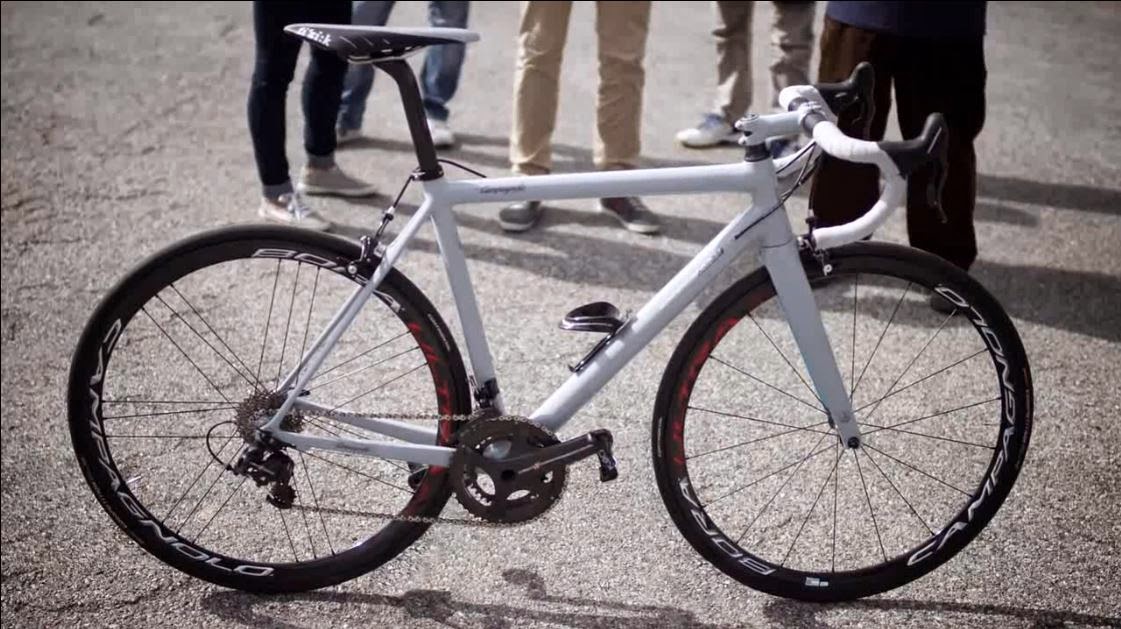
They present the rider with a new bike. A pretty generic-looking carbon fiber frame, loaded up with the latest Campy Super Record parts.
I still think that's a really ugly crank.
The rider at this point pulls on a Europcar team jersey -- and actually changes into a completely different person -- I presume a member of the team. I'm having to declare ignorance here, as I don't know who it is. The only Europcar rider I would recognize is Thomas Voeckler, and this ain't him. Also, I find it odd that it focuses on Europcar, since last I heard, they were denied their WorldTour license for 2015
A few odd choices, and maybe some questionable dates, but the overall effect was kind of fun to watch. You can watch the complete video, which is linked here to YouTube:


Enjoy!