Friday, July 15, 2016

Designed in America: Part One

So meaningful.
The other day I found an old mountain bike in the trash at the curb. It was rusty and looked like it had spent most of its life parked outside. It was a low-end Specialized -- a cheap model aimed at teens or tweens -- but I took it home anyhow. I figured if nothing else I might be able to scavenge a few useable parts off of it. A headset, bottom bracket, hub axles and cones, etc. -- all of which I figured were probably in decent shape beneath the rust and grime, as the bike probably hadn't seen much actual use in its lifetime.

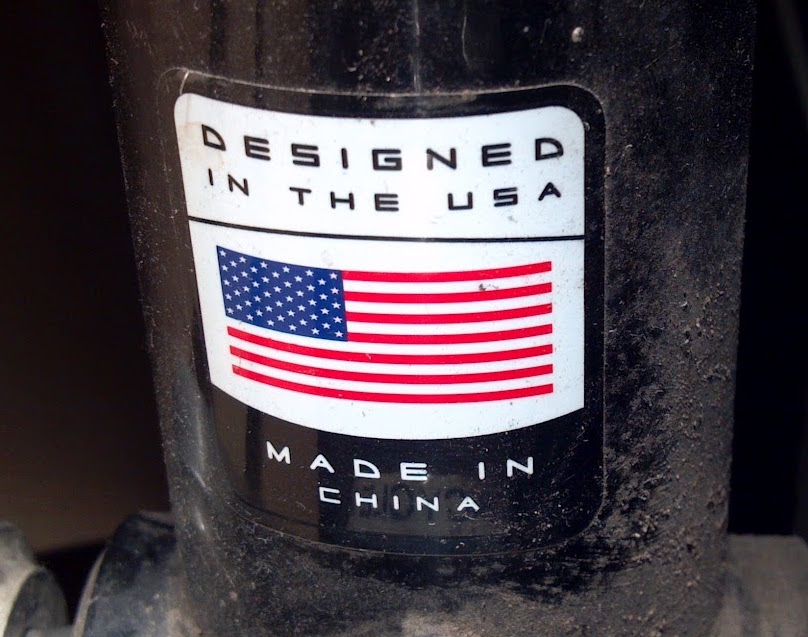
After I'd gotten what I'd wanted off of the frame, I was preparing to dump the rest back in the trash when I noticed a sticker on the seat tube. "Designed in California - Handmade in Taiwan." Oh, how meaningful. I've seen these stickers a lot on bikes from the last decade or so, but it got me thinking about how much the industry has changed since I first got serious about bicycles.

Apart from a few top-of-the-line models, some low-volume specialty bikes, or exclusive custom builds, very few bikes sold in America are actually built here these days. That wasn't always the case, and it really wasn't all that long ago when things were very different. But today, many supposedly American bike companies are little more than importers and marketers, designing decals and color schemes for bikes built in China and Taiwan, and bolting on whichever Shimano group fits the intended price range.

Here's another one. Can't miss the red, white,
and blue - but isn't it a little misleading?
Obviously, the shift of manufacturing away from the U.S. is something that has swept through almost all industries, but in the bicycle industry I believe the causes of that shift can be traced to several distinct factors: The American Bike Boom, the fall of Schwinn, the growth of importers (like Specialized), and the rise of Shimano. All these factors are inter-related in a number of ways, so any discussion of one is almost certainly going to overlap with others. It's also a subject that warrants at least a multi-post discussion. You've been warned.

The American Bike Boom

In the first part of the 1970s, sales of bicycles in the U.S. shot skyward beyond anyone's best expectations. Sales in 1970 were about 7 million bicycles. By 1972, bicycle sales had doubled to 14 million, peaking at 15 million in '73, then dropping back to 14 million in '74. The bubble burst the following year, with sales dropping back to 7 million in 1975. Although relatively short-lived, one permanent change that happened to bicycle sales through the boom was that adult bicycles became a significant piece of the pie. Prior to the boom, bikes for adults never accounted for more than 10% of the American market, which was overwhelmingly geared toward children's bikes. That percentage of adult bikes would peak at over 70% at the height of the boom, and remain at around 50% ever after.

Isn't a massive boost in sales a good thing for business? Well . . . yes, and no. On one hand, any company selling bicycles in the U.S. was suddenly making money hand over fist - at least for a couple of years. On the other hand, the short-lived nature of the bubble meant that a lot of companies tried to take advantage or get established during the boom and got caught badly in the bust. That rapid boom-bust cycle proved to be a massive shakeup to the whole industry. Those that couldn't ride it out didn't last. Another question to ask is what happened to all those profits that were flowing in the boom years? Were there significant investments in newer factories and updated equipment that would help move the American industry into a new era? Hmmm. . . apparently not. And this next thing might be a big reason as to why.

Manufacturing capacity was seriously put to the test during the boom, and most established bike companies simply could not keep up with the demand with their aging factories and tooling. Huge companies like Schwinn, Raleigh, Peugeot, and others were running at full capacity and quality suffered. The major component makers, such as Huret and Simplex were likewise at full capacity and could not keep up with orders. What this led to was a search for other suppliers of bikes and components, and Japanese companies were ready to fill the void.

Schwinn was the biggest of the American bike companies, and was a major influence on the industry, so their response to the boom is instructional. In order to meet demand, Schwinn started importing some of their bikes from Japan -- built to Schwinn's specifications by companies like Matsushita/National Bike Co. (Panasonic) and Bridgestone. The World Traveler was the first of these imported models, built with a lighter lugged steel frame and Shimano derailleurs, and priced near or just below the popular Varsity. Many buyers probably didn't notice or care that their bikes were built in Japan. It came from Schwinn -- a name synonymous with quality (Interestingly, the first imported models didn't actually say Schwinn on them - at least not prominently - but later models would proudly bear the trusted name). The number of Japanese-built models, and their quality advantage over the American-built bikes, would only increase from there.

Given a choice between updating their Chicago factory, or just importing more bikes from Japan, Schwinn decided to import - and that short term solution to a temporary supply problem ended up becoming a long-term plan for survival.

Other companies would follow a similar path. If not placing their own name on complete bicycles from Japan, they were at the very least building them with Japanese components from brands like SunTour and Shimano. In the previous decade, these companies were just starting to make major improvements to their component lines. Derailleurs were a notable example. No longer content to just produce cheaper versions of old French designs, SunTour and Shimano were both beginning to produce more innovative designs that increased shifting range and reliability - at a lower cost. But up until the '70s, there was a reluctance for bike companies outside of Japan to use these components. The American bike boom happened at an opportune moment for Japanese companies eager to enter the established markets. Suddenly, bikes that previously came with entry-level Huret or Simplex derailleurs were being equipped with Japanese pieces that worked better for less money.

Whereas previously, Japanese bikes and components were not taken seriously by bicycle buyers outside of Japan, millions of buyers during the bike boom were happy to give them a try. With Schwinn's help, companies like Bridgestone and Panasonic both grew tremendously, even though many American customers knew their names for tires and radios, respectively, and probably had no idea who actually built their Schwinn LeTours and Voyageurs. Likewise, Americans became far less skeptical of brands with distinctively Japanese-sounding names like Fuji, Miyata, and Nishiki -- all of which got a boost from the boom.

Giving the Japanese companies this foothold into markets previously dominated by American and European manufacturers was, I believe, the first step toward shifting the bike industry to Asia. Japanese manufacturers showed they could provide better quality at a lower price, and they eventually grew to dominate the industry.

Tuesday, July 12, 2016

Tour de France Coverage, Retrogrouch-Style: 1986

Since I'm only just barely paying attention to this year's Tour de France, I thought now would be a good time to drop back in the pack by 30 years and take a look at one of the most drama-filled races in Tour history: 1986, with its showdown between French legend Bernard Hinault and rising American star Greg LeMond.

The backstory to the '86 Tour is very familiar, but let me give a quick synopsis. In 1985, Hinault was the undisputed leader of the powerful La Vie Claire team, and offered Greg LeMond a $1 million contract to join the team and help Hinault win his 5th Tour de France. The plan, with LeMond as top domestique, came unravelled when Hinault crashed in stage 14, breaking his nose. In the next big mountain stage, on the Col du Tourmalet, Hinault was suffering and in danger of being dropped by the peloton, while LeMond was well ahead with a breakaway group. LeMond was gaining time on his leader, while Hinault was faced with the possibility of losing the Tour. At that point, a team car pulled up next to LeMond, with orders from team director Paul Koechli to slow down and wait for Hinault. LeMond was reportedly told that Hinault was less than a minute behind, but in reality he was more than 4 minutes back. By the end of the stage, Hinault was still the race leader, but it was clear that LeMond had sacrificed his own chance at victory for his leader. Hinault, recognizing the sacrifice, promised to help LeMond win his first Tour in '86. Whether Hinault actually made the promise is hardly disputable. But would he, or could he, keep it?

With or without the backstory, the 1986 Tour promised to be a special one as the race would be the first to include the participation of an American team, the 7-Eleven squad. It would also mark the return of 2-time winner Laurent Fignon, who had missed the '85 race due to Achilles tendon surgery. Another change included two new additions to the La Vie Claire team -- American climber Andy Hampsten, and Canadian sprinter Steve Bauer. The addition of so many English-speaking riders in the Tour would prove to be a turning point in the race's history. The '86 Tour would also be a very difficult one, with more climbs than previous years, including four major summit finishes, four time trials (3 individual, 1 team), and only one rest day.

Stieda won yellow, white,
sprinters, mountains and
combination jerseys
all in one day.
The opening stages of the '86 edition would be a good indication that the race would be dramatic. The prologue time trial was won by Fignon's teammate Thierry Marie, with Hinault just 2 seconds back. LeMond and Fignon both finished about 4 seconds behind Marie. The second day actually included two stages -- an 85 kilometer road race, followed by a team time trial in the afternoon. In the morning's race, 7-Eleven's Alex Stieda, of Canada, went on a solo breakaway and picked up so many time bonuses along the way that, even though he was eventually caught and finished 5th, he was shocked to be pulling on the race leader's Yellow Jersey (along with all the other prized jerseys) at the end of it. The celebrating wouldn't last long however, as the 7-Eleven team's performance in that afternoon's team time trial would mark them as Tour rookies. Eric Heiden crashed, several members suffered flat tires along the course, and Stieda, worn out from his earlier effort, had trouble finishing within the time limit. He was not only the first North American ever to wear the Yellow Jersey, but he narrowly missed having the unlikely distinction of being the first rider to win the Yellow Jersey and be disqualified in the same day.

The third stage would mark a redemption for 7-Eleven, as Davis Phinney would win after being involved in a breakaway for most of the day on the roads of Northern France. He would be the first on that team to win a TdF stage.

With several days of mostly flat stages, time gaps between the General Classification favorites stayed close until the individual time trial of stage 9. Bernard Hinault won the TT, and LeMond finished second, 44 seconds back. However, LeMond's performance was better than his time would indicate, as he had flatted on the course and some estimated that he lost nearly a minute as a result. Fignon was struggling with his post-surgery form and lost more than 3 minutes to Hinault.

With his win in the TT, Hinault must have decided that he didn't need to hold to his promise to help LeMond. If he could prove himself to be the strongest on the team, who would blame him for racing to win? So over the next stages, it was like internal warfare on the La Vie Claire team. In stage 12, with four major climbs in the Pyrenees, Hinault took French teammate Jean-Francois Bernard with him on a breakaway attack, leaving LeMond stuck in the peloton. By the end of that stage, Hinault was in 1st place, with more than 5 minutes on 2nd place LeMond. The day's temperature and the pace were both so hot that many riders (including two from 7-Eleven) abandoned before the end. Even Laurent Fignon abandoned the race the next morning.

In stage 13, with another 4 major climbs including the Tourmalet, Aspin, Peyresourde, and a mountaintop finish at Superbagnères, Hinault again went on the offensive, attacking on the first major descent, leaving LeMond in the difficult position of not being able to attack his own teammate. Though the group managed to catch Hinault, the offensive wasn't over, as he attacked again and again. Gradually, the five-time champion showed signs of weakening, though the good news for LeMond was that most of the rest of the field was also weakening. On the final climb of the day LeMond, with the help of the young climber Hampsten, was able to take off and win the stage, also gaining back much of the time he'd previously lost to Hinault. The French champion was still in 1st, but now only 40 sec. ahead of LeMond.

The next few stages continued with little change in the overall standings until stage 17 in the Alps. On the descent of the 2nd climb of the day, the Hors Category Col d'Izoard, Swiss rider Urs Zimmerman got a gap on the other favorites -- except for LeMond who managed to latch onto his wheel. Zimmerman pushed hard up the final climb up the Col de Granon, while LeMond hung on for the ride. Together, they gained time on nearly everyone, including Hinault who continued to attack but could not reduce the deficit on the road. The stage was won by Spanish climber Eduardo Chozas, who had gone off in a breakaway earlier and managed to stay away even from LeMond and Zimmerman -- but Chozas was not a contender for the overall lead, and LeMond had moved himself into the Yellow Jersey. Zimmerman had moved into 2nd, with Hinault now in 3rd.

LeMond and Hinault destroying the field
on Alpe d'Huez. Nobody else stood a chance.
Tensions on the La Vie Claire team were high, and to some extent, spread throughout the peloton. Loyalties on La Vie Claire were divided along national lines, and riders like Hampsten and Bauer were caught in the middle. Across the race, it seemed many European riders weren't ready to see the young American win the Tour. According to the book and documentary Slaying the Badger, there were some thinly veiled threats against LeMond. Even in the Tour coverage of the day, Phil Liggett reported "80% of the riders want Hinault to win. There's a nasty hint that LeMond could be nobbled." Although they rode for different teams, LeMond was able to get emotional support from longtime racing friends and fellow Americans on the 7-Eleven team, along with teammates Hampsten and Bauer. LeMond's wife, Kathy, was also there as a major source of support. After Tour organizer Jacques Goddet told LeMond "Watch your food. Watch your water bottles," Kathy was the one reportedly buying groceries and preparing food for her husband.

The 18th stage was another monster in the mountains with four big climbs: the Galibier, the Télégraphe, the Croix de Fer, and the summit finish on Alpe d'Huez. Hinault went on the offensive, attacking again and again, but always being caught. Just as in the Pyrenees, those attacks weakened everyone except LeMond.

It's one of those unforgettable moments from the Tour.
The difficult descents in that stage were an element that worked in LeMond's favor. By all accounts, LeMond was amazing at riding downhill, and on the descent from the Télégraphe, he dropped Zimmerman for the rest of the stage and caught up with Hinault. By the climb up Croix de Fer, Zimmerman worked hard but was unable to close the gap to the La Vie Clair leaders. On the descent of de Fer and the final climb of Alpe d'Huez, the duo of Hinault and LeMond buried all of the competition, and Hinault was moving himself past Zimmerman into second place in the overall standings. Reportedly on the climb of Alpe d'Huez, Hinault began feeling the heat and asked LeMond to slow up. LeMond, apparently taking it as a concession, stayed with Hinault to the finish. As they finished the climb arm in arm, right at the line, LeMond pushed Hinault ahead for the official stage win.
Hinault: "The Tour is not finished."

If LeMond was thinking that conceding the prestigious stage win meant that Hinault was going to honor his promise from '85, he was mistaken. In an interview following the stage, Hinault told reporters "The Tour is not finished yet . . . it's a sporting war . . . we'll let the time trial decide." The look of disbelief on LeMond's face could not be concealed. In any case, at this point in the Tour, LeMond was in Yellow, with Hinault in second, 2 min. 45 sec. back, and Zimmerman in third, well over 7 minutes back and essentially out of contention. As another bit of good news for the Americans, Andy Hampsten was fourth, but over 16 minutes behind LeMond.

The stage 20 time trial at St. Étienne was another contest between the two La Vie Claire teammates. Hinault rode a perfect race and won the stage. LeMond had another bout of horrible luck, with a crash that required a bike change and finished second, 25 seconds down from Hinault.

Stage 21 was another mountain stage with a summit finish on Puy de Dome. On the final climb, Zimmerman managed to gain back a small amount of time against Hinault, but LeMond extended his lead over both men and had an overall margin of more than 3 minutes. There were just two more stages to go.

On the final stage into Paris, LeMond once again crashed and needed a new bike. Luckily, any tensions that might have been in play during much of the Tour were set aside, and several La Vie Claire teammates, including Hinault, helped escort him back to the main field. Hinault contended for the final sprint on the Champs Elysées, and finished 4th in the stage.

When all the dust had settled, it was official. Greg LeMond had won the Tour de France. He was not only the first American to win it, but the first rider from any English-speaking country. The final standings were LeMond at 110 hours, 35 minutes, 19 seconds; Hinault @ 3 min. 10 sec; Zimmerman @ 10 min. 54 sec; and Hampsten @ 18 min. 44 sec.

La Vie Claire had three of the top four spots, and not surprisingly won the teams competition. In addition, Hinault won the Polka Dot Jersey for King of the Mountains, and Andy Hampsten took the White Jersey for the Best Young Rider competition. Rarely had any one team so overwhelmingly dominated the race.

For their first Tour, the 7-Eleven team had a brief stint with the Yellow Jersey and a notable stage win to feel good about. On the other hand, half of the team's roster ended up abandoning due to injuries, illnesses, or flat-out exhaustion. Bob Roll, who would become a commentator for American television coverage of the Tour, was the team's highest placed finisher in 63rd place - despite a punishing stomach flu. Other finishers for the team included future stage winner Jeff Pierce (80), Ron Kiefel (96), Raul Alcala (114), and Alex Stieda (120). Still, the Americans had arrived.

The 1986 Tour de France proved to be an incredibly tough race, with only 131 riders finishing out of the 210 who started. It's still a race that generates a lot of discussion and even some arguments after all these years. For instance - the "promise." To this day, Bernard Hinault insists that he always intended to honor his promise, even as he continually attacked LeMond. In fact, he has at times made the claim that by attacking continually, he was actually helping. In an interview in the documentary Slaying the Badger, he says "He won. So I kept my word. If I had not wanted to keep my promise, it would have been easy for me to race for victory." I think he may even believe that.

I, for one, believe Hinault was racing to win, despite whatever he may have said then or now. Still, I wouldn't vilify him for doing so. Hinault was an era-defining racer - the best of a generation. He was an amazing competitor, and when he felt he had a chance to become the only person to get 6 Tour de France victories, how could he ride for anyone else? I think he went into the race - particularly the individual time trials - thinking that if he could prove himself the stronger rider, then there was no reason for him to ride for LeMond, regardless of what he might have said a year earlier.

Not only that, but what kind of victory would it have been for LeMond if Hinault wasn't giving his all to win? Or if he appeared to truly be helping his younger teammate? Considering how many people weren't ready to embrace an American Tour winner, imagine how people would dismiss a LeMond victory as nothing more than a gift from a great champion to an undeserving outsider. Greg LeMond clearly didn't get the help he was hoping for, or that he felt was promised to him, and I don't know if he is bitter about it, or if he truly feels betrayed, but when all is said and done, he proved he really was the best and deserved victory by his effort, not as a gift. It makes the win all that much better.

1986 was an unforgettable Tour de France - and to think it all happened 30 years ago.

Sunday, July 10, 2016

The Perfect Number of Bikes? Update

As promised, I have an update with some photos of the Mercian Professional Track bike I picked up recently from Britain. The frame is from 1988 and has, as far as I can tell, original paint. I built it up with a mix of parts -- some new and some old, but I figure most have generally an appropriate "look" for a classic skinny-tubed lugged steel frame. Most of the components were things that I already had stashed away.
Wheels are modern sealed bearing hubs with large flanges. They are marked Origin 8, but the same hubs are sold under a variety of different brand names, including Formula. Even though they are modern, they have a traditional style -- sort of reminiscent of hubs from the '70s. The rims are Mavic CXP22 which have a modest aero profile (slightly taller than the Open Pro model), but not so much that they look odd on an older bike.
I installed a front brake, Dia Compe GC400, which is a decent quality piece from the '80s. I won't ride a bike on the road, even a fixed-gear, without a brake. I also put on a modern "interrupter" type of brake lever (sometimes called "cross levers,") which is a modern touch, and doesn't quite look right on a vintage bike -- but has the advantage of being easily unbolted from the bar with a single allen bolt, and the entire front brake assembly - lever, cable, and brake caliper - can all be removed together without detaching the cables or anything. Nice, if I ever take the bike up to the Cleveland Velodrome.
Crank is an old Sugino Mighty from the late '70s or maybe early '80s. The chainring is a new one, 46t, labeled Origin 8. Pedals are Specialized short-cage racing pedals from the '80s. I wrote about the touring version of these in a post from January.
Brooks Swift titanium railed saddle and a Nitto Jaguar 2-bolt seat post -- modern and classic looking at the same time. That's also another look at that wrap-over seat cluster.

The bars came off another bike and were already wrapped in that purple cotton tape. I was going to remove the purple and re-wrap them with a plain black Tressostar cotton wrap - but once I installed the bars, I thought that the purple looked kind of interesting with the blue frame. So I'm hesitating. Any thoughts? Leave a comment.

Thursday, July 7, 2016

Retrogrouch Reads: Paul Smith's Cycling Scrapbook

"Cycling has always been the sport for me," writes noted fashion designer Paul Smith in the Prologue of his new book Paul Smith's Cycling Scrapbook -- an aptly named exhibition of all things cycling from a lifetime of collecting. Jammed with hundreds of photos, artwork, and stories, Smith's book describes his love and fascination with the sport's legends, the bikes and equipment, its ephemera, and even its "look" -- all of which have influenced and inspired one of the world's most successful and celebrated designers.

Many people probably already know the backstory on Smith, who raced with the cycling club scene in England's midlands in the early '60s with ambitions of being a professional racer until a bad crash put an end to that dream. During his lengthy recuperation, he discovered the world of art and design, which opened up a new ambition, effectively changing the direction of his life -- but cycling always remained a special part of it.

The large format volume (approximately 10 x 14 in. and over 250 pages) is divided into a number of chapters, such as The Heroes, The Look, Great Races, The Jerseys, My Bikes, and more.
Smith as a teen with the Beeston Road Club near Nottingham (left) and the wrecked Mercian that marked the end of his racing ambitions (right).
Under Heroes, one will find features about some of cycling's legends from the '50s through the '70s, including such greats as Coppi, Bartali, Anquetil, Poulidor, Merckx, and others. Photos, paintings, and magazine covers and clippings help tell their stories.
Smith has an extensive collection of racing jerseys and promotional items from the classic era from which he draws inspiration. He also has a number of jerseys from today's stars, as well. 
"Sometimes a visitor will come to my office for the first time and mistake it for a bike shed," Smith writes in the chapter on his bike collection. He has quite a few bikes, some of which were built specially for him, while others have been gifts from racing sponsors (Pinarello and Sky) or racers themselves (such as Mark Cavendish and Bradley Wiggins). Some, like these Mercians, were special collaborations with the companies that built them, designed with Smith's particular sense of style and color.
Though not included in Smith's Scrapbook, I was lucky enough to see his original design boards for the Paul Smith/Mercian collaboration shown above. And what a fantastic surprise to see one of my own bikes pictured among his sketches and color swatches.
Paul Smith's Cycling Scrapbook, (published by Thames & Hudson) is a "must have" for any vintage cycling geek, but the text is written in a way that would appeal to anybody interested in a behind-the-scenes look at a famous designer's motivation and inspiration. The book lists for $50, but can be found for less through online retailers.

Tuesday, July 5, 2016

There's a Big Bicycle Race Going On in France

Did you know there's a big bicycle race going on over in France right now?

Did we mention it's French?
Yep -- It was a big deal once, and they apparently still do it. Who knew?

Last I heard, this guy was winning:

Did he just win the yellow jersey? Or prom queen?
Or maybe it was THIS guy?


Thaaat's right - it was "Mr. McFeely."

Watch out for those hands, ladies.
Though if you're at all familiar with the Big French Bicycle Race In France, you know that sprinters and crashes rule the first week, and the lead will change when the race hits the mountains. Once that happens, the race leader will probably be THIS guy:

Stefano Varjas, the Dr. Michele Ferrari of mechanical doping.
But if I happen to be watching (and there's no guarantee I will) I'll be looking for THIS guy:


It's entirely possible he might be doping, too, but who cares?

Sunday, July 3, 2016

How "High Tech" is Too "High Tech"?

There was a story in the New York Times last week about how electronic gimmickry has made cars "too smart" for our own good. With the death of young actor Anton Yelcin, who was pinned by his 2015 Jeep Cherokee when he thought he had the vehicle in "Park," there has been a fair amount of attention on the issue. Then on Friday, a highly publicized death in a "self-driving" car forced people to take an even closer look at the rush to higher tech in cars.

For decades, most cars -- particularly those with automatic transmissions -- either had a gear selector lever on the steering column, or on the center console with typically 5 distinct positions: Park, Reverse, Neutral, Drive, and Low. In fact, the name of that selector came to be known generally as the PRNDL (you'd pronounce it like Prindle). And even though the actual gear shifting was done automatically without any input from the driver, the simple action of selecting one of the 5 options involved a very physical movement with very distinct detents or positions. Most people could know their selection by "feel" without even looking.

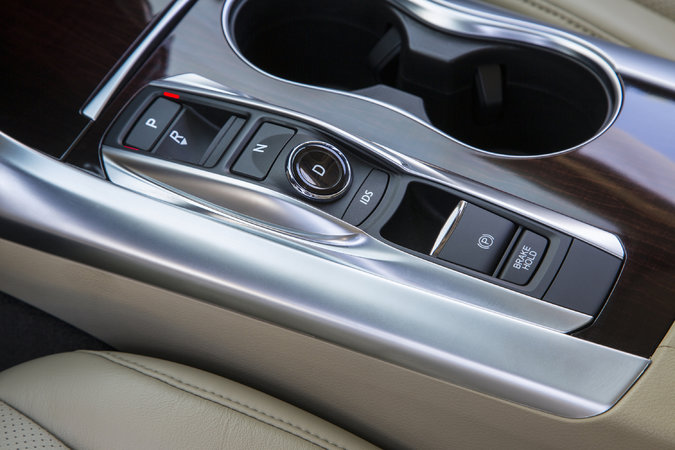
Somebody at Honda probably thought "What could be simpler
than pushing a button?" -- Great -- but try pushing the right
button without looking closely. Now imagine doing it in the dark.
But on a lot of new vehicles, electronic technical gimmickry has taken away even that minor physical connection to the functions of shifting a car. The lever with its distinct ergonomic positions has been replaced by push buttons, or a lever that "bumps" up or down but always returns to the same position, or "paddles" on the steering wheel, or something else that seems futuristic and cool, but isn't particularly intuitive. Others have engine "Start/Stop" buttons that are virtually indistinguishable from the other dashboard controls (like the radio, or the climate controls) so that somebody could be driving on the highway, go to change the radio station, and end up shutting off the engine (certain models from Ford/Lincoln were recently recalled for that very reason). Many of these features take away functions that one could previously perform by "feel" and replace them with actions that require the user to look carefully, even if that means taking their eyes off the road.

And this is cars I'm talking about (at least for the moment). Cars which, more than ever, keep drivers insulated, pampered, bathed in concert-level sound, distracted with smartphone convenience and multimedia entertainment, and lulled into thinking that they are in their own living room or a lounge that just happens to be able to take them to and from work, or across the country, swiftly and comfortably. And the drivers are completely flummoxed by the fact that the simplest physical driving functions of their car have been taken away and replaced by more buttons and digital foolery.

I for one still prefer a manual-shifting transmission, as selecting a gear -- any gear -- still has to be very deliberate, and takes several coordinated physical movements. Unfortunately, it's harder and harder these days to find a car equipped with a manual-shift.

Here's another thing on a related note. A few months ago I purchased a new car -- a VW Sportwagen. Interestingly, my previous car was also a VW Sportwagen, which gives me a unique opportunity to compare and contrast two generations of the same basic vehicle. (The old one was labeled "Jetta" and the new one is a "Golf" -- but it's not much more than a name change, since the two models have long shared most of the same underpinnings). Of course, VW (like any car company) has gone to great efforts to highlight all the improvements that have been made in the newest generation. After a few months of living with the new car, I've come to notice some differences, but in many ways, the differences actually lean in favor of the older generation -- at least by my priorities.

What are some of the highlighted "improvements"? The new car certainly has a lot more electronic "goodies" than the old one had. The new car has a tremendous sound system with touch screen controls, USB ports for connecting iPod or iPhone, complete smartphone interface, Bluetooth, satellite radio, premium speakers, and even a trunk-mounted sub-woofer. However, I've found that it's almost impossible to use it when driving -- easily as dangerous as texting and driving. Changing stations or media input is best done when stopped. It has the push button "Start/Stop," which is more of a gimmick than an improvement, and the gear shift paddles on the steering wheel, which I've found myself accidentally pushing on several occasions (HOLY CRAP, WHY IS THE ENGINE SUDDENLY REDLINING?!!??). It also has back-up camera, which I have to admit is a nice safety feature.

All great stuff (?) to be sure. Electronic gimmicks, feature-packed sound systems, and lots of push buttons seem to appeal to a wide cross-section of the car-buying public today, and they are super easy to sell. But what the car companies know, and many in the buying public don't, is that these "high tech" electronic do-dads are low-cost/high-value. That is, they cost the manufacturer next to nothing, but buyers place a premium value on them. Car manufacturers have found that they can load a car up with these high-tech goodies without increasing their own cost much, but people will be willing to pay more, and perceive the car as a better value. And that means big profits.

But what are some of the ways the older model was better? Not in the glamorous ways, or in the ways that today's typical buyer would notice. One thing I've noticed is materials. The older car felt more solid and much more substantial than one would expect from a sub-compact car. The newer one feels less so. Sure, all cars today use a ton of plastic in the interior surfaces. But there are all kinds of plastics out there. Some feel soft, thick and leather-like, and others feel hard and cheap. The new car uses lots more cheap-feeling plastic (some panels even have visible molding seams). Here's another thing I noticed. The older car came with a full-size spare tire. YES - a full-size spare - not one of those temporary-use-only donuts. You can guess what the new car comes with. There are other things along the same lines, but I'm not going to bore my readers with them. Suffice it to say, many buyers probably wouldn't give these things a second thought, but to me, the real quality is in a car that feels substantial and won't develop squeaks and rattles over time. Sure, the new car is nice, but it seems to have lost something compared to the old.

Okay - so what does this have to do with bikes?

Well, the same trends that we're seeing with cars are also working their way into bicycles. Electronic (and even wireless) shifting. Hydraulic shifting and braking. Smartphone connectivity. Push button convenience. There's this move towards high-tech gimmickry that sells a false sense of value, at least to the buyer. And often, these "improvements" really don't improve anything, but they're super easy to market.

High-modulus carbon fiber frame. Yours for only $599 from Nashbar.
Made in the same Chinese or Taiwanese factories that make the
premium brands, but without the "status" of the name. The same
basic frame can be sold under a variety of brand names --
only the decals and paint would be different.
On the other hand, many of today's bikes use cheaper manufacturing processes and materials, lowering the true value even as the prices to the consumer rise. Sure, carbon fiber is supposedly high-tech and expensive, but the reality is that a lot of the expense is due to hype and marketing, not the cost of the material, and certainly not the cost of the labor, which is mostly done in China or Taiwan for a reason. Could I be wrong about that? Then why does an "open-source" or "open mould" carbon fiber frame -- like those that are sold by Nashbar, Performance, Chain Reaction, or others (and sold under a variety of labels, differing only by the decals) -- cost only a small fraction of the price of a premium-brand frame, even though they are typically made with the same materials, by the same workers, in the same factories?

This cheapening of materials and manufacturing carries over to the metallic components as well. For example, compare a classic aluminum crank from early '80s to a typical aluminum crank today. The older crank will likely be cold-forged with the strongest aluminum alloys. Because of the strength of the alloys and the forging process, it will tend to have slimmer arms, narrower "Q-factor," and a nice polished or pearl anodized finish. Except for the very high-end of the market, many of today's aluminum cranks are hot-forged or melt-forged from lower strength alloys, then painted, or even given a dull "bead-blasted" finish. Other components, like derailleurs, stems, seat posts, and brakes, have fared similarly. Functionally, these things are fine, but they are much cheaper to make, and represent a step back from a quality standpoint. Many buyers today likely don't even notice these quality differences, though, because they're too dazzled by a high-end name, flashy graphics, "smart" technology, electronics, and push-button conveniences.

Another thing: the little paddles or buttons that shift most of today's bikes remind me a lot of those little paddles on the steering wheel, or those console levers that "bump" up or down but always return to the same position. They are definitely convenient, and they seem simple enough, but they have a hidden complexity that makes them difficult (if not impossible) to service, and they're less intuitive -- less "physical." Of course I'm not suggesting that a mistake on a bike with these features could have the same dire consequences as on a car or an SUV. Nobody's going to mistakenly shift their bike into Neutral, thinking it's in Park, and end up running themselves over. Not. Even. Possible. But it does take away some of that physical connection to a bike's function -- even more-so when those buttons or paddles are only activating electrons instead of a cable.

And now I've come back to electronic shifting again. By all accounts, the stuff works great. But it's terribly overpriced, and comes with certain downsides that the hypesters rarely acknowledge. Can the components be serviced - or only replaced? Will next year's "latest and greatest" be in any way compatible with last year's model - or will a full system upgrade be needed because of one fried component?

Here's something else that hasn't really gotten that much coverage. Last week I saw that a woman rider named Lael Wilcox had just won the 2016 Trans Am Bicycle Race -- over 4200 miles in 18 days, 10 minutes. Wilcox wasn't just the top-placed woman. She won the race outright. But something in the account of her victory caught my attention:

"As soon as she (Wilcox) pulled away from the former race leader, her Di2 battery died. The electronic shifting system enables fast, crisp shifting and minimal hand fatigue over thousands of miles. But it requires a battery, and Lael had struggled to keep it charged for more than 3 days at a time." 

At that point, Wilcox had to limp along without being able to shift, her derailleurs having become little more than useless aluminum tumors, until she got to a place where she could try to salvage the situation. She had a spare battery, but her bike's proprietary design features made removing the old battery out on the road virtually impossible, and connecting the new one a "cram-it-in-there-and-hope-for-the-best" situation.

So, there in a nutshell, a dead battery could easily have cost her that victory. The regular Shimano STI has an awfully light touch, so I can't imagine how much hand fatigue was saved by going electronic -- but it all would have been for nothing if she hadn't been able to (with considerable trouble and effort) replace the battery with a spare.

Let me here remind readers of an earlier post, on Electronic vs. Mechanical Shifting. In it, I offered "Seven Retrogrouchy Reasons Why Traditional Shifting Is Better Than Electronic." Two of them were "no batteries." Including that twice was originally meant as tongue-in-cheek. Now I'm even more inclined to stand behind it.

I've said this many times. Bicycles are at their best when they are simple, reliable, and beautiful (not necessarily in any particular order). Adding high tech complexity doesn't necessarily improve them, regardless of what that technology might do for cars. And what we're seeing now with these highly-publicized deaths and recalls is that the rush to incorporate more and more "smart" technology may be a double-edged sword in cars too.

How much is too much?

Friday, July 1, 2016

The Perfect Number of Bikes?

X+1, whereas "X" represents the number of bikes you own currently.

I found this lovely Mercian track bike, offered up from a seller in Britain. 1988 Professional model with original paint. And even though I need another bike like I need . . . well . . . another bike, I just couldn't pass it by. I'm such a sucker for these things. Of course, if I'd found it after last week's Brexit vote, the cost to me would have come down some more, but it's still a lovely find.


The flamboyant blue paint was a bit dull, and there were plenty of tiny little nicks in the paint, but on the whole it was in very good shape. I was able to do some touch-ups, and a bit of effort with a soft cloth and some polishing compound brought back a lot of the paint's original gloss.

Here's a cool build detail you don't see every day. The wrap-over seat stay treatment used to be fairly common on British bikes, including Mercians, but has really faded away since the '70s. I'm actually shocked that this frame, built in '88, would feature it. The original Reynolds decal was about half peeled off, but I was able to find an exact replacement.
Those long spear-points on the bottom bracket mark this as the Professional model. At the Mercian workshop, I got to see how those tangs are welded onto a shell, then filed seamlessly. They should add a lot of stiffness to the bottom bracket - not that my skinny legs need it.
The lugs on this bike are Prugnat 62D, which have long points, and a small "scroll" detail cut into them. But the really cool piece here is the fork crown. . .
That's a Fischer fork crown with long tangs added, to echo the tangs on the bottom bracket. The Fischer gives the overall impression of a twin-plate crown, but in a cast one-piece design. Being sand-cast, they were very rough-looking in their "raw" state and took a lot of filing and work to make them look good.
These pictures previously appeared in a couple of posts from this blog's earlier days - Lovely Fork Crowns, Parts I and II. There you can see the crown in its raw state, and with a bit of machining to pretty it up.
A look at the upper head lug. After the Nervex Professional, those Prugnats are among my favorite lugs out of the box. The long points and that little scroll detail have such a well-balanced, classic look that's hard to beat.
When I get this put together, I'll be sure to post more photos.