Monday, November 4, 2013

That Bike Cost HOW Much?

I wrote in an earlier post (Bikes Aren't Cars) that bicycles are starting to get a reputation as "toys for rich people." Of course, there are still plenty of good bicycles out there in a wide range of price points that offer good performance and value -- and many bicycle components have been developed that bring high-end performance to more affordable price points. Nevertheless, I've been reading articles recently about new "flagship" bike models -- dubbed by some as "halo" bikes -- that take the "toys for rich people" notion to new heights. And because these are the bikes that will get highlighted in the mainstream media, they'll only add to what I think is a bad perception that does nothing to help the rest of us.

Take a look at some bikes and prices:


Specialized S-Works McLaren Venge - $18,000


Trek Madone 7.9 WSD - $15,500


Cervelo R5ca - $10,000 (frameset only)


Honda CBR1000RR - $13,800 ($14,800 with ABS brakes)

I couldn't help but throw that last one in there -- the Honda CBR1000RR is about the closest thing a person can get to an all-out racing motorcycle for the street, and in fact, with only minor modifications is ready for the race track. It presumably fills the same role for motorcycle enthusiasts that the Specialized, Trek, and Cervelo (and others) fill for bicyclists. And the difference in price between the Honda and the other bikes listed here is enough that a person could buy the Honda, and have enough money left over to still buy an awfully nice road bicycle.

Is there less engineering and R&D cost for the Honda than for the other bikes listed above? Are the materials less expensive? Is there less labor involved? Is it less technologically advanced? Of course, the answer to all of those questions is NO. The Honda has a liquid-cooled four-cylinder, dual-overhead cam engine with four valves per cylinder, computer-controlled fuel injection and ignition system, available computer-controlled anti-lock brakes -- and that's just a start. It puts out 177 horsepower at 12,000 rpm and it's capable of a top speed of at least 170 mph. The precision of its engine and transmission and all its bearings has to be absolutely perfect in order to make any of that possible. But it sells for  $700 - 1700 less than the Trek Madone WSD, and $3200 - 4200 less than the Specialized McLaren Venge.

All the bikes I've listed (except for the Honda) are also available in lower-priced versions, made in the same basic molds with less "exclusive" materials and built with less expensive components, but selling for half (or less than half) as much. For example the "basic" Cervelo R5 frameset is "only" $5000. I have no doubt that there is still a huge profit margin built into that price.

So what justifies the cost of these "ultra-premium" bicycles? The makers will say these bikes are hand-built with the latest technology, highest "grade" carbon fiber weaves and top-level components -- but that doesn't really cover it. Hand-built? In a sense (a fairly weak sense, that is), most carbon bikes are "hand built" inasmuch as a person lays down layers of carbon fiber into a mold by hand. But it's still made in a mold, and the only difference in labor between the ultra-premium model and a less-expensive one based on it is whether the person doing the lay-up is an engineer in the US or a basic laborer in China making $2.00 per day. Top-level components? Well, top-level Shimano Dura Ace components cost almost double what their Ultegra counterparts cost -- but are they twice as good? Once again, the components are just another example where we have to wonder what justifies the price difference.

What it really comes down to is that the bikes are priced like this because they can be. Because there are people out there who can afford them, and are willing to pay the price. In an article from Cyclingnews.com ($10,000 bikes - What's the Point?) I found this, from a marketing manager with Giant:
"We find it's more of the affluent (doctor, investor, lawyer), performance-minded customer that purchases a bike at this price range. . . Their lofty prices (and presumably, the associated impressive performance) can raise the perceived status of the brand. . . We build halo bikes to see how far we can push our product line -- literally building what we feel are the best bikes in the world for that 1-2 percent of riders who desire the very best."

Like I said: Toys for rich people. Notice the near-admission that the lofty price merely implies impressive performance. Of course it's really all about appearances -- status. From the Cyclingnews article: "As with any gear-oriented sport, people just like to have the best -- if only for the illusion of competitive advantage (emphasis added by Retrogrouch) -- and some of those people have the money to spend. Moreover, many buyers don't make their bicycle purchases based on how well it suits their abilities. Truth be told, we often buy based on what we want to be and the image we want to project."

As I've already hinted, I also take issue with the notion that the prices of these bicycles are justified because they are "hand-made." From the above-mentioned Cyclingnews article comes this, from a Cervelo spokesperson:
"One thing that might be getting lost these days is the sense of how special a carbon frame is. We make very few R5ca frames and they're all just as fussed over as an artisan made steel frame. They're handmade and are as cutting edge as anything you'd see in F1 or Moto GP racing."

Likewise, the Nov. 2013 issue of Cyclist magazine also touted the exclusive "hand-made" nature of the new Trek Madone 7 series. "Investing in this, the highest level of Madone, means you're getting something entirely handmade in the US. . . the 7 Series is about as close to bespoke as you can get without going for a full custom one-off."

Umm. . . the frame is popped out of a mold. I'm sorry, but I cannot be convinced that putting sheets of resin-impregnated carbon fiber into a mold takes the same amount of skill as cutting, mitering, filing, brazing, and everything else involved in a custom-built steel frame.

A truly "hand-built" bike: a full custom Richard Sachs.
Very exclusive, and approximately $5000 for the frame.
Richard Sachs is one of the top frame builders in the US. (I don't mean that in a stepping-on-toes way -- there are a number of builders I'd put in that same level). To see the process involved in Sachs's work, check out his flickr page: (Sachs's collection). His reputation as a builder is as good as it gets, and the typical cost right now for one of his frames is about $5000 -- half as much as the Cervelo R5ca. Last I heard, the wait for one of his frames is at least 5 years - maybe more, so it's hard to get into a more "exclusive" club. Sachs only builds about 5 or 6 frames per month. Cervelo sets an arbitrary limit on how many R5ca frames it makes (to keep up the impression of more exclusivity), but I wonder how many they could make make in a month? Is it any less than the number of "basic" R5s they make?

If the price, and wait, for a Richard Sachs frame is too much, there are other builders who will also build a fully-custom, truly "bespoke" frame for less -- a bike that really is one-of-a-kind and made-to-measure. For example Mercian Cycles in England will build a custom frame for as little as $1200, and up to $2500 for the top of the line model with extra-fancy hand-cut lugs and Reynolds 853 heat-treated tubing. The wait is around 9 months. A fully custom Rivendell is about $3500 with a 6 - 12 month wait. Or peruse a list of framebuilders who show at the North American Handmade Bicycle Show (NAHBS) and find a wide range of seriously talented people who will build a custom frame as simple or as over-the-top fancy as one can imagine.

Any of these custom bikes, in my opinion, is every bit as unique and "special," as the so-called "halo" bikes -- with the added benefit that they are actually made for the specific buyer, meaning they are even more exclusive than anything popped out of a mold. It's very likely that one of these might truly be one-of-a-kind -- at a fraction of the price of the halo bikes listed above.

Friday, November 1, 2013

Brooks Saddles

I kind of lose count of how many bicycles I own. The total is somewhere around 12 or so, but the number changes from time to time. All but a couple of them have Brooks saddles. They are my favorites, and a favorite saddle of Retrogrouches the world over.

Natural leather saddles aren't perfect, but then what in this world is?

Yes, plastic saddles are lighter and require little/no maintenance or care. But maintenance isn't really a concern for me -- in fact, it's one of the things I enjoy about my bikes. Some say that leather saddles require a break-in period, but I haven't found that to be the case -- for most Brooks models that I've used, they feel pretty darn good right out of the box.

The Brooks story is practically legend -- one of those great stories of industry and invention that would have to be created if it weren't already true. The company was founded back in 1866 by John Boultbee Brooks, originally as a manufacturer of horse harnesses and leather goods. According to the company's history, J.B. Brooks's horse died in 1878 and he was unable to purchase another. The story goes that he borrowed a bicycle, but hated the saddle so much that he "vowed to do something about it." He filed for his first leather saddle patent in 1882.

Over the decades, the company has made a range of products for bicycles, and motorcycles for a time, including saddles, shoes, oilskin clothing, cycling bags, and more. The company had expanded into making furniture, and at one point, in the 1930s, had even purchased a motorcycle company! Other leather saddle makers were absorbed by the expanding Brooks company, including Lycett, Leatheries, and Wrights. Some of these continued to be made for a while, though essentially overseen by Brooks.

B-17 Standard. Nicely broken in, about 12 years old.
In 1958, Brooks was purchased by the huge Raleigh Cycle Company, which was then itself taken over by the British Tube Investment Group, or TI -- which also owned Reynolds Tubing and internal-hub gear maker Sturmey Archer. Brooks and SA were joined together into their own division by TI/Raleigh, where they remained until bankruptcy brought down the whole conglomerate in '99. I remember when that happened, and being a bit worried that I might not be able to get Brooks saddles anymore, but it didn't take long before investors stepped up to rescue Brooks from the ashes. In 2002, the company was sold to Italian saddle company Selle Royal, which has done a lot to revive the Brooks name and history. Selle Royal has kept production of the Brooks line in England, and has reintroduced lost saddle models and product lines, like bags, clothing, and accessories. Under this new ownership, it seems that Brooks is thriving like they were in their heyday.

B-17 Special, with titanium rails, and larger,
hand-finished copper rivets.
B-17: My favorite saddle is the B-17. I have a few of these and find them to be the best all-around saddle for most of the riding I do. Brooks calls it their flagship model, and it has been in production since at least 1898. It has a nice flat top across the back, with a good width to fit the "sit bones" of most people (about 17 cm wide - perhaps that's why it's called the B-17?). It has undergone only minor changes since its introduction, though it has also been offered in some different variations over the years. There was/is a narrower version, as well as the Swallow, which is like the narrower version with cutaway sides. It was a favorite among some racers. There was also an ultra-narrow version called the Sprinter that was used by some track racers.

Brooks Flyer -- basically a B-17 with springs.
Today, the basic B-17 is called the Standard, while there is also a slightly fancier version called the Special. The Special features larger rivets that are finished more nicely, leather that has been "skivved" or shaved along the bottom edge, and framework/rails that have been plated instead of painted. A titanium-rail version is also available.

Flyer: Basically, a B-17 with springs. Rivendell's Grant Petersen says the springs don't really kick in unless the rider is over 180 lbs., but I don't agree with that. It certainly doesn't give a bouncy, bobbing kind of suspension -- and that's good because I wouldn't want that. But the springs do take some of the bite out of harsher bumps. I use one of these on my mountain bike -- a vintage Stumpjumper from the early 80s. I also have one on my tandem, which works really well because it's a little harder to unweight for bumps on a tandem.

Brooks Professional, dated from 1972. Later versions have
the leather on the nose a little longer to keep more of the
front tension bolt covered. I like the truncated look of this one.
Professional/Team Professional: For decades, the primary choice for racing bikes was the B-17, but in the 1960s, Brooks offered the Professional, which quickly became the top choice for racers. The Professional was slightly narrower (16 cm vs. 17), and not quite as flat across the top as the B-17. It also seems to use slightly thicker leather, making it a little tougher to break-in. This is the saddle about which people tell stories of crazy pre-treating and break-in rituals, such as soaking the saddle in neats foot oil. Blogger and retired frame builder Dave Moulton posted this article about his most recent Brooks saddle purchase (Back in the Saddle Again). In it, he explains his pre-treatment routine to soften up his new Professional model saddle. The process he describes is pretty similar to what I've heard a lot of riders use back in the day.

In the 1970s, the Team Professional came with larger, hand-finished rivets. Eventually a "Pre-Softened" version was offered (with those very words embossed in the top) although I've heard more than a few people say it didn't make a big difference. I have the Professional on a couple of collectible vintage bikes where it is the right choice for the bike and the vintage -- but for most of my riding, I prefer the B-17.

Swift saddle, in this case with chrome-plated
steel rails, not titanium. I do have a titanium
version, however. The cork is an affectation,
coming out of old track-racing lore.
The Swift: This model is a lot like a Team Professional, but slightly narrower still, with a little more leather cut away on the sides. It also comes with titanium rails. It has a very cool, sporty, minimalist look. Although leather saddles in general weigh more than plastic ones, for people concerned about weight, the Swift is the one to get. This is another one that can take a bit of break-in, but it isn't too bad for a while on shorter rides until that point.

B-67: This is a wide, sprung saddle. I don't use these myself, as it's a good bit wider than a B-17 (205 mm) and more width than I need for the types of riding I do -- it's really designed to be a good saddle for a more upright riding position. But I have installed them on my wife's bike, and on the stoker position of our tandem. She seems to like it and says it works well for her. There is a very similar saddle, the B-66, which has an older style undercarriage with double rails, requiring an older style straight seatpost and clamp system. The B-67 has basically the same shape but with a modern single-rail undercarriage, so it works with the kinds of seatposts most people use today.

B-67 on my wife's refurbished Trek. Wide and comfortable.
Great saddle for a more upright position.
There are, of course, a lot of other Brooks models, but those are the ones I have the most experience with. All the saddles pictured are on my own bikes or bikes I've built.

Maintenance on a Brooks saddle is pretty straightforward. Don't let it get soaked so often, or ride on it soaked, as it can start to sag or splay out. For my commuting bike, I have a saddle bonnet, or rain cover, tucked away in a pocket of my saddlebag that I can use in case of rain. On other bikes, I'll just tuck a rolled up plastic shopping bag and a couple of rubber bands into the saddlebag or pack -- it isn't as pretty as the "official" Brooks rain cover, but it works fine in an emergency.

Use a little leather dressing on it now and then, but don't overdo it. Brooks Proofide is the product that Brooks recommends (of course) and the one that I use, but there are other products out there that do the same basic thing, such as Sno Seal -- but regardless of what product one uses, I don't typically apply it more than once a year or so, though it can vary depending on the kind of use the saddle gets. Sometimes if the saddle starts to sag, people will use the tension nut on the front of the saddle, but it is really easy to go overboard with that. I've seen a few old Brooks saddles where the leather was pulled from the nose rivets by aggressive over-tensioning. One of the better ways to deal with a sagging Brooks saddle is to drill or punch some lacing holes along the bottom edge of the leather, then lace it up like a shoe. Pulling the sides inward tends to restore a little shape to the top because as the top sags, the sides will splay out.

When it comes to comfort -- which is really the main job of a saddle -- it is hard to do better than an all-leather saddle, and there really aren't (and I'd argue never were) any out there better than the ones from Brooks. On a more personal note, another reason I like Brooks saddles is because it is a great way to always have my name on my bikes.

Wednesday, October 30, 2013

Rethinking "Normal"


I walked out of my classroom and into the hallway, wheeling my bicycle beside me as I headed out of school at the end of the day. A student looked at me, and then at my bike, and then with a screwed up expression said clearly, “THAT is not normal.”

Not “normal”?

Not typical, I thought. But not normal? I had to think about that one.
            
Unfortunately in America, our collective
attitudes about bikes were formed back
when this new.
Along my commute to the school where I teach, which is a rural/suburban school district, I notice students waiting at the ends of their driveways for the bus – kids waiting at one driveway after the next, for what is essentially “door to door” service. The bus picks up one child, drives maybe fifty yards to the next address, then picks up another child. Some of these kids wait inside idling cars with their parents who were kind enough to drive them from the house to the street, thereby saving them the walk down the driveway. Rain or shine, warm or cold, it’s always the same. After the bus pulls away, many of those parents then drive back to the house.
            
Apparently, that is normal.
            
I am frequently faced with disbelief from students (and even some teachers) when I answer affirmatively their question, “Did you ride that to school”?
       “Yes, I did.”
       “You’re joking, right”?
       “No. Really. I rode this to school.”
Then come more questions. “How far away do you live”?
       “About fourteen miles.”
       “Each way”?
       “Yep.”
            
Then come the weird looks. Sometimes jokes. Clearly, this is not normal.

A great way to get to work. 
I should make it clear that I’m not really concerned with appearing “normal,” or with what some fifteen-year-old kid thinks of me. But rather, I’d like to ponder the social/cultural significance that an offhand remark symbolizes.
            
We are a car-dependent culture. Or perhaps I should say car-crazed? Obsessed? In places like The Netherlands or Denmark, people are as likely to bike to school or work as drive. Car ownership is a burden many people don’t want or need. In Copenhagen, the notion of driving a car two or three (or five or ten) miles just to get a loaf of bread and some milk would be ludicrous. Driving kids to the end of a driveway to wait for a bus would mark a person as certifiable.
            
But that’s Europe, right? This is America. Wide open spaces, fierce independence, and all that. We need our cars, don’t we? But what is more independent than getting to work under our own power? Without the regular ritual of filling up a gas tank at prices that put us more and more into the pockets of big oil companies. 
Car full of girls and two guys on bikes. The conversation:
Guys: "Have you read Ralph Nader's book?"
Girls: "Get on the sidewalk!"

The thing is – we do need our cars. Nobody is denying that, least of all me. But are we really as dependent on them as we have allowed ourselves to believe? When we allow ourselves a moment to think about it, we might find that there are lots of trips that we might make by car that could just as easily be done by bike. We have options.

One thing about commuting by bike is that it is probably the best, most "pure" use of a bicycle. People tend to think of bicycles as "green" but that isn't necessarily true. Only when we use our bikes for commuting, shopping, or something else that would otherwise be done with a car -- only then is it truly a "green" vehicle. Don't think I'm getting preachy or smug about it -- I love bikes and riding, regardless of what the reason is. But if one is thinking that the simple act of riding a bicycle is somehow good for the environment, I'd say it really depends on what they're doing.

Last school year (August to June), I managed a "bike-to-work" average of 50% -- exactly. At the end of the year, I calculated that my bike commuting totaled over 2500 miles, and saved me approximately 75 gallons of fuel (I average about 33 mpg or so in mixed driving -- VW Jetta diesel, if anyone's wondering). And this, keep in mind, is in Northeast Ohio, which hardly has a riding-conducive climate. 

So far this year (at the end of October), I'm averaging over 70%, which is a good bit better than I was doing at the same time last year. I know my average will drop during the winter, but my goal is to increase my year-long average to 55% or more. 60% would be an awesome accomplishment.

In addition to the fuel savings, I also lost weight -- about 20 lbs in 12 months. The weight loss wasn't intentional -- just a fortunate side effect. I now weigh the same as I did when I graduated from college more than 20 years ago. The benefits have been fantastic.

Lastly, commuting by bike has made it possible for me to get a lot more riding time than I would otherwise be able to do. Between work, and my kids, and everything else that happens in life, it can be really difficult for me to find the time to get out for a ride. When I can combine my commuting time and my riding time, it becomes a win-win situation for me.

Back at work, I still get the weird looks, but I can deal with it. After all, what is "normal"?

Thursday, October 24, 2013

Religion, Politics, and Helmets

“In religion, politics, and helmets, people’s beliefs and convictions are in almost every case gotten at second-hand, and without examination, from authorities who have not themselves examined the questions at issue but have taken them at second-hand from other non-examiners, whose opinions about them were not worth a brass farthing.” -- Mark Twain

Mark Twain: America's First Retrogrouch?

OK, I added the "helmets" part, but I think if Mark Twain had been a cyclist, I'm sure he might have included them. After all, he did write The Adventures of Huckleberry Finn in 1885, the same year that the first safety bicycle was invented. Coincidence?. . . well . . . yeah, it is. But still, it fits.

I swore to myself that I wasn't going to write about helmets, despite having a bicycling blog. But something happened that got me thinking about the subject, and so at the risk of doing something as pointless as adding sand to a beach, I've decided that I might as well get to it now while my blog is young, and get it over with.

Here's the thing. I was out for a ride with an old college friend, one who has always been adamantly a "no helmet" rider as long as I've known him. I figure it's his choice to wear one or not, and as long as he has a choice, he refuses to wear a helmet. OK by me. As we were riding along in the local cycling mecca, the Cuyahoga Valley National Park, we passed a group of riders going the opposite direction. As they passed us, a woman in the group obnoxiously yelled across at my friend, "GET A HELMET!" To which my friend bellowed back viciously "F#@K YOU, B*%CH!!"

Suddenly I couldn't decide who I was more put-off by: the self-righteous Buttinsky who couldn't keep her opinion to herself, or my hot-headed and vulgar riding companion. Give me a choice which one I'd rather ride with, and I'll ride by myself, thank you.

Seriously, the helmet issue is right up there with politics and religion as far as taboo subjects go. In some ways, it is almost a religion in itself. It has its atheists and its evangelicals. And then there are people like me: former-altar-boys-turned-lapsed-catholics-dabbling-in-buddhism-but-really-just-agnostic-if-we-have-to-give-an-honest-answer. There might be a few of us. The thing is, actual religion is divisive enough. I don't understand why some people feel compelled to raise helmets to the same level.

I've read lots of articles about the safety standards and the tests that are done on helmets, and I understand pretty well the physics of a collision. The truth is, there isn't a lot of similarity between the tests on helmets and the real world. Helmets are weighted and dropped onto a hard surface at a speed that maxes out at about 13 mph or so, and the g-forces are measured. I suppose that might be a decent benchmark for an accident where someone simply falls over off the bike from a near-standstill. But it's hard to imagine any collision between a cyclist and a moving car where the impact speed would be less than 25 mph -- probably much greater. Add the weight of the vehicle, which increases the force even more, and the flaws of the testing become clear. No bicycle helmet currently made could withstand the kind of force generated in a serious car-bike accident, and any helmet that could withstand it would be unwearable.

When one is really aware of the testing and the standards of protection for bicycle helmets, it becomes pretty difficult to justify the kind of overt "Get a Helmet" fundamentalism that many people feel obliged to exhibit. On the other hand, there are all kinds of very real accident scenarios where a helmet may indeed prove very beneficial. Nobody should be so over-confident in their own bike-handling skills that they should think they will never hit the pavement, so the fervent refusal to wear a helmet doesn't make a lot of sense either.

I wear a helmet for most of my riding. But I would never over-estimate how much protection a helmet can give me. There are times, like pedaling around my neighborhood for instance, when I do not feel compelled to wear one. People in cities like Amsterdam, or Copenhagen never wear helmets, yet in some ways they are safer on their bikes than we are here in the States -- the overwhelming number of cyclists in those cities lends them a certain "strength in numbers" status that means drivers in cars actually look out for them.

I cannot even remember the last time I crashed a bike on my own, but I remember like yesterday the time I got side-swiped by a car (even though it was 10 years ago) -- the car's side mirror broke off as it slammed into me, and the impact was enough to knock my handlebars out of alignment, yet somehow I managed not to go down. But I do commute to work year-round, and I know it's a distinct possibility that I could hit some "black ice" some cold morning and end up on the pavement. A helmet would probably be a big help in that case. On the other hand, if I get nailed by a 6,000 lb. SUV, I have no illusions whatsoever that an 8-oz foam bowl on my head is going to do anything to keep me alive. In a situation like that, with or without a helmet, I'm toast.

That leads me to another thing about the helmet debate: that it even infects people who don't ride bikes at all. If a helmetless rider does get flattened by a cell-phone-distracted-driver in a Cadillac Escalade, you can be sure the newspaper articles (if there are any) will make sure to state prominently "The cyclist was not wearing a helmet." Then everyone can breathe a big sigh of relief and blame the cyclist, concluding that some "idiot" on a bike got what he deserved, and some can maybe even push for mandatory helmet laws while we preserve the right of every driver to text or talk on the phone, or surf the internet, or watch YouTube videos while driving.

The way I look at it, a helmet is a piece of safety equipment that may help in some kinds of accidents but not others. It's one piece (maybe only a small piece) of a safety picture that should also include such things as understanding the laws and the cyclists' rights, proper drivers' education that actually teaches those laws and rights, and providing proper infrastructure that accounts for non-car traffic. More important is having a good understanding of how to ride defensively, and developing the skills to avoid accidents in the first place. But there is nothing about a helmet that is "certain" enough to justify the kinds of falsely dualistic, black and white, manichean attitudes about them.

Addendum: Mark Twain did actually write about a bicycle-riding experience -- in a humorous essay titled "Taming the Bicycle" in 1884 -- about a failed attempt to ride what was known then as an "ordinary" or "penny farthing." The story was never actually published in his lifetime, but it ended with these words: "Get a bicycle. You will not regret it. If you live."

Wednesday, October 23, 2013

Press-Fit Bottom Brackets: The Creaking is Standard

One of my cycling friends recently got a new mountain bike. Carbon fiber wunderbike with one of the latest press-fit bottom bracket systems. Don't even ask what type of press-fit BB, because I don't think he knows, and I don't think I could tell the difference. Thing is, the bottom bracket creaks, and the shop mechanics seem unable to make the creaking go away. After asking around and doing a bit of reading on the subject, I'm finding that creaking is apparently the only thing that is actually "standard" about bottom brackets today.

It wasn't that long ago that there was a handful of national standards for bottom brackets, and though some would probably want to make it sound as if that was terribly confusing and problematic, in practice it was pretty easy to deal with. The most common was British/ISO. Most quality lightweight bicycles with threaded bottom brackets used it. Most Italian bikes used the Italian threading standard. There were also French and Swiss threading standards, and a couple of oddballs -- Raleigh, for instance, was a big enough company at its peak to have its own unique standard. Swiss was always rare, and both it and French threading disappeared by the 1980s along with the others, as most companies regardless of nationality adopted British/ISO. Only Italian bikes continued as a holdout, keeping Italian threading alive. But even when the various standards were in use (or when working on vintage bikes today) it wasn't hard to figure out what one was dealing with -- often just knowing when and where the bike was made was a huge clue. Taking a few simple measurements and looking closely at whether the threading was left- or right-handed generally confirmed it.

So, for the last 20 - 30 years, it seems bikes had finally arrived at one international standard (with just one nation holding out) for bottom brackets.

Today, it seems that there is a new bottom bracket standard every year. Try and keep them all straight. BB30; PF24; PF30; BB90; BB95; PF86; PF92; BBRight; and BB386. I may have left out a couple, and some of them may have different names depending on who makes them. What most of them have in common is that they have some type of press-fit bearings and require various adapter kits to make them work with different brands and types of cranks and axles. Some of them were created by frame or bike manufacturers, while others were devised by the component manufacturers. They all claim to be vast improvements over one another or over threaded bottom brackets.

What is the advantage to one of these new press-fit systems? As a rider/consumer, I don't believe there is one. Really. The manufacturers will claim the benefit is lower weight and greater stiffness, and people love to hear that, but the difference in weight is negligible -- anyone who can tell the difference in weight would also have to be able to feel the difference of a couple sips of water from their water bottle. As far as stiffness -- just how stiff does a bottom bracket have to be? Once the industry shifted away from square taper bottom brackets, it seems to me they got as stiff as anybody can possibly need. Again, the difference in stiffness between one of these new press-fit systems and an ISO threaded BB is just not something people are sensitive enough to feel.

So then what is the REAL advantage? Like a lot of bicycling "innovations" and "improvements" made in recent years, the advantage is mostly to the manufacturer, especially those working in carbon fiber. By switching to some type of press-fit BB, they can eliminate the metal sleeve in the bottom bracket shell, eliminate the need to have it perfectly aligned and machined to the right tolerances, and eliminate the need to cut threads into it. Lennard Zinn, who in my observation seems to embrace a lot of new technology (or so it appears to me when I read his articles in VeloNews), had this to say in Velo Magazine's 2012 Buyers Guide: "The whole idea of press-fit bottom brackets, after all, is to fit into frames that are not made to exact tolerances so that they can be simply molded with cheap labor and not machined afterward. Now you see the problem."
A press fit BB adapter

The DISadvantages to the consumer are plenty. Changing or replacing components, particularly cranks and bearings, becomes more complicated as installing the proper adapter becomes necessary. The design and quality of those adapters varies by manufacturer, and getting them to fit properly into the frame, and the crank and bearing assemblies to fit properly into the adapter are also issues. Poor fit is not uncommon, and creaking is the usual result. I have yet to talk to a mechanic who hasn't had issues with them. Again, Lennard Zinn: "With the upside of increased frame stiffness claims, that are largely correct, comes a mechanic's nightmare. . . Complaints about creaking or dislodged bearings are common after a frame is replaced with one that has a different BB shell standard than the original. . . but many times the adapters creak or work their way out of the frame. The solution to this creaking? In many cases, frame or crank manufacturers suggest using Loctite. Clearly this is a flaw in the design of the system if that's the fix."

BikeSnobNYC addresses his own experience/issues with a press-fit BB (Here, and Here). His description is funny, but also reflects a common frustration with these things. Here's a sample:
"I recently overhauled the bike, and it was time to pull the bottom bracket since the bottom bracket shell was full of all kinds of disgusting scum and frumunda which is something that happens to bikes. Naturally, the bottom bracket adapter was not supposed to be reused because it was plastic and this is the bike industry, so I replaced it with one made from metal that seemed like it would be a lot more better. And I rode. And I rode. The new bottom bracket adapter thingy was not more better. The crank kind of wiggled in there no matter what I did. So I called the company that makes the bottom bracket adapter thingy because they're the kind of company you can just call and be like, 'Hey duders, like, my bottom bracket's got like all this play in it and I'm totally bummed because it's not epic.' That's what I did, and the company was all like, 'Oh, yeah, duder, we know what that is,' and they sent me these new bearing cover thingies to put in the bottom bracket adapter thingy, and I put them in, but the crank was still all wiggly in there anyway."

The blogger and bicycle mechanic RogueMechanic doesn't pull punches when it comes to flawed or problematic bikes and components. He has stoked the ire of many in the bicycle world by blogging about engineering problems, poor construction, or flawed manufacturing -- problems that some out there would rather not hear about. Seriously -- the guy gets hate mail. He did some work for me on a completely different bottom bracket issue (or non-issue, depending on whom you listen to) with a Campagnolo UltraTorque crank system (that could be another whole post, believe me -- if you google "Campy Ultra Torque Problems" you'll find a lot of info on it, much of it from RogueMechanic). I'll never forget what he told me when he returned my repaired bike -- if you've got a bike with a threaded bottom bracket, "hold on to it" he said. Despite the problem with the UltraTorque, ultimately he was able to come up with a solid solution to it and it's been working beautifully ever since. Keep in mind, the UltraTorque crank system is designed for an ISO threaded bottom bracket. Problems he has seen with some of the press-fit systems are much more difficult to solve. Check out one of his articles about the BBRight system (Cervelo BBRight Problem and Solution).

Campy UltraTorque cups being installed
in a British/ISO threaded shell.
Why haven't the various manufacturers simply adopted one new standard? Competition is one reason, I suppose. One frame/bike company comes up with a new standard and releases to the public. But a competing company isn't likely to want to adopt it and seem to be supporting their competitor. Also, each new system supposedly addresses the perceived problems or weaknesses of the other systems, trying to out-do one another -- though not without having other weaknesses themselves. And with so many competing "standards" (that word is rapidly losing meaning) the only solution for any kind of compatibility is the use of adapters which lead to fit issues and creaking.

It's possible that at some point, the "market" will narrow down the choices. Maybe if we're lucky the manufacturers will stop coming up with new systems long enough for that to happen, and one system will emerge as the winner. It might not even be the best in every way, but it will at least be an actual "standard" in the true meaning of the word, then companies can actually make compatible parts that properly fit together. I can't help but think back to VHS and Beta home video systems. Anyone still have a Beta machine out there? If that's too far back to remember, how about BlueRay vs. HD-DVD? For a while, those two duked it out in the high-def video disc market, but eventually BlueRay won out. We can only hope the same thing happens here.

Addendum: So what is a person with a vintage frame to do if they need a new bottom bracket and they have one of the old, now-defunct threaded frames? Velo-Orange offers their sealed cartridge bearing bottom brackets in French threading, which is one of the more common of the obsolete standards. They also have an internally-expanding "threadless" bottom bracket that they claim works well in frames with damaged threading, and should also will work in some older Raleighs and frames with Swiss threading, but I've never tried or tested them. Phil Wood bottom brackets, which are about as good as one can find, are available for French, Swiss, and some older Raleighs and even Chater Lea threading which is yet another old oddball. Lastly, there's always eBay.

Monday, October 21, 2013

Roller "Needle" Bearing Headsets

Every now and then, I like to highlight some great components that are either getting scarce or gone. Today, I want to take a look at roller or "needle" bearing headsets ("roller" bearing is generally the preferred term, so I'll use it from here on). They aren't gone, but they aren't very common -- actually, they never really were that common to begin with. Nowadays, with so many threadless headsets out there, and excellent sealed units available, they are pretty much forgotten. They aren't the perfect headset in any way, but they are serviceable, last a long, long time and I like them.

The thing about ball bearings as they are used in headsets is that they are excellent at reducing the friction of the fork rotating in the frame, but not as great at handling loads. The fork of a bike (as I've described in an earlier post) is like a "front line of assault." Every bump, large or small, travels directly up the fork, transmitting shock through the headset. Ball bearings have very little contact area with their races (which is why they are so good at reducing friction), but that small contact area also means those forces are concentrated on a much smaller surface area. Over time, the bearing races can become dimpled or pitted, which leads to "notchy" steering. 

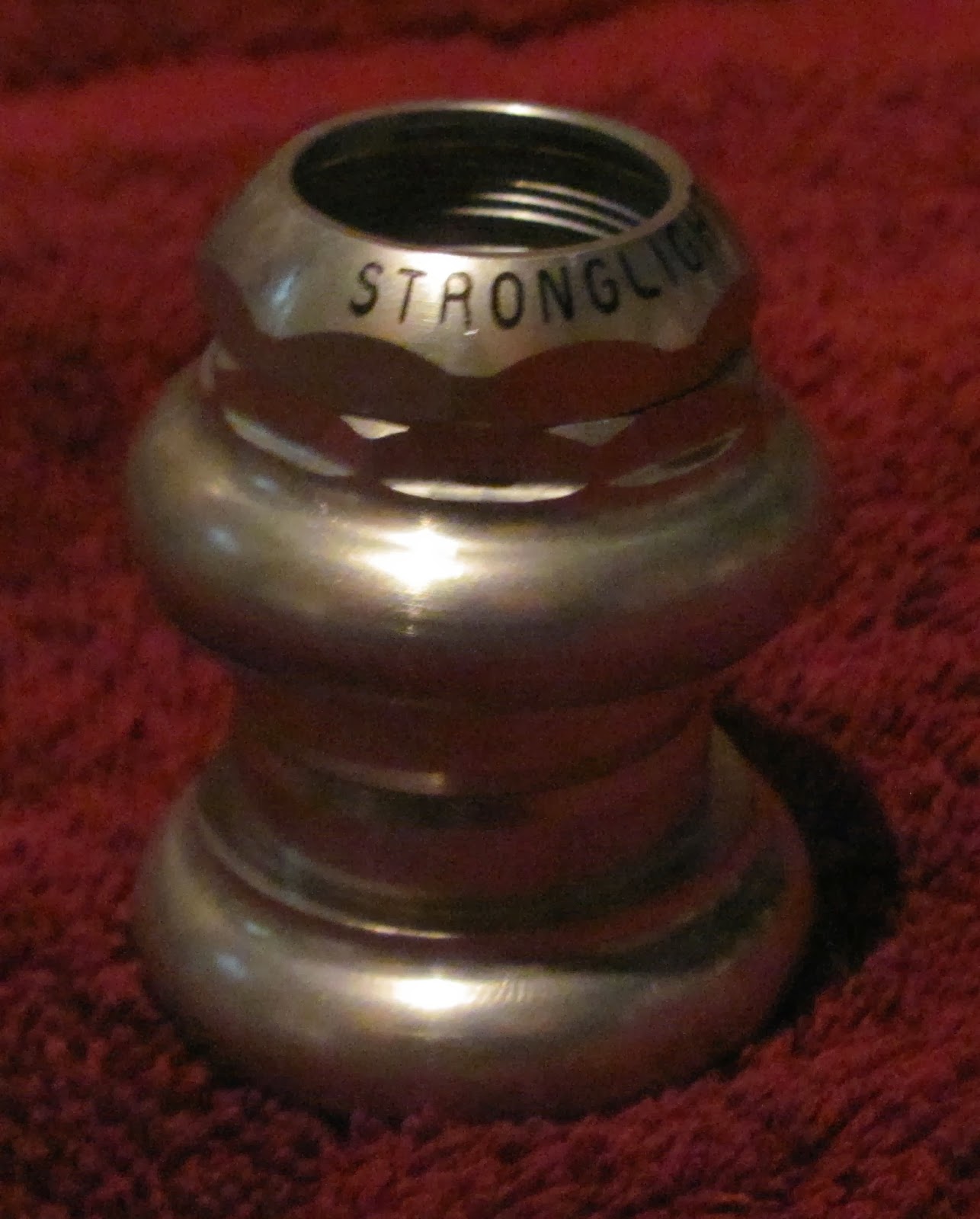
Stronglight A9, set out so all the internal parts can be seen:
(From top left) Lock nut; top adjustable cup; steel bearing
race; roller bearings/retainer; steel bearing race; upper
pressed in race; lower pressed in cup; steel bearing race;
roller bearings; steel bearing race; fork crown race.
Roller bearings have a larger contact area, which makes them better at handling loads. On the other hand, critics of roller bearing headsets will point out that they have more friction (I'll explain why later in the post. Read on.) -- they don't allow the fork to turn quite as freely as ball bearings. Then again, in actual riding, forks don't really move that much -- bikes turn or change direction more from leaning than by "steering." In the small amount that forks actually rotate in the frame, roller bearings work fine. 

Another benefit of roller bearing headsets is they are believed to add a bit of stability to some bikes. Occasionally, some bicycles will experience something referred to as "shimmy." There are different explanations (and some disagreements) about exactly what causes shimmy, but it is essentially a rhythmic, almost resonant shaking of a bicycle that one can feel through the steering. It seems to come from a combination of the gyroscopic action of the wheels and perhaps an oscillation or twisting in the frame. The steering action twists the frame one direction, then that energy is momentarily stored then released, twisting the frame back the other direction, then back again. In some cases, it can also be exacerbated by loading a bike with luggage/bags. Some bikes that feel fine with hands on the bars can shimmy badly when riding no-hands. I should point out that if a bike that never had a shimmy problem suddenly develops one, it could be a sign that something is actually wrong -- loose spokes, loose headset, cracked frame or fork -- so if it happens, definitely investigate, but be aware that sometimes it just happens. (read more about shimmy HERE)

In any case, sometimes a frame with a mild shimmy can be mitigated by a roller bearing headset because of that bit of extra friction. Rivendell's Grant Petersen describes it like this:
A roller bearing headset "increases rotating resistance. The thing is, headsets can be too smooth. A little smooth-stiffness, a little gumminess in the bearings, seems to eliminate the tendency of a bike to shimmy. . . Sometimes, fact of life, a bike will shimmy. It's almost always when you're doing something stupid, like riding no hands at 19 mph with a loaded bike. . . And in that case, a gummier rotation helps." (http://www.rivbike.com/product-p/hsrd.htm)

Stronglight A9. 
Over the years, there have been different roller bearing headsets introduced, though most were pretty similar to one another in design. Stronglight of France was one of the main manufacturers of them, having made several versions. Tange of Japan has made, discontinued, then re-introduced them at various times. Velo-Orange briefly offered their own version, but they don't seem to be currently available. Here are a few examples that were pretty common or notable:

Stronglight A9: This is probably the best-known, most common roller bearing headset one is likely to find. These were available throughout the 70s and 80s. French racing legend Bernard Hinault must have used them, because they had a "Bernard Hinault" edition of the A9 -- though other than having his name on it, I don't think it was any different from the basic version. Mostly aluminum in construction, with floating steel bearing races. The roller bearings were held in nylon retainers. It was lightweight, had a relatively low stack height, and was just a good all-around headset. Most roller bearing headsets use essentially the same basic design as this one, so I suppose one could say it set the standard. They weren't terribly expensive when new, and one can occasionally find NOS (new old stock) ones on eBay for a lot less than some of the deluxe sealed-bearing headsets of today.

Stronglight Delta -- with a lot of extra spacers and
a cable stop for cantilever brakes.
Stronglight Delta: The Delta was essentially a more deluxe version of the A9. It had a slightly taller stack height and included some extra seals that were supposed to help keep out water and dirt. I don't think those seals made any difference compared to the regular non-sealed A9, however. Apart from the outward appearance and the additional seals, the two headsets were pretty similar mechanically. I'm pretty certain that the bearings and races are exactly interchangeable between the two versions.

I have one of the Delta headsets installed on my Rivendell Long-Low. Twelve years and I don't even know how many miles, and it still works like new.

Saavedra (Argentina): This one is kind of an oddball and not well known. Saavedra was an Argentinian component maker that was probably best known for rims -- but "best known" is relative -- they weren't really well known for anything in the USA. The headset has the basic shape of the Stronglight Delta but without the seals, as well as internal parts that appear to be identical to the Stronglights. The design of the wrench flats is a little different from the Stronglight, though, perhaps a bit more reminiscent of the Campagnolo C-Record headset.  Like the A9, it is a very light component. Occasionally these will come up for sale, NOS, on eBay -- usually pretty inexpensive. When you can find them, these are a good bargain for a well-made, nice-looking headset.
Saavedra, from Argentina.

Tange/IRD RollerDrive: This is kind of a roller/ball bearing hybrid design, with roller bearings on the lower part and ball bearings on the upper part. The idea is that the lower race, which takes the most pounding from the road, uses roller bearings to better handle that load, while the upper part (which is much less prone to load damage) uses ball bearings for slightly less friction -- essentially delivering the best of both worlds. Made by Tange in Japan for Interloc Racing Design. Available from Rivendell.

I mentioned above that roller bearing headsets don't move quite as freely as ball bearing designs. This has to do with the fact that roller bearings are like tiny cylinders. When they roll, they want to roll in a straight line. That makes them work really well in bottom brackets and pedals or other places where they can follow a straight-line path around a more or less straight or cylindrical axle (yet as ideal as they are for those applications, their use is still fairly uncommon except in more expensive examples). But when put into use in a headset, they have to follow a curved path.
Tange/IRD RollerDrive: Long life
and low friction.
One way to help that is by setting the bearings up at an angle. The bearing races and the bearing retainer are set up in almost a conical arrangement around the bicycle's head-tube and fork steerer. That helps, but the bearings still have to travel in a bit of a curved line, and they have a certain amount of resistance to it. Given that a headset doesn't rotate very much in actual use, as I pointed out already, it isn't really that bad of a trade-off: Slightly more friction (in a component that isn't hurt so much by a bit of friction), in exchange for really long bearing life. One thing that would probably make them work even better would be to make the roller bearings tapered -- thicker at one end than the other -- but making precision tapered roller bearings is pretty expensive, so the added cost would be hard to justify for the tiny decrease in friction.

Roller bearing headsets aren't perfect or revolutionary in any way. If they did completely disappear, I'm sure we'd all survive. Many riders would never even notice. But I'll still hang on to the ones I have, and keep some spare parts handy in the unlikely event that one of them ever needs to be rebuilt. Who knows, that 12-year-old Stronglight Delta I have might need a rebuild some 15 years from now. I want to be ready.

Wednesday, October 16, 2013

Changing Positions: Bike Fit Then and Now

Let me tell you about a guy I occasionally ride with. He used to ride a pretty "traditional" styled road bike that he'd owned since the 1980s. Level top tube. Quill-type stem. Bars maybe an inch or two lower than the saddle. He was a pretty enthusiastic rider, but no racer. When I'd see him, he usually wore a mountain bike style of helmet (you know the ones, with the attached visor on the front). Why not, he figured, since he also liked riding his mountain bike, and why should he get different helmets for different bikes? I agreed. But he couldn't understand why his other riding friends -- "serious roadies" all of them -- sniggered about the visored helmet.

Not too long ago, this riding acquaintance got a new bike with modern "compact" frame geometry and lots of the latest innovations. Out for a ride on the new bike, this person suddenly understood the sniggers about his helmet. The visor kept blocking his view of the road ahead unless he totally craned his neck. Why? The relationship between the bars and the saddle on the new bike put him in a much lower position than the old bike. Off came the visor.

Road bike designs have changed a lot in the last couple decades. Racing bike positioning has gotten much more aggressive, and other road bikes have followed that trend. I'm not going to even attempt to say whether the more aggressive position is good or bad for racing, but when that becomes the model for other road bikes, most of which are not raced, it seems that the world is a little topsy turvy.

Take a look at some racing bikes and racers from the past:

Fausto Coppi, circa 1950
Eddy Merckx, early 70s
Laurent Fignon, 1980s. 
Fignon, again.
Bernard Hinault, in an old Gitane ad - probably early 80s.
Bernard Hinault and Greg LeMond in 1986.
This is the track bike Eddy Merckx used to break the hour
record in 1972. The perspective angle of the photo might be
throwing it off a little, but that bar/seat relationship is probably
closer than a lot of road bikes today.
Next take a look at some bikes and riders of today:
Bradley Wiggins's 2012 TdF bike. Note how low the stem
puts the bars, but then Wiggins has the bars angled upwards
just a bit. It must work for him.
Wiggins in the 2012 TdF. Notice that with his hands on the tops
of the brake hoods, he's not sitting much higher than riders of
the past when they were down in the drops.
One of Alberto Contador's TdF bikes.
Contador, racing in Spain, I believe. Note again, the
"on the hoods" position.
I found an interesting article on Dave Moulton's Blog: Frame Design Then and Now. (Dave built the bike I recently added to my collection, seen here). Dave Moulton is about as knowledgable as anyone can be about racing bike design, and in his article he describes how frame design has changed in the last few decades. He confirms that racers of the past rode in a more upright position compared to now, with their bars higher in relation to their saddles. As Dave explains, that change is at least partly due to changing bottom bracket height.

The way he describes it, racing bikes once had much lower bottom brackets than today. His own racing bike from the 1950s had a BB height of 23.5 cm. A similar bike today would have a BB height of 27 cm. (a difference of about 1 1/2 inches). Raising the BB leads to a higher saddle, as the saddle will be raised for proper leg extension. However, the handlebars and stem do not necessarily get raised by the same amount. When the BB is lower, the seat ends up being lower in relation to the bars. On smaller frames, particularly, there is a limit as to how low one can practically get the bars, as the wheel size and fork length are "fixed" measurements regardless of frame size. Interesting to note, at the end of that article, Dave concludes that the racing position one used to see in decades past is probably a good position for recreational riders today.

Another thing that has changed in bike design is the move to "compact" geometry, which is an unfortunate carryover from mountain bikes, which in turn took their clues from BMX bikes. Road bike frames in the past had a level top-tube, and good quality bikes were offered in many frame sizes -- usually in 2-cm. increments (some builders offered 1-cm. increments!). With compact geometry, the top-tube slopes downward from the head-tube to the seat-tube, making for a much lower stand-over height. In addition, the compact frames are often sold in "t-shirt" sizing -- S, M, L, and maybe XL. Whatever "fine-tuning" someone needs to make the bike fit is accommodated with seriously long seat posts and different length stems. The manufacturers claim that the benefit is lower weight (That's negligible. The seat-tube and seat-stays are shorter, therefore they must be lighter -- then again, there's a much longer seat post in place which offsets some of the weight savings). But in reality, there is virtually no benefit for the rider. The real benefit is very much that the manufacturers save a lot by making and stocking fewer frame sizes. There's probably a good bit of savings on the cost of tooling molds for carbon fiber frames, too. Fewer sizes means fewer molds.

How does compact geometry lead to lower bars? In fact, it doesn't need to, since in actuality, eliminating the somewhat arbitrary need to have a level top-tube means that head-tubes can be longer, and bars could in fact be higher -- and there are some bikes that are designed in that way. But on bikes that follow the racing trends, what happens is that frames are made long in reach from the seat-tube to the head-tube (I'd say "top-tube length," but that isn't really accurate on a compact frame -- it's more of a "virtual" measurement on a more-or-less imaginary horizontal line), but very short in the vertical measurements, including the seat-tube as well as the head-tube. Combine that with the high bottom bracket described earlier, and the saddle gets shot high up in the air, while the stem and bars remain low by comparison.

Here's yet another thing that leads to lower bars: threadless stems and carbon fork steerers. Threadless stems don't offer as much vertical adjustability as the traditional quill-type stems, because their height adjustability is somewhat limited by the length of the steerer. If a steerer is made of steel, it can be left very long without really losing much in strength -- but it isn't recommended to have carbon steerers extend too far above the head-tube or the top of the headset (how far is "too far" I really just don't know -- but suffice it to say, it's less than with steel).

So racing bikes with compact geometry, high bottom brackets, and carbon steerers, all combine to make a much greater difference between the heights of the saddle and the bars. What we see from this is that it puts the rider into a lower, flatter-back position, especially when down in the drops or "in the hooks." One other result is that it seems to me that riders (including racers) spend a lot more time in that "on the hoods" riding position. I think this effect especially can be seen with non-racers who are riding bikes that are overly influenced by the modern racing bike DNA -- for anyone who isn't as fit or flexible as a professional cyclist, getting down into the drops or the hooks of the bars means straining a lot more in the neck and shoulders, so they ride much more on the hoods. Further evidence of this trend is that all the integrated brake/shift systems seem to work best from that position, and some are even a little difficult to shift from the drops.

Wrapping it up, it seems to me that the "racing" position of the past is more than aggressive enough for any physically fit, non-racing, "sporting" rider of today -- I mean, it didn't slow down Fignon or Hinault any. I would perhaps go a little farther than Dave Moulton's assessment, and say that a "recreational" rider might even want their bars a little higher still (although we could be defining "recreational" differently) -- maybe within an inch of the top of the saddle. One of my favorite bikes has bars than are barely an inch lower than my saddle, and I feel like I can ride that bike all day. On it, I frequently switch hand positions from the tops to the drops to the hooks, and feel comfortable in all of them.