Wednesday, December 9, 2015

There's an App for That: Suspension Forks

Let me just make it clear at the beginning of this. I don't ride bikes with suspension. I know - heresy, right? The way I figure it, I'm one of the many, many people (the majority of cyclists, probably) who never rides in the kinds of conditions that make it necessary. And that for most of us, suspension is just a heavy complication.

Complication? Read enough on forums about mountain bike suspension, and you'll get the sense that proper suspension tuning is some surreal combination of art, science, and voodoo. And the ideal adjustment can change constantly, even during a single ride, depending on trail conditions.

Well, if any aspect of cycling screams out for computer-assisted intervention, I guess it's suspension tuning. And it looks like somebody is making that happen.

SussMyBike is just wrapping up a Kickstarter campaign (ends on Dec. 11) for a suspension fork setup tool that uses an electronic sensor and a smartphone app that analyzes suspension activity and recommends improved settings.

The fork-mounted sensor has a spring-loaded tether line.
Such sensor units are sometimes called "yoyo sensors."
The system consists of a box with a spring-loaded retractable tether cord - the box mounts on the lower fork stanchion, while the other end of the tether cord mounts to the upper part of the fork. Movement of the fork up and down causes the tether to pull or retract, which operates sensors in the box, where data signals are collected and sent via Bluetooth to the smartphone. Though the SussMyBike Kickstarter page never states it explicitly, some readers might recognize the fork sensor unit as something called a "string potentiometer" or more colloquially, a "yoyo sensor."

"Suspension has evolved!" shouts the SussMyBike ad. "We live in a world where (nearly) everything can be measured. We have an appetite for numbers and data. We want figures that will help us optimize results. Strava, MapMyRide . . . it's everywhere!"

Yes it is. It's everywhere. Like viruses. And when I get out on my bike, the last thing I want is more data. Riding is where I get away from it all.

There's the yoyo sensor mounted on the fork stanchion,
with a smartphone analyzing the data. (photos from SussMyBike)
So, why would somebody need all this technology to set up their fork? SussMyBike says: "The problem is that fine tuning your bike suspension for best results can take hours of trial and error and lots of head scratching. Ask your biking friends how to set up suspension and they will all give you a different answer! . . . They are not riding your bike and do not know how it is reacting. SussMyBike measures what actually happens so you do not need to be an expert rider to adjust your suspension." The crowdfunding ad goes on to cite professional mountain bike team mechanics, saying "Even professionals find this stuff hard!"

Actually, I have no problem believing any of that. But what it says to me is that I'm glad I don't bother with suspension.

I have no doubt that there are people who will find a suspension tuning app very useful. I'm just kind of happy not to be one of them.

Friday, December 4, 2015

Great Gloves From Rivendell

A great pair of gloves is a wonderful thing. And nowadays, a pretty rare one.

Have you bought a pair of cycling gloves in the last few years? I'm sure you have. Chances are, the manufacturer touted the gloves' "anatomic" gel padding -- designed to "relieve pressure on the Median and Ulnar nerves" in your hand -- and practically guaranteed to give "superior riding comfort" for mile after mile.
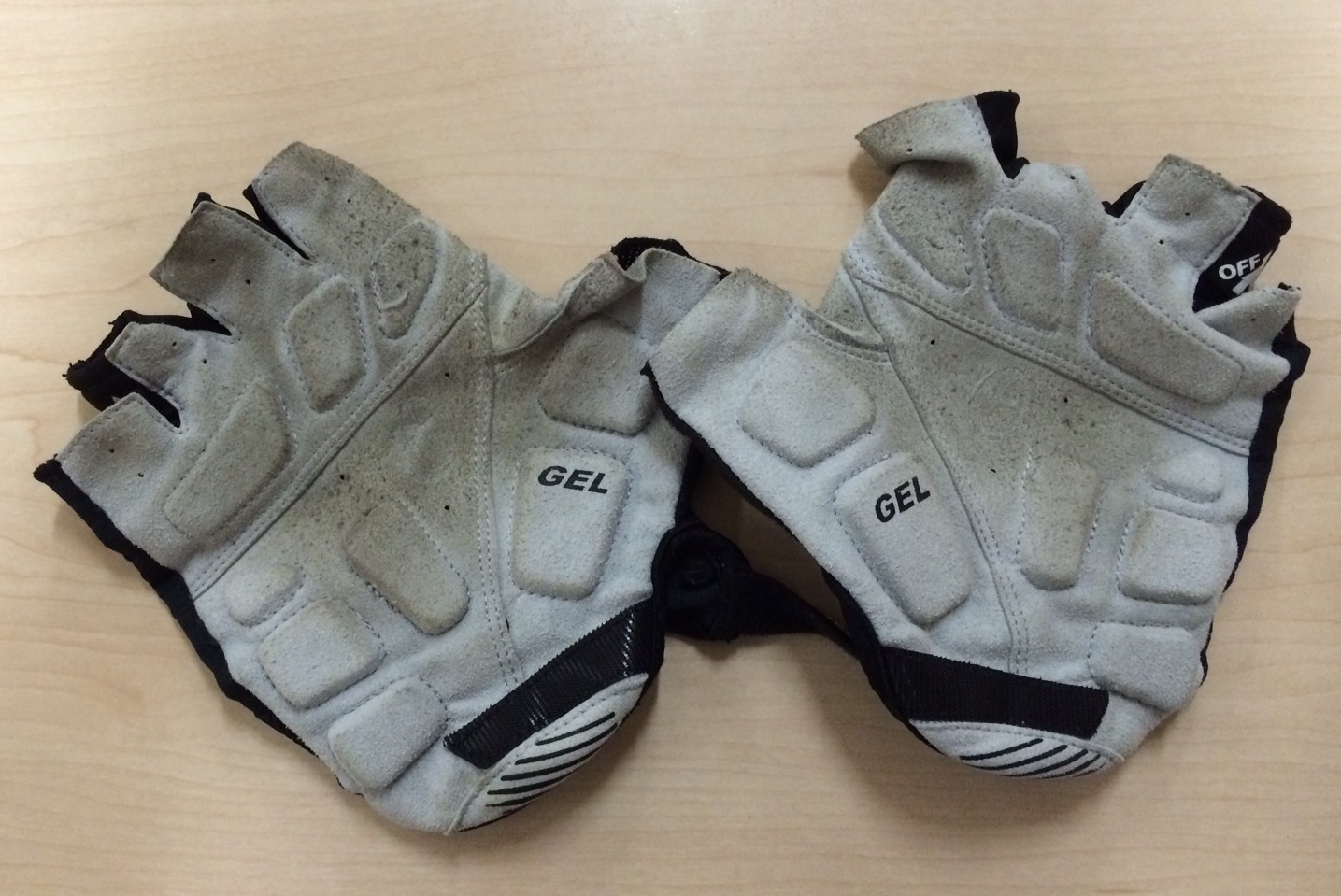
Those little "anatomic" lumps of gel padding are, at best,
annoying. At worst, uncomfortable.

I don't know about you, but the more "anatomic" the padding in gloves gets, the more it makes my hands hurt. It might seem counterintuitive, and probably counterproductive. As much as the makers try to say that putting strategically located little bumps of gel padding into the palm of their gloves is supposed to relieve pressure on key nerves, it seems to me that the anatomic pads only end up creating more localized pressure on adjacent areas -- and more discomfort.

The classic leather and cotton cycling gloves a lot of us remember from the past were typically a pretty simple affair. The padding was usually just an extra layer of leather across the palm, with a bit of simple flat padding stitched between the layers. But even with that, depending on the specific design, and where the padding hit, or where the seams hit, the padding could still lead to some discomfort. Maybe it would bunch up in the wrong places when you'd grip the bars. Maybe they just created too much of a "handful" when holding onto the bars.

In any case, it's hard to find a pair of good gloves today that I like as well as the best gloves of the past.

I recently got a pair of the new "Thinny Riding Gloves" from Rivendell that are well-made, rival the gloves a lot of us remember fondly, and do without the padding altogether.

According to Rivendell: "It's a hand physiological fact -- you can look it up -- that relying on gloves to protect hand nerves is just as effective as putting on false eyelashes to keep your cheeks dry when it's raining." There's probably something to that. I've long been thinking that maybe the ideal glove would have an extra layer of leather on the palm, but with no padding in-between. Well, these don't have that extra layer of leather, but they do dispense with the padding.

That's a nice, classic-looking glove.

Made of goatskin (there's also a "fake leather" version for vegans), the gloves are soft to the touch, but should prove to be pretty tough. I've had a few opportunities to try mine and have been pleased so far. The leather offers good grip and nice feel on the bars. My rides with the gloves have lasted about an hour or so, and I have not found myself to be missing the padding at all. In fact, compared to the so-called "anatomic" padded gloves that are so pervasive now, I found these to have a much more natural feeling.

Regarding fit -- it can be so hard to buy gloves when you can't try them on first, and of course what works for one person might not work for someone else. As far as all this goes, understand that I'm describing how the fit works for me, and your own mileage may vary. Rivendell suggested going up a size from what one might ordinarily wear. That might be easier to figure out for some than for others. In my case, I typically come in somewhere between Medium and Large. With some gloves, or some brands, I need Medium. With others, I've needed to go with Large. So it seemed to me that I had to decide between Large and X-Large. Ultimately, I went with the XL, as Riv seemed to be suggesting that when in doubt, go up, and I didn't want to struggle with getting the gloves off after a ride.


In my particular case, the gloves seem to fit pretty well all around the palm. In the fingers, it's mixed. Around my index, middle, and ring fingers, the fit is good -- close, without being too snug. On the other hand (just an expression in this case), the fit around my thumb and smallest finger is pretty loose. Remember that fit issues like that will affect everyone differently.

So, should I have gone with the Large instead of the XL? I'm thinking probably not. I have a feeling that, assuming the fit from one pair of gloves to the next were consistent, the parts that are loose on this pair of gloves would still be loose (maybe only a little less so) on the next size down, but the fit around the other fingers might be more snug, making the gloves tougher to take off. Anyhow, in actual riding, the loose fit around the thumb hasn't been very noticeable. If I start to notice it or it becomes a bother, I suppose I might be able to make some minor alterations with some heavy duty twine and some creative needlework on the crochet back. We'll see.

No chafing on this seam.
Over the years, I've been trying out other classic-styled leather and crochet-back gloves without a lot of luck. One area that sometimes causes a problem for me is the seam between the thumb and the forefinger. If not done right, I've found that the seam can cause some chafing in that fairly tender area. On these Rivendell gloves, I'm not noticing that to be a problem at all. On the inside of the gloves, the seam lays very flat. Not only that, but it almost looks as though the edge of the leather is thinned, or chamfered so it has a smooth transition (it looks that way, but I can't tell for sure if that's actually the case). Lastly, maybe it has something to do with the softness of the goatskin as opposed to tanned cowhide. Whatever the reason, so far I've felt no discomfort from seams on these gloves, which is a welcome thing.

I've only had the gloves for a short time, so it's impossible to know how they'll hold up after lots of miles. Still, looking them over closely, I don't see any potential issues in the construction. As somebody who has been known to rub broken glass off a moving tire with a gloved hand, having a second layer of leather might be a nice thing - but maybe that is a practice that I could consider halting.

Now that the temperatures are dropping, my opportunities to wear fingerless gloves are diminishing, but I'll keep wearing them when I can -- If I find anything that changes my mind about the durability, I'll likely mention it here on the blog.

So, what do the gloves cost? Given the apparent quality of the gloves and the materials, I'd say they are very reasonable at only $15. Shopping around for gloves from a variety of brands and styles, that price puts them about in the middle of the pack - with a range of prices from about $9 - $30. I'd definitely choose these over a pair of "anatomic" gel pad gloves costing twice as much, or even half as much.

My final thoughts on Rivendell's "Thinny Riding Gloves"?

Classic looks. Good grip. Great feel. Great price. 

Wednesday, December 2, 2015

Bikes and Bottles: Gifts for the Bicycling Alcoholic in Your Life

We bicyclists must be a heavy drinking lot. At least, it's easy to get that idea from looking at all the bike+booze products that are constantly being introduced.

Now that it's officially the gift-giving season (I say "officially" because people are welcome to give me stuff all year 'round), I thought I'd take a moment to highlight some of the gift possibilities for that heavy-drinking cyclist in your life - or even for yourself if you're so inclined.

Bicycle-themed bottle openers are always a popular choice, and one of the more common items:

The newest bottle-opening accessory (and the one that sparked this topic in the first place) is a joint effort between the folks at Silca and Wisecracker. What could possibly make your $450 Silca Ultimate Inflation Tool (it's too expensive to call a "pump") even more "ultimate"? Why, adding a bottle opener to the top cap, of course. Wisecracker has already made a name for themselves with stem-mounted and seatpost-mounted bottle openers (see below), so having one for the home-based workshop was a natural extension -- that way, nobody ever need be more than a few steps away from being able to pop open a cold one. (photo from Silca.cc)
While we're on the subject of the well-equipped home workshop, for the beer-drinking bike mechanic (is there any other kind?), both Pedro's and Park make "shop quality" bottle opening "wrenches." Big, rubber-coated handles give lots of leverage for stubborn bottle caps.
For an on-the-go wrench/opener option, those makers of overpriced titanium urban cruisers, Budnitz, also have a titanium wrench and bottle opener combination. With its knurled 5mm bolts, it is designed to be carried on standard water bottle braze-ons. (photo from Budnitz)
There seems to be a veritable cottage industry in so-called "upcycled" chains turned into jewelry, picture frames, and of course, BOTTLE OPENERS. This particular one comes from Uncommon Goods. I've never tried to use one, but I imagine that the flexibility of the chain "handle" would make it a little more awkward to use. What do I know?

Then there are those who can't wait until they get home before cracking open a beer, so there are a number of choices out there that attach right to the bike:

Surly has long offered a few choices for the drinking cyclist. The Tuggnut chain tensioner turns a track/fixie bike's rear fork end into a bottle opener. Two-sided, so it works whether mounted on the left or right side. Also aimed at the fixed-gear cyclist is their Jethro Tule, which has an offset 15mm box end wrench for axle nuts (it's angled slightly from the handle to help minimize knuckle scrapes), with a bottle opener on the other end.

The aforementioned Wisecracker makes seatpost-mounted and stem-mounted bottle openers that seem to have gotten pretty popular -- at least if the bicycle blogosphere is any indication. I mean, even BikeSnobNYC has one. Still, I have to wonder if this double-headed version - dubbed the "Twinduro" - is meant as a joke. What the hell? For two-fisted drinkers? Or people with really impatient riding buddies?

The Pub Nub, from Nub Nub mounts onto the end of a handlebar, like a bar-end plug. It's only shown on a MTB type of bar, so I don't know if it would work on drop bars or not (they're usually different diameter). Also available from Firebox.com where I found the following ad copy: "Here at Firebox we live by one rule and one rule only. . . Never, ever EVER leave the house without beer. It may seem like an easy rule to follow, but things get a little tricky once bicycles sneak their way into the equation. Where do I keep my bottle opener. What happens if I get all the way to the park and realize I've left it at home?"  
Remember: Admitting you have a problem is the first step to recovery.

Then there's this one from Chromoly, called the Road Popper that mounts to a bike's saddle rails. By the way, I approve of the saddle, but not so much the seat post. The Road Popper has the following tongue-in-cheek warnings (or at least I assume they're tongue-in-cheek -- maybe they really are teetotalers): "The Road Popper is not intended for alcoholic beverages. Chromoly does not condone cycling while under the influence of alcohol." 
Finally - what's the point of having all these "take-them-with-you" bottle opening options if you've got nothing to drink when you arrive wherever you're going?


All manner of leather-crafting artisans offer some variation on the 6-pack caddy. I don't know if there's much difference between them, but this example comes from the folks at Fyxation. For what it's worth, my own experience with beer is that lots of vibration has a pretty negative effect on it. Rest assured though, "Being from Milwaukee (Brew City), we've had more than a few opportunities to test out this product. When properly fastened to your top tube and seat tube and filled with a six pack of suds, there's plenty of clearance between the caddy and your legs while pedaling." 
I do think the operative word here might be "suds."

Live near a trendy brew-pub, and like to take home a growler of microbrew regularly? There are a number of artisans making versions of the growler carrier out there. This hand-crafted leather version comes from Pedal Happy Design, which makes several variations for different types of growlers.

Have you noticed that most of these things are focused on beer drinkers? Yeah, me too. But what about the wine drinkers out there? What are we supposed to do when we're out for a ride and the DTs start setting in?

If you search for 'bicycle wine carrier" you'll find there are plenty of leather crafters out there offering a way to carry a wine bottle. I didn't see a lot of differences between them, as most seem to consist of a couple leather straps that hang from the top tube. This one comes from Oopsmark. 

I just hope that's a screw-top wine bottle in there, because nobody seems to make a bike-mounted corkscrew. Of course, the ultimate bike-themed corkscrew is the Campagnolo Big Cavatappi - but good luck lugging that massive tool along for the ride. What's the use of all this misplaced booze-toting ingenuity if they're going to leave bicycling wine drinkers high and dry?

Is it too much to ask that somebody offer a clever, functional corkscrew that can be toted on a bike?

I'm starting to wonder if THIS thing was such a dumb idea after all.

Monday, November 30, 2015

I Use Bicycles in All of My Decorating. . .

Some people just can't get enough of their bicycles.

(photos from Twomakers.co.uk)
From a pair of custom furniture makers in Britain comes a chair that only a cyclist could love. The firm Two Makers, comprised of Andrew McDonald and Simon Taylor, have built a chair that combines traditional bicycle framebuilding techniques and materials into a rocker dubbed the Randonneur Chair.

Built from Reynolds 631 steel tubing, and using a combination of fillet-brazing and actual bicycle lugs, as well as fine saddle leather from Brooks of England, the Randonneur Chair even includes a "tool bag" and a pair of bottle cages. From some angles, the chair almost resembles a pair of bicycle frames, complete with drop bars, conjoined by a big hammock-like expanse of leather.

The result is sort of a modernist-meets-craftsman interpretation of a classic rocking chair, skewed through the perspective of a bicycle constructeur. Some websites are calling it "beautiful, deceptively light, and highly functional."

Notice the leather "tool bag" behind the seat. A good place to keep the T.V. remote?
On the Two Makers site, they quote Antonio Colombo, President of Columbus Tubing and Cinelli Bicycles, saying, "The best bike chair I've seen in forty years."


The finish on this example lets a person get a good look at the construction methods.
And yes, the "handlebars" are wrapped with Brooks leather bar-wrap.

I can't decide if the Randonneur Chair is really cool, or overindulgent ridiculousness. What I do know is that I can't afford one. It's definitely one of those "If you have to ask. . ." propositions. According to the site, the price is available "upon application." Jeezus, you have to apply for ownership? I have a feeling my application would be rejected.

It's interesting that the makers of the chair used a quote from Antonio Colombo -- not just because they used competitor Reynolds tubing in the chair -- but because Colombo might actually know a thing or two about furniture design. Little known fact about his family company, but back in the 1930s, the A.L. Colombo company used to make modernist-styled steel-tubed furniture, like this chair from one of their old advertisements.

Was that made from Columbus SL, SP, or SLX?

Even apart from the Columbus past in furniture design, there have been others to dabble in bicycle-themed furniture. Like Scarabike in Japan, who came up with this Brooks Saddle Sofa a few years ago:

I love a good Brooks B17 as much as a person can, but this thing looks crazy uncomfortable.

And doing a quick search online, I've found numerous examples of people mounting Brooks saddles on top of stools. Here's one from Freshome:

Here somebody grafted a heavily sprung Brooks B135 saddle onto a stool from IKEA.
Again, I think a Brooks leather saddle is about as good as it gets on a bicycle -- but I'm not sure it would make the best perch for a barstool. Maybe I'm wrong.

I just don't know. I love bikes. I have bikes hanging on the walls in my classroom. I'd have them hanging on the walls in my house, too, if my wife would let me. But does this stuff just go too far? Any thoughts?

Tuesday, November 24, 2015

Get Well Soon, Jan

Some regular readers may have already heard the news, but if not, I just wanted to take a moment to say Get Well Soon to fellow cyclist and blogger, Jan Heine of Bicycle Quarterly, Compass Bicycles, and the blog Off the Beaten Path.

Jan was injured in a crash with a car while on a trip in Southeast Asia. His injuries were not "life-changing" as he put it, but he did suffer a broken arm, shoulder, some vertebrae, and few ribs. One can find out more information on Jan's blog (HERE).

I'm a regular reader of Bicycle Quarterly, as well as Off the Beaten Path and find them to be a great resource and excellent reading. His Compass Bicycles is a good source for tires, components, and accessories for touring and randonneuring cyclists.

In the magazine and the blog, Jan frequently writes about his travels, and has been to many enviable destinations with his bike. I have to say I always enjoy reading about those travels, as well as his extended bike test rides.

I've heard updates that he's on the mend - but just wanted to wish him the best as he convalesces. Hope you're back on your bike soon, Jan.

Monday, November 23, 2015

Get Connected With Your Helmet

Last month, I wrote a bit about a couple of helmets on the market that boast integrated lights - the Torch, and the Lumos. Of the two, the Lumos went beyond simply having built-in lights, but also incorporated turn signals (operated by a bar-mounted switch) and brake lights (controlled by a built-in accelerometer). As a regular bike commuter who spends a lot of time riding in the dark, I concluded that while I could see some potential benefit in having some built-in helmet lighting, it was also a concern for me that the extra features, like turn signals and brake lights, might prove unreliable over time, and end up being more trouble (and expense) than they were worth.

As if to show that nothing succeeds like excess, though, the Livall Smart and Safe Bike Helmet is now on Kickstarter, boasting enough "connected" features to make anybody into Cyborg or RoboCop.


Except that you won't look anywhere near as cool.

The Livall Smart helmet has built-in lights, and incorporates turn signals, walkie-talkie, Bluetooth phone capability, music, and an SOS Alert system that sends out a signal if it detects that the rider has suffered a fall. It also incorporates cadence sensors, and integrates it all though the company's smartphone app. It comes with a stem-mount phone holder, and a handlebar-mounted controller for the turn signals, and which lets a user scroll through all the functions on the phone. 
For a product that's supposed to be so much about safety, it has a lot of features that seem designed to keep one's mind off their ride. Like making phone calls while riding:
"With the built-in Windbreak Mic and Bluetooth Speakers, the BH60 helmet enables you to answer or make phone calls when needed. You can enjoy your 'me time' without worrying people may not be able to reach you." Actually, that's about the last thing I want.

My favorite part of their crowdfunding approach is the promotional video, complete with an awkwardly dubbed voiceover:


In the video, we see this unlikely couple . . .

Holy Cow, what's with those shorts?!
. . . who act like they've just come from some kind of Masters and Johnson weekend.

They have an "enormous passion" for cycling.
We get to see them using the helmet's turn signals while weaving through traffic. The turn signals don't look particularly effective, though.
Somehow they end up separated - so they can use the "walkie-talkie" function to find each other.
The smart helmet makes cycling safer? More enjoyable? More distracting, if you ask me.

At this point in their date, they're off the bikes and on foot. You can take the helmets off now, kids. Or at least turn off the flashing lights.
The video also takes some time to show a lot of the features that come with the smart helmet. Like "the world's smallest nano cadence sensor."


And their own-design smartphone holder:


And the handlebar control switch, dubbed "The Bling Jet":


The most disturbing scene in the video comes about 1:25 into it - where we see how the SOS Alert feature works:


The voice dubbing becomes painfully obvious when we meet the creators of the Livall smart helmet:

"The helmet is an essential part of your cycling experience."
"Pledge now! Lets ride smart together."
It really seems to me that the more people come to rely on their smartphones, the dumber they get.

As I said before - I could maybe be persuaded to try a well-designed, decently styled helmet that incorporates some built-in lighting -- basic LED technology is inexpensive, simple, and has gotten pretty reliable. But all the so-called "smart" features of this thing seem to be more trouble than they're worth. Too much expense. Too much to go wrong. Too many distractions.

No thanks on the "smart helmet." But enjoy the video!

Thursday, November 19, 2015

Where's Waldo? Who Cares?

I know bike theft is a serious problem, but it's a problem that really requires no more than a very simple low-tech solution. And yet for some reason, every smart phone addict, tinkerer, and tech junkie believes they have the perfect fix.

Back in May, I highlighted the Noke U-Lock, which promises to eliminate "the hassle and frustration of lost keys and forgotten combinations." It connects with Bluetooth smartphones and allows a user to unlock their bike with the use of an app. It also boasts a "shrieking" alarm, allows easy sharing of the bike with friends, and even utilizes GPS tracking in case the user forgets where they parked their bike.

I suggested that people who can't remember where they parked their bike probably couldn't find their way home, either.

Well, just to show that there's apparently no shortage of people out there who can't remember keys, combinations, or even where they parked their bikes, there are a couple of new "Smart" locks for Dumb people just now hitting the market.

Where's Waldo?


(photo from Waldo)
The aptly named Waldo isn't so much a lock as it is a "Lo-Jack" type of device designed to "give you peace of mind." With the smartphone app, "you can check your bicycle's status and its position anytime. You'll get notified only when your bike is in danger."

Waldo attaches to the bike using a couple of silicone straps and a steel band. Of course, if someone tries to cut the steel band, or move the bike without de-activating the device, it is supposed to deliver a "loud sound alarm" to "deter any potential thief." You know - because car alarms are so effective in urban settings, and people always take them seriously. And nobody finds randomly shrieking alarms annoying. It also sends the owner a text alert to let them know their bike is being stolen.

Waldo is meant to be seen -- to act as a "deterrent" to
potential thieves. I should think riding a POS brakeless fixie
conversion should be deterrent enough. (photo from Waldo)
What if somebody just bumps, or moves the bike? Supposedly the "sensor has brains - it can differentiate between a theft attempt and a random movement of your bike. Thanks to this, you won't get notified if a fellow cyclists (sic) accidently moves your bike."

Oddly, if the battery gets too low, the device "unlocks" itself so the user can remove it for recharging. Great for the user, but also great for the thieves. So much for security and peace of mind.

As I mentioned, the Waldo is not a lock. If someone's really serious about security, even the makers of Waldo say, "though it is not compulsory, we do recommend using a trustworthy chain or U-lock." "Not compulsory"? Using a lock is never "compulsory." But it kind of begs the question: if one is going to use a good solid lock, then do they really need Waldo?

And because there must be a perceived rash of cyclists too dumb (or inebriated?) to remember where their bikes are, "Waldo automatically stores your bicycle's last location and displays it on a map." Their website proclaims, "Forgot where you parked? No problem, just let Waldo guide you to your bike."

As a final note for those whose memory incompetence comes from inebriation, it might be safe to point out that anybody who is too drunk to remember where their bike is parked is probably also too drunk to ride it. So maybe the makers of Waldo should team up with the makers of the Alcoho-Lock and offer a package deal discount.

There is a basic Bluetooth version, and a GSM version with more GPS capability and real-time tracking. Expected retail price of Waldo is posted as $124 - $170 (based on current exchange rates) depending on which version one opts for.

Grasp Biometric Lock

Another high-tech lock that does away with keys and combinations is the Grasp Biometric Lock; a battery-powered quick-release bike lock that opens with fingerprint recognition.

Supposedly the Grasp will change your life. It is billed as the "first bike lock that actually improves your cycling experience."
I hope this dude's wheel's aren't important to him. But then
securing the wheels means more time, effort, and extra cables,
chains, or locks. "Why does security need to be so unpleasant?"
(photo from grasplock)

Try to say that with a straight face. Go on. Try.

"Every cyclist knows the pain of locking up and unlocking their bike," says the company's Kickstarter ad. "Why does security need to be so unpleasant?"

Why? Because having your bike, or wheels, or components stolen sucks a lot worse than taking the time to secure them properly -- and if your bike is truly important to you, then you know that no cell phone technology shortcuts can take the place of that extra time it takes to do it right. That's the retro-grouchy answer.

For some reason, the tech-happy makers of all these "smart" locking products are convinced that every bike user wants to become their own private bike-share system. Grasp is no exception. "Sharing your bike has never been easier. Give access to family and friends using the Grasp App." One can add up to 20 additional fingerprints to the lock. Is it because I'm such a self-proclaimed grouch that I can't even conceive of having 20 friends I'd want to be sharing my bike with?

OK - some questions. What if the fingerprint recognition isn't working? "Unlikely" says the manufacturer, but apparently if that happens, one can unlock using the Bluetooth connection and the phone app.

What if the batteries go dead while the bike is locked up? Grasp stays locked tight, even if the AAA batteries are removed, claims the company. They also say the batteries should last over a year. If one needs to, they can replace the batteries while the bike is locked, at which point it should return to normal operation. How the lock stores all those fingerprints in its own memory if the batteries go dead is a mystery to me - but I don't really care enough to find out the answer. But is the trouble of dead batteries really better than just having a key?

Planned retail price on the Grasp fingerprint-recognition lock is posted at $159.

Considering that I don't believe this can really save much time or trouble compared to a normal high-quality U-lock, I'd be hard-pressed to come up with a reason to spend an extra $100 over the price of a good Kryptonite and some chains or cables. But then again, I don't have 20 friends clamoring to share my bike.

And I'm fine with that.