Tuesday, March 7, 2017

Free Speed?

I'm always skeptical when I hear bike and component manufacturers tout the idea of "free speed." In fact, I'm more skeptical of "free speed" than I am of the proverbial "free lunch."

The Dutch firm M5 has recently released a new aerodynamic two-spoke wheel design that they have (somewhat unimaginatively) dubbed "2-Spoke." The wheels are said to not only be the most aerodynamically slippery wheels to date, but that their unique profile actually generates speed in some cross-wind situations.

Well, that's what they say anyhow. The 2-Spoke website claims that compared to 12 or 16 steel bladed spokes, 3 to 6 carbon bladed spokes, or even full disc wheels, the 2-Spoke design  "has the LOWEST air resistance of ALL existing wheels" making them "currently the fastest wheels in the world." But more than that, the company claims that their special airfoil design makes them "generate speed" when crosswinds hit the wheels at angles between 10 and 170 degrees. Hmmm. . .

In this shot, you can pretty clearly see the wing-like (or maybe I should say, propeller-like) profile, where the leading edge of the spoke is rounded, and tapers almost to a point at the trailing edge. Notice that the rim depth also changes from deeper at the trailing side of each spoke, and shallower at the leading side.
Like all companies that make promises of incremental gains and increased speed, 2-Spoke touts how much time a person could potentially save in a time trial. In this case, the benefit is said to be "as much as 2.5 minutes in a one-hour time trial when averaging 51 km/h."

Cue the "record scratch" sound effect: Scraaaaaaattttcccchhhhhhh!
Wait. . . WHAT?? 51 km/h for an hour? Are we aware that the current hour record  (Bradley Wiggins) is 54.526 km? And remember that Eddy Merckx's long-standing record from 1972 was 49.43!

Well that's not a bit overly optimistic, is it?

Okay, so what do these wonder wheels cost ('cause they sure as hell aren't free, either)? List price, in Euros, is about €2400 for the pair, or about €1178 for the front wheel alone. Not quite as expensive as some of today's wonder wheels, but definitely up into the seriously rarefied air.

As often happens when I work on stories about bikes and components with hard-to-fathom promises of performance and speed gains for outlandish prices, I find the need to to go lie down in a dark room with an inhaler. So, as much as I'd love to write more about the 2-Spokes, I've got to cut this short because that tin of Proofide is calling my name again.

Thursday, March 2, 2017

Riding a Bike: You're Doing It Wrong

Look at some of the recent headlines you'll find in the mainstream cycling magazines and websites:

Why Everyone Should Take a VO2 Max Test

Get The Perfect Pedaling Stroke


Pain Is The Cycling Coach You Didn't Know You Had

Why You Should Invest In A Bike Fit This Season

The Ultimate 30-Minute Get Fast Workout

Breathing For Cyclists

Four Ways Your Tire Pressure Is Wrong

Rookie Cycling Errors That Will Ruin Your Ride

Ten Cycling Accessories That Will Transform Your Ride

Why You Should Throw Your Rim Brakes In The Trash

Honestly, you'd think that riding a bike was some kind of ancient unsolved mystery, and the magazines, blogs, and websites seem determined to convince us that whatever we're doing, we're doing it wrong. We're using the wrong bike. The wrong accessories. The wrong wheels. The wrong tires. The wrong brakes. We're apparently pedaling wrong, and even breathing wrong.

I'm not going to say that there aren't certain skills involved in bicycling that can't be improved upon, but I really wonder how many people learn to improve upon them by reading these "self-help" articles. In fact, the people who are probably the most in need of help are probably those who would never read a cycling magazine or website in the first place. Certainly, riding in traffic requires not only a good bit of skill, but also a fair amount of nerve. Just understanding the rules of the road (and realizing that they apply to us cyclists as well as drivers) is a big part of it. The "nerve" aspect of it isn't something a person gets from reading articles, though. I've found that the people who are most comfortable in traffic are those who have the most experience in dealing with traffic - and those who started sharing the road with cars at a younger age are often more comfortable than those who avoided riding among cars until they were well into adulthood. Riding with a group requires certain skills too, but again, a lot of it comes from riding with groups.

A billion Chinese people can't be wrong.
The "go-fast" workout advice and coaching tips have always struck me as a waste of time, too. I've always gotten the impression that people who take that stuff seriously are still hacks on the bike, and annoying to talk to, much less ride with. They talk in numbers - RPMs, watts, intervals, heart rate, and O² levels. They talk about "spanking" the climbs, and take pictures of themselves at the end of a ride with their bikes held aloft as if they've just done something unique (Dude - you rode your bike, just like millions of other people who don't even own cars). The "victory" pictures get posted to Facebook, because if it's not on social media, it didn't happen.

The post-ride "victory" photo: probably the most valid pro-carbon argument that can be made.
So much easier to hold the bike aloft.
Then there are the articles about how this component or that accessory will change your ride - or even change your life. Electronic shifting. Disc brakes. Smart phone integration. Power meters. Carbon fiber anything. What most of these things have in common is that they almost always require buying a whole new bike (perhaps I should say another whole new bike). The recent article about "Why you should throw your rim brakes in the trash," which appeared in Outside magazine, is pretty much the epitome of why I can't take such magazines seriously. Throw your rim brakes away - which means, by extension, throw your whole bike away too. If it doesn't have disc brakes, it's hopelessly obsolete and worthless, right? Never mind that the vast majority of bikes being ridden today have rim brakes, and somehow their owners are not careening out of control to their doom.

The Outside article cites a head-to-head comparison between a Trek Domane SLR 8 with carbon fiber rims and rim brakes and a Trek Domane SLR 7 with hydraulic disc brakes. Well, right there is a major problem, because rim brakes on carbon fiber rims are probably the worst braking combination a person could devise on a modern bike. And that's the head-to-head comparison model? They might as well have compared it with the braking of rock-hard 1970s-era brake pads on chromed steel rims. In the rain. Carbon fiber rims are probably the best justification for disc brakes on road bikes today. In trying to shave every gram of weight, wheel manufacturers have been pushing carbon fiber rims - but the braking on them is notoriously bad. So disc brakes are the solution to a problem that can largely be avoided by not "upgrading" to carbon rims. Modern dual-pivot brakes paired with high-quality aluminum rims work amazingly well with very little effort. Later generation higher-end single-pivot sidepulls also work great, and in my opinion, have better modulation. It's only a matter of time before disc brakes take over completely - but I'll never buy a bike specifically to get them.

Despite what the articles say, I'm also quite certain that I will not be getting a VO2 Max test this year, (or next year, or any year for that matter), nor would I recommend it for anyone who isn't getting paid by someone to win bike races. If I was making a significant investment in a brand new custom bike, I might opt for a fit session to make sure I get the best bike for my body, but otherwise I'm not going to shell out for one just because someone who doesn't know me thinks I should. Nor do I think a bike accessory has ever transformed my ride, much less my life.

Riding a bike is a deceptively simple thing -- so simple that people are always eager to overthink it, and to try to get us to do the same. I mean, most of us probably learned how to ride before we got out of the 1st grade, if not sooner. And there's some truth to the old saying that you never forget how. Millions of people enjoy riding on bikes that might be dismissed by some bike snobs as crap, but which get people where they're going cheaply and reliably. Most of us enjoy riding and get a lot out of our time on a bike, whether or not we know our O² levels, our heart rate, or how many watts we're expending. We're happy to use our thumb and forefinger to decide if our tire pressure is "about right" and leave it at that.

Enjoy your ride - don't overthink it. If you're not a danger to yourself and those around you, how "wrong" can you really be?

Wednesday, March 1, 2017

The Cyclist and the Hair

Let's talk about hair for a moment.

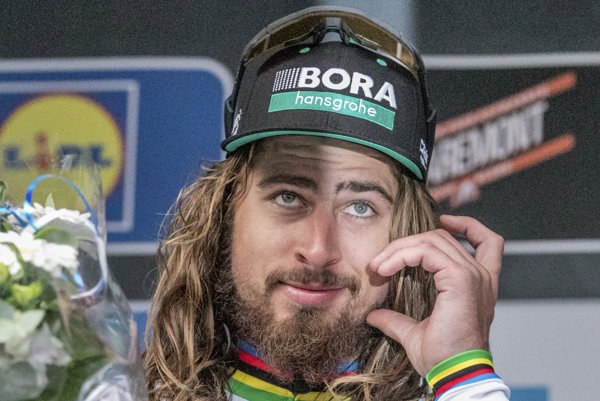
Am I the only one who's finding Peter "Mr. McFeely" Sagan's current look to be . . . well . . . a bit "coarse"?


He's kind of got that mountain-man-moonshiner look going these days. I guess he's still winning races - a lot - but he really looks like he just doesn't give a f#%k any more.

Long hair and beards have never really been part of the bicycle racer's image - regardless of what the fashion might have been in other areas. I mean, in the early '70s, when hairstyles were shaggier, one could sometimes see Roger DeVlaeminck's hair reach his collar, and Eddy Merckx began rockin' some serious sideburns - but shoulder-length hair and full beards just never became part of cycling's image.

I think the rider who was probably the most serious about the look of his hair would have to be Jacques Anquetil. By many accounts, he never rode without a comb in one of his jersey pockets. I've seen images of him at the finish line of a race and immediately pulling the comb through his hair. It's difficult to find photos of him with even a cycling cap on his head -- probably didn't want to flatten that awesome pompadour.


Note the scarred elbows, and the sweat still beading his face - but Jacques still had to fix that hair.
On the bike and off, Jacques just exuded class. In 50 years, will Sagan be remembered like Anquetil?

Wednesday, February 22, 2017

Wheelbuilding

I had a day off from work this week and took it as a good opportunity to lace together a new set of wheels. The intent of these wheels is that they be an extra special set of lightweight, high performance tubulars - like the kind of wheels I would have oohed and ahhed over when I was younger. I've mentioned some of my components in earlier posts: Campagnolo Record Hi-Lo hubs, and Mavic Monthlery Legere rims. As far as I can tell, the hubs were new-old-stock. I opened them up to pack fresh grease into them and found no signs of use on the races and cones, and the flanges don't seem to have any of typical signs of having been built before (I was told by the seller they were NOS, but it wouldn't have been the first time an eBay seller misrepresented an auction item). My rims, likewise, were unused. I selected 36 holes for the rear wheel, and 32 for the front. That made finding a matching pair of rims a little more difficult, but I eventually got what I needed.

For my spokes, I've always built with DT, but this time I decided to try Sapim 14/15g butted spokes. I've heard good things about the Sapims, and they were a little less expensive than the corresponding DTs.

As always, before I start building wheels, I refresh my memory by reviewing Jobst Brandt's excellent book, The Bicycle Wheel. Sheldon Brown's article on wheelbuilding is a good reference for anyone who doesn't have a copy of Brandt's book.

When I start building, I like to gather all my tools and supplies. Truing stand, spoke wrenches, flat-bladed screwdriver - and for later, a dishing tool. Since my last wheel build, I also added a spoke tension gauge to my tool collection. I keep my spokes separated or bundled and labelled while I'm building so I don't mix them up. There are three lengths: the longest spokes are for the front wheel, the second longest go on the left side of the rear wheel, while the shortest spokes go on the drive side of the rear wheel.


Jobst Brandt makes it pretty clear that there is no strength advantage to wheels built using the Hi-Lo rear hub, despite the folklore that surrounds them. He doesn't refer to any disadvantage except for one - that it makes inserting some of the spokes into the small flange more difficult. In a typical wheel build, spokes are either in-bound or out-bound in each flange. That is, they are either inserted from the outside of the flange, or they are inserted from the inside of the flange in an alternating pattern. When inserting the in-bound spokes through the small flange in a Hi-Lo hub, the builder has to bend or flex the spokes quite a bit so that they'll clear the large flange on the opposite side. Once that little hurdle is clear, the rest of the job is no more difficult than any other build. For the out-bound spokes on the small flange, it's pretty easy to feed them through the big oval-shaped cutaways in the large flange to get them through the small flange in a straight shot. If the large flange doesn't have those big cutaways (as on the old Phil Wood or Hi-E versions of the Hi-Lo hubs), then I have to admit it would be annoyingly difficult. It's worth mentioning that lacing spokes into the large flange is a breeze -- probably easier than with "normal" symmetrical hubs.

From Saint Sheldon Brown: "It is customary to orient the rim so that the label is readable from the bicycle's right side. If the hub has a label running along the barrel, it should be located so that it can be read through the valve hole. These things will not affect the performance of the wheel, but good wheelbuilders pay attention to them as a matter of pride and aesthetics." Nailed it.

I've heard of people doing crazy things like mixing patterns on the left and right sides, but that gets a bit advanced for me. I know a lot of people love to use 4-cross on large flange hubs, but that gets the spoke heads and elbows overly crowded on a small flange. A traditional, straightforward 3-cross (on both sides) was fine for me.

One thing I noticed about the butted Sapim spokes is that the butted sections are really short -- less than an inch at the elbow end, and shorter still at the nipple end. 

I still have some final tensioning and truing to do on the wheels, so I'm waiting for another day when I have the time and ability to focus my attention on the task. Then comes the (sometimes) messy task of gluing on tires. . . another time.

Saturday, February 18, 2017

New Workshop Find

What do libraries and bicycles have in common?

Nothing, actually, unless you count this awesome new storage addition I found for my bicycle work area. 

My wife works in the Kent State University library, where, over the years, everything has been converted over to digital records. So one day recently, she found a couple of workers in the Special Collections department hauling this old card catalog cabinet out to the trash dumpster. Being that both my wife and I have always been avid readers and library users, we have long had a nostalgic fondness for the old-fashioned card catalog files. She asked if she could keep it, and they of course had no objections.


The cabinet was too large to fit in her car, so we had to drive out to her office on the weekend with our station wagon to bring it home.

Funny thing - as the two of us were hauling this thing out of the library, a thought occurred to me: how would anybody "official" know that we were actually authorized to take this thing - or that we weren't just stealing it? So, just as that thought pops into my head, some very nosy woman notices us and starts following us. Before we can get out, she asks where we think we're going. Apparently she believed my wife, or at least decided it wasn't worth the trouble to verify her story, because she let us leave with it.


After getting it home, I needed to make some space for it, and build some kind of bench to hold it. That was an afternoon's project. The new bench includes a shelf underneath which will be perfect for holding some extra boxes, or large tools like my bench grinder seen below.

One drawer will hold four freewheels - or twice that if I stack 'em.
I have a pretty good collection of spare parts - like freewheels, bottom brackets, headsets, etc. that I'll be able to file away in the cabinet's many drawers. Before I can really put it to use, however, I'll have to modify the drawers a bit. The drawers don't have a completely solid bottom - there is a large "slot" or "gap" about 1½ inches wide running the length of each drawer. They could be fine for larger items, or boxed items, but small items would fall right through. If I carefully trim some thin pressboard, masonite, or the like, to fit across the full bottom of the drawers, they'll work well for all kinds of bicycle parts.

I'll make the modifications to the drawers, and then I can start filling this thing up with spares. What a cool find!

Tuesday, February 7, 2017

Bike Safety 101: Police Safety Council Bicycle Death Manual

Ahh, the 1950s. A simpler, more innocent time of sock hops and drive-ins, pig-tailed girls in their poodle skirts and saddle shoes, boys in letterman jackets, pompadours and penny loafers, and Greasers with hearts of gold. Bill Haley and the Comets were rockin' 'round the clock. We liked Ike.

Oh, wait -- that was Happy Days.

The communist-fearing McCarthyist reality is probably a bit more complicated. The '50s hid a lot of ugliness under that scrubbed and sparking, lily-white suburban surface.

This particular copy was distributed by the Stark County
Sheriff's Dept. in Ohio - but the manuals were available all
over America, "personalized" for various localities.
Automobiles had been taking over the American roads for several decades, but in post-WWII America, the conquest became complete. The Axis powers surrendered to the U.S. in 1945 -- and soon after, the American people surrendered to the automobile. During the war, travel by bicycle made a brief resurgence, but by the 1950s, it was a fact of life that bicycles were for kids. Adults drove cars.

The dominance of the automobile can be seen clearly in the safety films and educational materials of the day. In the Bike Safety 101 series, I've looked at a lot of safety education films from that era, but today I thought I'd share a classic bit of anti-bicycling propaganda disguised as helpful safety advice: a 1953 Bicycle Death Safety Manual, brought to you by the fine folks of the Police Safety Council.

I've been searching to find out more about the Police Safety Council, but figuring out who exactly they were is difficult. All I know for sure is that they were located in Milwaukee and published a variety of safety manuals and pamphlets for American school children in the 1950s, and probably at least through the 1960s - and distributed them through local police and sheriff's departments across the country. There was a similar group called the Police Safety League, as well as a National Safety Council. With their similar missions, it's possible that these various groups merged into one over time, but I have nothing with which to substantiate that hunch. The safety manuals from these groups are all basically the same in that they all propagate virtually identical messages:

- Bicycles are for children.
- Riding a bicycle will get you killed.
- If a kid dies on a bicycle, it's always the kid's own fault
- Drivers are not responsible, nor should they be held responsible, for the deaths they inflict.
- Anyone who has any sense of self-preservation will get a driver's license and a car as soon as possible (and never look back).

"Plenty of speed -- no thought of danger."
Just think about some of the ironies in the message. First, there's the obvious contradiction that bicycles are considered toys for kids, yet they are depicted as horrible death traps. Yes - we love our kids so much that we give them toys that we believe will kill them.

Then there's the contradiction that a bicycle is a "means of transportation," and riders are responsible for following the rules of the road - yet the message one gets from these manuals is almost like a bicycling version of the Dred Scott decision -- a cyclist has no rights that an auto driver is compelled to respect. If the cyclist's rights conflict with the auto driver's convenience, then the cyclist is out of bounds.

"Sad but true - another healthy boy meets his death."
Don't forget the obvious distortion that Americans were (still are, to some extent) being fed by the Automotive Industrial Complex - that cars are safe and bicycles are dangerous - despite the fact that an average of 35,000 people died in car collisions each year in the U.S. through the decade of the 1950s - and that number grew to roughly 50,000 deaths per year in the 1960s. By way of comparison, the average of 35,000 vehicular deaths per year in the 1950s seems almost identical to the number of vehicular deaths in recent years, but there's more to the figures. There were 35,000 people killed in automobiles in the U.S. in 2015. However, as a percentage of population, the carnage in the 1950s and '60s was well above what it is today. In the 1950s, the average per year was about 21 deaths per 100,000 people - compared with 11 deaths per 100,000 people in 2015. Compared with the average of vehicle miles traveled (VMT), the difference is even more stark. Throughout the 1950s, there was an average of 6 deaths per 100 mil. VMT. In 2015, that figure was about 1.12 deaths per 100 mil. VMT.


Kids get killed or permanently disabled on almost every single page of the Bicycle Death Safety Manual making it pretty clear that being a bicyclist (or even a pedestrian, when you get right down to it) is potentially deadly -- but what gets virtually ignored is the fact that all these people are killed by cars. Of course, nowhere is it even hinted that anything should be done about the cars or their drivers. It also never seemed to occur to anyone that providing better infrastructure to accommodate cyclists might help to make them safer (only a socialist would suggest such a thing). What does it say about a car-centric society when they are so willing to overlook all kinds of carnage as long as we don't put any extra restrictions on cars? It's so much easier (and profitable) to just keep blaming the victims.

"John is making the mistake of riding in the center of the road. A bad piece of pavement suddenly appears. . . The suddenness and closeness make it impossible for the motorist to stop in time. Another death that might have been avoided." 
Forget about "taking the lane," even if it means avoiding the doors of the parked cars. And is it just me who thinks that maybe the city bears some responsibility in keeping the roads in better condition? Or that the driver bears some responsibility for following so close to a cyclist who should have been very visible?

"Mary will never walk again."

"Another unnecessary death due to carelessness on George's part." Yes - George should signal before making a left turn - but he also shouldn't be expected to make his left turn from the far right side of the lane. But even more than that, what the hell is that car doing driving along just inches behind George's back wheel? Seems to me that poor George was going to die whether he made that left turn or not. Of course, it's not the driver's fault at all.

"Beware of car doors opening and striking you." But whatever you do, don't stop hugging the right side curb. "Bill is shoved into the middle of the street and run over."

"The child is thrown to the pavement -- Skull fracture and death."
According to the manual, bicyclists were not only a danger to themselves, but a serious danger to others as well -- a belief that persists today. 

"Screeching brakes -- But too late -- Result -- a limp, lifeless body."

"So engrossed in the plane she failed to watch the approaching automobile. Result -- She ran headon into the automobile, suffering severe injuries."

"Unfortunately Jack is hit and killed instantly."

Maybe because they had a few extra pages to fill, or perhaps because there wasn't enough death and dismemberment to go around with a bicycle-only manual, the PSL brings out a few other safety standbys to remind kids that they don't have to be on a bike to suffer a gruesome and untimely end.

Kids are run over while playing in leaf piles, electrocuted while flying kites, trapped in iceboxes, fall through floors, and blow themselves up with "chemicals." Life is good.

And then there's "stranger danger." Don't take candy from strangers. If a creepy stranger approaches, hopefully he'll be wearing a very distinctive outfit, like mr. straw hat, dark jacket, and striped pants. And always remember that the policeman wants to be your friend. Oddly, mr. policeman is probably the creepiest-looking person on the page.
Considering how many manuals like this one were distributed to schoolchildren around America in the '50s and '60s, it really is no wonder that bicycles were pushed off the streets, and that people are so willing to "blame the victims" when cars kill so many pedestrians and cyclists in addition to the tens of thousands of other motorists.

If only we could say things have gotten better. But propaganda like this is still out there, and the only real difference is that the quality of the graphics has gotten a little better. Remember this beauty?

The City of Phoenix Dept. of Transportation created these glorious "Bicycle Safety" death manuals last year.

Yeah - we're still screwed up.

Thursday, February 2, 2017

Motor Doping - On 60 Minutes

"The sport of cycling is notorious for its culture of cheating—made most famous by the rise and fall of Lance Armstrong and his use of performance-enhancing drugs." 

That is the opening of a recent investigation story that aired on CBS's 60 Minutes last week. Wow. As if professional baseball and NFL football are drug free, right? But still, it does seem that pro cycling has ZERO credibility, especially in the eyes of the general public. I've talked about that in this blog plenty of times before, so the revelations aren't new to me, but to have it put that way by "outsiders" is like hearing someone insult a member of your family. I can complain about my own siblings all I want, but if someone else insults them, I'm going to be looking to start a fight.

Anyhow, the segment, which can be seen on CBS's 60 Minutes website (If the embed works, it will appear at the end of this article) covers some familiar ground about motorized doping. The last time I wrote about "mechanical doping" was last spring, after a joint investigation was released by the Italian sporting newspaper Gazzeta dello Sport and the French television network Stade 2. Anyone who looked at those reports won't find much new in the 60 Minutes segment.

The main source for the 60 Minutes investigation is a now-familiar face: Hungarian engineer Istvan/Stefano Varjas, who has created and sells hidden motors, and claims that they are being used in the professional ranks (but it's not his fault, he adds).

Varjas again shows and demonstrates the small motors that can be installed in a bike's down-tube or seat-tube. And in an extra addendum video, "60 Minutes Overtime," he again claims that his newer technology, electromagnetic wheels, are the latest thing and virtually undetectable. However, just as in the Stade 2 and other stories, he only shows the carbon fiber wheel with little cut-outs for the magnets -- but does not actually demonstrate one in use. In the "Overtime" segment, even the 60 Minutes reporter Bill Whitaker describes Varjas as "complicated" and "cagey." It's difficult when you want some real answers, but all you get is innuendo.
I will say that in this scene, where the motorized bike is being ridden on the road, there is an audible "whirring" motor sound coming from the bike. Would that be audible in the midst of a racing peloton? I don't know. Side note, if you watch the extra "60 Minutes Overtime" segment, you can watch Bill Whitaker crash the bike. Sheesh.
A couple of claims made in the 60 Minutes story that were not in some of the earlier reports are very troubling -- but again, not very well substantiated by actual fact, which is frustrating. Again, it is Varjas who makes the claim that he first developed his hidden motors in 1998. He says that an unnamed party saw an early version of his motor and paid him $2 million U.S. dollars for exclusive rights to use the technology (60 Minutes verified from bank records that he did indeed have that amount in his bank at the time). He couldn't talk about his motors or sell them to anyone else for 10 years. So of course, whose name gets brought up as a possible recipient of the technology? You guessed it, Lance Armstrong, who won his first Tour de France in 1999.

In the absence of actual proof that Armstrong or the U.S. Postal team used hidden motors, The 60 Minutes crew buys a 1999 Trek US Postal Team model off of Craigslist, then has Varjas install one of his early-design motors into it (apparently at a cost of $12,000!).

Well, THAT settles it!
The stunt is somewhat sensationalistic proof that it could be done - but unfortunately (again), not proof that it actually was done. They do talk to former US Postal member Tyler Hamilton and have him try the bike, but for his part, Hamilton (who has been very forthcoming and, I believe, honest about his own history of doping, and the doping of teammates like Armstrong) says he never knew of any motors being used.

60 Minutes also talks with Greg LeMond - and LeMond is almost certain that pros are using the motors to cheat. LeMond has worked with authorities to find hidden motors, but insists that the UCI isn't doing nearly enough to catch them.
"I don't trust it until they figure out how to take the motor out," says LeMond. I won't trust any victories on the Tour de France." 

Another troubling insinuation brought to light involves Team Sky. Varjas insists that his special "enhanced" wheels are absolutely being used in the pro peloton (whether the electromagnetic rims - or wheels with a motor hidden in the hub - it wasn't exactly clear to me). Kathy LeMond says that Varjas told them "Weigh the wheels. You'll find it in the wheels. The wheels are in the peloton." The "enhanced" wheels weigh about 800 grams more than normal wheels. 60 Minutes then reports that at the 2015 Tour de France, the time trial bikes of Team Sky consistently weighed 800 grams more than those of other teams.

A spokesman for Team Sky said that the extra weight was due to aerodynamic equipment (though all the teams would be using similar aerodynamic equipment on their time trial bikes, wouldn't they?) and that the team's bikes were checked and cleared by the UCI. However, 60 Minutes says that French investigators were not allowed to remove the wheels and weigh them separately. So again we have questions, but not real answers.

Some observations: First - it is clear that this story was put together by and for people who know very little about bikes or bicycle racing. Everything has sort of a "dumbed down" feel to it (The fact that Whitaker can't stay upright on the bike doesn't help the "outsider" impression). Second, there are lots of allegations made, and a fair amount of innuendo - but no conclusive proof. The segment does make it virtually undeniable that motorized doping is possible, but still doesn't prove that it is happening in the pro ranks. Third - apart from the contributions by Greg LeMond, the segment doesn't reveal much that is new that hasn't been pretty well covered by other sources.

Overall, the 60 Minutes segment is probably worth watching, but a bit frustrating in its lack of hard proof. People who insist that mechanical doping isn't happening will continue to deny it. Those who believe it is likely (as I do) will still be stymied by the inability to prove it.