Tuesday, March 17, 2015

Eric Clapton - Bicycles and Rock & Roll

I was listening to Disraeli Gears by Cream the other day and it got me thinking about bicycles.

Bicycles? Really?

Yep.

Granted, lots of things get me thinking about bicycles, but it's probably already well known among us old bicycle enthusiasts (or maybe not) that Eric Clapton has been a huge fan of bicycles -- especially classic Cinellis -- going back to his youth. So was the band's drummer, Ginger Baker, for that matter. Their mutual love for racing bicycles, and a roadie's malapropism, led to the title of that iconic 1967 album.

The story goes that Baker and Clapton were talking about bikes one time in the back of a car, and according to Baker, "Mick Turner was one of the roadies who'd been with me a long time, and he was driving along and Eric was talking about getting a racing bicycle." Apparently, Turner commented about the bike having "disraeli gears," as opposed to derailleur gears. (The actual Disraeli was a British Prime Minister during the Victorian era). "We all just fell over," said Baker. "We said that's got to be the album title." (disraeligears.co.uk)

I first heard about Clapton's passion for bicycles when I saw this picture in one of the bike mags back in the 80s"
That's Eric Clapton taking delivery of a new Cinelli Supercorsa from Antonio Colombo in 1987. Colombo is the owner of Columbus tubing, and has been the owner of Cinelli since 1978.
Clapton's love for classic Cinelli bikes has been well documented over the years, and he has apparently owned more than a few, from different vintages. In fact, here's another picture from the 80s, which one can find on the Cinelli website.


I've heard and read from numerous sources, including former British framebuilder Dave Moulton, that Clapton used to race a bit in his teens, probably time-trials mostly (like most British racers in those days), and that bikes and guitars were the competing interests in his life. Guitars and music of course took the lead, but he never really let go of the bike bug.

Clapton used to have a blog (it appears to be defunct at this time) where he would occasionally post some thoughts, and sometimes pictures, of his passions. Sometimes, his bikes would make the blog, like this vintage track bike:
Photo from Eric Clapton's now-defunct blog. Great old components
would sometimes make the blog, too.
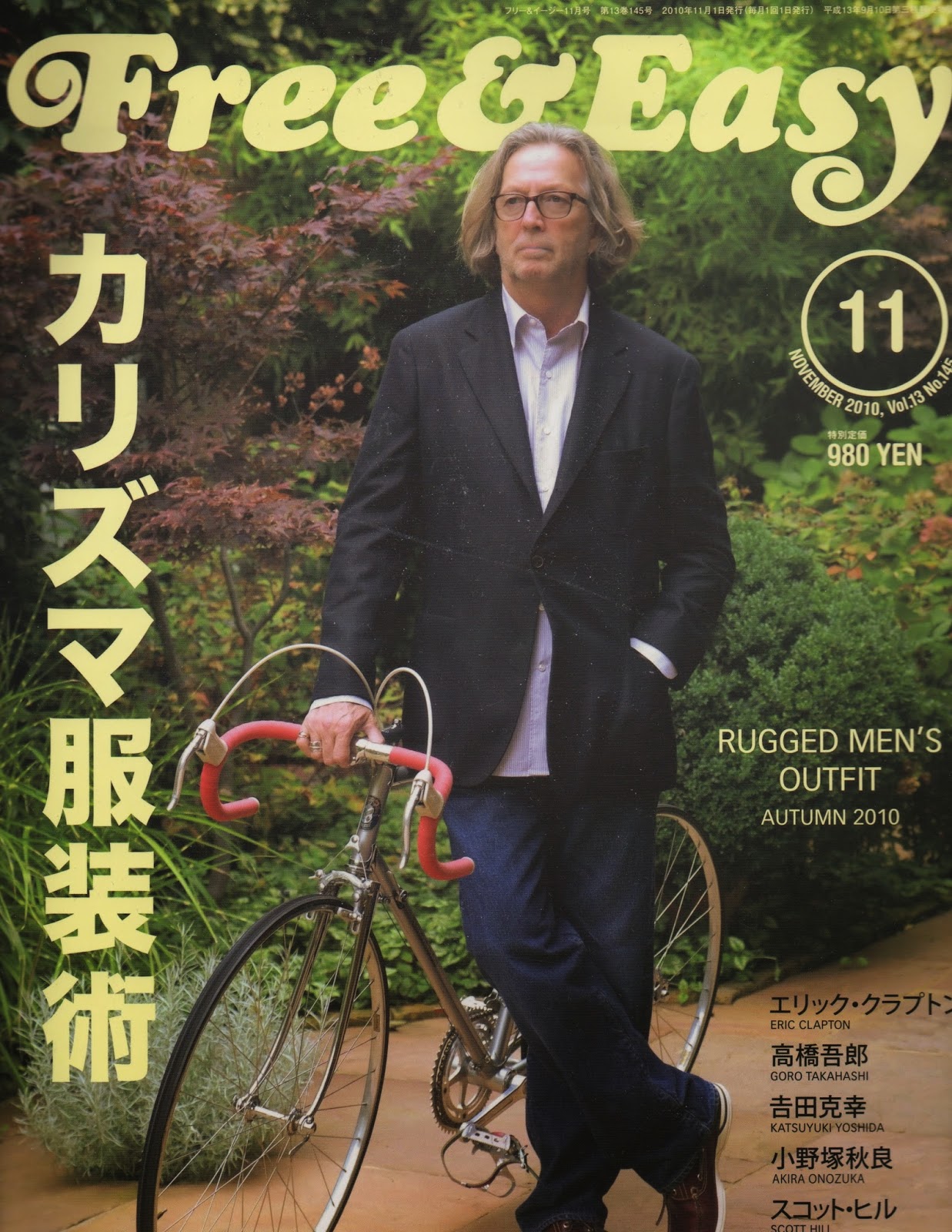
In 2010, Clapton was pictured on the cover of a Japanese fashion magazine (with an English-language title -- Free & Easy. Gotta love it!) posing with what looks to be a '60s-vintage Cinelli.


Clapton mentioned bikes a few times in his 2007 autobiography, too. In one passage, he talks about getting one of his first bicycles. In another he describes a visit to Japan, and meeting with designer Hiroshi Fujiwara. He writes, "Hiroshi came over to the hotel with his new Cinelli track bike. He is still a leading pioneer in street culture, hence the Cinelli. . . I have caught the obsession of course. He is very infectious, and I have begun buying vintage road bikes, not to ride but because I have always loved the equipment of cycling, especially bikes and accessories from the sixties."

Legendary drummer, Ginger Baker,
looking ironic in the 60s
(from gingerbaker.com)
As mentioned previously, drummer Ginger Baker, who collaborated with Clapton both with Cream and with Blind Faith, was also once an avid cyclist and aspiring racer. In Baker's own website, under the history archives, there is a quote from a 1967 press article: "Ginger Baker was doing very well as a professional bicycle racer when he was fifteen. He had already discovered and enjoyed listening to the music of jazzman Dizzy Gillespie. One day he sat down at a drum set and found he could play . . . He's been a drummer ever since."

Something tells me that the description of the 15-yr old Baker as a "professional bicycle racer" is a slight exaggeration, but numerous sources mention his early ambitions to race bicycles. In a 2009 Rolling Stone interview, it was said that an accident on the bike with a taxi left him with a busted bicycle, ending the dream. Another source says that the accident broke his leg, and it was during that time while he was recuperating that he started playing the drums. In any case, the drums quickly changed the direction of his life.

It's fun to imagine these two legends of rock -- one of the greatest guitarists, and one of the greatest drummers -- chatting between gigs, or out on tour, swapping stories of riding, racing, and the bikes they loved.

Friday, March 13, 2015

Axles of Evil

Decisions, decisions. Don't ask the bike industry to make them. And agreeing on standards? Forget that too. Bottom brackets and headsets are both in such a state of flux that there's a good chance that a lot of new bikes sitting in showrooms right now will be as obsolete in a couple of years as a Betamax video player (or an HD-DVD player, for you kids who might be reading this).

Joining those components in a race towards confusion and forced obsolescence are hubs and axles.

Seemingly forever, bicycle wheel axles have been 10 mm for back wheels, and 9mm for the front. The width of back wheels went from 120mm in the days of 5 speed freewheels, grew to 126 for 6 and 7 speeds, and generally up to about 130mm for 8, 9, and 10 speed cassettes (for road bikes that is -- mountain bikes were often more like 135mm). Front axle widths have been consistent at 100mm for pretty much everything other than children's bikes. In addition, the simple quick release system we're all familiar with has been a feature on higher-quality bikes going back to before most people reading this can remember.

So, what is driving the current change and confusion? Simple answer: Disc brakes, and thru-axles.

Mountain bikers, who were the early adopters of newer disc brake systems, started having problems with braking forces overwhelming the traditional quick release, and pulling the front wheel out. This was particularly a problem with the downhill bikes which have evolved to be more like engine-less motorcycles than bicycles. I'm guessing that most "regular" mountain bikers, especially those who know how to properly use a quick release, didn't have serious problems (please forgive me if I'm wrong about that). Anyhow, the chosen solution to the problem was to ditch the traditional quick release in favor of a thru-axle design. Not only that, but the size of those front axles continued to swell so that eventually some downhill bikes started using massive 20mm thick axles (think about it - that's double the thickness of the traditional rear axle!). I can only suppose that the rationale was not only about the braking forces, but also the forces directed on the front axle from big hits suffered in their downhill runs. The way I understand it is that many of the mountain bikes out there now have settled on 15 x 100mm thru-axles for front wheels, and 12 x 142mm thru-axles for the rear.

Disc brakes and thru-axles on road bikes. But which
"standard" to use? (photo from Trekbikes.com)

Now with frame and component makers pushing disc brakes for the road, the question of hub standards is suddenly becoming another puzzle. And the solution to that puzzle keeps changing. Can the industry agree upon a standard? Are you kidding?

The component makers seem to be waiting for the bike companies to make a choice, while the bike companies are waiting for component makers to come up with the answer. Smaller bike companies are waiting to see what the big boys are doing. In the meantime, there is a hodgepodge of options floating around out there. Some companies are sticking with traditional quick release. Some are moving to thru-axles, but the exact dimensions are up in the air. Some, like Trek, are betting on 15mm front axles to keep things consistent with mountain bikes. Others, like Specialized, think 12mm axles will work fine for the road. On the back, the current choices seem to be the mountain bike "standard" (there's that meaningless word again) of 12 x 142mm -- which seems really freakin' wide for a road bike! Others are looking into 12 x 135mm. Some companies are hedging bets by offering different versions -- some of this, some of that -- as if hoping the consumers will make the choice for them.

Personally, if I were in the market for one these new bikes (and I definitely am not), I'd be hesitant to plunk down a lot of money on the "latest thing," only to find out in a couple of years that I'd made the wrong choice when I can't find components to fit my frame.

A recent article on the subject on BikeRadar had a quote from an "industry veteran" who says such a worry is exaggerated. "The bicycle industry has done a good job of continuing support of older standards." I don't know that I'd totally agree with that. Quick release has been around for a long time, and will probably continue to be supported for a long time to come. But what about some other so-called "standards" (perhaps "fads" would be a better term) that don't stick around long enough to become really established before being superseded by something else? The industry veteran in that BikeRadar article went on to say "at a point, you can trade up. By then other systems will have advanced as well, making it, if you're so inclined, time for a new bike."

Basically, when this year's bike becomes obsolete, you'll just buy a new bike -- because the new stuff will be so much better anyhow. If that doesn't sum it all up, I don't know what else would.

Tuesday, March 10, 2015

More Press-Fit Bottom Bracket Madness

Back in 2013, I wrote about press-fit bottom brackets, and all the various "standards" that have been introduced in recent years. I summarized it by saying essentially that the only thing "standard" about bottom brackets today is the creaking. Not surprisingly the creaking continues. What IS surprising to me is that the industry has gone almost two years without introducing yet another new bottom bracket "standard."

Several companies think they have the solution to creaking press-fit bottom brackets, and they want you to spend a lot of money attending to something that should never have been an issue on a $4000+ carbon fiber wünderbike to begin with.

One of these solutions is the BBInfinite. Funded on Kickstarter last summer, the BBInfinite is supposed to eliminate the variables in tolerances between the bottom bracket shell of the frame and the bearing mechanism by putting both the left and right side bearings into one complete shell, and the whole shebang is pressed into place as one single unit.

The BBInfinite sells for $165, and it does come with tool adapters for Park headset presses. Removal takes more special tools, including an air hammer (!) and those tools are sold separately. Some users will probably want to buy the tools anyhow, though I wouldn't recommend doing the job at home.


Remember when these were all the tools you needed to install, remove, or service a bottom bracket and crank? And keep in mind that two of those spanners also service headsets. The one on the top also installs/removes pedals.

The installation video for the BBInfinite shows all of these tools to install the unit -- though I think the main one needed would be the Park headset press and the special adapters or inserts for the press. Given the very specific nature of some of the tools (made solely for the BBInfinite) and the immense possibility of destroying a very expensive carbon fiber frame should something go wrong, I think few home mechanics will be doing the job themselves.

No grease or oil. Everything must be clean and wiped down and decontaminated with alcohol. Only in the final stage of the press-fit process does one apply a bit of loctite -- because loctite is like the "take two aspirin and call me in the morning" solution for press-fit bottom brackets. 

They say it goes in fairly easy with a headset press and some special adapters, but it hurts just to watch it. I think the potential for destroying a carbon fiber frame would be great, so I wouldn't recommend trying this at home, kids.

To remove the BBInfinite, you need an air hammer and their own special bearing dies. The video also notes "Make sure removal of the module is necessary before commencing" Why? I'm guessing the BBInfinite is not meant to be installed or removed more than one or two times in its lifespan.

An instructional video on YouTube shows how to remove the BBInfinite with the air hammer -- good thing they remove the sound from the video. "Eye and hearing protection are recommended." Luckily this isn't something that needs to be done often. I guess the makers are pretty confident that once installed, it shouldn't need to come out again. Should the bearings need to be serviced (well, not serviced, exactly - I should more correctly say "replaced") it is possible to do it without removing the entire BBInfinite unit - but that job requires yet another special set of tools (not shown).
Now, the whole point in creating something like the BBInfinite is to try to eliminate some of the fit issues that come from inconsistent tolerances between the frames and the components. It seems like a good system in that the left and right bearing units will always remain in parallel with one another -- which may not be true of units that are pressed in separately from each side of the frame. But it seems to me that if the tolerances of the frame are off enough from those of the bottom bracket unit (even this one) it could still have problems with creaking. And on the company website, there are two posts headed up with something like "It still creaks." For example, "I installed a BBInfinite module and my bike is still creaking. What do I do now?" Various culprits are then named, from cranks to wheels, to cracks in the frame. Great.


Another new entry into the Stop-My-BB-From-Creaking foray comes from Enduro. Called the TorqTite, it uses an innovative new method to eliminate persistent creaking. It threads together. That's right --- the solution to press-fit bottom bracket fit issues is to install a threaded bottom bracket. When the two sides are threaded together and tightened down, the frame is then essentially "clamped" tightly between the cup flanges to eliminate any movement that would then lead to creaking. It's like the next logical step in the evolution of press-fit bottom brackets. My prediction is that the next step is that someone will suggest cutting threads into the frame's bottom bracket shell to match up with the threading in the BB unit -- thereby giving a uniquely sure-fit, fool-proof solution.

Proponents of press-fit bottom brackets like to point out that headset cups have been press-fit into frames practically forever with no issues. To that I point out the obvious, that being that headsets are subjected to totally different kinds of forces than bottom brackets. Others will remind us that old-style American one-piece cranks, like those found on old cruisers, department store bikes, and on BMX bikes, have always used press-fit bearing cups without problems. Yes, that's also true -- so then what does that say about the state of the industry today that their manufacturing tolerances aren't even as good as those used on bottom-level bikes from the past? Proponents also love to talk about the increased stiffness in today's bottom brackets. To that I reply, just how stiff do bottom brackets need to be? Once things moved from the old square-taper bottom bracket spindles (typically about 17 mm in diameter), to the external-threaded cups with their 24 mm spindles, it seems to me that bottom brackets got as stiff as they'll ever need to be. Nobody can feel the difference, despite what the manufacturers proclaim in their ads.

Nope - I've said it before, but I'll say it again. The only real reason for going to these press-fit bottom brackets is to save time and money for manufacturers. No metal sleeves to be bonded into their popped-out-of-a-mold-somewhere-in-asia frames. No machining to precise tolerances. No threads to be cut. And it's apparently left up to various frame makers and component makers to come up with their own tolerance specs.

If somebody has a modern carbon fiber wünderbike with bottom bracket creaking issues, one of these two new products might offer viable solutions. But wouldn't it just be better if the industry picked itself a standard, and eliminated some of the tolerance variables? I think high-end bicycle buyers need to start demanding better.

On BikeRadar, I saw this recent rant from AngryAsian where he points out that "frame warranties almost always include a clause that covers 'manufacturing defects'." Therefore, if a person's frame is not made to the proper specifications for the intended bottom bracket system, then they should demand replacement. "You're sitting on a lemon - and no amount of sugar is going to make it taste good. . . Demand a correctly made version of what you bought. If the shell dimensions really aren't what they should be, your bike is defective and you're entitled to one that isn't." Maybe he's right. If people kept coming back to the manufacturers demanding replacement, instead of trying one "sure-fire" fix after another to solve the problems, something might actually done about it.

In the meantime, I'm quite happy riding along in silence on my steel framed bikes and their traditional threaded bottom brackets.

Sunday, March 8, 2015

A Break in the Cold: March 8th Ride

Could it be? Is winter finally starting to release its icy grip?

I got out today for (I'm almost embarrassed to admit) my first ride of 2015.

I have a self-imposed limit of 25 degrees (American) for bike rides. I know people who ride when its even colder than that, but below 25, even with double gloves and neoprene overboots and my thickest wool socks, I just can't keep my fingers and toes from getting numb. I try not to feel too bad about it, though I do sometimes feel like a bit of a wuss when I see the abominable snowmen riding in the single digits with snotcicles dangling from their noses, and frosty beards of ice.

That's the Rivendell parked in front of our house. I know it doesn't
look like much, but we call it home. And yes, despite the warming
temps, our driveway is still a solid sheet of ice.
I don't think we've had a day above 25 here in Northeast Ohio since December -- at least not one that wasn't also accompanied by heavy snow, or sleet and freezing rain. If the temperatures this week go as predicted, I may get to ride to work a few times this week (fingers crossed). I haven't been able to do that since the week before Christmas.

Out on the roads today, I was able to see (and feel) up close and personal all the damage wrought on our roads by this brutal winter. Last winter was rough as well, but I don't remember any winter having a bigger impact on the roads than this one. Huge sections of pavement are affected by heaves, while others were heaved up, and apparently sunk back down to create big dips. Sometimes it's heaves in-between dips for a stomach-churning whoop-de-doo effect. Deep, uneven cracks crisscross the asphalt. The ones that run longitudinally, parallel to the direction of travel, can be particularly hazardous. And the potholes are everywhere -- deep, wide, and sharp-edged, and strung together like strings of diabolical beads. They are so numerous and cover so much of the roadways that in some parts they are basically unavoidable. The areas around the worst of the potholes are littered with the broken remains of hubcaps and other wheel coverings from unlucky motorists. If I'm out there in the early morning darkness commuting to work, I'll have to use extreme caution, as all these new hazards will be harder to see. Some of them are wheel-busters.

I did see a few other cyclists out today, though not as many as I'd expected. With so much water from melting snow on the roads, I was surprised at how few of them had fenders on their bikes. Most of the people I encountered had tell-tale sooty black wet stripes up their backs from the roads which still carry the grime from a terrible winter's worth of salt and cinders. I got up behind one rider, who was wearing a bunch of team kit, only to catch a face full of that filth coming off their back wheel. They were going too fast for me to pass, and they didn't seem like they were looking for a ride companion, so I eased up and let them go. That pace was a bit hard for me to sustain, anyhow. Too soon.

I didn't go very far today, just far enough to realize that it's been too long since I've been out on my bike. I'm sure we'll have some more nasty cold and more snow and ice before spring arrives for real. But for now, it feels like a long-awaited reprieve.

Friday, March 6, 2015

Vintage Helmet Ads

When I was going through all those old issues of Bike World, Bicycling, and Bicycle Guide from the '70s and '80s to find helmet advertising, one can imagine that I found and scanned lots more than I could use in the article on helmet history.

Here was one I almost used, then decided it was unnecessary for the content of that article - but I thought it was a pretty good ad:


The "Protection vs. Tradition" ad ran in both Bike World and Bicycling a few times in 1978 and '79.

One thing I think is pretty good is the expression on the two riders' faces -- it's subtle, but the expression of the guy on the left has an edge of confidence, while the guy on the right has just a touch of uncertainty, maybe fear.

By the way, the leather hairnet worn by the "tradition" guy looks like one of the later models that I remember -- it's a bit bulkier, thicker -- probably in an effort to make them a little more effective, given the appearance of more hardshell choices on the market. That one looks like those that were sold by Kucharik in the later 70s and early 80s.

You might assume that a retrogrouch would always side with "tradition," but as much as I have a bit of nostalgia for the old leather helmets (I still have a couple of them, but keep them for nothing more than display) this is one area where I think newer really is better.

Wednesday, March 4, 2015

Hardshell Helmets: A History Through Advertising

In my list of Top 10 Bicycling Inventions posted back in January, I listed at number 10 the introduction of effective bicycle helmets. Like a lot of people, I credited the Bell Biker as the first really effective bike-specific helmet, though looking back through old Bicycling and Bike World magazines from the 1970s, I found that may not be quite true. Still, looking through the old advertisements got me thinking that others might be interested in what I found. So here's a little history, told through the advertisements of the day which should give a decent idea of what was available, and when.

This ad for the "new" MSR helmet
 appeared in the Summer of 1974.
Up until the 1970s, the only headgear worn by cyclists, if any, was either a cycling cap, or maybe a leather strap helmet or "hairnet" as some called them. Sometimes it was the leather helmet over the cycling cap. The leather helmets were light, and cool (as in well-ventilated, though I suppose they looked pretty cool, too) but they really didn't offer much protection from anything more than the lightest impact. People looking for more serious head protection sometimes turned to things like hockey helmets, or kayaking helmets, either of which may have been an improvement over the leather hairnet, but really not ideal for the job.

An MSR helmet ad from 1978 promises
a free replacement for a busted helmet
in exchange for the user's story.
As mentioned, I had been thinking of the Bell as the first bicycling-specific helmet, but looking through the old magazines, I found ads for the MSR (Mountain Safety Research) bicycle helmet at least as early as the summer of 1974, which makes it earlier by at least several months than the Bell. Based on their mountaineering helmets, the bicycle helmet had what they billed as a "penetration-resistant" Lexan hard shell, with a 5/8-in. thick "headband" of expanded polystyrene foam (EPS). The crown of the helmet had a web of "suspension straps" inside, not unlike those found in construction hard hats. It had a row of holes, maybe 3/4-in. diameter across the front to provide some ventilation. I'm assuming that the ventilation holes were probably the main difference between the cycling helmet and the mountain helmet -- or perhaps it was the EPS headband?

When it comes to reducing the force of a head impact, it's been shown that stiff, crushable EPS is really the best material there is, and it is the basis of almost all modern helmets. The band of EPS in the MSR helmet probably provided decent protection from blows to the front, back, or sides of the helmet, though the suspension straps across the crown would not have been as good at reducing the force of impact on the top. I saw the results from a helmet test in the later '70s confirming that assessment. But the MSR helmet was sold right through the end of the decade and even into the early 80s with only minor changes. Through the 1970s their ads proclaimed "MSR helmets have saved over 60 heads. Let yours be the next one!" Over the years, the number of saved heads would grow, so by 1980, they were proclaiming 120 saved. Where did they get the numbers? The company had a policy, listed in their advertising, that they would replace a busted helmet, free of charge, in exchange for the broken helmet and the user's story. Clever, and effective.

This is one of the earliest ads I could find for the original Bell
bicycle helmet, in late 1974. Notice how they want to build
up anticipation with the line "Not For Sale . . . Yet!" 
The first mention I could find of the Bell bicycle helmet was in the fall of '74 in Bike World. "Not For Sale . . . Yet!" the ad read -- as a teaser to generate interest. A few months later, the ads would declare that the anticipated helmets were available for purchase, direct from Bell (with a little order form to be clipped out of the magazine) so I'm guessing the first Bell Bikers were probably hitting the streets at the beginning of 1975.

The Bell Biker may have been beaten to the market by the MSR, but it was a better helmet. Fully lined throughout with thicker EPS foam, and with more and larger vents, Bell really set the standard for head protection for the next 10 years. And while the MSR may have been marketed as a bicycle-specific helmet, it probably wasn't all that different from their mountaineering helmets, while the Bell was designed from scratch for cyclists. By the mid 1980s, most good bicycle helmets would follow at least the structure if not the look of the Bell. The Biker would evolve a little over the years, a Biker II was produced, and a more deluxe, updated version called the Tourlite (with a built-in tinted visor) would come out in the early 80s.

From Bicycling magazine, early 1975 - now declaring that the
Bell helmet was available for purchase.

This ad for the Skid Lid II appeared in Bike World
in late 1975. Being dubbed "Skid Lid II," I'd assume
 there was a "Skid Lid I" but I couldn't find one earlier than this.
Later in 1975, ads started appearing for the Skid Lid II. Was there a Skid Lid I? If there was, I couldn't find it advertised anywhere. The Skid Lid was billed as a quality bicycle-specific helmet, but other than having a partial-coverage shell, it was really no better than the leather hairnets. It had a polycarbonate "hard" shell (that was still fairly flexible) which was open at the top. There was no EPS, but rather a "low rebound foam" -- more like foam rubber padding that was not nearly as good at absorbing serious blows. With its open top design, the makers touted its ventilation, light weight, and comfort, despite the fact that it would leave a rider completely unprotected in a serious header. The Skid Lids performed miserably in most (maybe all) independent helmet performance tests, so when groups like Snell and ANSI started creating their helmet standards in that decade, it was pretty clear early on that the Skid Lid wouldn't get their certification, but they were still being advertised and sold in the early 80s.

As helmet buyers became more aware of the helmet lab tests, and magazines started publishing the results of those tests, the ads for Skid Lids got downright defensive:

Skid Lid ads from Bicycling, 4/83 and 9/83. Notice the text on the left: "How much is known about head injury? Not Enough. Modern science has yet to solve all the mysteries of this menace. Until it does so, the perfect helmet cannot be built." It goes on to talk about Skid Lid's dedication to head protection then concludes with "We will leave the use of invalid tests in defense of traditional designs to others." In other words, we don't care about independent scientific tests, and neither should you. The one on the right says "Cycling puts special demands on a helmet that laboratory test methods cannot duplicate." Skid Lids faded away within the next year or two.
From Bicycling, 3/79


In 1979, Pro-tec entered the bicycle market with a helmet that seemed to have a lot in common with football helmets, minus the face mask. It was a full-coverage design that had a thick liner of a rebounding type of foam that would make it suitable for sustaining multiple minor impacts -- probably making it better suited to activities like skateboarding than cycling. Not surprisingly, a lot of skateboard helmets still have a design that is somewhat reminiscent of the Pro-tec, but made with stiffer EPS.

Available in limited numbers as early as '77, the Bailen
Bike Bucket first starts appearing in the national
bike magazines in 1979. This ad was from Bike World.

Ads for the Bailen Bike Bucket also started appearing '79. But the helmet was apparently available in limited quantities as early as 1977. I found mention of it (but no pictures) in the August '77 issue of Bike World. Created by Dr. Hal Bailen, a sports medicine specialist from Sausalito, California, the Bailen helmet was the result of his studies on bicycle head injuries in the earlier part of the decade. The Bike Bucket had a layer of EPS foam, and a unique suspension system that made it a one-size-fits-all proposition. Notably, it had absolutely no holes or vents, as Bailen felt that ventilation would come from air moving between the scalp and the suspended helmet liner -- that, and he believed the holes would weaken the helmet. The helmet was made and sold at least through the first half of the 1980s. I could find ads for a slightly updated version with a built-in visor as late as 1986.

From Bicycling, Sept/Oct. 1983.
The first "real" bicycle helmet I ever bought was the Bell V-1 Pro. It was supposed to look something like a leather hairnet, and was billed as one of the lightest hardshell helmets available at the time. The earliest ad I could find for it was in the fall of 1983, though it may have got its start a few years earlier. In a 1980 ad for Bell helmets, featuring a Bell Biker that had been cut in half to reveal its nearly 1-in. thick layer of EPS foam, there was a small inset photo of a helmet they called the "Prime."

The Prime - circa 1980.
The Prime basically looked like the V-1, except that the space between the "ribs" was closed, not open. Funny thing about that helmet, though, is that other than this one advertisement, I've never actually seen one. Searching through sales ads of the time, from retailers like Bike Warehouse (which would become Nashbar) and Bikecology, I can find listings and prices for the Biker, but no mention of the Prime. Regardless, the V-1 Pro became very popular and spawned several imitators or copies, including one from Avenir that looked almost identical.
From Inside Cycling
July 1987.

This full-page ad for the Giro was from the
Nov. '87 issue of Bicycling
The next big thing to hit bicycle helmets would have to be the introduction of "shell-less" helmets, beginning with the Giro Prolight. Working on the theory that the critical component of the helmet was the EPS foam, the Giro dispensed with the hard shell and just used more foam, wrapped in a cosmetic covering of lycra -- otherwise the helmet didn't look much different from a styrofoam beer cooler. Helmets suddenly got a lot lighter, and everybody soon followed with their own versions of the beer cooler helmets. Wikipedia lists the introduction date for the Giro as 1985. So does the Gear Junkie blog. But researching it myself, the earliest mention I can find of the original Giro didn't come until the October 1986 issue of Bicycling. No picture. No ad. Just a mention of the helmet in a paragraph near the back of the magazine, alerting readers to watch for it in upcoming issues. Pictures and previews followed later, and the Dec. '86 issue of Bicycling had a rider wearing the Prolight pictured on the cover - but again, no advertisements for it within. The first advertisements that I can find for the Giro don't appear until 1987. That lines up with my own memory of them as well, as I bought one myself, probably in the summer of '87. And as I recall, I had to drive quite a ways to find a shop that had them, as no shops in my area were carrying them yet. But by the end of 1987, pictures of riders wearing the Giro helmets were appearing in all the bicycle magazines. Many copies and imitators were released within a year or two.

I don't think this is the first ad for the Pro-tec
Mirage - but it's a favorite of mine. 
With the quick spread of the new designs, reports started coming out that the lycra-covered foam helmets might be protecting riders against impact effectively enough, but that the foam might not "slide" well in a skidding situation -- it could perhaps "snag" and cause neck injuries. The other issue raised was that, without the hard shell to keep it together, the foam helmets could break up on impact. The Pro-tec Mirage of 1988 dealt with the latter issue by embedding a plastic mesh-like reinforcement inside the EPS foam -- not unlike the rebar or steel mesh inside reinforced concrete. Apart from the internal reinforcement, the helmet had a lycra cover and looked a lot like the Giro. Other makers soon adopted something similar.

The solution to the other problem, that of the sliding resistance, came at the end of the decade in the form of an extra thin plastic shell. Not so much a "hard shell" as a "micro-shell." The first example I can find is the Bell Ovation. I found them listed in the Performance Bike catalogs from 1988. The first micro-shells were typically glued or taped to the EPS foam, but by 1990 or so, some helmet makers were molding the EPS directly into the micro-shell, making them stronger. Most modern helmets today are made in similar fashion.

With the craze for aerodynamics, which may be credited to Greg LeMond's 1989 Tour de France win wearing a teardrop-shaped Giro, helmets have gone more and more to wind-tunnel designs, with elongated shapes and wing-like fins. The result is that road riding helmets, especially, are supposed to look like they're going fast even when they're standing still. Granted, I love that a good helmet now weighs in the neighborhood of 9 ounces, or about half a pound -- but the look of most new helmets really leaves me cold. Not only that, but some sources show that helmets with ridges, points, and projections are not as effective as a smooth, rounded shape at protecting against neck injuries. It gets back to that "sliding resistance" issue. There's some info about that at the Bicycle Helmet Safety Institute website.

I've heard from people who still ride wearing Bell Bikers from the 70s or early 80s. I don't actually recommend using helmets that old, because I believe that the claims of EPS foam degrading over time are more than just planned-obsolescence marketing cooked up to make us all buy new helmets. But looking back at them, I have a renewed appreciation for the simple shape of the old Biker. If the folks over at Bell (which is now owned by BRG Sports, the same company that also owns Giro) are reading this - how about recreating the Biker - in modern materials and methods, maybe with slightly larger vents? Traditional looks, but a lot lighter. It would probably be a hit -- at least with us retrogrouches.

Monday, March 2, 2015

Sharing The Road Electronically

Bicycles are best when they're simple. All the electronic gadgetry and other car-like technologies being applied to bicycles only serves to make them more expensive and more complicated, but not really any better. I really believe that.

A variety of sensory alerts -- from audible alarms, to buzzes
and vibrations, and even physical "taps" would let drivers know
of bicyclists around their vehicle. (from Jaguar Land Rover)
Cars, on the other hand, being inherently more complicated to begin with, as well as considerably larger, heavier, faster, and capable of inflicting far more damage to fellow road-users, have a lot more potential to be improved by the addition of more technology. And now a couple of car companies are applying some of that new technology to actually making cars a little safer for cyclists and pedestrians.

Currently, Jaguar Land Rover is working on a system called "Bike Sense" that will use a number of sensors to detect bicyclists around the vehicle, as well as a variety of sounds and sensations to alert drivers to the presence and location of cyclists.

According to the company, "Rather than using a generic warning icon or sound, which takes time for the driver's brain to process, Bike sense uses lights and sounds that the driver will instinctively associate with the potential danger." For example, an audible sound, such as a bicycle bell, would come through the audio system on the side of the vehicle from which the cyclist is approaching. Other sensory tricks would include a "tap" on the shoulder when a cyclist is approaching from behind, and the driver's door handle would buzz or vibrate to alert them not to open the door in the path of a cyclist.
Volvo's Cyclist Detection System uses sensors and even
radar to detect cyclists, and can even apply the brakes if
necessary. (from Volvo)

Always at the forefront in motor vehicle safety, Volvo is another company that is looking at the safety of bicyclists sharing the road with drivers. Their Cyclist Detection System, introduced in 2013, is supposed to detect bicyclists and/or pedestrians in the vicinity of the car, and even apply the brakes if needed.

In a more recent development, the company is even working with the helmet company POC, and with the telecom company Ericsson, to enhance their alert system and even extend the alerts to the cyclists in something like a "mutual awareness system" -- as long as those cyclists happen to be wearing the appropriate POC helmet.

These are definitely some interesting developments -- though they are not completely immune from criticism. Certainly, nobody should think for a minute that these new technologies could or should take the place of badly needed driver and cyclist education. But also, there is the potential that drivers might come to rely on the technology instead of actually using their own senses -- you know, actually looking where they're going. With the Volvo/POC/Ericsson approach particularly, the system only works if everybody is using compatible devices or equipment. I wonder if drivers would get so used to being alerted by the car's technology that they stop looking, only to end up crushing some rider who doesn't happen to be wearing the right helmet (or no helmet for that matter).

There are valid concerns and criticisms -- though I'm going to remain hopeful that the technology is still in early stages, and that it will become better, more inclusive, and even find its way onto more affordable makes and models. In the meantime, I'll try to remain encouraged that car companies are turning some of their attention to us cyclists. It's a start, and it will be interesting to see where it leads.