Thursday, December 17, 2015

Handmade Leather Cycling Shoes

Well, it happened. My favorite pair of riding shoes, vintage Carnac touring shoes, have given it up.

Rest in peace, friends.
The old Carnacs had been my go-to shoes for much of my riding, and all my commuting. And even though the uppers still looked great after about 3 years and thousands of miles, it was the plastic sole that gave out -- cracked all the way through, right where the edge of the pedal cage made contact. It happened to both shoes, and it was almost like the pedal cage acted like a little cleaver, splitting the sole in two. Interestingly, I've had other previously loved pairs of plastic-soled touring shoes suffer the same fate. And like most plastic-soled shoes, they aren't really resole-able -- or at least no shoe repairmen that I know will try it.

So it was time to find some replacements - quickly - and as anybody who has looked for classic-styled riding shoes knows, there isn't a lot to choose from. I wrote about some of the options more than a year ago (Classic Cycling Shoes). SPD-type touring shoes are plentiful, but for people like me, who prefer traditional toe-clip and strap pedals, there are fewer choices. There are some models available from Vittoria, Quoc Pham, and Dromarti priced between about $170 - $250. The Vittoria 1976 models are designed for SPD-type pedals, but if one left the cleats off, they might work OK with traditional pedals.

While traditional-looking shoes similar to my old Carnacs are pretty hard to find here in the U.S. (apart from the vintage market), it turns out that our friends in the U.K. still have some nice touring shoe choices.

I recently discovered the Arturo cycling shoes, handmade in England by William Lennon & Co. The Arturos have been made for over 30 years by this 4th generation family business. The shoes are designed for wider feet, which could be very welcome to many of us who find a lot of cycling shoes to be too narrow.

This flier from William Lennon shows some of the options - like brown, 
tan, or other colors of leather, and choice of plastic or leather soles.
The Arturos are made with leather uppers, and a choice between a thermoplastic rubber sole, or an all-leather sole. All the shoes have a wood shank reinforcement to give some extra pedal support under the sole. They do not seem to have any retailers here in the U.S., but they can be purchased direct from William Lennon. The company's website/webstore only lists the plastic-soled version of the Arturo shoes for £74.95 (about $112 at current exchange rates), but I am assured that if someone wants to order the shoes with leather soles, or any other customization (such as color), they can email the company directly. The all-leather version starts at £84.95 ($127), and one can add other options, such as a rubber no-slip grip on the sole for an extra fee. The shoes can be made to order in 4 to 6 weeks.

I managed to find a U.K.-based retailer who could sell me a pair of the Arturo shoes with leather soles - ready to ship, no waiting. If I weren't feeling pressured because I needed to replace my old shoes right away, I wouldn't have worried much about ordering direct from the company (it might have saved me a few bucks, too). Considering that I was buying new shoes precisely because my old plastic-soled shoes had failed, I felt pretty certain that I wanted an all-leather shoe. My experience is that traditionally made leather-soled shoes tend to be more repairable should something go wrong over time. I get all-leather dress shoes re-soled and re-heeled all the time with no trouble, and not much expense. I don't know for certain if the Arturo shoes could be re-soled someday, but I figure the odds are better.


The Arturo shoes are sharp-looking and appear nicely made, with thick full-grain leather. The soles feel adequately stiff on the pedal cages, though my rides in them have not been for much longer than an hour at a time -- I don't know how they'd feel after several hours in the saddle. The best thing, especially for those with wider feet, is that compared to most traditional European cycling shoes, the Arturos feel downright roomy. If you order a pair, do not get to thinking you should go up a size -- in my case, I could probably have even gone about a half-size smaller. If I ordered the shoes again, one thing I would recommend is getting the optional no-slip rubber grip, as the soles feel pretty slippy on smooth floors. For a traditional hand-made, all-leather touring shoe, the price for these is pretty surprising. They are no-frills, but seem like a good pair of shoes.

And Another Option -- Revived:

Right after I purchased the Arturo shoes above, I was made aware of another option - newly revived - from the venerable R.E.W. Reynolds company. I had looked into the Reynolds shoes sometime last year, but got the impression they might have gone out of business. As it turned out, that wasn't quite the case, but it was apparently close. Reynolds had been in the business of making traditional hand-made leather touring shoes since 1921, but was on the verge of shutting down for good. Earlier this year, a new owner, David Smith, stepped in to save the company. Smith has brought a new energy to Reynolds, introducing some new styles and colors to the traditional offerings.

The original "Classic Touring" model.
Prior to Smith's purchase of the company, the only shoe was the "Classic Touring" which came only in black leather with leather soles. Recently they have launched what they call the "Classic Road" shoe which is a little sportier, built on a sleeker last, and comes in a couple of choices of colored leathers and stitching combinations.
The new Classic Road shoe comes in some very cool-looking combinations.
The Black/Orange and the Black/Red are particularly sharp, if you ask me.
Or this dark brown with orange stitching looks pretty awesome, too.
The new Reynolds has also just created a leather SPD-compatible shoe which they plan to release in early 2016. According to Smith, the company would like to release a cleated road shoe sometime next year.

Here in the U.S., Reynolds shoes can be hard to find as they don't seem to have any U.S. distributors at this time. However, their shoes can be purchased directly from the company through their website (reynolds-england.com), and they will ship worldwide. One can email the company to see if the style and size are in stock, but the website says shoes can be made to order in as little as 3 weeks.

The price puts them in the same league as the very nice Dromarti shoes that I've drooled over but can't afford. With prices ranging from £149 - £195 ($225 - $295 at current exchange rates) depending on styles, the Reynolds shoes do cost quite a bit more than the Arturo shoes shown above, but the shoes do appear to have some extra features and details in the construction that may justify the higher price. I can't get a pair of the Reynolds shoes at this time, so I can't speak from personal experience, but I think one might find these to be a more deluxe option if they have the budget for them.

Tuesday, December 15, 2015

Gizmag's Top 10 Innovations of 2015

I love Top 10 lists, especially lists like this one from Gizmag: Top 10 Cycling Innovations of 2015. Coming from tech-junkies, you can be assured that most of the "innovations" are things you can probably live without.

The article opens with this quote: "A little over a century ago, the U.S. Patent Office estimated that about two-thirds of all new patents were bicycle-related. While the figure is no longer quite that high, bikes continue to inspire inventors in a way that few other devices do."

Yeah - What is it about bicycles that every tech-happy tinkerer out there thinks they can improve on it? Or improve "the experience" of riding? Is it the inherent simplicity? Well, yes -- something MUST be done about that.

So here are the top innovations, according to Gizmag. You decide if these would improve your riding experience or not.

Variotronic glasses use liquid crystal technology to change the tint of the lenses in less than a second, as controlled by a built-in light sensor. Yes, that can be a good thing if one gets off the bike to go indoors, or perhaps enters a tunnel or something. But at $350 a pair, I should think one can probably find a way to survive with a low-tech solution. Oh yeah, did I mention that they change tint, but don't go fully "clear"? These are available from Uvex and CTRL-Eyewear.

Need a power meter? Actually, no, you probably don't. Not really. And especially not if you're reading this blog. But if you absolutely must have one, and don't want to spend $1000 or more for one built seamlessly into your crank, then you might be interested in the Limits Power Meter. This little guy sells for only $385 and threads into the crank between the arm and the pedal, where it can measure cadence, torque, and power output. What's that awkward sensation when I pedal? Oh yeah - it must have something to do with the fact that one of my pedals is now sticking out about an inch farther than the other. Wonderful.

One of the big benefits of going with one of the latest electronic shifting systems is that it gets rid of cables (and replaces them with electric wires and batteries). Well, now with the latest SRAM Red wireless, one can get rid of the cables AND the wires altogether. OK, that's not quite accurate, as you'll still need cables to work the brakes - or maybe hydraulic lines. Oh hell, who cares? At nearly $3000, the derailleurs and levers shown above cost more than my last couple of complete bikes. And don't think of it as getting rid of cables so much as gaining more battery packs to charge.

According to Gizmag, another benefit over cable-operated shifters is that "cables stretch and snap" but a "wireless system isn't impacted by wear and tear, which potentially offers precise, instant gear changes every single time." Well, until you forget to charge up the batteries. Then the whole system is just a bunch of useless lumps of aluminum and carbon fiber. As far as cables stretching and snapping? Maybe if a person does "zero" maintenance on their bike - but then I don't see that kind of neglect being kind to electronic systems, either.

Just last week I wrote about SussMyBike, which uses sensors and a smartphone app to recommend better suspension settings. Little did I know that they weren't the only ones at that party. ShockWiz does basically the same function, though it works on rear suspension in addition to suspension forks. And just like SussMyBike, this just makes me glad I don't use suspension.

Back in October I wrote about the Lumos helmet with its built-in LED lighting. I thought that the styling was decent, and the inclusion of some auxiliary lighting in a helmet might be a nice touch for someone who does a lot of riding in the dark. On the other hand, features like turn signals (operated by a remote switch on the handlebar) and a brake-light function (controlled by an on-board accelerometer) might be a bit more trouble than they're worth. And at $170, it becomes a pretty danged expensive helmet.

Yet another questionable "must-have" component to mountain bikers today is the "dropper" seatpost -- an idea that really goes back to the '80s with a simple little spring device called the Hite Rite. Today's dropper seatposts are much more involved affairs, often involving cables and bar-mounted controllers. The Vyron eLECT is air-sprung, and controlled remotely by ANT+ wireless signal. Says Gizmag: "Mountain bikes already have quite enough cables running from their bars to various components, so if one can be eliminated, so much the better." As far as I'm concerned, if someone has too many cables running to various components, apart from brakes and derailleurs, then they need to start getting rid of components, not cables. And again, getting rid of cables means adding more batteries to replace or recharge. Cost is about $455.

SpeedForce is a "smart" stem that combines a headlight and computer into one package. It also integrates with a user's smartphone (of course) and can provide navigation cues. Still on Indiegogo, but planned retail price is $179. Can you live without a stem that alerts you when you have an incoming call? If you're one of those people who can't function without fiddling with your smartphone, then maybe not.

I wrote about this little item back in September. It's the ShockStop suspension stem that keeps its elastomers hidden so it has a relatively "normal" look for road bikes. Do you need a suspension stem on a road bike? Maybe if you keep your elbows locked while blithely slamming into every pothole.

The $200 Garmin Varia headlight (the tail light shown is extra) syncs with a Garmin GPS unit to gauge the rider's speed, then adjusts the focus of the beam pattern accordingly. At higher speeds, it shines farther down the road, while giving a wider but less-intense beam at lower speeds. The tail light brightens like a brake light when the GPS senses the rider stopping. From the looks of it, one can attach the Garmin GPS computer directly to the top of the light unit. If they have one, that is. I don't.

Almost exactly a year ago, I wrote about the COBI system that is supposed to turn any bike into a "smart bike." It consists of a lighting package and a smartphone dock, as well as an extra bar-mounted control switch. With the included app, a rider can summon all kinds of ride data, navigation functions, activate a "bell," activate turn signals, get the weather report, and even frighten off thieves (maybe unusually timid thieves) with its "anti-theft alarm." Its makers claim it makes "every ride more rewarding and more fun." My advice was to unplug once in a while and just ride the damn bike.

There you have it, the Top 10 Innovations of 2015. Yes, they're keeping the patent office busy, but I think I'll still enjoy my ride experience without adopting any of this. Will you?

Sunday, December 13, 2015

Chuck Schmidt's '59 Mercian

Every now and then I need to take a break from retro-grouching to do some retro-admiring. Today's subject for admiration comes from Chuck Schmidt, a vintage bike enthusiast who also runs the Velo-Retro site. Chuck's site is a great place to find reproductions of vintage bicycle posters, advertising materials, t-shirts, and more.

Regular readers know how much I love Mercian bikes, old and new - and that I have a small collection of them (I'm up to 8 complete bikes, plus one frameset). Well, Chuck's bike is one that any vintage bike fan would love to have - and would make any Mercian fans' knees get wobbly. It's a 1959 Superlight Road-Path, and it's a gem.

Chuck's bike has terrific original paint and decals. He says the color has been described as "Creme Pesto Sauce" but it is not a color currently offered in the Mercian color pallette (a shame, really). One of the things I'd like to point out is the lettering style used on the down tube. That is a pretty rare style that, as far as I can tell, was only used for a very short time - probably no more than a few years. Most other Mercians I've seen from the '50s tend to have "script" style lettering. In the early 60s, Mercian adopted the lettering style they currently use, which they call "gothic." The lettering on this bike bears a resemblance to the current gothic style, but with the addition of a shadow detail -- making it almost a transitional design between the older script and the current style. Searching the whole archives of the Mercian Cycles Flickr page, I could only find a couple other examples with that style down tube lettering, and they were from about the same timeframe as this bike.

The Superlight model is distinguished by its unique lugs that are cut away to the minimum, yet still display a certain ornate character. The lugs were all cut and filed by hand, and I don't think any other builders made anything quite like them. The model was quietly dropped from the Mercian lineup sometime in the late '90s -- probably about the time they started switching over to investment cast lugs.
Those minimalist-yet-fancy lugs are the detail that sets the Superlight apart. Notice that Chuck's bike also features an earlier version of the Mercian head tube crest, featuring World Champion colors and Olympic rings. According to their website, the company would switch to the current "The World Over - Globe" design in the early '60s, not long after this bike was built.

This may be the first Superlight - built
for Tom Crowther. Other than color
and decals, it has a lot in common with
Chuck Schmidt's bike. (Photo from
Hilary Stone's site)
This would have to be one of the earliest production examples of the Superlight model that one is likely to find. It's not clear exactly when the model was first introduced to the lineup, but the earliest catalog in which I've seen it was from 1963 where it was listed as "The New Superlight." (Mercian didn't put out new catalogs every year -- the next earliest catalog I've seen came out some time in the 1950s but doesn't mention this model). There is some evidence that the first Superlight may have been built in 1958, specially for Tom Crowther, who was one of the Mercian co-founders, so one can assume the model was probably offered to the public soon after. Pictures of that bike can be seen at ClassicLightweights, and it had apparently been sold previously through Hilary Stone's site, where more pictures and information can be found. Although Stone's description states that the Crowther bike has many of its original parts and its provenance can be verified, Stone did not specify original paint, and I do have some questions about whether the paint and decals on that bike are original since it has the later graphics. Maybe the Crowther bike had a repaint in the '60s?

This is probably my favorite part. I love how the painter added an extra little curl in the lug outlining just ahead of the binder. Notice how the original Superlight seat lug only wraps about 3/4 of the way around, and how the seat stays are brazed in directly to the back of the seat tube without reinforcement. Later-built bikes have a different seat lug design - one that wraps all the way around the seat tube, with an extension down the back to receive the seat stays. I don't know if there was a problem with these earlier ones breaking, but I'm sure that the later version was stronger. This version's prettier, though.
Just by way of comparison, here is the revised seat-lug from my own '73 Superlight. Still nice, but there's something awesome about the super-minimalist original version.
Chuck tells me that the original owner of this bike had welded a derailleur hanger onto the right rear fork end, which was then removed, returning it to the original state. You can see where some of the paint was lost on the lower half of the fork end as a result. The wheels are built with "BH" (British Hubs) aluminum hubs that are fixed-gear threaded on both sides. The rims are Super Champion Medaille d'Or tubulars (260 grams!). Holding the wheels in place are Gripfast wing nuts, though I'm told the bike now sports GB (that's "Gerry Burgess," not "Great Britain") wingnuts.
Appropriate-looking Philippe bars and stem, with some of the details picked out in red. The bar tape is vintage Gem plastic tape. Brakes are Weinmann 500. (Wanna start a "religion and politics" style of debate with vintage bike fans? Ask whether that front-brake-lever should be mounted on the left or the right!)
Keeping with a "French Lightweight" theme, the bike has a Stronglight crank with a 48-tooth ring. In this shot, you can also see the curly details cut into the bottom bracket shell. Fantastic.

Given the age, and the condition of this bike - and the fact that it is a very early example of a really special model, I'd call this one a very enviable bicycle.

Thanks, Chuck, for sharing the bike with us!

Thursday, December 10, 2015

Will Bottom Bracket Woes Continue?

It was just over a month ago that I wrote about the T47, a new threaded bottom bracket standard designed to solve the problems associated with press-fit BB systems. I actually went so far as to express optimism (rare for me, as I haven't been honestly optimistic about anything since 1992) that the bike industry could get behind T47 and settle the issue for good.

"It's nice to point out that the T47 is an 'open standard' - which means that anyone can use it freely." I had written. "That speaks well to the possibility that it could be adopted widely around the industry, and restore some meaning to that currently meaningless word 'standard'."

BWAAAA-HAAAA-HAAAAA!!! (diabolical laughter)

Yep - just over a month after the introduction of T47, some are already on the verge of declaring it DOA.

Retrogrouch throws hands in the air and stomps out of the room . . .
BikeRadar's Angry Asian, James Huang, says of T47, "Sorry to be the killjoy, but I wouldn't go celebrating just yet."

After pointing out how "the proliferation of multiple bottom bracket 'standards' is one of the biggest headaches for riders, shops, distributors," etc., he explains that "as with any illness, these are only symptoms of the core issue: in this case, the lack of cooperation within the industry for the sake of the buying public and the never-ending need to one-up the competition, at whatever cost."

It's probably true. Admitting you have a problem is the first step to seeking a cure. But the problem, as Huang sees it, apparently isn't something many manufacturers are willing to admit.

Huang then cites a number of people in the industry who give various reasons why they may not be considering adopting the new system.

From Giant: "While the T47 'standard' might have its benefits (on paper), in reality, on a mass production scale, it's highly unlikely that we would ever consider incorporating it into our future designs. . . With over 25 road bike series (most with six sizes) you can imagine the amount of engineering work it would take to redesign each and every individual frame to accommodate T47."

Seriously? Does Giant have no plans on ever redesigning their various models again? Have they reached a state of bicycle design nirvana? Must be awesome.

From Specialized: "We're always looking to provide the rider with a better ride experience. We need to test it to verify how well it works, then look into the cost it would push to the rider, serviceability, and manufacturing. If it's good, we'll go for it but if it raises the cost and creates longer lead times it might not ultimately be the end-all solution."

That's not exactly "no" but it's pretty wishy-washy. Also, notice the caveat about manufacturing cost. Why did manufacturers switch to press-fit in the first place? Because it's cheaper than having to cut properly-aligned threads into each and every frame.

Then there's Trek: After admitting the benefits for manufacturers using alloy bottom bracket shells (or pressed-in alloy sleeves, as the case may be), they say, "Threads in a carbon frame come with a huge amount of compromise from a design and manufacturing point of view: redundant material, post-molding bonding and machining, etc." In other words, we cut those costs by switching to press-fit - so why would we go back?

Once again, it's apparent - adopting press-fit in the first place was about ease of manufacturing and cutting costs. The benefits were always intended for the manufacturer - not the consumer. Building a carbon-fiber frame that can accept a threaded bottom bracket adds a cost they'd rather just avoid.

Another article, which was published just days after the T47 release, also looked at the reasons why the industry might not support the standard:


In this article, you'll find several press-fit backers claiming that there's no problem. That their bikes or components adhere to the proper specs and have received no complaints. It's the other companies that are creating the problem.

Proponents of press-fit bottom brackets still cling to the idea that press fit cups have been used in headsets almost since the beginning, and nobody complains about them. Such proponents claim that the industry adheres to the tolerances for headset cups and frame head tubes better than they do for bottom brackets. That's Bullspit, if you ask me. The manufacturers of frames and components can adhere to proper tolerances for headsets/headtubes, but not bottom brackets? Give me a break. I don't believe the tolerances are any better - I just don't think that it matters as much with headsets because they aren't subjected to the same kinds of forces that bottom brackets are.

I haven't built or repaired as many bikes as a professional mechanic - but I've done a lot. And in my experience, I've found lots of variation with the fit of headset cups and frames. Some fit so snugly you'd think the press would break trying to get them installed. I've had others that could literally be pressed in without tools, with only the lightest hand pressure. Once, on a bike I was rebuilding, the headset cups were loose enough that the lower one almost fell out on its own when I removed the fork -- yet when rebuilt and properly adjusted, it was impossible to tell there was anything unusual. But no doubt a bottom bracket fitting like that would chirp like a cricket.

Other critics cited in that article point to weight worries. Putting a metal sleeve into a carbon frame adds weight, they say. Nearly 100 grams, says the article. Please. That kind of argument perfectly encapsulates the difference between "light" and "stupid light." When someone chooses to shed 100 grams (and I think that's overestimated) over better reliability, then that's stupid light.

That article also recommends that if someone has a bike with a bottom bracket that creaks because of bad tolerances between the frame and the press-fit BB, they should demand a replacement. Sure, I agree with that - but good luck all the same. If manufacturers who've embraced the press-fit "revolution" don't think there's any problem - or if they're going to keep saying the problem is with "them" not "us" then it seems unlikely that an unhappy customer is going to get satisfaction.

OK - is it time to give up? Probably not. Sure, some manufacturers will continue down the non-cooperation path. They may remain successful -- maybe because of their size, or maybe because there are still plenty of people willing to tolerate less reliability in the name of a few grams - or even a few bucks.

Ultimately though, success of T47 depends on something that the industry has a real problem with - the ability to cooperate with one another instead of trying to outdo each other. Maybe they'll get the message and finally settle on something that will benefit the consumers.

Yeah . . . and maybe I'll trade in a couple of my lugged steel Mercians for this thing:


Wednesday, December 9, 2015

There's an App for That: Suspension Forks

Let me just make it clear at the beginning of this. I don't ride bikes with suspension. I know - heresy, right? The way I figure it, I'm one of the many, many people (the majority of cyclists, probably) who never rides in the kinds of conditions that make it necessary. And that for most of us, suspension is just a heavy complication.

Complication? Read enough on forums about mountain bike suspension, and you'll get the sense that proper suspension tuning is some surreal combination of art, science, and voodoo. And the ideal adjustment can change constantly, even during a single ride, depending on trail conditions.

Well, if any aspect of cycling screams out for computer-assisted intervention, I guess it's suspension tuning. And it looks like somebody is making that happen.

SussMyBike is just wrapping up a Kickstarter campaign (ends on Dec. 11) for a suspension fork setup tool that uses an electronic sensor and a smartphone app that analyzes suspension activity and recommends improved settings.

The fork-mounted sensor has a spring-loaded tether line.
Such sensor units are sometimes called "yoyo sensors."
The system consists of a box with a spring-loaded retractable tether cord - the box mounts on the lower fork stanchion, while the other end of the tether cord mounts to the upper part of the fork. Movement of the fork up and down causes the tether to pull or retract, which operates sensors in the box, where data signals are collected and sent via Bluetooth to the smartphone. Though the SussMyBike Kickstarter page never states it explicitly, some readers might recognize the fork sensor unit as something called a "string potentiometer" or more colloquially, a "yoyo sensor."

"Suspension has evolved!" shouts the SussMyBike ad. "We live in a world where (nearly) everything can be measured. We have an appetite for numbers and data. We want figures that will help us optimize results. Strava, MapMyRide . . . it's everywhere!"

Yes it is. It's everywhere. Like viruses. And when I get out on my bike, the last thing I want is more data. Riding is where I get away from it all.

There's the yoyo sensor mounted on the fork stanchion,
with a smartphone analyzing the data. (photos from SussMyBike)
So, why would somebody need all this technology to set up their fork? SussMyBike says: "The problem is that fine tuning your bike suspension for best results can take hours of trial and error and lots of head scratching. Ask your biking friends how to set up suspension and they will all give you a different answer! . . . They are not riding your bike and do not know how it is reacting. SussMyBike measures what actually happens so you do not need to be an expert rider to adjust your suspension." The crowdfunding ad goes on to cite professional mountain bike team mechanics, saying "Even professionals find this stuff hard!"

Actually, I have no problem believing any of that. But what it says to me is that I'm glad I don't bother with suspension.

I have no doubt that there are people who will find a suspension tuning app very useful. I'm just kind of happy not to be one of them.

Friday, December 4, 2015

Great Gloves From Rivendell

A great pair of gloves is a wonderful thing. And nowadays, a pretty rare one.

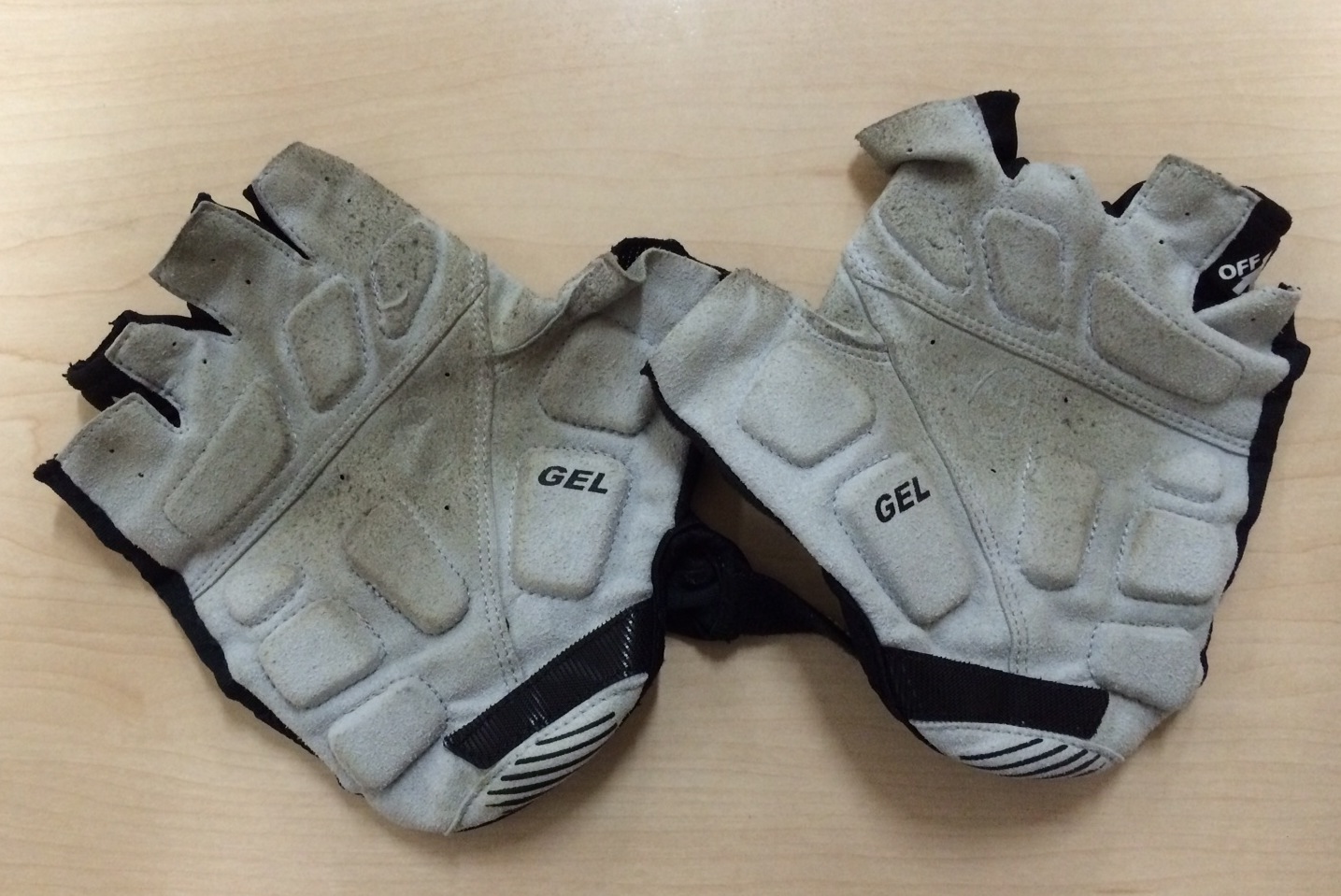
Have you bought a pair of cycling gloves in the last few years? I'm sure you have. Chances are, the manufacturer touted the gloves' "anatomic" gel padding -- designed to "relieve pressure on the Median and Ulnar nerves" in your hand -- and practically guaranteed to give "superior riding comfort" for mile after mile.
Those little "anatomic" lumps of gel padding are, at best,
annoying. At worst, uncomfortable.

I don't know about you, but the more "anatomic" the padding in gloves gets, the more it makes my hands hurt. It might seem counterintuitive, and probably counterproductive. As much as the makers try to say that putting strategically located little bumps of gel padding into the palm of their gloves is supposed to relieve pressure on key nerves, it seems to me that the anatomic pads only end up creating more localized pressure on adjacent areas -- and more discomfort.

The classic leather and cotton cycling gloves a lot of us remember from the past were typically a pretty simple affair. The padding was usually just an extra layer of leather across the palm, with a bit of simple flat padding stitched between the layers. But even with that, depending on the specific design, and where the padding hit, or where the seams hit, the padding could still lead to some discomfort. Maybe it would bunch up in the wrong places when you'd grip the bars. Maybe they just created too much of a "handful" when holding onto the bars.

In any case, it's hard to find a pair of good gloves today that I like as well as the best gloves of the past.

I recently got a pair of the new "Thinny Riding Gloves" from Rivendell that are well-made, rival the gloves a lot of us remember fondly, and do without the padding altogether.

According to Rivendell: "It's a hand physiological fact -- you can look it up -- that relying on gloves to protect hand nerves is just as effective as putting on false eyelashes to keep your cheeks dry when it's raining." There's probably something to that. I've long been thinking that maybe the ideal glove would have an extra layer of leather on the palm, but with no padding in-between. Well, these don't have that extra layer of leather, but they do dispense with the padding.

That's a nice, classic-looking glove.

Made of goatskin (there's also a "fake leather" version for vegans), the gloves are soft to the touch, but should prove to be pretty tough. I've had a few opportunities to try mine and have been pleased so far. The leather offers good grip and nice feel on the bars. My rides with the gloves have lasted about an hour or so, and I have not found myself to be missing the padding at all. In fact, compared to the so-called "anatomic" padded gloves that are so pervasive now, I found these to have a much more natural feeling.

Regarding fit -- it can be so hard to buy gloves when you can't try them on first, and of course what works for one person might not work for someone else. As far as all this goes, understand that I'm describing how the fit works for me, and your own mileage may vary. Rivendell suggested going up a size from what one might ordinarily wear. That might be easier to figure out for some than for others. In my case, I typically come in somewhere between Medium and Large. With some gloves, or some brands, I need Medium. With others, I've needed to go with Large. So it seemed to me that I had to decide between Large and X-Large. Ultimately, I went with the XL, as Riv seemed to be suggesting that when in doubt, go up, and I didn't want to struggle with getting the gloves off after a ride.


In my particular case, the gloves seem to fit pretty well all around the palm. In the fingers, it's mixed. Around my index, middle, and ring fingers, the fit is good -- close, without being too snug. On the other hand (just an expression in this case), the fit around my thumb and smallest finger is pretty loose. Remember that fit issues like that will affect everyone differently.

So, should I have gone with the Large instead of the XL? I'm thinking probably not. I have a feeling that, assuming the fit from one pair of gloves to the next were consistent, the parts that are loose on this pair of gloves would still be loose (maybe only a little less so) on the next size down, but the fit around the other fingers might be more snug, making the gloves tougher to take off. Anyhow, in actual riding, the loose fit around the thumb hasn't been very noticeable. If I start to notice it or it becomes a bother, I suppose I might be able to make some minor alterations with some heavy duty twine and some creative needlework on the crochet back. We'll see.

No chafing on this seam.
Over the years, I've been trying out other classic-styled leather and crochet-back gloves without a lot of luck. One area that sometimes causes a problem for me is the seam between the thumb and the forefinger. If not done right, I've found that the seam can cause some chafing in that fairly tender area. On these Rivendell gloves, I'm not noticing that to be a problem at all. On the inside of the gloves, the seam lays very flat. Not only that, but it almost looks as though the edge of the leather is thinned, or chamfered so it has a smooth transition (it looks that way, but I can't tell for sure if that's actually the case). Lastly, maybe it has something to do with the softness of the goatskin as opposed to tanned cowhide. Whatever the reason, so far I've felt no discomfort from seams on these gloves, which is a welcome thing.

I've only had the gloves for a short time, so it's impossible to know how they'll hold up after lots of miles. Still, looking them over closely, I don't see any potential issues in the construction. As somebody who has been known to rub broken glass off a moving tire with a gloved hand, having a second layer of leather might be a nice thing - but maybe that is a practice that I could consider halting.

Now that the temperatures are dropping, my opportunities to wear fingerless gloves are diminishing, but I'll keep wearing them when I can -- If I find anything that changes my mind about the durability, I'll likely mention it here on the blog.

So, what do the gloves cost? Given the apparent quality of the gloves and the materials, I'd say they are very reasonable at only $15. Shopping around for gloves from a variety of brands and styles, that price puts them about in the middle of the pack - with a range of prices from about $9 - $30. I'd definitely choose these over a pair of "anatomic" gel pad gloves costing twice as much, or even half as much.

My final thoughts on Rivendell's "Thinny Riding Gloves"?

Classic looks. Good grip. Great feel. Great price. 

Wednesday, December 2, 2015

Bikes and Bottles: Gifts for the Bicycling Alcoholic in Your Life

We bicyclists must be a heavy drinking lot. At least, it's easy to get that idea from looking at all the bike+booze products that are constantly being introduced.

Now that it's officially the gift-giving season (I say "officially" because people are welcome to give me stuff all year 'round), I thought I'd take a moment to highlight some of the gift possibilities for that heavy-drinking cyclist in your life - or even for yourself if you're so inclined.

Bicycle-themed bottle openers are always a popular choice, and one of the more common items:

The newest bottle-opening accessory (and the one that sparked this topic in the first place) is a joint effort between the folks at Silca and Wisecracker. What could possibly make your $450 Silca Ultimate Inflation Tool (it's too expensive to call a "pump") even more "ultimate"? Why, adding a bottle opener to the top cap, of course. Wisecracker has already made a name for themselves with stem-mounted and seatpost-mounted bottle openers (see below), so having one for the home-based workshop was a natural extension -- that way, nobody ever need be more than a few steps away from being able to pop open a cold one. (photo from Silca.cc)
While we're on the subject of the well-equipped home workshop, for the beer-drinking bike mechanic (is there any other kind?), both Pedro's and Park make "shop quality" bottle opening "wrenches." Big, rubber-coated handles give lots of leverage for stubborn bottle caps.
For an on-the-go wrench/opener option, those makers of overpriced titanium urban cruisers, Budnitz, also have a titanium wrench and bottle opener combination. With its knurled 5mm bolts, it is designed to be carried on standard water bottle braze-ons. (photo from Budnitz)
There seems to be a veritable cottage industry in so-called "upcycled" chains turned into jewelry, picture frames, and of course, BOTTLE OPENERS. This particular one comes from Uncommon Goods. I've never tried to use one, but I imagine that the flexibility of the chain "handle" would make it a little more awkward to use. What do I know?

Then there are those who can't wait until they get home before cracking open a beer, so there are a number of choices out there that attach right to the bike:

Surly has long offered a few choices for the drinking cyclist. The Tuggnut chain tensioner turns a track/fixie bike's rear fork end into a bottle opener. Two-sided, so it works whether mounted on the left or right side. Also aimed at the fixed-gear cyclist is their Jethro Tule, which has an offset 15mm box end wrench for axle nuts (it's angled slightly from the handle to help minimize knuckle scrapes), with a bottle opener on the other end.

The aforementioned Wisecracker makes seatpost-mounted and stem-mounted bottle openers that seem to have gotten pretty popular -- at least if the bicycle blogosphere is any indication. I mean, even BikeSnobNYC has one. Still, I have to wonder if this double-headed version - dubbed the "Twinduro" - is meant as a joke. What the hell? For two-fisted drinkers? Or people with really impatient riding buddies?

The Pub Nub, from Nub Nub mounts onto the end of a handlebar, like a bar-end plug. It's only shown on a MTB type of bar, so I don't know if it would work on drop bars or not (they're usually different diameter). Also available from Firebox.com where I found the following ad copy: "Here at Firebox we live by one rule and one rule only. . . Never, ever EVER leave the house without beer. It may seem like an easy rule to follow, but things get a little tricky once bicycles sneak their way into the equation. Where do I keep my bottle opener. What happens if I get all the way to the park and realize I've left it at home?"  
Remember: Admitting you have a problem is the first step to recovery.

Then there's this one from Chromoly, called the Road Popper that mounts to a bike's saddle rails. By the way, I approve of the saddle, but not so much the seat post. The Road Popper has the following tongue-in-cheek warnings (or at least I assume they're tongue-in-cheek -- maybe they really are teetotalers): "The Road Popper is not intended for alcoholic beverages. Chromoly does not condone cycling while under the influence of alcohol." 
Finally - what's the point of having all these "take-them-with-you" bottle opening options if you've got nothing to drink when you arrive wherever you're going?


All manner of leather-crafting artisans offer some variation on the 6-pack caddy. I don't know if there's much difference between them, but this example comes from the folks at Fyxation. For what it's worth, my own experience with beer is that lots of vibration has a pretty negative effect on it. Rest assured though, "Being from Milwaukee (Brew City), we've had more than a few opportunities to test out this product. When properly fastened to your top tube and seat tube and filled with a six pack of suds, there's plenty of clearance between the caddy and your legs while pedaling." 
I do think the operative word here might be "suds."

Live near a trendy brew-pub, and like to take home a growler of microbrew regularly? There are a number of artisans making versions of the growler carrier out there. This hand-crafted leather version comes from Pedal Happy Design, which makes several variations for different types of growlers.

Have you noticed that most of these things are focused on beer drinkers? Yeah, me too. But what about the wine drinkers out there? What are we supposed to do when we're out for a ride and the DTs start setting in?

If you search for 'bicycle wine carrier" you'll find there are plenty of leather crafters out there offering a way to carry a wine bottle. I didn't see a lot of differences between them, as most seem to consist of a couple leather straps that hang from the top tube. This one comes from Oopsmark. 

I just hope that's a screw-top wine bottle in there, because nobody seems to make a bike-mounted corkscrew. Of course, the ultimate bike-themed corkscrew is the Campagnolo Big Cavatappi - but good luck lugging that massive tool along for the ride. What's the use of all this misplaced booze-toting ingenuity if they're going to leave bicycling wine drinkers high and dry?

Is it too much to ask that somebody offer a clever, functional corkscrew that can be toted on a bike?

I'm starting to wonder if THIS thing was such a dumb idea after all.