Wednesday, March 9, 2016

The 36er is Real

Last month, I wrote about the Ridiculous Bikes' 39er, a monstrous but fictional XC mountain bike. After I ended that by saying "Right now, somewhere in America, a bike shop sales manager is trying to explain to a customer that he can't actually buy a 39er XC bike. And somewhere else, in a major bike company's marketing department, someone else is asking 'why not'?" a Retrogrouch reader pointed out that while the 39er may be fictional, the 36er is for real.

Yes - I know that Coker has made its Monster Cruiser for some time now, built around 36-in. wheels (which are also available for large unicycles), but I don't know that too many people take the Coker very seriously as more than a novelty beach cruiser.

DirtySixer, which is currently on Kickstarter, is billing itself as the only big bike for really tall people. More than a novelty, the DirtySixer is meant as a serious bike for extra-large riders who can't get bikes to fit them.

Yes, that's Shaquille O'Neal with a custom DirtySixer. On the left is
creator David Folch. The 36er looks downright "normal" next to Shaq.
I've long believed (and written a number of times in this blog HERE , HERE, and HERE) that wheel/tire size should ideally be a function of proper bike fit, and not a fashion trend. When I see people who barely top 5' trying to ride a 29er because some bike magazine or industry cheerleader has convinced them that everyone needs a 29er, I just shake my head. Likewise, when I hear that many in the industry would be happy to let 26-in. wheels fade away because 27.5 and 29ers are "the future" (or some similar rubbish), I have to wonder how they plan to serve smaller riders properly.

On the other end of the scale, really large riders can also have difficulty finding a bike that truly fits them when the largest wheels available are 700c/29-in. (those are both ISO 622). Granted, building an extra-large frame around 622mm wheels should present fewer problems than trying to build an extra-small one on the same wheel size -- but it does present issues. Loss of triangulation (and therefore strength) in the frame can be one problem. Visually speaking, a humongous frame on small wheels can look a bit weird and out of proportion. But also consider that a big guy at 6' 6" probably carries a lot of extra weight, too, and think about how that weight is distributed or centered over such an unusually proportioned bike.

(from Rivbike.com)
I know that Rivendell makes some of their models in gargantuan sizes. The A. Homer Hilsen, for example, can be ordered as large as a 71 cm frame! Grant Petersen designs his larger frames with an extra top tube to help add strength. Such designs might be a perfectly acceptable way to go - but to my mind, the larger-wheel concept seems to have a lot going for it.

DirtySixer has gotten some good testimonials and endorsements - including one from the NBRPA (National Basketball Retired Players Association), and retired NBA stars like Bill Walton and Shaquille O'Neal.

After looking over the information and the testimonials on the site, I have to say that for riders over about 6' 6" or so, this could be a welcome development -- assuming that rim and tire makers can keep them supplied. Looking for replacement tires could prove difficult as there aren't many choices out there (the aforementioned Coker tire offers a couple styles, but there isn't much else available), and it's doubtful that many local bike shops would have such tires in stock.

Now, if they really want to see the industry step up with more tire choices and availability, they'll have to push 36er as a hot new trend. Everybody should have one! Of course, if that happens, you'll be able to hear my dismayed groan from space.

I sometimes take to ridiculing bike startups on Kickstarter, pushing old ideas or pointless gadgets as something new and innovative. But I'm inclined to think that DirtySixer might be a worthwhile enterprise. I mean, bikes in these gargantuan proportions are never likely to represent more than just a fringe of the marketplace, so it's unlikely that many of the big bike companies are going to invest a lot into it. But for that small segment of the population who would benefit from such a thing, it would be cool to see the idea succeed.

Monday, March 7, 2016

I Love Light Metal - MANAIA

I just saw this the other day from Kickstarter: "I Love Light Metal" -- the MANAIA from a group calling itself T°Red Bikes.

What exactly is "Light Metal" -- is it like Iron Maiden meets Yanni?

You know you're just dying to hear it.
Well, no. It's aluminum. A go-fast bike made from aluminum. Only, supposedly it's really special aluminum, from the aerospace industry. Yeah, I know -- pretty much all the aluminum tubing used in bikes today has some history of use in the aerospace industry. Humor them.

From the T°Red Kickstarter page:

"These light, aluminum-based alloys are enriched with rare materials such as magnesium, scandium and zirconium. . . The resistance of these alloys is typically 30-40% higher than that of Ergal and they were first used in the construction of submarine-launched missiles designed by the USSR, which were even able to penetrate polar ice layers."

So if you decide you'd like to punch through polar ice with your bike, you're all set.

"High-Tech" bike startups always want to highlight the aerospace connections, but basically, it's 7000-series aluminum with some traces of scandium in the alloy mix. The traces of scandium are supposed to affect the crystalline structure of the metal during welding and presumably mean stronger welds. I got that from Wikipedia, by the way, not MANAIA.

Speaking of welds, at least they smooth the heck out of these after welding.
There are lots of typically puffed-up claims about the bike on the website. For example:

"The impeccably finished TIG welding and the brushed surface enhanced by an indelible Maori tattoo make MANAIA a truly unique bicycle. It has been designed to offer its best performance when pushing for the limits . . . with a lightness and rigidity comparable to the best carbon frames . . . while the innovative rear triangle and integrated seatpost ensure a truly amazing feeling. A metal creature born to ride, whose sole purpose is to make you win."

As long as you were already winning on your old bike, that is. If you were a mid-pack "also ran" the MANAIA won't change that.

In any case, what we have here is a pretty typical welded aluminum racing bike, fairly short-coupled, and equipped with carbon wheels and disc brakes. Overall, not that different from most other higher-level race bikes today.

So, to distinguish it, the company makes quite a bit of the unique "maori tattoo" graphics that decorate the frame.


Act now and pledge on Kickstarter, and you'll even get a matching skinsuit:

Matching bike and skinsuit are the apex of Fred-dom.
I highly recommend watching the video. . .

. . . which opens on a half-naked Fred in an empty warehouse. Cue the overly dramatic music.
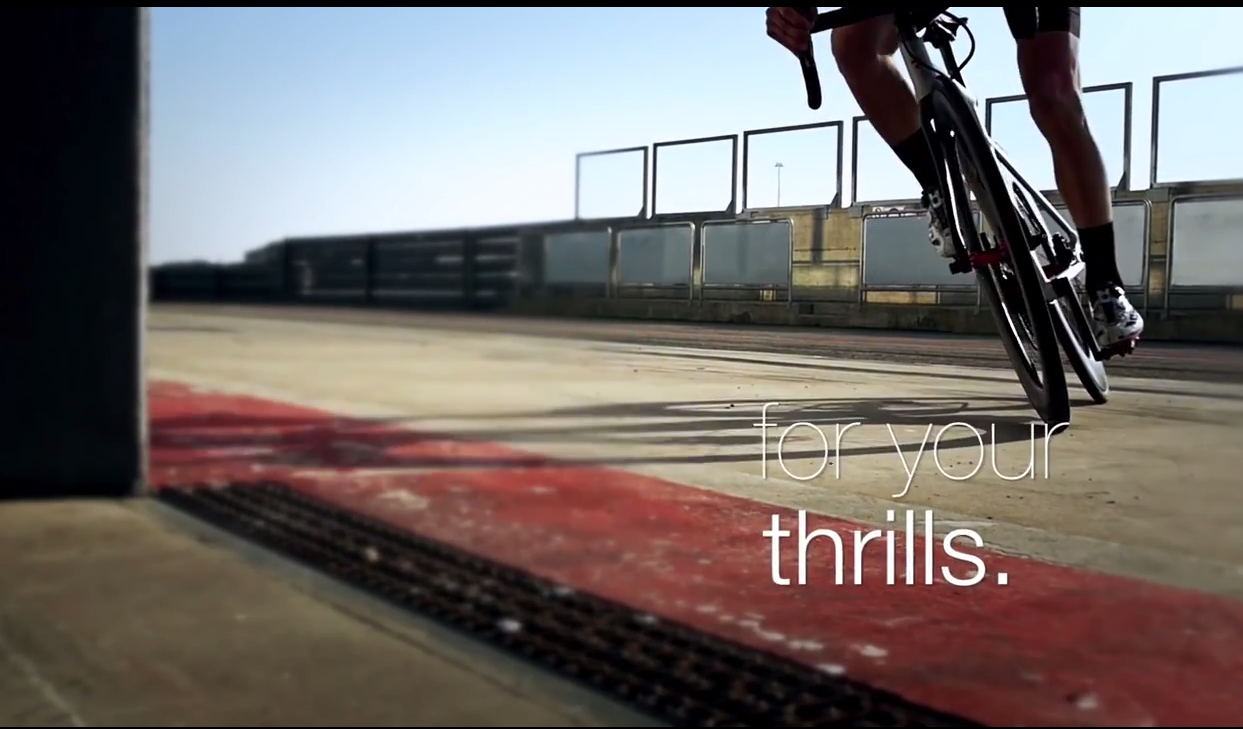
Include lots of shots of bike and skinsuit-matching Fred zipping around the tarmac (that's lower-case "t" tarmac, so don't sue me, Specialized).
Make sure to include some gratuitous skids "for your thrills."
Then make the Retrogrouch laugh out loud:

"Life"
"will never be the same."
Yes. Yes, actually, it will.


Enjoy!

Friday, March 4, 2016

Another Electronic Shift System Drops

In case anyone had any doubts, electronic shifting is here to stay, if the latest Taipei Cycle Show is any indication. Shimano, Campagnolo, and SRAM all have their own electronic shifting systems -- all of them costing thousands of dollars. And now a low-cost version from Microshift is clearly in the works, with a functioning prototype system on display at the industry show in Taiwan.

Reports are that the system would cost about $600 or less, making it cost-competitive with a lot of "normal" cable-operated shifting systems.

Apparently, one of the challenges with producing another entry to the electronic shifting world is getting around the patents of the leaders -- as virtually every element of the current systems on the market, right down to the wiring, is protected from infringement. The way I understand it, that was one of the reasons that ROTOR components decided to create their hydraulic shifting system, which is just about to launch later this spring.


Microshift, a Taiwanese company, has been making a name for itself with their good-quality-low-price components. In my experience, their current derailleurs function as well as anything from Shimano, and some even have nice buffed or polished silver finishes that look good on older bikes as well as new. I guess it was only a matter of time before they tried to break into the electronic shifting market.

The way I understand it, the Microshift system, called eXCD, uses "standard" batteries -- in this case rechargeable AAs -- and keeps them in the bar-mounted shifter unit. According to visitors to the Microshift booth in Taipei, there are no other battery packs to mount onto the bike. The company says that a charge should be good for about 1000 km, or 6000 shifts.

I don't know if that's good or bad, but I do know that my old cable-operated shifters have virtually no limit of miles or shifts.

The rear derailleur doesn't look any better or worse than other electronic derailleurs I've seen so far, which is another way of saying that it's just as ugly as the rest. The shifter unit, which houses the batteries, brains, and buttons, is a clunky-looking thing, and doesn't look like it would "integrate" with a bike's brake levers the way some other electronic shifting systems do. Then again, it is intended for mountain bikes - not road - and it's still in the prototype stage, so the design could change. Doesn't matter to me, though.

Once the eXCD system hits the market, in another year or so, I suppose that it will only be a matter of time before we'll be seeing more and more e-shift systems at lower and lower prices, and eventually it could be hard to find a bike -- even at the entry-level -- that doesn't have to be plugged in or charged up before riding.

And won't that be something to celebrate?

Wednesday, March 2, 2016

Quiz: Do You Know Your Lugs?

After failing (miserably) the BikeRadar quiz on "Do You Know Your Mountain Bikes" (believe me, I'll get over it) I decided to create my own quiz on classic road bike bits. Identifying current mountain bikes by their blackened silhouettes just isn't in my repertoire. And as I mentioned previously, putting silhouettes of vintage road bikes up could be even more difficult to identify. For example, can you tell what this bike is by its silhouette?
Hint: It starts with "M" and rhymes with kamikazi.

Classic steel bikes are about details, and while the details can go much deeper than elements like lugs, it seems to me that lugs are a good place to start.

So with that, I present you with a little 10-question quiz.


Try it, and report in the comments on how you did!

Monday, February 29, 2016

Quiz: Do You Know Your Mountain Bikes?

I just took a quiz on BikeRadar - How Well Do You Know Your Mountain Bikes? 


The quiz is set up with pictures of 10 current mountain bikes shown only in silhouette so that no logos or colors are visible. You then have to pick the right bike from about 4 multiple-choice options.

So, how well do I know my mountain bikes? Turns out, not very well at all. I got 2 out of 10, and one of those was just a lucky guess.

Here was the only one that I got right that was more than a simple shot in the dark guess:

Something about the curves in this bike's top-tube told me "Ibis," so I went with that. YEAH!

On the whole, though, they all looked pretty much the same to me. Suspension forks, rear suspension linkages and shock absorbers, extra long seatposts, and weird alien-meets-praying-mantis proportions. It's just not something I can fully appreciate, I guess. That's not to say they aren't great bikes -- they're just not my thing.

No idea what this is.
To be fair, however, if someone were to set up a similar quiz with a bunch of silhouette pictures of classic steel road bikes, I might have to admit there'd probably be even less to distinguish one from another.

For example:

I couldn't tell you the make or model of this bike by its silhouette. I could, however, tell you that it's full Campy (except for that seat-post), and it has some deep-drop Cinelli bars on it (Campione del Mondo?). The top-tube cable clips would hint at something from the '70s, and something about the bike's overall proportions and angles would lead me to guess it's Italian. And all of that info is probably much more than you'd get from somebody who got 10 out of 10 on the mountain bike quiz.
The thing about classic steel bikes is that the differences are in the details -- not what you see from a distance. What kind of lugs are used? Did the builder file and thin them? Are there any cut-outs in the lugs or bottom bracket? Is the brazing clean and free of lumps or gaps? How did the builder handle the seat-stay tops and the seat-lug cluster? How are the tubes finished at the dropout ends? What kind of seat-stay and chain-stay bridges were used? What type of fork-crown does it have? What's the fork rake like? Someone who has even more experience with construction details, or with certain brands and builders, might be able to identify more.

Its for reasons like those that a reasonably well-versed classic-bike fan can often identify the make and model of a bike even if the thing has been stripped of its original parts and Kryloned half to death. It's the minutiae of details that, to me, make a hand-built steel bike so much more interesting.

Now, some builders over the years have made their bikes easier to identify from a distance than others. Hetchins made bikes with "curly" stays that are instantly recognizable. Bates made their "Diadrant" forks with a double-bend in the rake. And there were "Flying Gates" and other unusual models as well -- all of which could be recognized from afar, with or without names or logos. But on the whole, classic steel road bikes are special not because of what you can see from a silhouette, but what you learn to appreciate up close and personal.

Friday, February 26, 2016

Excel & Elgin - American Derailleurs from Beatrice Foods

It's probably not widely known that the U.S. had a bicycle derailleur and component industry in the years shortly after the Great American Bike Boom -- long before the CNC'd boutique parts craze that began in the 1990s. Nor is it likely that many people know that the now-defunct mega corporation Beatrice Foods was behind it.

Beatrice Foods? Their slogan used to be "You've known us all along" because they were the parent company of all kinds of brands and products that were a big part of everyday American life: Peter Pan peanut butter, Butterball turkeys, Hunt's tomato products, Tropicana orange juice, and much, much more. In addition, they also were the parent company of numerous non-food-related companies such as Airstream campers, Samsonite luggage, Avis car rental, and others. In the 1970s, probably due to the bike-boom, they must have decided that bicycle components were a good bet.

According to Frank Berto's bicycle history The Dancing Chain, the Illinois-based Beatrice got started in the bicycle component business in the early '80s, but according to the Disraeli Gears site, it seems that the start may actually have been earlier than that - at least by the mid '70s. Their line of derailleurs and other components bore the name Excel, although the name Elgin also enters into the history.

The Excel Dynamic of the late '70s was a blatant copy of the
Huret Allvit -- but without all the "refinement" the original
was known for. Ha Ha.
There have been a lot of companies and products that carried the Elgin name -- many of them based in Elgin, Illinois: watches, sewing machines, and bicycles, among others. Elgin bicycles were a brand owned by Sears (based in Chicago, you may recall) and sold at least up until WWII. In the 1970s, many Sears Free Spirit-branded 10-speeds were using derailleurs with the Elgin name, and made in the USA. Both Elgin and Excel derailleurs were made in the same Illinois factory, and the same basic derailleurs could apparently be found marketed under either brand name.

Unlike the made-in-the-USA CNC'd derailleurs of the '90s, which were extravagantly expensive creations hewn from colorful anodized aluminum, the Excel and Elgin derailleurs were bottom-of-the-barrel stamped steel copies of verging-on-obsolete French Huret and Simplex units. The Excel Dynamic was a cheap, less-refined clone of the Huret Allvit (except that it was almost impossible to adjust, and had menacing springs poking out dangerously), and the model known as the Elgin American was a copy of the old Simplex Prestige, complete with plastic pivot bodies. There were also front derailleurs that worked somewhat like old Campagnolo Valentino units, but cheaply stamped out of steel and shrouded in plastic. Together, these derailleurs were used on Sears Free Spirits and other American department store bikes in the late '70s. Big surprise there, right?


One can still find parts diagrams of the old Excel derailleurs on Sears Parts Direct. Shockingly, some of the small parts are still in stock. Why would anybody rebuild one of these things when it would be easier to just replace it with a better derailleur?
Here is an early '80s edition of an Excel steel derailleur. It's been prettied up a bit compared to earlier versions, and the plastic pivot bodies have been changed to steel, but it's still basically a Simplex derivative (maybe with a little Shimano Lark thrown in for good measure).

In the early '80s Excel also began importing Italian copies of SunTour derailleurs. Made by Cambio Rino, the rear derailleurs looked remarkably like SunTour Vx and Cyclone models. Called Excel Gruppo Rino, they didn't hide the group's origins. The Rino-made derailleurs are a real curiosity because they are faithful SunTour knockoffs -- including SunTour's patented slant parallelogram, even though that patent wouldn't expire until the end of 1984. It is unclear whether Rino (and by extension, Excel) faced any legal action for violating the patent, or if they paid some kind of licensing fee to SunTour for the rights to use the design. One can search for the answer to that question and find nothing definitive either way. Nevertheless, I've never seen one up close, much less used one, but I have no doubt that they worked just fine. Why wouldn't they? While the imported Rino components made up the company's high end, their American-made French-inspired steel derailleurs continued to be sold as the budget line.

In the early '80s, ultramarathoner Lon Haldeman figured prominently in Excel's advertising. Haldeman was a notable user of the higher-end Excel components in the Race Across America.
In 1983, Excel introduced their Ultimate line, which was also made for them by Rino. The ads proclaim it the "official" component group of the '83 Race Across America. The Ultimate rear derailleur also utilized the SunTour slant parallelogram, but looked less like a faithful copy than a heavily streamlined refinement -- or a derailleur-shaped blob of molten aluminum, depending on your taste.
Also in 1983, Excel introduced the Cambiogear, an expanding chainwheel crank that shifted gears without a derailleur. I wrote about that one back in January. Made of graphite-reinforced plastic, it offered 16 sequential gears with a 3-to-1 range. Unlike the Rino-made derailleurs that made up the company's "high end" products, the Cambiogear was made in the USA. The product was only available for about one year before disappearing. Judging from the advertisements in the bicycle magazines (it seems that they stopped appearing sometime after '83), Excel must have gone under not long after. That was it for American-made derailleurs for the rest of the decade.

The Excel Cambiogear was
an expanding-chainring crank
introduced in 1983.
The '90s brought a resurgence of American bicycle component makers, mostly using CNC technology - like Joe's, Precision Billet, Paul's, White Industries, and others. Most of those companies are still in business today, though few if any of them are making derailleurs anymore. And of course there is now SRAM which has made serious in-roads against Shimano and Campagnolo -- but while that company may be U.S.-based, as far as I know the derailleurs and most other components are made in Taiwan.

I'm not implying that Excel's American-made components were in any way good -- far from it -- but in the '70s and '80s, Excel was about the only game in town for American-made bicycle derailleurs for the burgeoning "10-speed" market. Yes, Schwinn had components with their own name on them, but most of those were made overseas and re-branded. Otherwise, any bicycle parts made in the USA were primarily for kids bikes and heavyweight cruisers. But any discussion of American bicycle components wouldn't be complete without including Excel.

Thursday, February 25, 2016

ENVE Carbon Fork Recall

If you're a regular Retrogrouch reader, it's unlikely that this would apply to you, but there is another carbon fork recall in the works. Recently, ENVE and the CPSC announced a voluntary recall of the ENVE Road 2.0 disc brake fork. Apparently the forks, which are made in Vietnam, have the potential to break just above the disc brake mount. So far, they've had a handful of failures of the forks, though there are no reports of injuries at this time.

According to the CPSC, the affected forks have 1.25" tapered steerer tubes and were sold for about $540 between June 2014 and December 2015. Owners should check the serial numbers marked on the steerer tube. Affected forks have serial numbers beginning with VCT1406, VCT1410, VCT1411, VCT1501, VCT1503, VCT1505, VCT1506, VCT1507, VCT1508, VCT1509, and VCT1510.

If you, or someone you know has a bike with one of the forks, CPSC says they "should immediately stop using the recalled forks" and contact ENVE for a full refund or a substitute model (recall form HERE).

Many things about this recall say that it's unlikely that any retrogrouches would be affected. "Carbon Fork," "Disc Brake," "Tapered Steerer," and "$540." But you might have a friend who won't (or shouldn't) be riding until they get this thing sorted out. If that's the case, please be nice and let them borrow a solid, reliable steel bike until they can get their new forks from ENVE.

Of course, there's always the risk that they won't want to give your bike back.