Monday, October 5, 2015

Standards Schmandards: Roost Carbon

I've ranted lots since starting The Retrogrouch Blog about the lack of standards in the bike industry - or how new so-called standards are constantly being introduced. Well, it seems someone out there, calling themselves Ridiculous Bikes, has created a fun statement on the industry's disregard for standards in video form.

Introducing the Roost Carbon mountain bike - which takes a lack of standards to its ridiculous result.

Some of the bike's features include:

. . . ultra-wide 188 mm rear dropout spacing
. . . 28 inch wheels (to get the best of 27.5 and 29er - without having to choose!)
. . . an 11 - 53 tooth 13-speed cassette
. . . and an extra long 1500 mm wheelbase, for a riding position the company describes as "prone geometry." 

Very telling quotes from the bike's creators:

"188 mm dropout and huge BB spacing are not patented" and "free for use by all drunkards."

"Full geometry will not be released due to the waste of time from measuring."

The creators also explain that the bike and the video were computer-generated by "Grabcad's J. Deschamps," and "heavily modified, setup, textured and remodeled by Patrick Ng." Nice work, guys.

Though the video was originally released on Vimeo (which I can't seem to embed here), I did find another copy on YouTube from Extreme Sports that you can watch right here:


The one main disclaimer the video's creators include says, "This full 3D video was not meant to diss anyone or discourage change in the MTB industry, there are no affiliations to Club Roost products and the video was created for fun in one afternoon after an awesome trail ride! Cheers."

Hell - they may not have wanted to criticize the industry, but there's plenty of ridiculousness out there to serve as fodder for more satire. I say own it - and bring on more.

Friday, October 2, 2015

Flipping the Bird: fUCI Concept Bike

What would a fast road bike look like if it weren't for those wet-blanket retrogrouches at the UCI constantly stifling innovation?

Robert Egger, Creative Director at Specialized, thinks he has the answer to that question in the form of his fUCI concept bike. In case folks don't get the significance of the bike's name, the "f" stands for F#@K the UCI. The name is probably the most subtle thing about the bike. In a number of ways, the bike represents all kinds of design ideas that would never make it through the UCI rulebook.

Take a look (all images from Specialized):

Nothing's classier than a double-bird salute.
The motorcycle-inspired fairing, different-sized wheels, and electric motor are some of the major points on the bike that raise a symbolic middle finger to professional cycling's governing body. Egger points out (correctly) that most bicyclists don't race, and for that reason, the UCI only represents a small portion of the bicycling world. He designed the fUCI concept bike for people who are only interested in going fast, regulations be damned.

It's the "crotch rocket" of bicycles.
The oversized rear wheel (33.3 inches - as it says on the side of the deep-profile rim) is supposed to act like a "flywheel" and help preserve the bike's momentum. Getting that oversized tri-spoke wheel spinning would take a fair amount of extra effort, though - so that's where the electric motor comes in. Hidden in the bottom bracket, with the battery stored in the wheel-hugging lower fairing, the motor is supposed to act like "turbo boost" so that riders "don't need to endure tough energy-intensive starts." Just let the motor do the work.

As for me, I still balk at adding electric motors to bicycles. Sure, the bike may be fast -- but it's not all that impressive when you get that speed with a motor. In this case, the bike reminds me more of a motorcycle than a bicycle. Or at the very least, an electric moped. In fact, why not just go all the way and ditch the crank? Just put on some foot pegs and call it a motorcycle.

Can't have a modern bike without a smartphone dock. Of course, when the next incarnation of your iPhone completely changes the size, shape, and connection ports (again), it probably won't fit anymore. By then it will be time for another new bike.
What everyone wants on a bike: A magnetically latched compartment. I can hear that thing (and all of its contents) rattling away already.
The full-size model -- and another bird salute from Egger. Nice. . . 
Yeah - it's just a concept -- and as such, doesn't have a lot of practicality for actual riding (storage compartment or not). And it's true that if someone doesn't race, then why worry about what the UCI says? But then again, bike companies have always been free to offer whatever technology they want to regular consumers. There really is no limit on what companies like Specialized can offer to the non-racer, which makes the defiant F.U. attitude of the fUCI concept a little puzzling. As it is, there's nothing to prevent them from putting their electric moped into production.

Go ahead, Specialized. Make the bike. Go-fast poseurs will probably love it.

People like me will still think of it as kind of a crude joke, but maybe those bird salutes are meant for us, too.

Wednesday, September 30, 2015

"Smart" Pumps and PSI Apps

It's getting to where a person can't even pump up tires anymore without a smart phone and some kind of "app."

At least, that's how it seems after looking at a couple of recent pumps from Airace. Offered in both mini pumps and in floor models, the i-Gauge pumps use a Bluetooth 4.0 connection to the user's iOS or Android phone, and the pressure gauge app is claimed to be accurate to within +/- 1 psi up to 100 psi. In the case of the floor model, it is supposed to be capable of reading up to 300 psi -- you know, for people who like their tires really, really hard. On the other hand, the actual pump is rated for "only" 240 psi so maybe they're being optimistic.

Besides the claimed accuracy, one of the benefits of using a smartphone app for a pressure gauge is that the app allows a person to pre-program a desired psi, then an alarm will sound when that pressure is reached. Wow - that right there probably just made the whole thing worth whatever price they're charging.

Most mini pumps and frame pumps lack a pressure gauge. Then again, if all you want is to fix a flat and finish your ride, how important is having the perfect pressure? Squeeze the tire between two fingers 'til it feels right. Am I wrong? But now the iGauge mini pump with Bluetooth sends a signal to the user's smart phone, where an app will give the accurate pressure. And yes, that means the pump requires batteries (two CR1632 coin-type batteries). If the batteries go dead, users will have to guess at the pressure just like the "old days," but at least the pump will still work. Oh well. . . Price? $102. (photo from Airace)
Having a Bluetooth-enabled mini pump is a cute (but ultimately unnecessary) gimmick for people who obsess over having the perfect air pressure for on-the-road repairs. But for a full-size floor pump that stays at home, wouldn't it just be better to have a normal built-in gauge? Apparently not. Heck, it could even be a digital gauge for those people who are convinced that such things are automatically more accurate than a good quality analog gauge (which isn't necessarily true). But then users wouldn't be able to fiddle with their smart phones when pumping their tires, and where's the fun in that? The iGauge Veloce Bluetooth floor pump has no gauge whatsoever apart from the smartphone app. Like the mini version, it also requires batteries. If getting the right pressure is important, then keep an eye on those batteries. Price: $117 (photo from Airace)

30 years and still working fine, even
if the pink is a little out of fashion.
Are floor pumps equipped with analog pressure gauges (that don't take batteries) going away? I certainly doubt it. "Smart" pumps like this aren't likely to change that, or make my classic old Silca track pump obsolete. So I suppose these Bluetooth pumps are little more than an amusing little indulgence for people who believe there has to be an app for everything.

As for me, I still don't own a smartphone. My phone makes calls and takes calls, and that's about it. I'm resisting this technological march as long as possible, and so far, I'm proud to say that I'm still smarter than my phone. It's shocking just how much a person can do without one. Maybe more people should try it.

Monday, September 28, 2015

The Carbon Fiber Anachronism

Have you ever wondered what the first bicycles would have looked like if people like Pierre Michaux and other early pioneers had access to today's carbon-fiber and e-bike technology?

Though fully rideable, the front wheel is only 39-inches diameter,
which would seriously limit the "gearing." Proper P-Fars would
often have wheels up to 60-inches! (photo from DING3000)
Yeah, me neither.

But that didn't stop designers and engineers from THM-Carbones, BASF, and the design firm of DING3000 from teaming up to create a pair of €50,000 carbon-fiber penny farthings (that's €50,000 each!). Dubbed Concept 1865, the idea was to take the bicycle back 150 years, which apparently coincides with the founding of the chemical/plastic company, BASF. One of the bikes was shown recently at Eurobike 2015.

THM-Carbones is a German manufacturer of carbon fiber cranks and other components, and used their expertise in some of the P-Far's construction, utilizing BASF's latest plastics. And DING3000 apparently came up with the anachronistic design.

The removable seat hides the battery, which can be charged
off the bike. Notice that the bike also has some kind
of integrated LED taillight. (photo from DING3000)
Not only does the rolling anachronism sport plastic and carbon fiber construction throughout, but it also incorporates an electric motor hidden in the rear wheel. Traditional penny-farthings used the larger front wheel to increase gearing, (the larger the wheel's circumference, the farther the bike would travel on one crank revolution. To this day, gearing is often described as "gear inches" for that reason). This P-Far only has a 39-inch diameter wheel, making it much easier to mount and dismount, but would limit the gearing or speed considerably. To that end, the bike should get fairly speedy with its e-motor assist.

On the other hand, penny farthings had their cranks mounted directly to the front wheel without any kind of "freewheeling" mechanism. They were the original "fixed gear" machines, which meant that going downhill could be a pretty scary experience, or perhaps "thrilling" if a rider had what we might nowadays call "thrill issues." In any case, I haven't found any mention as to whether this little carbon P-Far has any kind of freewheeling action built into that front wheel. If it doesn't, then zipping along on the motor assist would mean the rider's legs would have to spin like crazy to keep up.
The THM carbon-fiber fork also has a loop of LED lighting.
(photo from DING3000)

Braking duties are taken care of with what appears to be a carbon fiber disc brake on the rear wheel.

Still, the basic design of the penny-farthing, or "ordinary" is it was also known, is such that the possibility of a face plant was all too real and likely -- which is why such things were really nothing more than a quirky-yet-charming dead end in bicycle design. Having a 39-inch front wheel doesn't really change that, other than reducing the falling distance a little. If anyone should actually want to ride the Concept 1865, I'd suggest they avoid hills.

Another tech feature of the bike is the tires, which are some new BASF polyurethane elastomer, and have some kind of expanded polyurethane foam for shock absorption. What is that? Solid tires? So, when they say they're going back to the 1860s, they really mean they're going back. Nevermind that the invention of pneumatic tires in the 1880s remains one of history's all-time greatest transportation-related inventions. The creators also gave the bike some new high-tech pedals that are made entirely of plastic -- without any ball bearings whatsoever. Again, ironically eliminating one of industry's greatest inventions (pioneered on bicycle pedals, of course! Jules Suriray, 1869).

Watch the carbon fiber anachronism in action in this little "image film" available on the DING3000 and BASF websites, or right here courtesy of YouTube.


At  €50,000 don't expect to see carbon-fiber P-Fars tooling around near you. But enjoy the video!

Friday, September 25, 2015

Sprocket Man Comics

It was the Bike Boom of the early '70s, and bike use at college campuses was . . . well . . . booming. With so many young cyclists taking to the streets, and probably annoying the drivers who up until that point believed they owned the roads, public safety officials declared that "the anarchy of the cyclist can be afforded no longer!" (*) So at Stanford University, in coordination with the Urban Bikeway Design Collaborative (UBDC), the solution was to create a new kind of super hero -- not a hero who could fly, or melt steel with lazerbeam eyes, or anything resembling superhuman powers. No, this super hero would be found astride a 10-speed bike, and would subdue his adversaries with a relentless onslaught of safety admonishments and, occasionally, a well-aimed freewheel cluster.

He would be forever known as SPROCKET MAN!

Sprocket Man was first published by Stanford University, then acquired by the CPSC.
Sprocket Man came to life in 1974 through the pen of Louis Saekow, a Stanford pre-med student who had no formal art training but enjoyed drawing comic book characters. Working as a file clerk at an urban research institute on campus, Saekow was given the opportunity to draw some cartoons on bike safety for a newsletter. That eventually became the Sprocket Man comic book, published in 1975 by the Stanford Dept. of Public Safety and the UBDC. (Stanford University)

A later version of the Sprocket Man
cover, after a little make-over.
Within a couple of years, the Consumer Product Safety Commission (CPSC) acquired the rights to the Sprocket Man comic book, and began distributing it nationally. The CPSC had begun regulating bicycles in 1976, and I believe they first issued their version of the comic in '78. In the CPSC editions of Sprocket Man, there is a legalistic-sounding preface that explains (or perhaps defends) the commission's right to regulate all bicycles sold in the U.S., including some language that probably alienated many serious adult cyclists. For example, it states that the CPSC's "regulation applies to nearly all bicycles that are toys or other articles for use by children (but may also be used by adults)."

In fact, it was the CPSC's definition of bicycles as "toys for children" that more than anything angered the more outspoken bicycle advocates of the time. There seemed to be no distinction to the regulatory commission between bikes for children and bikes for adults. John Forester, who first published his Effective Cycling in 1974, was one of the harshest critics of the CPSC's bicycle regulations, dismissing many of them as ineffective and misguided -- predominantly created and mandated by people who had no understanding of bicycles, or cycling. Interestingly enough, however, Forester's Effective Cycling is listed in the comic book's bibliography as one of the sources for the Sprocket Man's safety advice.

KA-BLOOM! Sprocket Man thwarts two bike thieves with a well-aimed freewheel cluster. It's the only real "action" this super hero sees.
Apart from dispatching a couple of long-haired bike thieves, Sprocket Man doesn't really battle a lot of actual villains. More typically, his efforts are aimed at promoting safe riding, stopping dangerous and lawless cycling behavior, and sometimes encouraging courtesy to drivers and pedestrians.

Some tips on avoiding the common "right hook" scenario, though it's mostly presented as an admonishment to follow the rules of the road, just like the driver of any vehicle.
Don't get "doored." Sprocket Man declares (rightly) "Don't waste your time fiddling a horn or bell. Go for your brakes and . . . SCREAM!!! Move left BUT . . . Don't swing into traffic!!"
Lock your bike. Use a good quality lock (U-locks like the one shown were still a pretty new item when this came out). Sprocket Man advises locking the front wheel, too.
The Sprocket Man comic book would go through a couple of minor re-makes over the years, but the majority of the text and most of the drawings were simply re-used throughout a couple of decades. Fun fact: In Saekow's drawings for the original Stanford version of Sprocket Man, he managed to slip in some little visual jokes. In one, he had a hapless cyclist dropping a bunch of books -- one of which, if you looked closely, was Playboy Magazine (a PDF of the original can be found HERE). When the CPSC took over the comic, that little detail got left out.

Another version of Sprocket Man was re-issued by Raleigh Bicycles - probably as a giveaway to their customers to promote safety. Again, most of the comic's artwork stayed the same - though some of the text was changed to reflect Raleigh's commitment to safe riding. For example, Sprocket Man says "Your Raleigh Dealer has asked me to share some of Sprocket Man's SAFE CYCLING SURVIVAL SKILLS with you." By the way, Raleigh must not have looked closely at some of the pictures, because their issue of the comic includes the "Playboy" image mentioned above.

In the '90s, the CPSC put out a slightly revised version of the comic - but this time, updated (rather awkwardly) to include the religion of helmet use (full PDF file).

Yet another re-make of Sprocket Man, this time from the '90s, clumsily adds helmets to all the old '70s era drawings.

The 1975 original (left) and the 1990s remake. Every single cyclist in the remake is shown with a helmet -- even the idiots who do everything wrong. Notice that the hair on the guy at the bottom still manages to stand on end, despite being covered by the helmet.
In 2002, the Stanford Department of Parking and Transportation Services went back to Louis Saekow (who gave up on his medical ambitions to become a graphic designer) to create a newer, updated Sprocket Man safety campaign - combining some of the original '70s artwork with newer, more modern graphics:


And now, the latest news in the saga is that, at long last, Sprocket Man, like all the other super hero franchises, is finally being turned into a movie for the big screen. And much to the dismay of hard-core Sprocket Man fans, Ben Affleck has been tagged to play the bike-riding superhero.


OK - that last part is complete B.S., but the poster is real.

So, he's not the Hulk, or Captain America, or Iron Man. He doesn't fly, and he doesn't seem to have any actual super powers. And when you get right down to it, he's even a little bit of a safety nerd. But for bicyclists, Sprocket Man may just be the only bike-riding super hero we're ever going to see.

(* actual quote from the Sprocket Man comic)

Wednesday, September 23, 2015

Suspension Stems

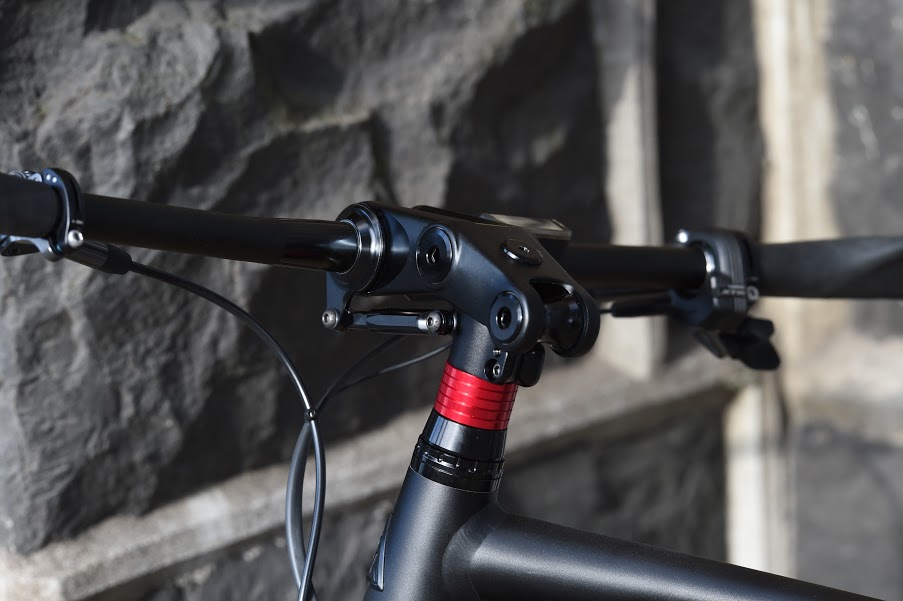
Like lots of other rehashes of old technology posing as something new, it seems that suspension stems are back. In the days before suspension forks became a virtual marketing requirement on mountain bikes, some companies tried marketing "simpler" alternatives for suspension by putting the suspension into the stem. Using pivots, linkages, elastomers or, in some cases, coil springs, some of these suspension stems actually rivaled suspension forks for complexity and price -- and were eventually dismissed by buyers as pointless before basically disappearing from the market.

One of the original suspension stems. The Girvin Flexstem (originally known as the Offroad Flexstem) used elastomers to provide some damping. (photo from MOMBAT.org)

One of several versions of the Softride suspension stem. I remember when it was known as "Frankenstem." (photo from MOMBAT.org)

Recently, the editors of Dirt mountainbike magazine listed the stems as one of "The 15 Worst Mountainbike Products Ever." They wrote, "The young 'uns amongst you might not believe this, but there was a time when even the validity of front suspension forks was questioned." (Yes, I was one of those who questioned it -- and in many circumstances, still feel the same way). "For those that weren't sold on this newfangled idea, but didn't want to suffer the pain that a fully rigid bike dished out, there was an alternative . . . the suspension stem. The most well known of these was the Girvin Flex Stem, and that was a crime against suspension itself, but its saving grace was that it was at least relatively cheap compared to a suspension fork. The Softride stem on the other hand was the supposed dog's bollocks of suspension stems, and it cost as much as many suspension forks . . . but unsurprisingly it was just as rubbish as the Girvin, which is why I think it's the Softride in particular that needs naming and shaming."

Although the stems were primarily intended for mountain bikes, I imagine some were put into service on road bikes. Nevertheless, perhaps hoping that road riders are either unfamiliar with the old follies, or have perhaps forgotten about them, this new crop of suspension stems are primarily aimed at road riders. I'm still convinced that they're even more unnecessary on road bikes than they were on old mountain bikes.

It's even more complicated than it looks.
(photo from Nailed.it) 
One of these new stems comes from Naild and their R3ACT (I think that's supposed to make us think "react"). Their website declares, "The patented R3ACT System preserves the rider's energy by acting like a rigid fork on smooth terrain. Once a structure is encountered (potholes, bumps) the rider's weight reacts on the handlebars (Newton's 3rd Law) activating the system. Now fully active, R3ACT can track the terrain maintaining wheel contact with minimum loss in forward momentum. The system combines travel from above and below the frame, geometry and tire contact remain constant throughout resulting in improved handling, braking and control while reducing fatigue."

Or you could just run larger tires and keep your body loose over bumps.

By the way, their marketing materials mention Newton's 3rd Law so much, you'd think Sir Isaac had a hand in developing this thing.

The Naild R3ACT stem is actually a pretty complex item, as it incorporates extra linkages which keep the handlebar angle constant even as it pivots up and down. But more than the pivoting of the stem, the system also incorporates elastomers in the fork steerer, so it isn't really something that can be retrofitted to an existing bike -- the bike must be designed for the system from the beginning.

Simpler than the Naild R3ACT, but I suspect just as pointless.
(photo from the ShockStop Kickstarter page.)
Another new suspension stem comes from Redshift Sports: the ShockStop stem. Using hidden elastomers inside the stem, the ShockStop doesn't look a whole lot different from other threadless stems, and can be installed on most modern road bikes (with a common quill-stem-to-threadless adapter, it could probably be installed on older bikes too).

Here's what they say on their Kickstarter page: "Bikes should be comfortable, but ride more than a few miles and you realize very quickly that bikes are stiff, and they transmit every little bump straight to your hands and arms. After a while those impacts and vibrations make it hard to enjoy the ride."

Again - anybody who slams into every pothole and road imperfection with arms locked probably doesn't enjoy riding much anyhow.

In their promotional video, the company claims that with ShockStop, "You can relax and enjoy the ride. Instead of dodging every little bump and crack, you can focus on the road ahead." Suspension stem or not, focusing on the road ahead for bumps and cracks is still a good policy. Good technique is essential with or without suspension.

I still have some questions about this new generation of suspension stems, so I thought I'd go right to the source -- and ask the ShockStop stem directly.

Retrogrouch: So, isn't this basically just a reboot of old rejected mountain bike technology?

ShockStop:


Retrogrouch: Couldn't a person save a lot of money by keeping their current setup and just learn some decent riding technique?

ShockStop:


I'll take that as "Yes" on both counts.

Fully expect to see the current crop of suspension stems selling cheap on eBay in a few years, just like those old Girvins and Softrides do today.

Monday, September 21, 2015

Sexist Selling Strategies?

About a week ago, I posted about an old advertisement for Lambert Bicycles from 1973 which featured the following photo:


A reader pointed out the irony of my waxing nostalgic about the ad with its sexy model on the same day that much of the bicycling blogosphere was foaming at the mouth over some free socks that were given out in the swag bags at this year's Interbike trade show. Quickly dubbed "Sockgate," (why do ALL scandals since Watergate have to end in "gate"? Can't somebody get creative?) the giveaway socks renewed accusations of sexism in the bicycle industry -- even as they claim to be trying to appeal more to women cyclists. To be honest, until the reader mentioned it, I hadn't yet heard about the sock scandal.

I found the above photo on the Surly Bikes Blog, where Christina Julian, or Jules, makes a strong case against the "Sex Sells" strategy, and even includes some awful examples of the kinds of sexual harassment that she's experienced by some in the industry. It's worth a read. (photo originally from pretty.damned.fast)
Needless to say, it got me wondering if appreciating a 40 year old advertisement puts me in the same league as the doofuses who thought those socks would be appreciated by all attendees at Interbike. I will mention that even though I like the old Lambert ad (and lots of other old ads like it), I wouldn't be caught dead in those ridiculous socks -- even if they were free. Still - it's something to think about.

Of course, women have been used in bicycle ads (the word "used" suddenly seems more significant) almost from the beginning. Who can forget this old poster, and the many, many more like it from the turn of the century?


And the images of women appear in all kinds of bicycle ads throughout the century -- and in a lot of favorites from the Bike Boom of the '70s, including the Lambert ad shown above, or this similar Crescent ad from about the same time:


But now the question I ask is, is it the same? Or is there a difference? Is appreciating images in these vintage ads from earlier eras, when things were different, the same as giving out those tacky socks?

Sex is obviously still used in bicycle ads today, but somehow to me it feels different than in those older ads. More crass. And there's a sense that maybe people should know better by now. As a great example of this, do a quick search for Stradali Bicycles, and find tons of images like this one below:

She isn't going anywhere in those shoes. . . or facing the wrong way. Doesn't matter though --
the bike doesn't have pedals anyhow. They get worse -- some of the images would probably
qualify as NSFW (Not Safe For Work).

And to show that a giant like Specialized is not "immune," there's this one from last year.
Hell, this one doesn't even make much sense.
Even though I like some of the old vintage ads, the newer ads shown here seem worse to me somehow -- and more pointless.

I'm not a woman. But I am a man who tries to be sensitive to the way women think and feel. So, back to my question. Are those tacky socks, or those Stradali ads, et. al. in the same league as the old vintage ads I call attention to so often? Or are they different? I don't really know how many women read The Retrogrouch, but I sure as hell wouldn't want to alienate any of them. Getting some comments from readers on the topic would worthwhile. Any thoughts?