Friday, November 6, 2015

Resurgence of Steel Frame Bikes?

Ever check out Gear Patrol? I usually don't, as it is a website/online magazine that's mostly aimed at an economic demographic that pretty much eats people like me for lunch.

But the other day, it was called to my attention that I should check out the site. And there, amid articles about hyper-expensive exotic cars and motorcycles, expedition watches, and brandy -- all priced for the top 1% -- I saw this article about steel bicycles:


The bicycle pictured at the top of the article was built by Chris Bishop, who is one of a new generation of very talented framebuilders working today. Though the bike shown has some very non-retrogrouchy features (electronic shifting, disc brakes, and a straight fork), it's an awfully nice bike -- and it's lovingly built in steel.

The GP article quotes Bradley Woehl, the owner of American Cyclery in San Francisco, as well as former racer Andy Hampsten, who now heads Hampsten Cycles, which offers most of their models in steel (though generally designed and built for non-retrogrouches). The article talks about how steel was displaced, briefly, by aluminum in the '90s, then carbon fiber started taking over by the end of that decade. OK - nothing most of us don't already know. What's cool is to see an article about latest and greatest trends saying something like this:

"But where these newer materials excel at traits necessary for speed in racing like lightness and stiffness, they have major shortcomings in characteristics important for everyday riders, like comfort, toughness, and cost-effectiveness."

American Cyclery's Woehl adds, "When aluminum came along, it was lighter and stiffer than steel, which, if you're a good hill climber, you need that out of your bike. If you're just riding to work, the coffee shop, or even a bike tour down the coast, not so much."

The article describes a perceived shift in priorities that may be leading to renewed interest in steel as a building material. "Utilitarian bikes for everyday riding and bike touring; high-end custom frames from big-name bike builders; and even classic bike races that mix romanticism with reality. This shift of the gears has been a good one for cycling. Bike commuting has increased by 46 percent in America since 2005, and as that boom continues today, steel's influence on cycling's identity is rising."

Some other excerpts that might resonate with Retrogrouch readers:

"The steel bike rides better, it lasts longer, it ages more gracefully, and it's a more practical thing," Woehl says. . . "They're heavier than aluminum and carbon fiber" but "the extra weight of steel versus aluminum or carbon fiber isn't a deal breaker for most amateur riders who, unlike pro racers, don't need to shed every possible ounce of weight in order to keep up with the peloton. And unlike carbon fiber bikes, steel frames are being custom made around the country without reaching astronomical price tags."

That last part can be true, though it's also just as true that one can easily spend just as much on a custom-built steel frame as they would on a carbon fiber one. Though some of us would argue that they'd be getting much more bike for their money.

There are some elements in the article that I believe are a bit over-simplified. For one, there was this quote: "An aluminum bike has a really harsh ride quality -- it's stiff and unforgiving. Every little pebble you run over in an aluminum bike, you feel that bump."  Such a statement can often be supported by looking at most of the aluminum bikes that have been on the market over the years - built with over-sized tubing to compensate (usually over-compensate) for that material's lack of stiffness as compared to steel. But the harsh ride quality is more a product of design and construction than it is of the material itself. I've ridden some old Vitus aluminum frames with their 1-in. to 1 1/8-in. diameter tubes and found them to be quite comfy. Granted, I still greatly prefer steel as a frame material, but it's important to understand the differences.

The sidebar titled "What to Look For," is similarly simplified. I guess the gear-heads who worship the latest equipment are only expected to be able to afford it, not fully understand it.

"Steel is versatile, strong and relatively affordable -- but its popularity has also spawned shoddy versions not worth their cost. . . Start by checking the grade of the steel . . . Chromoly is a safe bet, as is higher-grade steel like Reynolds 853. . . Classic steel frames and higher-end models often use lugged construction or fillet brazing, both of which are beautiful but expensive. The more modern construction uses stronger TIG weld, which works just fine."

Reynolds 853 is a "safe bet"? That's pretty high-end stuff -- and not likely found on junk frames. And regular readers of this blog know how much I love lugged construction, but there are some relatively inexpensive lugged frames built in automated factories these days. It's true, I don't know of many (or any) inexpensive fillet-brazed frames. What about TIG welding? Is it really stronger? All three construction methods, if done right, will result in frame joints that are stronger than the steel tubing itself, so a statement like that could really use some clarification. TIG welding is a lot more common these days, too -- but it isn't necessarily any less expensive. Most low-cost mass-produced steel frames are TIG welded today, but a lot of super expensive high-end and custom-built frames are welded, too.

With so much hype about the latest carbon fiber wűnderbikes, and pushing the envelope in search of the lightest and fastest bike possible, it's almost a shock to see an article like this one extolling the virtues of a steel bike as though it might be the latest thing. But no doubt, if a person is looking for a bike to be a long-time riding companion, and want a bike that is more versatile - capable of more than just go-fast racer-wannabe riding - then chances are, that person is going to get the most bike for the money in steel. It's just surprising to see others coming around to that.

Wednesday, November 4, 2015

Classic Components: 2 Bolt Seat Posts

People don't often give a lot of thought to the basic seat post. Until they have one that doesn't stay put, that is. Or maybe the problem is that it's impossible to get the position "just right."
The Nuovo Record seat post is the perfect mount for
a Brooks leather saddle.
When it comes to seatposts, my favorites have long been the 2-bolt designs -- exemplified by the classic Campagnolo Nuovo Record, made from the 1960s through the mid-'80s. Campy also made a Gran Sport seatpost of the same basic design in the 1970s that looked almost identical (actually, they were so similar that I don't think I could reliably tell the difference between them). Particularly rare is the original version of the Record seat post from the 1950s -- which looked pretty similar to the later ones, but was made of steel, not aluminum.

The great thing about the 2-bolt design is that it allows infinitely small adjustments for saddle angle, while holding the saddle firmly in place, requiring less tension per bolt. Once adjusted, they do not move. Another benefit to the 2-bolt design is that one can make tiny adjustments to the saddle angle or the fore-aft position independently. That is, one can easily alter the tilt of the saddle without moving it forward or backward on the rails. Or move the saddle forward on the rails without affecting the angle. That isn't easily done with a single bolt post.

The big complaint people would have with the NR seat post was that it was a pain to set up. Its two bolts for tightening and adjusting were only accessible from above the cradle -- under the top of the saddle, which meant trying to get a wrench into the awkward and tiny spaces between the saddle rails and the side skirts. OK, in retrospect, it could have been thought out a little better. Maybe a lot better.

Campagnolo did make a special offset wrench for the task:

The classic Campy seat post wrench -- angled to get up under the saddle to reach the bolts. As an added bonus, the open-end was just the right size for adjusting the tension bolt on Brooks saddles.

Park Tool used to make their own version of the Campy seat post wrench that was a little easier to use -- especially with plastic saddles. Instead of gripping the bolt heads on their six sides, it gripped the bolts at the corners, which gave the user a lot more "angles" to work with, which was helpful when trying to work in the tiny space under a saddle. It worked great as long as the bolts didn't get rounded. I have one, but they're long out of production and very hard to find today.
Racing leather saddles - like the Brooks Swift (shown)
or the Swallow make adjustment a bit easier. Wide touring
models aren't bad, either.
Another thing about the Campy 2-bolt seat posts is that, in my experience, they are easier to set up with leather saddles -- especially those racing models with more cut-away sides. The side skirts on all-leather saddles tend to be a little more flexible than plastic, so its easier to get up under them with the wrench. I've found that plastic saddles, like the old Cinelli Unicanitor, or an '80s-vintage saddle like a Selle Italia Turbo, are tougher to adjust. The side skirts just don't have as much "give" to allow the wrench some room to work. For those, I think the Park Tool wrench shown above is a big help.

Campagnolo's first single-bolt seat post, the Super Record, also had to be adjusted from the top, so the bolt was nearly as difficult to access -- and it had the distinction of requiring arm-breaking tension to get the saddle to stay put. Even then, it might still end up slipping. At least that was my experience with them. I'd get the saddle position and angle where I'd want it, and torque the hell out of the bolt. Out on the road, by the end of a ride, the saddle would be pointing at the sky. For that reason, I've got a couple of bikes with full Super Record components throughout, with the exception of the Nuovo Record seat post. Yes, it takes longer to set up. But once it's set, you can forget about it.

In the '70s and '80s, there were some direct copies available.
This Sakae Ringyo, or SR, seat post from Japan is a very faithful copy of the Campy design. Not that I've tried, but I wouldn't be surprised if the parts were directly interchangeable. Sugino made one too, that I believe was very popular with the Japanese Keirin racing circuit. Vintage ones, sometimes NOS, can be found regularly on eBay. 
Today, if there is a "spiritual descendent" of the Campy 2-bolt seat post, I'd have to say it is this one, made by Nitto:

Nitto calls this model the Jaguar, but Rivendell fans probably know it as "the Frog" because the clamping parts, when viewed from the side (without a saddle mounted) kind of look like a smiling frog. So that's what they always called it in their catalogs. Whatever name people prefer to call it, the Nitto has similar dimensions and set-back as the old Nuovo Record, and it is sumptuously finished. But the real benefit of the Nitto design is that it adjusts with an allen wrench from below the cradle. What a concept. Superior clamping, nearly infinite adjustability for angle, and easy setup. There's also another model from Nitto called the S-83 which is very similar in design and I believe slightly less expensive.
On one of my bikes, I decided to give this post a try, from Velo-Orange:

The VO Grand Cru seat post has a good amount of set-back, is nicely finished, and adjusts easily from below the cradle. There is a newer version that has slightly more setback, though personally I prefer the look of this original version. At $55, the VO is a nice value. (photo from VO) 
I don't suppose there's anything wrong with a well-designed, well-made single-bolt seat post. But when a simple component works as well as the ones shown here, it's hard for me not to be drawn to them.

No retro-grouching today. Just a little look at stuff I like.

Tuesday, November 3, 2015

Viks Carbon

Back in April of this year, I commented on an article from BBC Autos that looked at the supposed "10 Most Beautiful Bicycles."  I think an important qualification should be that they were the 10 most beautiful bicycles in the eyes of a bunch of automotive editors.

One of the bikes included on that list was this one - the Viks Urban Cycle (all photos from Viks):

 Here's what I had to say about it at the time: "Designed by Estonia's Velonia studio, the Viks is best described as industrial minimalist -- right down to its seat-tube-less frame design. Its shape is formed out of two large steel tubes that join together at the head tube. Given the extra wheel-following curve at the "down-tube," it seems like they've more than made up for whatever weight they lost with the lack of a seat tube -- while further reducing structural integrity at the same time. According to the designers, brakes would be very tricky to fit. In other words, this is better suited for hanging on the wall than actually riding."
Incidentally, I've often wondered why so many "futuristic" design-school re-imaginings of the bicycle leave out the seat tube - as if that one structural detail is somehow holding everyone back.

Well, the Viks is apparently still rolling, and I recently saw that they've released some new models that keep most of its unusual design aesthetic, while still retaining its lack of useful features. Like brakes.

Brakes? We don't need no stinkin' brakes.

For the company's first anniversary (or anniloversary, as they called it) they showed we don't need no stinkin' seatstays, either:

Apparently not for production, the company says that the bike shares most of the geometry, etc., from the original Viks, with the exception of the "invisible seat stays." Invisible seat stays? So that's what they're calling them. And the bike uses thicker frame tubes to compensate for the lack of both a seat tube and seat stays. "The frame flexes only to an extent of making the ride even more comfortable over small bumps and potholes." Yes, it probably does that -- at the expense of structural integrity. Keep in mind that these guys are designers, not engineers.
Looking at the original Viks design, one could probably have guessed that, despite the lack of a seat tube and other amenities, the bike would probably still weigh quite a bit. In fact, even the bike's designers at Velonia studios apparently described the weight as "an unimaginable amount." I don't know - I can imagine quite a bit.

But to answer the weight critics, the company has recently announced a new model for their "2nd Anniloversary:" The Viks Carbon. It is said that with its carbon fiber tubes (joined by stainless steel connecting joints) and carbon aerospoke wheels, the new version drops about 3 kilos, or over 6 pounds as compared to the regular version. Apparently, it still weighs about 22 lbs complete, though.

Now it's even more about style over substance. Carbon-style.
Browsing through the Viks website, I also saw this little styling exercise:
No - that's not really wood. It's only painted with a (fairly real-looking) faux wood grain. I know that wooden bikes seem to be all the rage these days, but the point of a faux wooden bike eludes me.
For people who want to look really good while sipping espresso, while their impractical style machine leans on the wall next to them, I guess the Viks is the way to go. Either that, or hanging it on the wall - I can't imagine much else a person would do with it.

Friday, October 30, 2015

Who Really Pays For Our Roads?

Get into an argument with a driver about a cyclist's right to use the road, and at some point expect to hear something like this: "Bikers don't pay for the roads. You don't pay gas taxes. You don't pay license fees. Bikers are leeches on the roads that are built and paid for by car drivers."

If that particular "argument" doesn't sound familiar, then just try to imagine it with a bunch of cuss words and epithets thrown into the mix. Then it might ring a bell.

Well, there was a great article in The Atlantic that appeared this week that takes a look at who the real leeches on the system are, and which any cyclist should really read: The True Costs of Driving.


Did I say any cyclist should read it? Heck - many of us probably already knew or at least suspected as much. Maybe I should say every driver should read it.

Much of the info in that article is based on a study published earlier this year from the Frontier Group and the U.S. PIRG Education Fund. Who Pays for the Roads? It's also well worth checking out.

The basic gist of the Atlantic article, and the U.S. PIRG study, is that gas taxes and other fees directly associated with driving don't even come close to paying the cost of maintaining our existing road infrastructure, much less the cost of new road construction. Those taxes and fees merely give drivers (and even many public policymakers) the false notion that drivers are somehow paying their own way and therefore deserve a privileged position in transportation policy decisions.

Here are some notable excerpts:

"The amount that road users pay through gas taxes now accounts for less than half of what's spent to maintain and expand the road system. The resulting shortfall is made up from other sources of tax revenue at the state and local levels, generated by drivers and non-drivers alike. This subsidizing of car ownership costs the typical household about $1,100 per year -- over and above the costs of gas taxes, tolls, and other user fees."

Understand that that amount is paid by everyone - including those who don't even drive or own cars. The article goes on to show that the amount of that "driver subsidy" has been steadily increasing since the 1950s, and at an accelerated rate in the last 15 - 20 years.

"The huge subsidy to car use has another equally important implication: because user fees are set too low, and because, in essence, people are being paid to drive more, there is excess demand for the road system. If roads were priced to recover even the cost of maintenance, driving would be noticeably more expensive, and people would have much stronger incentives to drive less, and to use other forms of transportation, such as transit and cycling."

That point is particularly relevant in the current climate where even suggesting the possible need for increasing the gas tax is political suicide. An impossibility. The article states, "What the reaction to this hike really signals is that drivers don't value the road system highly enough to pay for the cost of keeping it in operation and maintaining it. Drivers will make use of roads, especially new ones, but only if the cost of construction is subsidized by others."

It is also important to note that because many of the costs associated with driving are hidden in ways that we often don't think about, the true cost of the driving subsidy is actually much higher than the direct dollar amount stated.

Hidden costs? Like what? Well, what about "free" parking? Consider the cost/value of real estate in any city or community, then think about how much of it is given over to the huge parking lots in front of just about any retail center. Such "free parking" isn't really free, but it has become an absolute necessity -- one of the costs of doing business -- and it is paid for by all of us in the form of higher prices for consumer goods, groceries, and more. Many cities still offer free on-street parking as well which should be counted as another "giveaway" and part of the driving subsidy.

There are other costs as well, that are more difficult to quantify in dollar amounts. Congestion. Pollution. Public safety. The shrill and very vocal anti-cycling activists out there, who stand in the way of bicycle infrastructure projects, often throw around bogus "public safety" arguments, saying that cyclists are a threat to safety -- particularly to the very young and the very old. But the fact is that, after a number of years where driving fatalities had been declining, the number of people killed in cars and by cars is now growing. According to recent statistics, the number of people killed in the U.S. in traffic crashes may hit 40,000 this year for the first time since 2007. The number of pedestrians killed by cars in 2013 was more than 4,700 -- many of whom were on sidewalks and in crosswalks. On the other hand, the number of pedestrians killed by bicycles is so small that it's difficult to even find statistics on it. In New York City, according to their Department of Transportation, from 2005 - 2013, the total number was four people (and all 4 probably made major news there). Compared to the rest of the nation, NYC was apparently a bloodbath of bicycle-inflicted carnage.

Next time you find yourself in one of those arguments about a cyclist's right to the road, or when some of your lawmakers start complaining about the cost of "unnecessary" bicycle infrastructure, or they start throwing around bogus arguments about the "proper" use of public funds in transportation projects, be sure to remind people who really pays for the roads. We all do.

Wednesday, October 28, 2015

Bike Safety 101: You And Your Bicycle

This latest installment of the Bike Safety 101 series, produced by Progressive Pictures, shot on a shoestring budget in and around Oakland, California, is a dull and scolding bicycle safety film, You And Your Bicycle.
Opening title shot from the 1960 version
of You And Your Bicycle.

One thing that makes You And Your Bicycle unusual among bike safety films was that the producers must have been so convinced of its appeal that they actually made the film twice. That's right. You And Your Bicycle was first produced in 1948 (making it one of the earliest films of the genre that I've found), and then re-made almost shot-for-shot with only minor revisions in 1960. Although a couple of sequences simply recycled the exact same footage between 1948 and 1960, the biggest difference between the two versions seems to be the era of the cars that put the hapless riders in peril.

Though no riders ever seem to get seriously injured in the films, the narration seems to highlight -- and even overemphasize -- the potential for death or dismemberment.

Here's one of those shots that's exactly copied between the older and newer versions.
"Bicycling can be a lot of fun, good exercise, and a fine way to go places. But you have to know the rules of safe riding and stick to them, or you'll find it can also be very dangerous."
Yes - very dangerous - but the narrator is only getting started.

The 1960 version encourages viewers to pick up a safety manual, like the one shown, from their local police department.
In such a manual as the one shown, you'd find such images as these, to completely convince anybody that no sane person would even consider riding a bike:
"Another death that might have been avoided." Yikes!
The first lessons, as always, are on keeping the bike properly maintained.

"Handlebars should be approximately as wide as your shoulders." Maybe so, but if the bars on that American heavyweight bomber are shoulder-width, then that kid must be the Hulk. The narrator recommends checking occasionally that the bars are tight.

"Never ride a bike with pedals in this condition. Your foot can very easily slip off, causing a spill. Or you may gouge your leg on the bare metal." They forget to mention that you could be crushed under a truck, but they're saving that for later.
Now that we've made sure our bikes are safe, it's time to get some riding lessons.

Here, a police officer explains to kids the relationship of "reaction time" to "stopping distance."
Another re-created shot from 1948 and 1960 -- this one warning kids about the infamous "right hook" situation (no, the film doesn't use that term). "Never pass to the right. A car may suddenly turn into a parking spot, or around a corner. Many children are injured or even killed in this way." Of course, it's explained in a way that makes it totally the rider's fault for attempting to pass cars on the right -- as opposed to the far more likely scenario where it is the car that is doing the passing. Don't forget who actually owns the roads, kids.

Don't get "doored" 1948 and 1960.
"An automobile is not as maneuverable as a bike. So don't swerve in and out of traffic. Follow a straight line and avoid being run down." Holy cow.
"Don't be a bicycle hitchhiker. An unexpected turn or stop can mean sudden death."
"Riding two on a bicycle means double trouble. You can't see or balance yourself with the efficiency you need for safe travel. Your passenger may stick his heel in the spokes, wrecking the wheel and killing both of you."
For the segment on riding double, the 1960 version adds this horribly crude animation where a little onion-headed kid gets thrown to the pavement face-first:

My favorite part of the whole movie!
There's also a section on riding at night, with admonitions against dressing in dark clothing . . .


. . . as well as recommending that riders cover their bikes in a "coat of white enamel" to help them be seen.

The filmmaker must have had some financial backing from the makers of Krylon.

After admonishing kids about riding in the schoolyard, the narrator adds, "Above all, NEVER be a show off. It just doesn't pay."

There are copies of You And Your Bicycle available on YouTube, as well as on the Prelinger Archive. However, I've found that they often tend to be mis-identified. That is, the 1960 version is often identified as 1948, and vice versa (I'd think the cars would be a pretty clear giveaway which is which). Online copies of the 1960 version that I've seen tend to be pretty poor quality, but there's a pretty decent quality copy of the 1948 edition from YouTube that you can watch right here:


Enjoy!

Monday, October 26, 2015

What's Old is New Again - But Still Dumb

I recently saw this "innovative" new take on the bicycle called the "Bird of Prey" bike. It is described as a "prone" position, and of course its designer, California architect John Aldridge, has lots of claims for how much better it is than either normal bicycles, or typical recumbents.


As opposed to being seated, either on a saddle, or on a recumbent's seat with a backrest, clearly the rider lies face-down, with arms stretched out forward, and legs extended to the rear. As shown in the photos, the rider's abdomen rests on a large, wide pad, while arms are supported by pads on the handlebars. The bike's "Bird of Prey" moniker obviously implies that the position should feel like flying. The makers say that it keeps the rider very aerodynamic, while keeping the center of gravity low, and making for "quick and agile" handling. Supposedly, the position also makes it easy to turn the huge 60-tooth chainring (with an 11-36 cassette on the rear wheel). They also claim that the position makes climbing hills easy, though I have my doubts.

How new is this design? Well, as we often find when looking into the latest bicycle innovations, there's something decidedly familiar here.

Here's an old article dated from 1949:
This 1949 picture was recently shared with the ClassicRendezvous group by Peter Jourdain. The rider's fashion sense is different (note the high heels!), but the bike looks almost the same.
In addition, I was reminded of several pictures I'd spotted in old issues of Bicycling! magazine.
A speed-record attempt with a bike designed by Dr. Allan Abbott. From the Aug. '76 issue of Bicycling! Notice in this case, the rider is suspended below the framework with some kind of harness. The basic rider position is similar, though.
This one is probably the same bike as above, but equipped in this case with a plastic fairing to further reduce drag. Also by Dr. Allan Abbott, who set a few speed-records in the '70s.
But such things go back even farther, as shown here:

I found this one in the Nov. '73 issue of Bicycling! A terrible quality photo, but claimed to be from 1917. It shares a lot with the Bird of Prey bike.

Then there's this one, the Flying Rider, designed by another California architect, David Schwartz. Like Dr. Abbott's speed-record bikes shown above, the rider dangles underneath by a harness. The main difference here is that the pedals are still below the rider in a relatively "normal" position - but they still make much of the fact that the rider can stretch out prone, simulating the feel of flying like Superman. I still think this looks like some kind of bizarre S&M device.

OK - so it's really nothing new. But what about the advantages over traditional bikes or recumbents?

Well, the aerodynamic advantage could be pretty easily established. Then again, a lot of recumbents also can make that claim. I already mentioned my doubts about climbing hills on such a bike -- which is a common issue with regular recumbents. Without being able to use one's weight to help turn the pedals, climbing hills becomes one of those "I'll get there when I get there" propositions. Get a low gear and just keep spinning.

I also doubt the claimed "agility" with that long wheelbase. I can't picture tight turns on such a bike.

And comfort? Well, a lot of people who have serious comfort issues with regular bikes seem to get some relief on recumbents. But despite the claims by its makers, I don't imagine the Bird of Prey being very comfortable for a ride of any appreciable length, given that one has to basically hold their head up in that unnatural position just to see where they're going. I have no doubt that my neck and shoulders would be aching in no time.

The makers claim that the low center of gravity makes the bike particularly safe, because it would be very difficult (they actually use the word "impossible") to pitch over the bars in a panic stop. Maybe so. But with a rider position so low, I'd really have to wonder about visibility -- either by the rider to see ahead, or by other vehicles to see the rider. I can't help but think that the prospect of riding on roads with much car traffic would be questionable.

No, other than reaching some pretty impressive top speeds, I don't really see this thing catching on today any more than its predecessors did in the '70s, or '49, or even 1917.

Wednesday, October 21, 2015

There's Light, and There's Stupid-Light

I've said it before, and I'll say it again. There's light. And then there's stupid-light. In case the distinction isn't obvious, stupid-light pushes the boundaries of reliability, safety, and good sense. I just watched a video on BikeRadar about the Top 5 Lightest Road Bikes, and I'm going to have to chalk this stuff up as stupid-light.

Last year, Trek introduced their Emonda SLR 10, declaring it to be the lightest production bike in the world at just 4.65 kilos, or just over 10 lbs. (10.25, to be exact). The frame is a scant 690 grams, or a pound and a half. Selling for around $15,000, it was and still is out of reach for all but the most dedicated and materialistic weight weenies.

Still crazy a year later. But now it has some competition in the stupid-light stratosphere.
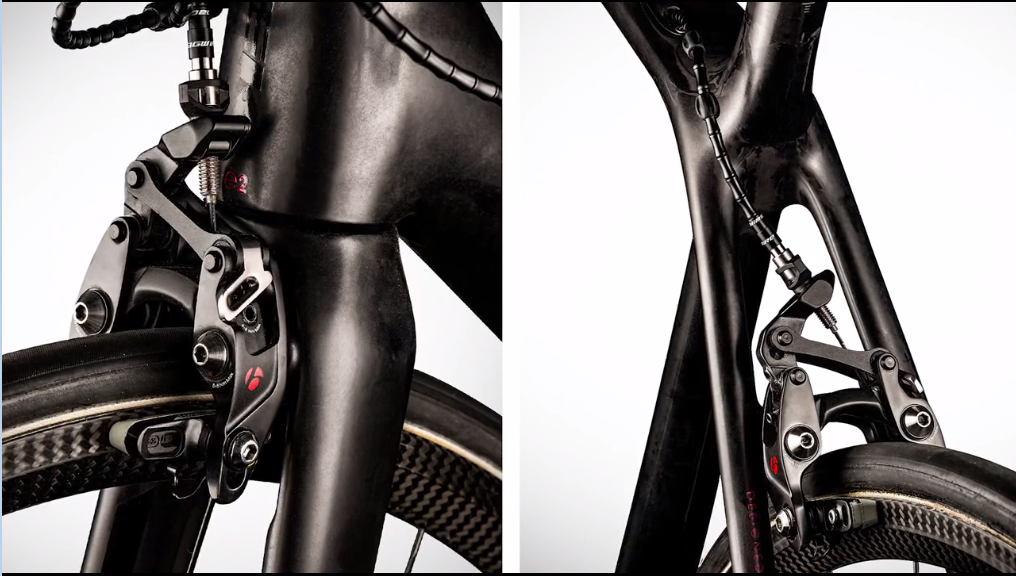
Jeezus those are some complicated-looking brake calipers. Whatever mechanical advantage those extra linkages might provide probably don't make a bit of difference when trying to stop on those carbon fiber rims, though.
Earlier this year, Fuji came out with their SL One.1 which weighs a claimed 4.9 kilos for a 56mm bike (Though actual weight might actually be a smidge over 5 kilos, according to the video. Yes, Fuji apparently rounds down in their ads. GASP!). Still, that's an 11 pound bike, which the folks at BikeRadar call "a relatively bargain price of $10,000."

Damn, it's a sick, sick world.

To wit, the video goes on to say, "Though Fuji does not enjoy the 'cool factor' of other brands, it has shown that you don't need boutique components to spec a 5-kilo build for everyday riding and racing."

Creative math aside, it's still a stupid-light bike. Er, I mean a bike for "everyday riding and racing."
For whom???
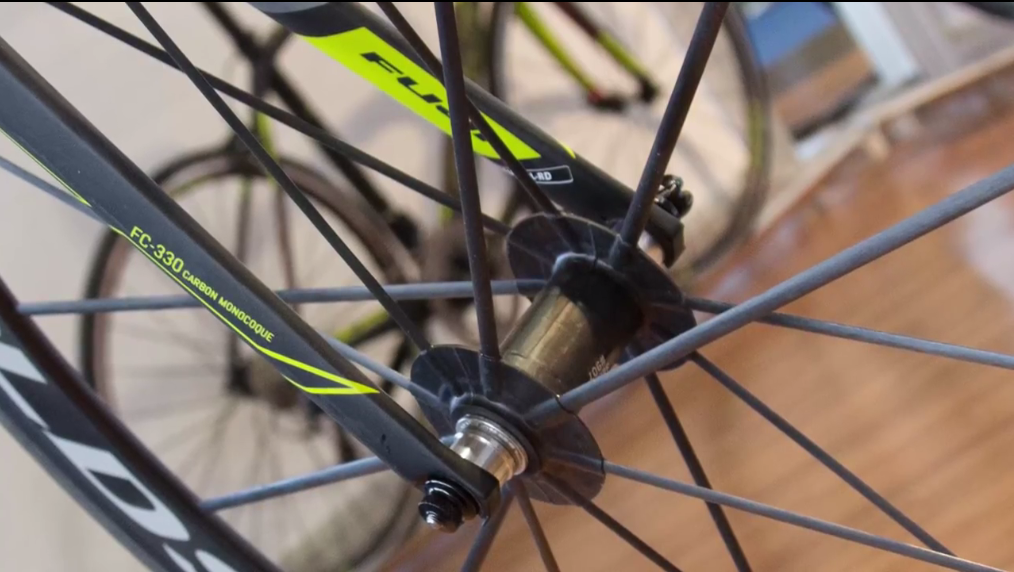
The Fuji's Reynolds RZR wheels feature carbon rims, spokes, and even hubs. No worries about durability with these wheels. Nope. Not at all. And remember - those are for "everyday riding and racing."
Next comes the new Canyon Ultimate CF EVO which weighs in at 4.85 kilos or 10.7 pounds. 


The 665 gram frame is actually lighter than the Trek, so the "extra" weight must come from a 20-gram "porkier" build kit. And you just know that those extra 20 grams equal loads more durability.

"It's refreshing to see that the German brand has opted for a build that's more suited to the rigors of everyday riding instead of just going for headlines." Yeah - those carbon-fiber calipers (and rims, and spokes, crank, etc. . . ) look like they're designed to take all kinds of everyday riding abuse.
At least the video jokes that it's a bike for "all you everyday riders with five figures of cash burning holes in your pockets."
So that's what an "everyday rider" crank looks like. Actually, a couple of the bikes on this Top 5 list use the same THM carbon crank. Notice those huge openings in that spider. No worries.

Knocking the Trek Emonda off the pinnacle of lightest production road bike is the Merida Scultura 9000 LTD. Weighing a claimed 4.5 kilos (9.9 lbs.), the company pushes the limits of carbon fiber construction with frame wall thickness of just 0.4 mm in some sections.

The Merida's 690-gram frame weight pretty well matches that of the Trek, so the additional weight savings must come from more feathery components. No word on pricing. If you have to ask. . .

The AX-Lightness VIAL evo ULTRA is claimed to weigh just 4.4 kilos (9.7 lbs). The frame is only 600 grams. It must be a special-order build, as there is no mention of it being a production model. Also no mention of price.
Many of the AX-Lightness components are of the company's own manufacture, including carbon fiber brakes, stem, seatpost and saddle, and even a pair of ultralight wheels that weigh 800 grams -- for the pair. Total. Yes, that's less than a lot of high-end rear wheels alone these days. According to the video, AX-Lightness says the wheels can be used by riders up to 220 pounds. Yeah. If they only ride on roads as smooth as glass, maybe.

Now, all the bikes on this list earn their stupid-light distinction through liberal uses of carbon fiber - in many cases pared down to the limits of the material. I suppose I should point out that stupid-light bikes can be made in any material, including steel and/or aluminum. Remember drillium? That was stupid-light going old-school. Build a steel frame with 0.3 mm wall thickness (yes, tubing was available that thin) and put it under a big American-sized rider, and you might call that stupid-light, too. But knowing the difference in the way carbon fiber fails (usually quickly, with little warning) vs. the way metals fail (usually cracks will be the first signs of impending failure), I just can't see spending so much money for something so potentially temporary.

Watch the video at the BikeRadar site, or right here:


Enjoy! Meanwhile, I need to go use my Proofide inhaler.